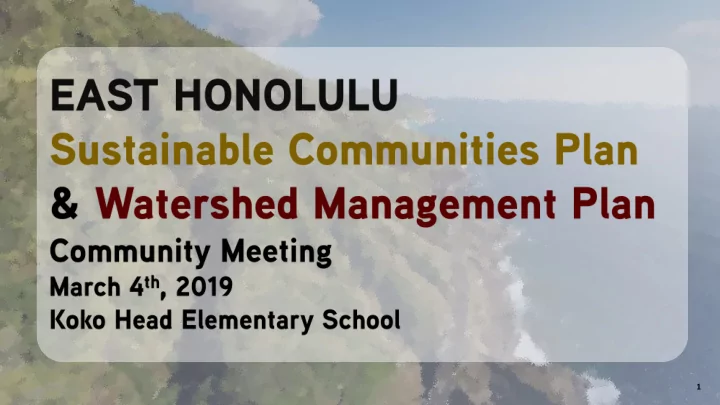
1 Agenda Welcome & Introductions East Honolulu Sustainable - - PowerPoint PPT Presentation

1 agenda
SMART_READER_LITE
LIVE PREVIEW

1 Agenda Welcome & Introductions East Honolulu Sustainable - - PowerPoint PPT Presentation

1 Agenda Welcome & Introductions East Honolulu Sustainable Communities Plan (EHSCP) Presentation EHSCP Q & A East Honolulu Watershed Management Plan (EHWMP) Presentation EHWMP Q & A Open House 2 Ground Rules


slide-1
SLIDE 1

1

slide-2
SLIDE 2

2

Agenda

  • Welcome & Introductions
  • East Honolulu Sustainable Communities Plan

(EHSCP) Presentation

  • EHSCP Q & A
  • East Honolulu Watershed Management Plan

(EHWMP) Presentation

  • EHWMP Q & A
  • Open House
slide-3
SLIDE 3

3

Ground Rules

  • Please hold your questions until the Q&A sessions
  • Provide comments & questions that pertain to the

presented content

  • Keep comments to under 1 minute
  • Show aloha and respect to your neighbors
  • Please don’t leave before sharing your input!
slide-4
SLIDE 4

EAST HONOLULU SUSTAINABLE COMMUNITIES PLAN PUBLIC REVIEW DRAFT

Community Meeting: March 4, 2019 Koko Head Elementary School

slide-5
SLIDE 5

Presentation Agenda

Overview of General Plan and DPSCPs Contents of Plan Process Since the 1999 Plan Current Process Proposed Significant Changes

slide-6
SLIDE 6
slide-7
SLIDE 7

East Honolulu’s Role in O‘ahu’s Development Pattern

Designated Urban Fringe Limited development and population growth Predominantly residential area, generally low-rise Maintain the existing Community Growth Boundary Population stabilization around 50,000

slide-8
SLIDE 8

Content of the East Honolulu Plan

  • East Honolulu’s Role in O‘ahu’s Development Pattern defines the region’s role

and identity;

Chapter 1

  • The Vision for East Honolulu’s Future summarizes the community-based vision

for the future of the region;

Chapter 2

  • Land Use Policies and Guidelines provides the land use policies needed to

implement the vision;

Chapter 3

  • Public Facilities and Infrastructure Policies and Guidelines provides the

infrastructure policies needed to implement the vision;

Chapter 4

  • Implementation identifies the means through which the policies will be

applied, including zone changes, and infrastructure budgeting;

Chapter 5

  • Conceptual Maps

Appendix A

slide-9
SLIDE 9

Process Since the 1999 Plan Adoption

  • Community orientation and outreach

Workshop I – January 2005

  • Research, draft Plan revisions and recommendations

2006-2011

  • Community outreach restart

Workshop II – September 2012

  • 3 Climate adaptation workshops

Workshop III – Spring 2016

  • Publication of the Public Review Draft

January / February 2019

  • Announcement of the Publication and Comment Period

Workshop IV – March 4, 2019

slide-10
SLIDE 10

Public Review Process – Going Forward

City Council (Winter 2019 and beyond) Planning Commission and Public Hearing (Fall 2019) Proposed Revised Plan and Review Report (Fall 2019) Public Comment Period (June 28) Neighborhood Board Presentations (Feb. 26, March 21, April 4) Public Review Draft and Community Meeting

slide-11
SLIDE 11

The Vision to 2040

Population remains stable at approximately 50,000 Revitalize existing commercial centers while limiting their expansion Maintain low-rise, low-density, residential character Avoid flood damage and slippage from development of slopes Use capacity of Kalaniana‘ole Highway to manage growth Preserve scenic views Promote access to mountain and shoreline resources

Protect Community Resources Adapt to Changing Community Needs

slide-12
SLIDE 12

Become more age-friendly and focus on complete streets Create resilient, disaster-ready communities Address, minimize, and adapt to potential impacts of climate change and sea level rise Implement ahupua‘a concept and low-impact development standards

The Vision to 2040 – New

Image: Hawaii Bicycling League

slide-13
SLIDE 13

Making Honolulu an Age-Friendly City

7 Principles of Universal Design Mixed-Use Development Accessory Dwelling Units (ADUs) Complete Streets

Percentage 65+ 1980 1990 2000 2010 2015 2040 East Honolulu 9.3% 11.7% 18.2% 21.6% 23.5% 37% All O‘ahu 7.3% 10.9% 13.4% 14.5% 16.2% 23.7%

Adopted as Ordinance 18-36

slide-14
SLIDE 14

Creating a Resilient, Disaster-Ready Community

Protect Community Resources

Limit development

  • f steep slopes

Implement Low- Impact Development (LID) Standards Incentivize green infrastructure investments Protect existing preservation lands inside and outside the CGB Natural improvements and stormwater retention

Adapt to Changing Community Needs

Form a community- based redevelopment district Identify repetitive loss areas Use current guidance from the City Climate Change Commission and State plans Protect, adapt, or relocate structures, facilities and resources vulnerable to Sea Level Rise

slide-15
SLIDE 15
slide-16
SLIDE 16

Ahupua‘a Health and Low-Impact Development

Reduce area of impermeable surfaces Retain water on-site Plant more trees Use park and preservation lands for ecological functions

slide-17
SLIDE 17

Contact Information and Timeline

City Council (Winter 2019 and beyond) Planning Commission and Public Hearing (Fall 2019) Proposed Revised Plan and Review Report (Fall 2019) Public Comment Period (June 28)

Thomas.Blair@Honolulu.gov Phone: (808) 763-9054 Fax: (808) 768-6743

  • Dept. of Planning &

Permitting 650 South King Street, 7th Fl. Honolulu, Hawaii 96813

http://www.honoluludpp.org/Planning/DevelopmentSustainableCommunitiesPlans/EastHonoluluPlan.aspx

slide-18
SLIDE 18

Honolulu Board of Water Supply

East Honolulu Watershed Management Plan

Community Meeting #1 East Honolulu Watershed Profile & Issues March 4th, 2019 / Koko Head Elementary School

18

slide-19
SLIDE 19

Presentation Agenda

  • Background and Overview of the Oʻahu Water

Management Plan (WMP)

  • Overview of East Honolulu Watershed

Management Plan (EHWMP)

  • East Honolulu Watershed Profile
  • East Honolulu Water Resource Issues
  • Getting Involved

19

slide-20
SLIDE 20

O‘ahu Watershed Management Plan Overview

STATE WATER CODE

O‘AHU GENERAL PLAN HAWAI‘I WATER PLAN

  • State Water Projects Plan
  • Agricultural Water Use and Development

Plan

  • Water Quality Plan
  • Water Resource Protection Plan
  • County Water Use and Development Plans

8 Development Plan (DP)/ Sustainable Communities Plan (SCP)

  • Act 152: Watershed

Protection

  • Waiāhole Ditch Decision
  • Ch 30, ROH Water

Management

  • BWS Sustainability

Mission

  • CCH Mayor’s Climate

Change & Sea Level Rise Directive (2018)

O‘AHU WATER MANAGEMENT PLAN (BY DP/SCP DISTRICT) Wai‘anae Ko‘olau Loa North Shore ‘Ewa Central O‘ahu PUC EAST HONOLULU

20

Legal/ Regulatory/Policy Guidance

Ko‘olau Poko

slide-21
SLIDE 21

O‘ahu Watershed Management Plan Status

  • 4 WMPs completed

(Wai‘anae, Ko‘olau Loa, Ko‘olau Poko & North Shore)

  • 4 WMPs in

progress (Central O‘ahu, ‘Ewa, Primary Urban Center & East Honolulu)

21

slide-22
SLIDE 22

Ahupua‘a Model

Planning concept based on Native Hawaiian systems-thinking, emphasizing:

  • Watershed health
  • Holistic resource management
  • Self-sufficient and sustainable

communities

  • Inter-relationship of mauka and

makai resources

  • Stewardship and kuleana of

land, people, and culture

22

Ridges to Reefs

Upper Watershed Forests & Native Species Habitat Middle Watershed Aquifers, Water Bodies, Streams, and Drainage Lower Watershed Shorelines & Coastal Waters Reefs Threatened & Endangered Species

slide-23
SLIDE 23

One Water Approach

23

slide-24
SLIDE 24

O‘ahu Water Management Plan Goal

To formulate an environmentally holistic, community-based, and economically viable watershed management plan that will provide a balance between: Preservation and management

  • f O‘ahu’s

watersheds Sustainable water use and development to serve present users and future generations

BALANCE

24

slide-25
SLIDE 25

O‘ahu Watershed Management Plan Objectives

  • 1. Promote sustainable watersheds
  • 2. Protect and enhance water quality and quantity
  • 3. Protect native Hawaiian rights and traditional and

customary practices

  • 4. Facilitate public participation, education, and project

implementation

  • 5. Meet future water demands at reasonable costs

25

slide-26
SLIDE 26

EHWMP Overview

26

slide-27
SLIDE 27

East Honolulu Planning District Kāhala to Makapu‘u

27

Kāhala

Makapu‘u

slide-28
SLIDE 28

EHSCP/WMP Nexus

28

EHSCP

  • Provides the vision,

implementing policies, and guidelines for the planning district

  • Guides City land use

approvals, infrastructure improvements, and private sector decisions

  • Establishes growth

projections & policies to manage growth over the next 20 years

EHWMP

  • Manages and protects

watershed health from a holistic, mauka to makai perspective

  • Recommends policies,

strategies and project, ensure adequate and sustainable water supply for East Honolulu for the next 20 years with an ultimate 2100 scenario

  • Provides an implementation

plan

NEXUS

Both plans provide policies to address:

  • Water supply and demand
  • Water conservation (e.g.,

water recycling, rain barrels)

  • Stormwater runoff (e.g., low

impact development, street landscaping)

  • Climate change & sea level

rise impacts

  • Mauka & makai access issues

(e.g., trail management, beach access)

  • Watershed management
slide-29
SLIDE 29

EHWMP Planning Process

Research & Identify Key Water Resource Issues Preliminary Watershed Analysis & Water Demand Forecasting Water Supply Options & Watershed Management Policies, Projects & Strategies Preliminary & Public Review Draft EHWMP Final EHWMP Community Input

29

slide-30
SLIDE 30

EHWMP Schedule

2019 2020 2021

Year Quarter 1 2 3 4 1 2 3 4 1 2 3 4

Stakeholder Consultation Watershed Profile Water Demand Analysis Projects, Policies & Strategies Implementation Plan Public Review Draft Final EHWMP & Approvals Process Community Meeting

30

We are here

slide-31
SLIDE 31

East Honolulu Watershed Profile

31

Photos Source: Creative Commons

slide-32
SLIDE 32
  • Land Area: 15,042 sq acres
  • Population: 48,100 (2010)
  • ~60% of EH is

Conservation Land

  • ~40% of EH is Urban Land
  • 10 Watersheds
  • 2 Ahupua‘a
  • 3 Neighborhood Boards
  • Strong presence of

community organizations

East Honolulu Planning District Overview

32

slide-33
SLIDE 33

O‘ahu Groundwater Aquifer Systems East Honolulu is within:

  • Honolulu

Aquifer Sector Area

  • Wai‘alae West

& Wai‘alae East Aquifer System Areas

33

slide-34
SLIDE 34

10 Watersheds in East Honolulu

8 watersheds drain into Maunalua Bay:

  • Wai‘alae Nui
  • Wailupe
  • Niu
  • Kuli‘ou‘ou
  • Haha‘ione
  • Kamilo Nui
  • Kamilo ‘Iki
  • Portlock

One watershed drains into the Ka Iwi Coast:

  • Koko Crater

One watershed drains into Hanauma Bay:

  • Hanauma

34

slide-35
SLIDE 35

East Honolulu Water Supply & Demand

  • East Honolulu relies upon

Urban Core & Ko‘olaupoko aquifer sources to meet its demand of appx. 8.5 mgd

  • Water demand is projected

to decrease due to conservation programs

  • Water supply is expected

to be affected by climate change

35

mgd= millions of gallons per day

BWS Water Demand

(Average 2013-2017)

slide-36
SLIDE 36

East Honolulu Water Resource Issues

36

slide-37
SLIDE 37

Sea Level Rise

Preliminary Water Resource Issues & Concerns

Water Conservation Efforts Climate Change Flooding & Drainage Nearshore Water Quality Wildfires Access to Mauka & Makai Areas Maintaining Traditional & Customary Practices

37

slide-38
SLIDE 38

2100 O‘ahu Rainfall Scenarios

38

Source: Zhang et al. (unpublished)

Issue: Climate Change Areas of Concern:

  • Amount of

rainfall & impacts

  • n drinking water

supply

  • More frequent &

intense storms

slide-39
SLIDE 39

East Honolulu Sea Level Rise Exposure Area

39

Source: Hawai‘i Sea Level Rise Vulnerability and Adaptation Report (2017)

Issue: Sea Level Rise Areas of Concern:

  • Coastal

areas (mostly makai of the highway)

  • Areas near

Kuapā Pond

  • Salt water

intrusion

slide-40
SLIDE 40

40

Issue: Nearshore Water Quality Areas of Concern:

  • Erosion from

upland areas

  • Runoff from

development

  • Sewage spills

& cesspools

  • Invasive

species

Upland land uses impact nearshore water quality

East Honolulu Wastewater

Source: State of Hawai‘i GIS Program

slide-41
SLIDE 41

Issue: Water Conservation Efforts Areas of Concern:

  • Wai‘alae & Hawai‘i

Kai Golf Courses

  • Large single

family home development

  • Commercial

development

  • Agricultural uses

41

Photo Source: Creative Commons

slide-42
SLIDE 42

East Honolulu Flood Insurance Rate Map

42

Issue: Flooding & Drainage Areas of Concern:

  • Coastal areas

(mostly makai of the hwy)

  • Wailupe Valley
  • Kuli‘ou‘ou Valley
  • Kamilo ‘Iki Valley
  • Kalaniana‘ole

Hwy

Source: Federal Emergency Management Agency

slide-43
SLIDE 43

East Honolulu Ahupua‘a + Historic Fishponds

43

Issue: Maintaining Traditional and Customary Practices Areas of Interest:

  • Kuapā Pond
  • Maunalua Bay
  • Ka Iwi Coast
  • Kalauha‘iha‘i

Fishpond

  • Kānewai Spring
  • Koko Head &

Hanauma Bay

  • Mauka sites

Source: State of Hawai‘i GIS Program

slide-44
SLIDE 44

Kuliouou Ridge Trail Stairs Wailupe Beach Access Kamilo Iki Ridge Trail

44

Photo Source: Creative Commons

Issue: Access to Mauka + Makai Areas Areas of Concern:

  • Upland trail

management (for erosion / invasive species/ ungulates control)

  • Beach access
slide-45
SLIDE 45

2018 Kamilo Nui Fire

45

Photo Source: Hawai‘i News Now

Issue: Wildfires Areas of Concern:

  • Upland

forests

  • Kamilo Nui

Valley (Mariner’s Ridge)

  • Ka Iwi Coast
slide-46
SLIDE 46

Stay Connected

46

slide-47
SLIDE 47

East Honolulu Stakeholder Outreach

Neighborhood Boards / Elected Officials Meetings Stakeholder Outreach as of March 2019: 4 Community Meetings Stakeholder Consultations

Community Organizations:

  • Maunalua Watershed Hui
  • Livable Hawai‘i Kai
  • Aloha Aina O Kamilo Nui
  • Mālama Maunalua Bay
  • Hui o Ko`olaupoko
  • UH Sea Grant
  • Ka Iwi Coast Coalition

Neighborhood Boards / Elected Officials:

  • Hawai‘i Kai ( NB Distict #1)
  • Kuliouou-Kalana Iki (NB District

#2)

  • Wai‘alae-Kāhala (NB District #3)
  • Stanley Chang (HI Senate District

#9)

  • Gene Ward (HI Rep. District #17)
  • Mark Hashem (HI Rep. District #18)
  • City Council

Agencies:

  • CCH Office of Climate Change,

Sustainability & Resiliency

  • CCH Dept. of Facilities Maintenace
  • DLNR Division of Forestry &

Wildlife

  • DLNR Nā Ala Hele Program
  • Ko‘olau Mountains Watershed

Partnership

47

slide-48
SLIDE 48

EHWMP Community Meetings

Community Meeting #1 MARCH 2019 East Honolulu Overview & Water Resource Issues Community Meeting #2 JULY 2019 East Honolulu Water Use & Future Water Demand Community Meeting #3 OCTOBER 2019 East Honolulu Watershed Projects & Strategies Community Meeting #4 DECEMBER 2020 EHWMP Public Review Draft

48

We Are Here

slide-49
SLIDE 49

Stay Connected

For more information, please visit: http://www.boardofwatersupply.com/water- resources/watershedmanagement-plan/east-honolulu

Barry Usagawa 808-748-5900 busagawa@hbws.org Melissa White 808-628-5861 mwhite@ssfm.com

Honolulu Board of Water Supply

49

slide-50
SLIDE 50

50

QUESTIONS?

Photo Source: Creative Commons

slide-51
SLIDE 51

51

OPEN HOUSE

  • Sticky dots to indicate your three

priority EHWMP water resource issues

  • Post it notes to provide detailed

comments on EHWMP critical water resource issues