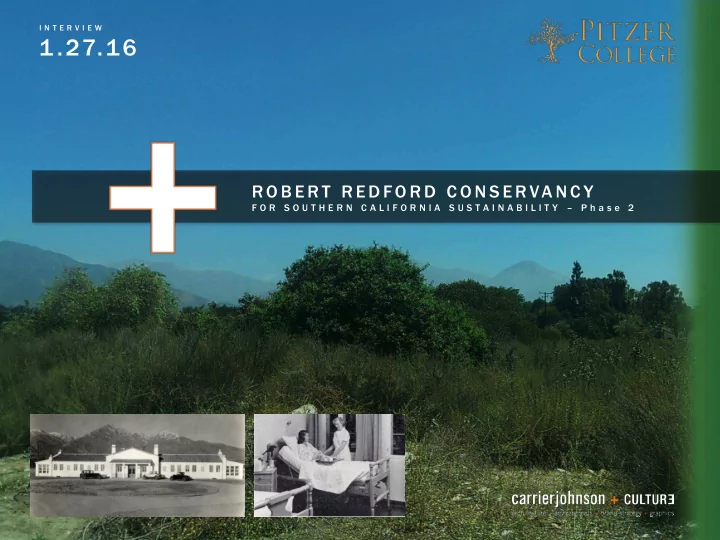
SLIDE 1 I N T E R V I E W
1.27.16
R O B E R T R E D FO R D C O N S E R VA N C Y
F O R S O U T H E R N C A L I F O R N I A S U S T A I N A B I L I T Y – P h a s e 2
SLIDE 2
The Presentation Team
SLIDE 3
COLLECTIVE ASPIRATIONS FOR THE RRC PROJECT + Regenerative - The Conservancy Center as the Model of Regenerative
Design... + Reenergizing and restoring the land, the building, and the culture + Resurrect the infirmary respectfully + Maximizing the positive contributions of the site to the greater good (ecological, educational, cultural, and societal)
+ Harmonious – Use Nature’s Momentum to Fulfill Users’ Needs
+ Embrace passive design usage + Demonstrate low impact site design
SLIDE 4
COLLECTIVE ASPIRATIONS FOR THE RRC PROJECT + Integrative - Create a Center of Cross Pollination Where Diverse Groups
Create and Sow the Seeds of Change + Promote open collaboration and meaningful intellectual exchange between diverse groups + Weave site and building together holistically to support multiple uses: Science, art, ecology + Make the RRC environment a living eco lab
+ Inclusive - Universally appealing, culturally inclusive design where
everyone will feel welcome and valued
Get the dream you want within the budget you have.
SLIDE 5
R E E N E R G I Z I N G A N D R E S T O R I N G
THE BUILDING, THE LAND, THE CULTURE
Regenerative
+ The Building - Rising from the ashes like a phoenix, the 1930s era
infirmary will be reborn as a new hub of sustainable research and discovery.
+ The Land - Native vegetation restored to reflect the site’s natural character + The Culture – Indigenous influence reflected in designated indigenous studies
area which will offer valuable lessons to be learned
SLIDE 6
R E E N E R G I Z E
THE BUILDING AND LAND
+ Restoration approach + Maintain appearance + New construction approach + Materials that can be used for dual purposes
SLIDE 7
H A R N E S S I N G T H E P O W E R O F N AT U R E :
PASSIVE AND LOW TECH DESIGN
+ Strategies for minimizing the building’s external load (daylighting, thermal mass and natural ventilation) + PV renewable energy + Skylight wells as thermal chimneys + Punched windows with spectrally selective glazing + Slow moving large blade ceiling fans
Harmonious
SLIDE 8
Elements of Passive Solar Design
+ Textbook greenfield design ideal
SLIDE 9
Passive Solar Design Ideal : Det ail
SLIDE 10
Passive Design Oppor tunities
+ These elements are already present in our building
SLIDE 11
PV Solar System
Active Systems
Low Energy HVAC
+ Minimal electricity driven equipment + Zero carbon energy flow + Enhanced thermal comfort
SLIDE 12
M A K I N G E V E R Y O N E F E E L W E L C O M E :
UN IV ER SA LLY A P P EA LIN G, C ULT UR A LLY IN C LUSIV E DESIGN + Biophilic Design
+ Simplicity in Design + Connecting with specifics of place (history, culture, geology, etc.) + Natural light to evoke positive emotion + Connection to Nature + Natural materials, shapes and colors
Inclusive
SLIDE 13
C R E AT I N G I N T E R D I S C I P L I N A R Y S PA C E S :
SUPPORTING INNOVATIVE COLLABORATIONS
+ Variety of Open, Interconnected Spaces + Flexible, Interactive, Mobile and Adaptable + Flexibility Will Allow for Growth and Change for a Forward Thinking Institution
SLIDE 14
C R E AT I N G I N S P I R I N G S PA C E S :
EXPERIENTIAL LEARNING
+ An indoor/outdoor environment that fosters exploration + Change in physical environment encourages creativity + Outdoor learning spaces provide organic and seasonal stimuli
SLIDE 15
B L U R R I N G B O U N D A R I E S :
INTEGRATION OF NATURE AND THE BUILT ENVIRONMENT
+ Outdoor classrooms + Outdoor labs + Courtyards + Sunroom/Maker’s Space
SLIDE 16 Site Plan
+ A home for the Conservancy to cultivate connections to the campus, region and global community
BLAISDELL NEIGHBORS VEGETATED BUFFER BIOSWALE D.G. PATH – FIRE TRUCK RATED OUTDOOR CLASSROOM (32’ X 48’) OUTDOOR CLASSROOM (32’ X 48’) BIRD BANDING OUTDOOR LAB MODEL ENTRY GARDEN PATIO/ MAKER SPACE COURTYARD INDIGENOUS STUDIES MODEL GARDEN COASTAL SAGE SCRUB RESTORATION NON-NATIVE GRASSLAND INDIGENOUS STUDIES SUPPORT SITE TELESCOPE I.S. STORAGE/ SOLAR D.G. PATH – PEDESTRIAN
SLIDE 17
C R E AT I N G E C O L A B S T O P R O M O T E :
ECOLOGICAL LITERACY
+ Learning Landscapes – Tactile and Immersive + Plant Collecting + Native Habitat and Fauna
SLIDE 18
Entr y
+ Site sensitive + Native Coast Live Oaks + Potential Conservancy gathering area
SLIDE 19
Outdoor Maker Space
+ Outdoor spaces + Providing different environments for exploring ideas, learning and creativity
SLIDE 20
Site Birdseye
+ Integrated within the land + Outdoor classrooms added in the disturbed site areas + Creating connections between spaces
SLIDE 21 Site Sust ainability
+ Sustainability infused as part of the design + A Home for the Conservancy
BASKETRY GARDEN – INDIGENOUS PLANTING AND LESSONS USE OF LOCAL MATERIALS COMPOSTING PERMEABLE PAVING MODEL GARDEN – LOCAL, REGIONAL, GENETICALLY MATCHED NATIVE PLANTS STORMWATER COLLECTION FOR REUSE VIEW CONNECTION PROTECT NATIVE OAKS – NATURAL SHADING SOIL PROTECTION PERMEABLE PAVERS SOLAR ROOF RESEARCH STATION
SLIDE 22 Entr y at Foothill Blvd
+ A window into the site + Sensitive to the environs + Integrating green practices for circulation, site access, and natural resources
D.G. PATH – SENSITVELY DESIGNED DUE TO COASTAL SAGE SCRUB LANDSCAPE COAST LIVE OAK TREE RAMMED EARTH ACCENT WALL FENCE AND GATE COBBLE WALL – LOCAL SOURCE D.G PAVING – PERMEABLE, LOCAL MATERIAL MID-HEIGHT COBBLE SIGN WALL WITH BIKE RACKS BEHIND SIDEWALK PLANTED BUFFER/ BIOSWALE BIKE PATH
SLIDE 23 Connection to Main Campus and Greater Community
+ Close proximity to Pitzer main campus, the Claremont Colleges, and the Bernard Field Station + Close proximity to broader community
SENSITIVELY DESIGNED PATH
SLIDE 24 Vehicular Access
+ Vehicular access (including ADA and emergency vehicles) could be achieved in a few different ways + Alternative 1 shown in the light blue dashed line at Blaisdell/Lowell is preferred
PREFERRED VEHICULAR ACCESS, INCLUDING FIRE AND ADA
SLIDE 25
Local, Regional, and Global Influence
+ We see the RRC influence extending beyond the physical site
SLIDE 26
QUE ST I ON S A N D A N SW ERS
SLIDE 27
8 REASONS WHY WE ARE THE BEST TEAM
WE ARE
FULLY IMMERSED IN THE
CONSERVANCY’S VISION AND NEEDS WE HAVE ESTABLISHED
STRONG RELATIONSHIPS WITH THE COLLEGE AND BFS USERS
WE HAVE DESIGN
MOMENTUM WHICH ALLOWS PITZER TO COMPLETE THE RRC FASTER
WE OFFER
DEEP COMMITMENT
TO THE PROJECT, INVESTING OUR HEART + SOUL INTO PHASE 1
1 2 3 4
WE WILL FURTHER ENGAGE WITH
LOCAL TRIBAL LEADERS
TO REINTRODUCE THEIR CULTURAL VALUES AND KNOWLEDGE INTO THE SITE WE CAN GROW OUR REGIONAL
SUSTAINABILITY IDEAS MORE COMPLETELY
IN THE ALLOTTED TIMEFRAME WE HAVE SHOWN HOW OUR
COLLABORATIVE SPIRIT
CAN CREATE A MORE HOLISTIC SOLUTION TO DELIVER ON THE RRC’S COMPELLING VISION ON A PERSONAL LEVEL
WE ARE PASSIONATE
ABOUT THIS PROJECT, ITS GOALS, + THE TEAM
5 6 7 8
SLIDE 28 I N T E R V I E W
1.27.16
R O B E R T R E D FO R D C O N S E R VA N C Y
F O R S O U T H E R N C A L I F O R N I A S U S T A I N A B I L I T Y – P h a s e 2