1 2 3 4 Phylogeny of Rickettsiales ( rrs ) proteobacteria E - - PDF document

1 2 3 4
SMART_READER_LITE
LIVE PREVIEW

1 2 3 4 Phylogeny of Rickettsiales ( rrs ) proteobacteria E - - PDF document

Disclosures Diagnosis and empirical treatment of suspected rickettsial infections Funding National Institutes of Allergy and Infectious Diseases (R01AI044102) PAT-74-3977 Uniformed Services University of the Health Sciences CDMRP


slide-1
SLIDE 1

Diagnosis and empirical treatment

  • f suspected rickettsial infections
  • J. Stephen Dumler, M.D.

Professor and Chairperson Integrated Departments of Pathology Uniformed Services University, Walter Reed National Military Medical Center, and the Joint Pathology Center Bethesda, MD

Disclosures

Funding

  • National Institutes of Allergy and Infectious Diseases (R01AI044102)
  • PAT-74-3977 Uniformed Services University of the Health Sciences
  • CDMRP Tick-borne Disease Research Program (W81XWH-17-1-0668)
  • CDMRP Tick-borne Disease Research Program (TB180110)
  • Global Emerging Infections Surveillance / Armed Forces Health Surveillance Branch

(P0019_17_HS)

The opinions expressed herein are those of the author(s) and are not necessarily representative of those of the Uniformed Services University of the Health Sciences (USUHS), the Department of Defense (DOD); or, the United States Army, Navy, or Air Force.

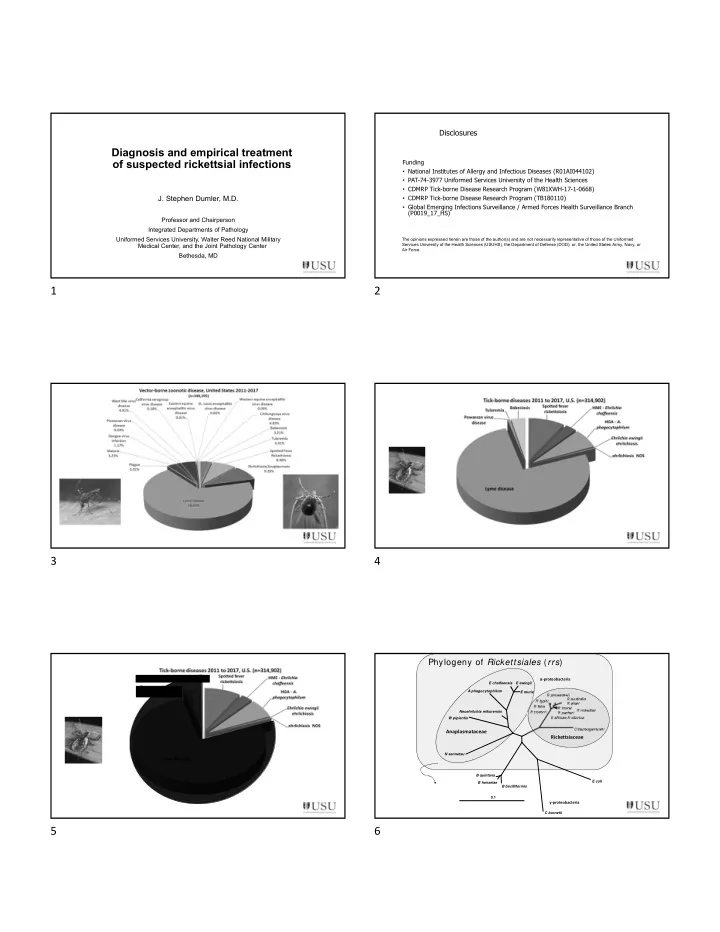
Phylogeny of Rickettsiales (rrs)

0.1 O tsutsugamushi E coli C burnetii B bacilliformis B henselae B quintana N sennetsu W pipientis A phagocytophilum E chaffeensis E ewingii R typhi R prowazekii R felis R australis R akari R honei R rickettsii R parkeri R conorii R sibirica R africae

α‐proteobacteria γ‐proteobacteria

Rickettsiaceae Anaplasmataceae

Neoehrlichia mikurensis E muris

1 2 3 4 5 6

slide-2
SLIDE 2

Rickettsial diseases:

The genera Rickettsia, Ehrlichia, and Anaplasma

  • obligate intracellular bacteria
  • Rickettsia and Orientia
  • cytoplasmic
  • Ehrlichia and Anaplasma
  • vacuolar
  • contain DNA, RNA, ribosomes
  • divide by binary fission
  • Gram-negative cell wall
  • genomes with typical bacterial

genes

  • lack genes for glycolysis
  • genes for transmembrane transport

e.g. ATP, amino acids

Pathogenesis of vasculotropic rickettsioses

Rickettsia

endothelial cells endosome escape

  • smotic injury

spread

Rickettsia spp. with Standing in Nomenclature

species group vector human pathogenicity disease Rickettsia africae spotted fever tick yes African tick bite fever Rickettsia conorii spotted fever tick yes Mediterranean spotted fever Rickettsia heilongjiangensis spotted fever tick yes Far Eastern tick‐borne rickettsiosis Rickettsia honei spotted fever tick yes Flinders Island spotted fever; Thai tick typhus Rickettsia japonica spotted fever tick yes Japanese spotted fever Rickettsia massiliae spotted fever tick yes

  • R. massiliae spotted fever

Rickettsia parkeri spotted fever tick yes

  • R. parkeri rickettsiosis; Maculatum disease

Rickettsia raoultii spotted fever tick yes scalp eschar and neck lymphadenopathy Rickettsia rickettsii spotted fever tick yes Rocky Mountain spotted fever Rickettsia sibirica spotted fever tick yes Siberian tick typhus Rickettsia slovaca spotted fever tick yes scalp eschar and neck lymphadenopathy Rickettsia australis transitional tick yes Queensland tick typhus Rickettsia aeschlimannii spotted fever tick potential Rickettsia helvetica spotted fever tick potential Rickettsia montanensis spotted fever tick potential Rickettsia peacockii spotted fever tick potential Rickettsia rhipicephali spotted fever tick potential Rickettsia tamurae spotted fever tick potential Rickettsia hoogstraalii transitional tick potential Rickettsia canadensis ancestral tick potential Rickettsia amblyommatis spotted fever tick unknown Rickettsia asiatica spotted fever tick unknown Rickettsia buchneri spotted fever tick unknown Rickettsia bellii ancestral tick unknown Rickettsia akari transitional mite yes rickettsialpox Rickettsia prowazekii typhus louse yes epidemic (louse‐borne) typhus Rickettsia asembonensis transitional flea unknown Rickettsia felis transitional flea yes flea‐borne spotted fever Rickettsia typhi typhus flea yes murine (endemic or flea‐borne) typhus

Spotted fever group rickettsioses Typhus fever group rickettsioses Orientia

7 8 9 10 11 12

slide-3
SLIDE 3

Febrile illness in Southern Sri Lanka, March ‐ October, 2007

Infection / Disease

  • no. tested
  • no. with serologic

evidence % with acute infection bacteremia/sepsis 1091 11 1.0% HIV 1079 0% leptospirosis 889 120 13.5% dengue (serotypes 2,3,4) 859 54 6.3% any rickettsial infection 883 156 17.7% scrub typhus 9 2.7% spotted fever group rickettsiosis 86 9.7% typhus group rickettsiosis 29 3.3% indeterminate 32 3.6% Q fever 889 13 1.5% TOTAL 883‐1091 354 37.3%

Reller ME, et al . Emerg Infect Dis. 2011; 17:1678-84; Reller ME, et al. Emerg Infect Dis. 2012; 18:256-63; Reller ME, et al. Emerg Infect Dis. 2012; 18:825-9.

Febrile illness in Southern Sri Lanka; March ‐ October, 2007

Infection / Disease

  • no. tested
  • no. with serologic

evidence % with acute infection % initial dx correct bacteremia/sepsis 1091 11 1.0% HIV 1079 0% leptospirosis 889 120 13.5% 23% dengue (serotypes 2,3,4) 859 54 6.3% 14% any rickettsial infection 883 156 17.7% 0% scrub typhus 9 2.7% spotted fever group rickettsiosis 86 9.7% typhus group rickettsiosis 29 3.3% indeterminate 32 3.6% Q fever 889 13 1.5% 0% TOTAL 883‐1091 354 37.3%

37%

Reller ME, et al . Emerg Infect Dis. 2011; 17:1678-84; Reller ME, et al. Emerg Infect Dis. 2012; 18:256-63; Reller ME, et al. Emerg Infect Dis. 2012; 18:825-9.

Etiology of Severe Febrile Illness in Low‐ and Middle‐Income Countries: A Systematic Review

PLoS One. 2015; 10: e0127962.

Percent of febrile patients as confirmed cases according to region and age in all eligible studies, 1980–2013 East Africa North Africa* West Africa South Central Asia South East Asia West Asia* Pediatric All Regions All Regions Rickettsial infections 7.4 4.9 6.6 2.3 3.3 4.9 Spotted fever group 8 3.8 7.4 6.8 Typhus group 0.4 1.1 6.6 2.3 1.9 3.3 Scrub typhus 4.9 8 8 7.8

* None tested

Case 1 - 8y boy from suburban Atlanta

  • 2 wk PTA - mild respiratory sx, low fever, vague rash - proventil,

steroids, amoxicillin, quell

  • 2 d PTA - fever, rash - augmentin, deltasone, albuterol
  • unresponsive - plt 19K, Na 130, BUN 45, creat 1.2, AST 237, ALT

152

  • diffuse cerebral edema - herniation, death
  • Post-mortem examination performed

Case 1. 8y boy from suburban Atlanta

  • R. rickettsii serology

< 64 I mmunohistochemistry For R. rickettsii + Final dx: RMSF

lung kidney

Clinical manifestations of spotted fever rickettsioses: RMSF

  • fever, headache, myalgias, rash
  • rash - macular, maculopapular,

petechial

  • gastrointestinal system
  • renal system
  • acute tubular necrosis 2 to hypotension
  • shock and multi-organ failure
  • cardiopulmonary system
  • non-cardiogenic pulmonary edema
  • central nervous system –

meningoencephalitis

  • cerebral edema, herniation

skin lung brain

13 14 15 16 17 18
slide-4
SLIDE 4

Skin rash in RMSF

macular macular maculopapular maculopapular petechial petechial ecchymosis ecchymosis Frequent clinical features of rickettisoses (meta analysis median percentages of patients with clinical feature)

History, signs, or symptoms

  • R. rickettsii

RMSF

  • R. prowazekii

typhus

  • R. typhi

murine typhus

  • R. conorii MSF

Fever

100 100 100 100

Headache

91 100 75 70

Myalgia

72 70 50 58

Rash

90 32 45 98

Rash on palms and soles

82 na* 2 79

Nausea or vomiting

60 45 46 36

Abdominal pain

43 65 18 na

Conjunctivitis

30 34 33 36

Pneumonitis

15 8 7 10

Any severe neurologic complication

26 50 1 11

na* data not available

Laboratory abnormalities in ehrlichiosis (%) Laboratory finding RMSF HME HGA White blood cell count > 10,000/L 28 1 1 < 5,000/L 66 49 > 10% bands 69 76 Platelet count/L < 150,000 52 72 71 Serum sodium < 132 mEq/L 56 ALT or AST  2x normal value 62 76 71 Cerebrospinal fluid Pleocytosis mononuclear cell predominance neutrophil predominance 48 46 50 60 67 33 rare Glucose  50 mg/dL 8 14 Protein  50 mg/dL 35 44 Opening pressure  250 mm H2O 14

Rocky Mountain spotted fever

diagnosis and risk

  • risk of death 5 x in patients after day 5 of illness
  • most patients are initially examined before day 5, but not

treated until after day 5

  • major factors for ineffective diagnosis and delayed therapy:
  • absence of typical rash
  • presentation during non-peak tick activity season
  • presentation during first 3 days of illness

Demographics of SFG rickettsiosis cases by hospitalization status and fatal

  • utcome, 2008–2012 (CRFs)

n (HR, %) RR n (CFR, %) RR Gender Male 1,474 (28) – 17 (0.3) – Female 711 (24) 1.2 19 (0.6) 2.0 Age group (years) < 10 131 (29) 1.0 8 (1.6) 7.7 10–19 140 (21) 0.8 2 (0.3) 1.4 20–29 174 (23) 0.8 1 (0.1) 0.6 30–39 229 (23) 0.8 1 (0.1) 0.5 40–49 302 (22) 0.8 7 (0.5) 2.4 50–59 376 (24) 0.9 6 (0.4) 1.8 60–69 401 (28) – 3 (0.2) – 70+ 399 (40) 1.4 6 (0.6) 3.0 Race White 1,674 (27) – 23 (0.4) – Black 118 (44) 1.7 1 (0.4) 1.1 American Indian/Alaska Native 67 (34) 1.3 7 (2.0) 5.4 Asian/Pacific Islander 19 (41) 1.5 1 (2.0) 5.7 Ethnicity Hispanic 104 (34) 1.4 4 (1.3) 3.2 Non‐Hispanic 1,570 (26) – 25 (0.4) – Immune status Immunocompromised 205 (50) 2.0 7 (1.7) 4.4 Not immunocompromised 1,066 (25) – 17 (0.4) – Life‐threatening complications One or more 241 (79) 11.7 17 (6.0) 27.9 None 1,949 (24) – 19 (0.2) –

Case 2 - 67 year old physician from Maryland

  • Traveled to Argentina and Brazil (6 weeks ago)
  • Traveled to Kenya and South Africa (returned 4d ago)
  • safari
  • walked in/along ocean and brackish rivers
  • drank local water
  • exposed to feral dogs and cats
  • ate partially cooked meats
  • Returned to US with fever (38.5C), headache, confusion for 24h, 20-

30 petechiae on both calves; two eschars on right thigh

  • WBC 3.9 x 10⁹/L; platelets 210 x 109/L
  • Acute phase serology for viruses and rickettsiae negative; malaria

smear neg.

  • Skin biopsy performed

19 20 21 22 23 24

slide-5
SLIDE 5

Case 2 ‐ 67 year old physician from Maryland who traveled to Argentina, Brazil, Kenya, and South Africa

Convalescent spotted fever group antibody titer ‐ 2560

Eschar biopsy IHC for spotted fever group rickettsiae Diagnosis: African tick bite fever (R. africae or R. conorii) Frequent clinical features of rickettisoses (meta analysis median percentages of patients with clinical feature)

History, signs, or symptoms

  • R. rickettsii

RMSF

  • R. conorii MSF
  • R. typhi

murine typhus

  • R. conorii MSF

Fever

100 100 100 100

Headache

91 70 75 70

Myalgia

72 58 50 58

Rash

90 98 45 98

Rash on palms and soles

82 79 2 79

Nausea or vomiting

60 36 46 36

Abdominal pain

43 na 18 na

Conjunctivitis

30 36 33 36

Pneumonitis

15 10 7 10

Any severe neurologic complication

26 11 1 11

na* data not available

Laboratory abnormalities in rickettsioses

Laboratory finding (% of cases with finding) Rocky Mountain spotted fever Mediterranean spotted fever Epidemic typhus Mediterranean spotted fever White blood cell count > 10,000/L 28 28 14 28 <5,000/L 20 3 20 > 10% bands 69 Platelet count/L < 150,000 52 35 43 35 Serum sodium < 132 mEq/L 56 25 25 Elevated ALT or AST 62 39 63 39 Cerebrospinal fluid Pleocytosis mononuclear cell predominance neutrophil predominance 48 46 50 present 21 present Glucose  50 mg/dL 8 Protein  50 mg/dL 35 Opening pressure  250 mm H2O 14

20 40 60 80 100 % of patients with finding

Comparison of clinical findings in various spotted fever rickettsioses Eschars and skin lesions with SFGR

African tick‐bite fever–multiple eschars African tick‐bite fever ‐ vesicles Rickettsialpox ‐ eschar Rickettsialpox ‐ vesicles TIBOLA or DEBONEL TIBOLA or DEBONEL MSF – tache noire Japanese SF ‐ eschar

  • R. parkeri ‐ eschar

Rickettsial infection in travelers to Sub-Saharan Africa

  • GeoSentinel Surveillance Network 2007

2,451 travelers with fever

  • 21% malaria
  • 2% rickettsia
  • 22% undiagnosed
  • GeoSentinel Surveillance Network 2009
  • 280 travelers with rickettsial infection
  • 231 (82.5%) had spotted fever (SFG) rickettsiosis
  • 16 (5.7%) scrub typhus
  • 10 (3.6%) typhus group (TG) rickettsiosis
  • 4 (1.4%) indeterminable SFG/TG rickettsiosis
  • 1 (0.4%) human granulocytic anaplasmosis
  • Swedish travelers 1997-2001
  • 77 cases
  • risk 4-5 x malaria risk in same region
  • 152 first time Norwegian travelers to Sub-Saharan Africa
  • 9% seropositive
  • 62% of seropositives symptomatic
  • 940 Norwegian travelers followed prospectively
  • 4 to 5% overall
  • 27% of those flu-like illnesses

25 26 27 28 29 30

slide-6
SLIDE 6

Case 3 - 4 year old Hispanic boy with sudden onset fever

  • Lives in McAllen TX, but travels often to Mexico to visit family
  • Physical exam
  • T 40.0C
  • generalized petechial rash (day 2)
  • Vomiting and diarrhea (day 6)
  • WBC 2.9 x 10⁹/L (7% bands), platelets 51 x 109/L, Hct 30.1%, Na+

132 meq/L, ALT 102 U/L

  • Started amoxicilin, then cefotaxime
  • All blood, urine, stool cultures and O&P exams negative

Case 3 - 4 year old Hispanic boy with sudden onset fever from South Texas who travels to Mexico

  • CXR Bilateral interstitial infiltrates
  • Required PICU management:
  • 13 units platelets
  • 1 unit FFP over 3 days
  • Acute phase serum
  • Day 1: Weil-Felix OX19 160, OX2 160, OXK 40
  • Day 4: Weil-Felix OX19 320
  • Treated with doxycycline
  • Convalescent serum R. typhi titer 8192

Frequent clinical features of rickettisoses (meta analysis median percentages of patients with clinical feature)

History, signs, or symptoms

  • R. rickettsii RMSF
  • R. conorii MSF
  • R. typhi

murine typhus

  • R. prowazekii

typhus Fever

100 100 100 100

Headache

91 70 75 100

Myalgia

72 58 50 70

Rash

90 98 45 32

Rash on palms and soles

82 79 2 na*

Nausea or vomiting

60 36 46 45

Abdominal pain

43 na 18 65

Conjunctivitis

30 36 33 34

Pneumonitis

15 10 7 8

Any severe neurologic complication

26 11 1 50

na* data not available

Laboratory abnormalities in rickettsioses

Laboratory finding (% of cases with finding) Rocky Mountain spotted fever Mediterranean spotted fever Murine typhus Epidemic typhus White blood cell count > 10,000/L 28 28 30 14 <5,000/L 20 28 3 > 10% bands 69 Platelet count/L < 150,000 52 35 48 43 Serum sodium < 132 mEq/L 56 25 50 Elevated ALT or AST 62 39 50 63 Cerebrospinal fluid Pleocytosis mononuclear cell predominance neutrophil predominance 48 46 50 present 21 100 21 Glucose  50 mg/dL 8 Protein  50 mg/dL 35 (sl ) Opening pressure  250 mm H2O 14

Murine typhus ecology

Sylvatic/ suburban urban

Rat flea (Xenopsylla cheopis)

Rattus spp.

Cat flea (Ctenocephalides felis)

Didelphus virginianus

31 32 33 34 35 36

slide-7
SLIDE 7

Case 4 - 51 year old business executive from Minnesota

  • Recreational travel to Thailand near Burmese border
  • walked through rugged, hilly country
  • Returned to St. Paul, MN 8-12 days later
  • Within 1 week
  • fever (40.6C), headache, confusion, eschar on left scapula
  • bilateral CN IV palsy, facial diplegia, bilateral evoked nystagmus; motor 0/5 lower extremeties;

DTR 3+ symmetrical

  • WBC 14 x 109/L; platelets 115 x 109/L; ALT 462 U/L; CSF – 25 WBC/μL, protein 49

mg/dL, glucose 57 mg/dL

  • Illness progressed rapidly
  • ARDS requiring prolonged ventilation and tracheostomy
  • Renal failure requiring hemodialysis
  • Coma
  • Blood cultures negative
  • JE and dengue antibodies negative
  • malaria smear neg.

Case 4- 51 year old business executive from Minnesota with recreational travel to Thailand near Burmese border

  • Convalescent serum rickettsia serologic results
  • Spotted fever group rickettsiae (R. rickettsii) <64
  • Typhus group rickettsiae (R. typhi) <64
  • Scrub typhus (Orientia tsutsugamushi) 10,240
  • 6 month follow-up
  • Stable, partially blind, nerve deafness, significant cognitive

deficits, gait ataxia

  • Diagnosis: Scrub typhus

Scrub typhus

  • Orientia tsutsugamushi
  • transmitted by larval

trombiculid mites (chiggers)

  • febrile illness
  • 50% with eschar
  • > 1 billion at risk
  • 1 million infections/year

http://www.mikebaker.com/animals/chiggers.html

Frequent clinical features of undifferentiated febrile illnesses (meta analysis median percentages of patients with clinical feature)

History, signs, or symptoms spotted fever typhus scrub typhus dengue leptospirosis Fever

100 100 100 100 100

Headache

82 77 100 78 85

Myalgia

70 45 32 77 77

Rash

94 55 49* 11-53 5

Rash on palms and soles

79 1 na* * na na

Nausea or vomiting

54 31 28 53 45

Abdominal pain

33 18 na na 33

Conjunctivitis

21 35 29 na 61

Pneumonitis/ cough

11 31 28 35 37

Any severe neurologic complication

17 10 10 1-6 <25

* includes eschars; **na data not available

Laboratory abnormalities in acute undifferentiated febrile diseases

Laboratory finding (% of cases with finding) spotted fever typhus scrub typhus dengue leptospirosis White blood cell count > 10,000/L 28 22 34 6 39 <5,000/L 24 13 3 25 8 Platelet count/L < 150,000/μL 44 46 25 59 26 Elevated ALT or AST 50 57 70 64 78

37 38 39 40 41 42

slide-8
SLIDE 8

The global expansion of scrub typhus

Differential diagnosis of rickettsial diseases

  • Viral syndromes and fevers
  • Human Herpes virus 6 infection
  • Human parvovirus B19
  • Enteroviral infection
  • Epstein-Barr virus infection
  • Dengue fever
  • Rubella
  • Disseminated gonococcal infection
  • Mycoplasma pneumoniae infection
  • Leptospirosis
  • Secondary syphilis
  • Meningococcemia
  • Post-group A Streptococcal infections
  • Typhoid fever
  • Secondary syphilis
  • Lyme disease
  • Rat-bite fever
  • Toxic shock syndrome
  • Rheumatic fever
  • Hemolytic uremic syndrome
  • Acute gastrointestinal illness
  • Acute abdomen
  • Hepatitis
  • Hemophagocytic and macrophage activation

syndromes

  • Kawasaki disease
  • TTP
  • ITP
  • Drug reactions
  • Immune complex-mediated illness

rickettsiosis diagnosis

  • Clinical suspicion most important
  • Exposure to or known vector bites
  • Appropriate clinical manifestations
  • diagnosis of active infection
  • skin biopsy with rickettsial antigen demonstration
  • PCR (blood, buffy coat, eschar swab/biopsy)
  • culture
  • serologic confirmation
  • not useful during the first 7 to 14 days – need paired sera
  • IgG vs. IgM
  • IFA, ELISA, RDT
  • routinely unable to distinguish TG from SFG
  • routinely unable to distinguish among species
  • Weil-Felix febrile agglutinins insensitive and nonspecific

Median clinical sensitivity of PCR methods for detection of spotted fever group and typhus group rickettsia in blood and skin/eschar biopsy samples.

Sample rickettsia method

  • no. assays

% clinical sensitivity median (IQR) all PanRick all 145 23 (15‐34) SFGR 331 48 (34‐65) TGR 257 5 (3‐7) skin all all 233 43 (7‐55) SFGR 101 67 (55‐79) TGR 88 6 (5‐6) blood all all 331 18 (4‐30) PanRick 101 18 (12‐23) SFGR 230 42 (24‐56) TGR 169 3 (2‐10) all PanRick real‐time PCR 525 7 (4‐23) SFGR real‐time PCR 123 23 (14‐33) TGR real‐time PCR 257 5 (3‐7) SFGR nested PCR 29 31 (31‐31) SFGR conventional PCR 179 69 (61‐80)

Curr Opin Infect Dis. 2016; 29:433-439

Sensitivity and specificity of serological tests for confirmation of scrub typhus, spotted fever rickettsiosis, and murine typhus

Disease* Serological assay Sensitivity Specificity Scrub typhus IFA IgG 91% 96% IFA IgM 70‐87% 84‐100% ELISA IgG 80‐97% 89‐98% ELISA IgM 84‐100% 73‐99% ImmChrom IgG RDT 86‐95% 96‐100% ImmChrom IgM RDT 82 ‐ 94% 86‐100% Dot EIA 60‐100% 94‐99% Spotted fever rickettsiosis IFA IgG 85‐100% 99‐100% IFA IgM 83‐85% 100% ELISA IgG 83% 87% ELISA IgM 98% 94% Murine typhus IFA IgG 83% 93% IFA IgM 53 ‐ 85% 99%

Kinetics of serological response in RMSF

43 44 45 46 47 48

slide-9
SLIDE 9

0.1 0.2 0.3 0.4 0.5 0.6 0.7 0.8 0.9 1 0.8000 0.5000 0.2000 0.1000 0.0100 0.0010 0.0001

Post-test probability pretest probability (prevalence)

Predictive value of R. rickettsii serology

IgG PPV IgG NPV 0.1 0.2 0.3 0.4 0.5 0.6 0.7 0.8 0.9 1 0.8000 0.5000 0.2000 0.1000 0.0100 0.0010 0.0001

Post-test probability pretest probability (prevalence)

Predictive value of R. rickettsii serology

IgG PPV

800,000 500,000 200,000 100,000 10,000 1000 100 pretest probability (cases/million population/year)

Arkansas Arkansas – fever, headache, rash

Rickettsiosis treatment

  • adults: doxycycline, tetracycline
  • children: doxycycline, tetracycline, chloramphenicol, rifampin?
  • chloramphenicol associated with excess mortality as compared with

doxycycline or tetracycline when controlled for all other factors

  • Possibly useful for MSF, other SFG rickettsioses, scrub typhus
  • Fluoroquinolones (ciprofloxacin, pefloxacin, ofloxacin)
  • Macrolides (azithromycin, clarithromycin)

Case 5 – 70 year old woman with MCTD syndrome in Wisconsin

  • 70y female from Shell Lake, Wisconsin
  • History of MCTD syndrome with ANA+; no current medications
  • 24h sudden onset fever, rigors, headache, N&V, myalgias
  • ED: ill-appearing, T 38.3ºC, no focal physical findings, WBC

10,400, platelets 244,000

  • Admitted with increasing fever (T40.0ºC) and transient right-

sided seizure; Rx: ceftriaxone without response; blood culture x3 negative

  • WBC 6,400, platelets 53,000, peripheral blood smear shown

Case 5 – 70 year old woman with MCTD syndrome in Wisconsin

  • Peripheral blood smear: inclusions in ~1%

neutrophils and bands

  • Peripheral blood PCR + for A. phagocytophilum

DNA

  • Convalescent serum rickettsia serologic results
  • E. chaffeensis IgG titer <80
  • A. phagocytophilum IgG titer 1280
  • Diagnosis: human granulocytic anaplasmosis

(HGA)

Human Anaplasmataceae infections (human ehrlichiosis)

  • E. chaffeensis
  • A. phagocytophilum
  • E. ewingii
  • Human monocytic ehrlichiosis (HME) - Ehrlichia chaffeensis
  • Human granulocytic anaplasmosis (HGA) - Anaplasma

phagocytophilum

  • Other human ehrlichioses

– ehrlichiosis “Ewingii” - caused by E. ewingii, genetically like E. chaffeensis, phenotypically like HGA – Ehrlichia muris-like agent ehrlichiosis (Upper Midwest USA) – Panola Mountain Ehrlichia - genetically similar to Ehrlichia ruminantium (Southeast USA) – Ehrlichia canis (Venezuela) – Neoehrlichia mikurensis (Europe and Asia) – Anaplasma capra (China)

  • Ehrlichioses are undifferentiated febrile illnesses with typical

laboratory findings.

Pathogenesis of leukocytotropic rickettsioses

phagolysosome fusion inhibition

49 50 51 52 53 54

slide-10
SLIDE 10

Ehrlichia ewingii infection of humans

  • 82% of patients are immune compromised
  • No fatalities have been identified

Ehrlichia muris eauclairensis ehrlichiosis (Upper Midwest USA only)

  • 27% of patients are immune compromised
  • 23% of patients are hospitalized; no fatalities

Neoehrlichia mikurensis ehrlichiosis (Europe and Asia)

  • 15/16 European patients with immune compromise and persistent fever
  • > 50% with vascular or thromboembolic events
  • 0/7 Chinese patients had immunocompromising conditions
  • ≥ 7 subjects (in tick-bite studies) had asymptomatic or very mild infection

Anaplasma capra infection (Asia only)

  • 14% with underlying disorders
  • 18% of patients are hospitalized, but no fatalities have been identified

The “new” human ehrlichioses….

Geographic distribution of proven and serologically suspected ehrlichiosis and anaplasmosis in humans

Frequent clinical features of ehrlichiosis (meta analysis median % with clinical feature)

History, signs, or symptoms

  • A. phagocytophilum

HGA n= 797 E. chaffeensis HME n= 464

  • E. ewingii

ehrlichiosis n= 8

  • E. muris

eauclairensis infection n= 48 Candidatus

  • N. mikurensis

infection n= 23 Anaplasma capra infection n= 28 Fever

100 97 100 87 78 82

Rash

5 29 35 25

Headache

82 70 63 66 35 50

Myalgia/ arthralgia

73 68 38 69 35/17 14

Nausea

40 57 25

  • 22

21

Vomiting

22 43 25

  • 22

4

Pneumonitis or cough

24 30

  • 17

4

Confusion/ altered MS

17 20

  • 4

4

Case fatality rate 0.3 1.0 0 deaths 0 deaths 1 death 0 deaths

Table 2. Antibiotic Recommendations

Drug Category Dosage, administration and comments

Doxycycline hyclate effective Adults 100 mg orally or intravenously at 12 hour intervals Children (<100 lbs.) 4.4 mg/kg/day orally or intravenously in two divided doses Duration of therapy HME 7-10 days, or at least 3 days after fever has abated Duration of therapy HGE 10 days Tetracycline hydrochloride effective Adults 500 mg orally in four divided doses Children (<100 lbs.) i) 25-50 mg/kg/day orally in two to four divided doses or ii) 0.6-1.2 g/m

2/day in two to four divided doses.

Duration of therapy As for doxycycline hyclate Rifampin probably effective Adults 300 mg orally twice daily. Children (<100 lbs.) 10 mg/kg/day orally twice daily, maximum dose 300 mg each Duration of therapy Unknown (7-10 days?)

Prevention of RMSF, HME, and HGA in humans

prompt tick removal transmission of A. phagocytophilum may require as little as 4h No vaccines currently available for humans Prophylaxis for RMSF contraindicated Prophylaxis for HME and HGA after tick bite not investigated Thanks for listening. Questions?

55 56 57 58 59 60