SLIDE 1
- Steve De Castro Eco-UnB
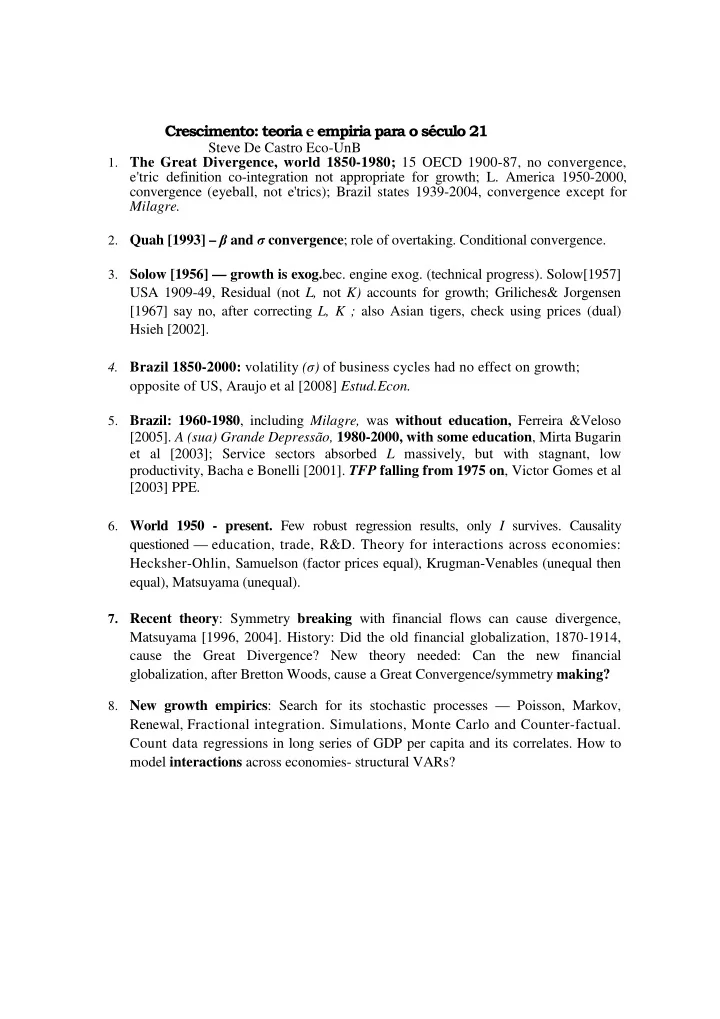
- 1. The Great Divergence, world 1850-1980; 15 OECD 1900-87, no convergence,
e'tric definition co-integration not appropriate for growth; L. America 1950-2000, convergence (eyeball, not e'trics); Brazil states 1939-2004, convergence except for Milagre.
- 2. Quah [1993] – and convergence; role of overtaking. Conditional convergence.
- 3. Solow [1956] — growth is exog.bec. engine exog. (technical progress). Solow[1957]
USA 1909-49, Residual (not L, not K) accounts for growth; Griliches& Jorgensen [1967] say no, after correcting L, K ; also Asian tigers, check using prices (dual) Hsieh [2002].
- 4. Brazil 1850-2000: volatility () of business cycles had no effect on growth;
- pposite of US, Araujo et al [2008] Estud.Econ.
- 5. Brazil: 1960-1980, including Milagre, was without education, Ferreira &Veloso
[2005]. A (sua) Grande Depressão, 1980-2000, with some education, Mirta Bugarin et al [2003]; Service sectors absorbed L massively, but with stagnant, low productivity, Bacha e Bonelli [2001]. TFP falling from 1975 on, Victor Gomes et al [2003] PPE.
- 6. World 1950 - present. Few robust regression results, only I survives. Causality
questioned — education, trade, R&D. Theory for interactions across economies: Hecksher-Ohlin, Samuelson (factor prices equal), Krugman-Venables (unequal then equal), Matsuyama (unequal).
- 7. Recent theory: Symmetry breaking with financial flows can cause divergence,
Matsuyama [1996, 2004]. History: Did the old financial globalization, 1870-1914, cause the Great Divergence? New theory needed: Can the new financial globalization, after Bretton Woods, cause a Great Convergence/symmetry making?
- 8. New growth empirics: Search for its stochastic processes — Poisson, Markov,
Renewal, Fractional integration. Simulations, Monte Carlo and Counter-factual. Count data regressions in long series of GDP per capita and its correlates. How to model interactions across economies- structural VARs?
SLIDE 2
##$ %% & '"%(% )*+$,- .#'
0*1,-2.#34+" Implication: 5% %%!&
/!5%! %per capita %%% 7 8!
:;+"%2 <
SLIDE 3
- 1 1700, 1820, Maddison (1989); 1910, Prados de 1a Escosura (2000) and
Maddison(1989); 1952, 1978 and 1992, Penn World Tables. From:
- R. Feenstra&G.Clark [2001], ""Technology in the great divergence" NBER WP #8596
SLIDE 4
Fonte: Ernani César e Silva Cabral 2008, Convergência de renda per capita entre os estados brasileiros de 1939 a 2004, Tese de doutoramento defendido em 2008.
APÊNDICE Gráfico Estimativ Preliminares dos PIBsper capita para estados brasileiros
SLIDE 5
SLIDE 6 Relative GDP per Head, 1820-1990: Alternative Estimates [United States = 1]
Relative GDP per head in 1820 (pre-World War I borders) Prados de laEscosura Maddison (R) Exchange Rate IAustralia 1.023 I Netherlands 1.670 I Australia 1.361 2 USA 1.000 2 UK 1.437 2 UK 1.228 3 UK 0.965 3 Australia 1.316 3 USA 1.000 4 Netherlands 0.800 4 Denmark 1.282 4 Netherlands 0.959 5 France 0.713 5 USA 1.000 5 France 0.690 6 Denmark 0.513 6 France 0.829 6 Denmark 0.548 Relative GOP per head in 1850 (pre-World War I borders) Prados de laEscosura Maddison (R) Bairoch Exchange Rate I Australia 1.096 1 Australia 1.903 1 USA 1.000 I Australia 1.540 2 UK 1.000 2 UK 1.392 2 UK 0.996 2 UK 1.299 3 USA 1.000 3 Netherlands 1.372 3 Netherlands 0.928 3 USA 1.000 4 Canada 0.827 4 Belgium 1.203 4 Belgium 0.894 4 Belgium 0.889 5 Netherlands 0.791 5 Austria 1.119 5 France 0.724 5 France 0.840 6 France 0.781 6 Denmark 1.097 6 Spain. 0.681 6 Netherlands 0.796 7 Belgium 0.742 7 USA 1.000 7 Germany 0.67(1 7 Canada 0.770 8 Denmark 0.661 8 France 0.865 8 Portugal 0.565 8 Spain 0.656 9 Spain 0.638 9 Germany 0.853 9 Denmark 0.557 9 Denmark 0.655 10 Germany 0.609 10 Canada 0.783 10 Sweden 0.459 10 Germany 0.473 11 Austria 0.541 1 1 Spain 0.700 1 Sweden 0.442 12 Sweden 0.520 12 Sweden 0.631 12 Austria 0.441 13 Portugal 0.456 13 Portugal 0.488 13 Portugal 0320 Relative GDP per head in 1913 (pre-World War I borders) Prados de laEscosura Maddison (R) Bairoch Exchange Rate I USA 1.000 1 Australia 1.125 1 USA 1.000 1 Australia 1.063 2Australia 0.976 2 Argentina 1.086 2 Canada 0.835 2 USA 1.000 3 Canada 0.968 3 New Zealand 1.069 3 Australia 0.754 3 Canada 0.971 4 UK 0.847 4 USA 1.000 4 UK 0.707 4 New Zealand 0.966 5 New Zealand 0.838 5 Belgium 0.966 5 Switzerland 0.705 5 UK 0.715 6 Argentina 0.813 6 UK 0.961 (i Belgium 0.655 6 Switzerland 0.662 7 France 0.770 7 Canada 0.865 7 Denmark 0.632 7 France 0.645 S Belgium 0.743 8 Switzerland 1).859 8 New Zealand (1.586 8 Argentina 0.633 9 Germany 0.742 9 Netherlands 0.830 9 Germany 0.555 9 Belgium 0.588 10 Switzerland 0.726 10 Denmark 0.800,, 10 Netherlands 0.552 10 Denmark 0.583 I1 Norway 0.683 11 Germany 0.754 I1 Norway. 0.549 11 Norway 0.544 12 Denmark 0.677 12 Austria 0.704 12 France 0.509 12 Germany 0.529 13 Sweden 0.673 13 France 0.687 13 Austria-Hungary 0.499 13 Sweden 0.507 14 Netherlands 0.668 14 Sweden 0.632 14 Sweden 0.493 14 Netherlands 0.438 15 Austria 0.532 15 Greece 0.539 15 Ireland 0.448 15 Austria 0352 16 Italy 0.526 16 Italy 0.527 16 Finland 0.381 16 Italy 0.339 17 Spain 0.511 17 Norway 0.463 17 Italy 0.232 17 Spain 0.332 18 Finland 0.490 18 Spain 0.442 l8 Spain 0.269 18 Finland 0.267 19 Ilungary 0.461 19 Finland 0.424 19 Russia 0.239 19 Hungary
20 Russia 0.451 20 Hungary 0.424 20 Greece 0.236 20 Bulgaria 0.220 2 1 Portugal 0.396 21 Bulgaria 0.302 21 Portugal 0.214 21 Greece 0.202 22 Greece 0.391 22 Russia 0.300 22 Bulgaria 0.193 22 Portugal 0.200 23 Japan 0.375 23 Japan 0.269 23 Japan 0.185 23 Russia
24 Bulgaria 0.369 24 Portugal 0.239 24 Japan 0.131
From: Leandro Prados de la Escosura [2000] in Explorations in Economic History 37 (1): 1-41. T - . . , r . ,
. . . . f v n n t n r i
SLIDE 8
SLIDE 9 Table 1-8. The Ten Largest Economies in 1820 and 1992
GDP (million 1990S) GOP as Per Cent of World Total % Population (000s) Population as Share of World Total % 1820
199 212 28.7 381 000 35.5
110 982 16.0 209 000 19.6
37 397 5.4 30 698 2.9
36 164 5.2 21 240 2.0
33 779 4.9 45 005 4.2
21 831 3.1 31 000 2.9
13 460 1.9 14 268 1.3
12 975 1.9 12 203 1.1
12 432 1.8 9 656 0.9
11 864 1.7 11 214 1.1 Top Ten Total 490 096 70.5 765 284 71.7 World 694 772 100.0 1 067 894 100.0 1992
5 675 617 20.3 255 610 4.7
3 615 603 12.9 1 167 000 20.9
2 417 603 8.6 124 336 2.3
1 359 696 4.9 80 576 1.5
1 188 096 4.2 881 200 16.2
1 030 356 3.7 57 372 1.1
939 685 3.4 57 900 1.1
927 772 3.3 57 848 1.1
801 837 2.9 149 400 2.7
756 014 2.7 156 012 2.9 Top Ten Total 18 712 219 66.8 2 987 254 54.9 World 28 000 037 100.0 5 440 983 100.0 Source: Angus Maddism, Monitoring the world economy, OECD, 1995
- Table 8.2 Levels of GNP in the Third World and the developed countries, 1750-
1990 (in 1960 US dollars and prices)
Total (billions of dollars) Third World Developed countries Per capita (dollars) Third World Developed countries 1750 112 35 188 182 1800 137 47 188 198 1830 150 67 183 237 1860 159 118 174 324 1900 184 297 175 540 1913 217 430 192 662 1928 252 568 194 782 1938 293 678 202 856 1950 338 889 214 1,180 1970 810 2,450 340 2,540 1980 1,280 3,400 390 2,920 1990 1,730 4,350 430 3,490 Source: P. Baicoch, Economics and World history, U. Chicago Press 1993
SLIDE 10
" "
# # ' '! &( # ' '
./ ''
' ' , ,0 # # ' " 1%,
Average 2 ,-
' 0-,
4475,4-3
=8-(933,,/3&)6$-
,0(96-,, ,(033-
SLIDE 11
have these stagnation factors been in place? Maddison's data suggest they may have persisted over the last century.2( ' shows relative Latin American income in 1900, in 1950, 1980 and in 2001. These data show that Latin America's stagnation has been the norm for the last 100 years. Latin American per capita income was 29 percent of the U.S. in 1900, almost exactly where it was in 1950, and slightly above
SLIDE 12
SLIDE 13 7 8 $
8 $ ? 4 + $
8
$; 4' @ Mankiw Capítulo 24 Produção e Crescimento Tabela 24-1
$.80 A *)+ $' 4@$4B+$@ @08B@@C )$.80 A 08+ $' 4@)$; @08B@@C ' > 0 +80-+$;04'@ ;D$@ 4, A E(F GH I"II 6 J66 & . I"I=K 6&J &6= &I +L ="II " && ==
="II & 6 = 0, ="II 66
+ I"I= 6 =6 = ;M* I"I= J6I JJ= J6 8, ="II JI& &I &J
6 && I $M I"I= 6II
I"I= 6&
I"I= &= JJ J . I"I= &6I &=
- 5:Robert J. $ & Xavier Saia-i-Martin, Economic Growth E4!N5;"/IIF
- 2(&L$,
;*-<-
SLIDE 14
&''
()*+,$-*-(,,).,/))0*1
2(3 37-(,--37 38-8==-- &-->---?"@6 4(,!A,-0 3--064,4(,
!!
'99%6
460
O P
EF
SLIDE 15
Table 1: Growth rates, 1800-2000
Period Brazil GDP pp USA GNP pp 1822-2000 1.55% 1800-1989 1.67% 1822-1950 1.01% 1820-195Ó 1.56% 1822-1900 0.16% 1800-1913 1.60% 1822-1850 0.44% 1800-1850 1.10% 1850-2000 1.76% 1869-1996 1.74% 1850-1950 1.18% 1869-1950 1.66% 1850-1900 0.01% 1869-1900 1.73% 1900-2000 2.64% 1900-1996 1.76% 1900-1950 2.34% 1900-1950 1.89% 1950-2000 2.93% 1950-1996 1.89% 1950-1975 4.48% 1950-1975 1.52% 1975-2000 1.39% 1975-1996 2.10%
Sources: Brazil: Table 1 in Appendix and Summers-Heston world tables; USA: 1800- 1989 Engerman&Sokoloff[ 1997]; 1869-1996 Shively [2001]. * Madison [ 1995] From: De Castro and Q![2005] "Tests for history dependence ...."
SLIDE 16 Décadas PIB PIB !" #!$" % $!#&" !" %$ %!" #! " $& &!$" %!" & ! " !#&"
!& " !"
!# " !&"
Produtiv idade da m ão dc obra 1950 1960 1970 1980 1991 Contas Nacionais 1991 1999 PIB (pm) 4563 7000 9727 15582 14096 13203 16459 AenOrEcuÂRIA 1093 1404 2016 3289 4378 3600 5130
$ 4 @ - ' 8 (tic. coNsTUUCAo)
6595 •. 11873 15748 19196 20210 20410 29688 coNsrxuçÃo 11714 20269 18275 26101 18965 19070 21942 c o .t é R c t o 6718 8785 10167 12236 7570 6956 7411
' 8 4 - 8 ' 0 - - + @ ; , 4 + R S 0 -
1905 2857 4890 9504 12357 12814 18583 IANc0S c: ' $ 7 $ 0 - ) $ 4 4 + A ot, p ú n t, t c As t e u r u c ) s
Nota: De 1950 a 1991
(cinco primeiras
22433 12842 12958 4167 colunas), dados 19628 16634 12138 6261 de mão de obra 36952 23457 12856 9468 provem dos 52249 22274 IZ
`S ,,4,Z
15254 C e n s
D c m
r a f i c
21234 1312 13708 66522 20254 12774 12840 80017 28046 13308 15380 ESTRUTURA SETORIAL DO EMPREGO: 1940-1999 1940 1950 CENSOS DEMOGRÁFICOS 1960 1970 1980 1991 NSCN 1991 1999 AGROPECUÁRIA 65,90% 59,91% 53,97% 44,75% 30,21% 22,71% 25,86% 23,64% INDÚSTRIA CONSTRUÇÃO) 12,13% 14,17% 14,18% 16,13% 21,58% 16,90% 15,68% 12,84% CONSTRUÇÃO 1,78% 3,42% 3,43% 5,86% 7,50% 6,70% 6,24% 6,35% COMERCIO 5,20% 5,65% 6,57% 7,74% 9,84% 12,75% 13,00% 15,21%
- 1 RANSPORTES&COMUNICAÇÕES
3,39% 4,03% 4,60% 4,18% 4,50% 4,18% 3,78% 4,30% BANCOS E ATIVIDADES FINANCEIRAS 0,35% 0,67% 0,90% 1,48% 2,37% 1,78% 1,57% 1,17%
Pl)BLICAS•
4,07% 4,93% 5,66% 8,16% 10,37% 10,33% 10,15% 8,44% SERVIÇOS 7,18% 7,23% 10,69% 11,70% 13,62% 24,64% 23,72% 28.05%
SLIDE 17
SLIDE 18
SLIDE 19
De fato, Ram (1990) mostra que passes com nível educacional médio similar ao do Brasil têm desigualdade educacional de magnitude similar às estimadas para o Brasil. ERESS) »
SLIDE 20
Tabela 10.3 Evolução da escolaridade média no Brasil e países selecionados, 1960/2000. População de 15 anos ou mais de idade Ano Brasil Argentina México Índia Coréia do Sul Chile Grécia Portugual 1960 2,9 5,3 2,8 1,7 4,3 5,2 4,8 1,9 1965 3,0 5,5 2,9 1,9 5,4 5,0 5,1 2,4 1970 3,3 6,2 3,7 2,3 4,9 5,7 5,4 2,6 1975 3,0 6,3 3,9 2,7 6,6 5,6 5,9 2,8 1980 3,1 7,0 4,8 3,3 7,9 6,4 7,0 3,8 1985 3,5 7,1 5,2 3,6 8,7 6,7 7,3 3,9 1990 4,0 8,1 6,7 4,1 9,9 7,0 8,0 4,9 1995 4,5 8,5 7,0 4,5 10,6 7,3 8,3 5,5 2000 4,9 8,8 7,2 5,1 10,8 7,6 8,7 5,9 Fonte: Barro & Lee (2000).
SLIDE 21 !"
0*!
1960 1970 1976 1981 1989
!"#
% % % & '
%% % '(&"#
$ $
Fontes: Calculado a pair das Tabelas 4.1 e 4.2 em Langoni (1973) e tabulações dos autores a partir das PNAD - 76, 81 e 89.
From: Ricardo Paes de Barros e Rosane Mendonça [1993], "Geração e reprodução da desigualdade de renda no Brasil", em #$!(org), Perspectivas da economia brasileira
5%667&vols. pp. 471-491.
" ! % & ' ( ) * ' + , ' - ( % ' *
.* / * 0 1 # - '+ * 2 2 2 2 2 2 2 2 2 2 2 2 2 2 2 2 2 2 2 2 2 2 2 2 2 2 2 2 2 2 2 2 2 2 2 2 2 2 2 2 2 2 2 2 2 2 2 2 2 2 2 2 2 2 2 2 2 34
5 ' - , 6 + ' % ' 7 88 % ' 9 :'
7
; % ' + # % ' +
3 : ( ' +
48
*
= > 6 ( ,
! - * ' ' + 6 ( , 9 ?
9 2 2
+
?? . * A $ ' - , 6 ' * 6 .
SLIDE 22
- r do not occur, the multipliers could be (1 u) and (1 + v) '.
Alternatively, or in addition, upper and lower bounds can be placed on nr8 to prevent runaway cases. I do not dwell on the results of such experiments, because they come out just as one would expect. Although the focus in these lectures is appropriately on learning by doing, most of the variations that have been ex- plored in these Monte Carlo experiments have been elabora- tions of the innovations I am not sure why that should be so. Most likely the possibilities have been tied down by Arrow's original and convenient formulation. There is little room for small alterations in the model itself. Variations in the parameter ishave predictable consequences. Variations in b amount merely to changing the relative weight of learning by doing and more traditional innovation in the process of
SLIDE 23
SLIDE 24 T a b le 2 : Re a l GD P p e r c a pi t a ( r e l a ti v e to wor l d -' - ag e ) ;-%B'',C4D2?.BE .'A5 @*%1 8F 8 G!-A
?4=
??3 ?4 ??
0.01
0.94 (1.02 (508)
0.99 !(- 9 ? 0.16 0.16 0.27
- 6 (- %'++, 6 ' 6 -'- ++ +' 6 &+- 'B
'( 6 ++ ' '',- '( - &6 6 +& (6B6'- F
- +',( ' % 6 6 /++ 6' ' H & +-B
%'+ +' ' %- 6 *% '6 6 + ' 6 *% *,8,' ' (( ' '*+' ++ 6 (- -* %*-'6+(-(6+'-1*('+* ' + 3 : ( L o g ) p e r s o n a l p e r c a p i t a i n c o m e ( r e l a t i v e t o U S ' ' ( 1 ;-*++B'',4944I 5-A!%'+*%A.'+A3 @*%1 9D1 B?A? ?4 G!-A B?? B?? ?? ??? ?3C=9 91 0.06 0.8' 0.10
(1.81 0.09
(1.10 0.85 (1.01 (421)
0.94 L• rgoclir 0.1!) (1.22 11.23 0.20 0.16
>6-'%+.6'+2. ++ % (* C '- &6 % & B*6 '- B 6'+ 6 &+- ''( < 6C 40C %'- 6' '% % (* 6 ++&(- '+ 7+ : &6 6 ' - ,' 6 B
- %' '* B *(+,B6(6 A '++ -'('+ B
- 4?0 6 ' BH +, ' 6 %' -'('+
(6&C 6 '+ &C &66 '*+' 6 (- -*B %+- , 6 %'- 7+E 6' -* 6& ' 6( 6 %--+C '- - ' 'u%*+' 6 +& '- 6(6 '+ % 6 ' '+, 6 %' '* *((BBC:1 (* •1.1: it +'H' 6' * ' 6 &+-C ( /( +* ' 6 6(6 '- +&
- 6 % -*A 6 %--+ +' '6( 6 -
''+*((-%'++,,(*(3 J=991
'+ A K%A 6 '% '+*+' + & #>. '+&
%*6(' %+, ''A -'('+ ' %'++A +B-'('+ +'(6-6*((('(*(&66 ' 6 G. +C 6 (- -*A +( 6& 6 %-'+6'-6'-&+-%-*-,'% @(+*+*-6 #6'JD=1 6'*--'' 6'6 6C '%+,C 6' %'+ ''+, ( % '+( &6
- %'6&6e n t i r e -*+BL*6-,'%
' ' %,M #+*-AN '%( 6 '' 'A '++&( 6(6B- -,'% 6' B- ' )*' 31 '7( '*'+ % 6H (' 6' ,' '++&( 6 (-B '+ '- C '-''-+%-H(C*'-'(6**
@6(
6 '+*+' *)* ' (--* # a )* 6 -'' 6' +, *6
<6subsequent. &7++&(*6-'+*-J?1
SLIDE 25
Figure 7 - Uniform Beta distribution (parameters ==1) and increasing returns in research activity (6% =3) Figure 8 - Unimodal Beta distribution (parameters ==1.5) and increasing returns in research activity (=3) Figure 9 - Unimodal Beta distribution (parameters ==1.5) and decreasing returns in research activity (=0.7)
SLIDE 26 Markovmatrix . Unimodal Beta B e t a ( 1 . , . 5 ) , d e c r e a s i n g decreasing returns in reaseainrrrrrresearchrese (0.5)
1
2. 3.
4.
. 0.8079 0.1683 0.0190 0.0048
2
0.1815 0.5697 0.2118 0.0336 0.0034 3 0.0053 0.2148 0.5528 0.2113 0.0158 4 0.0019 0.0225 0.2251 0.5704 0.1801 5
Ergodic vector
0.1945 0.0057 0.1936 0.0076 0.2069 0.1889 0.2058 0.7977 0.1992
Ergodic vectorErgodic vector Markov matrix U-shaped Beta(0.5) , decreasing returns in research ( 0.5) 0.8874 0.0962 0.0114 0.0049 0.0991 0.7339 0.1478 0.0139 0.0052 0.1534 0.6790 0.1429 0.0247 0.0054 0.1825 0.6494 0.1628 0.0112 0.1791 0.8097 Ergodic vector
0 . 1 7 3 R 0 . 1 9 3 9 0 _ 2 1 9 2 0 . 2 0 5 2 0 . 2 n s n
SLIDE 27 How the Poisson process becomes a Random Walk
The Poisson process treats with the occurrence of random events, here innovations that increase instantaneously the GDP per person. Time-series methods deal with direct
- bservations of GDP but at regular intervals, usually yearly now also quarterly
In the simplest model posed by Aghion and Howitt [1992], if the economy is in a SSE, then GDP per person, Υ(t), follows: Υτ+1 = γΥτ ; γ>1 constant, exogenous; …..(1) whereγ represents the constant proportionate increase caused by each innovation; τ is the innovation counter, τ = 0,1,2….. In the SSE, innovations arrive in a (simple) Poisson process, with constant parameter,λ the mean rate of arrivals. Thus the arrival times, t1, t2, …..tτ , are such that the time interval between arrivals, Wτ≡ tτ - tτ-1 , have a negative exponential distribution, with parameter λ. But the GDP per person Y, is observed only at fixed times, t, t+1, t+2 …. Let n(t) be the number of innovations between times t, t+1; n(t) would have a Poisson distribution, parameter λ, constant if the economy is in a SSE. E[n(t)] = λ = Var[n(t)] Equation (1) can be transformed to: ln Y(t+1) = ln Y(t) + d(t) ; t = 0, 1, 2, . . …(2) Whered(t) ≡ (lnγ) n(t) ; E[d(t)] = (lnγ) E[n(t)] Define e(t) ≡ d(t) - λlnγ E[e(t)] = (lnγ) E[n(t)] - λlnγ = 0 Var[e(t)] = (lnγ)2 Var[n(t)] = (lnγ)2λ Equation (2) becomes: lnY(t+1) = lnY(t) + λlnγ + e(t) ; t= 0, 1, 2, …time periods ….(3) Define y(t) ≡lnY(t) and ε(t) ≡ e(t-1). Equation (3) becomes: y(t) = y(t-1) + a0 + ε(t); a0 ≡λlnγ …..(4) which is a random walk with constant positive drift. The solution is:
1
( ) (0) ( )
t i
y t y a t i ε
=
= + + .......(5) Random walk models have a unit root. Each shock ε(i), i=1,2,...t has a permanent effect on y(t) as demonstrated in equation (5). The only difference here with standard random walk models is that the shocks are not normally distributed but are Poisson variates, derived from the n(t) distribution. Shively [2001] tested the same US series, log real GDP per person, 1869-1996, and rejected the unit root null. Thus he concluded that the series had shocks which are temporary deviations from trend. De Castro & Gonçalves [2005, 2010] came to the equivalent conclusion, namely that the US was on average never far from its long-term growth rate. It was trend stationary throughout its trajectory.
SLIDE 28
SLIDE 29 Table 2: Arrival times of innovations: Brazil 1822 - 2000; To (1822) = 0; 3% size
= J 6
== J 6
=6 &
6I &
= 6 & 66 I J6 66 6 I
6 II J 6J6
J = J J= 6J & JJ 6=& J = = =I = = 6= &J J= 6=J = I
6 &6 J 6=I
I = I = 6I && JI 6 I J=
& &6
= 6I I =
&
= 6IJ I =J
&
=
I && 6 & &J= =& &
= 6 &= =6
& J
= =
II &J =& J &I =J I
II &= = = &IJ == 6
&=
= =
& I 6 =I
J J 6
- Graph 1 - Observed vs. Uniform Distribution of arrivals: Brazil, 1822 - 2000.
SLIDE 30
Graph 3 — Observed vs. Uniform Distribution of arrivals: USA, 1869-1996. Graph 2 — Observed vs. Uniform Distribution of arrivals: Brazil, 1889-2000.
SLIDE 31
- < % ' '' %' %-+ % ' ' ''-'- -'
' - ' ('- O% - outliers' PC %P- %('- '' ' ' QB''-'- -' P $6++B$ $$1C $6++ $41 % - ; *(%-7,B;*++1C )* 'H ' Q
- ' '*+'Q - R-* '-'- % -''- -'- % '
+ ''-')*'Q-C$$'H*%'Q''''R'B-
SLIDE 32 .*6' )* '% '- ' -%Q - *%' P S, tTC % * % % %' .L' z *%' (*-' '+ )* P ''-' +
- 6)* *6' z ''1 !QC ' 'Q - %-+ U
%-*''--'-'A <*A <-EitE Q6)**R-'Q+V%'---''(%
SLIDE 33 Figure 2c summarizes the results. In case D, this model has little predictive content, because both asymmetric and symmetric stable equilib- ria exist. The prediction of this game, as a theory of equilibrium diversity, is most power- ful in cases B and C, where all the symmetric equilibria are unstable. In these cases, the play- ers participate in different activities at different levels in any stable outcome. Thus, the model predicts diversity. Note that coordination fail- ures are not responsible for the equilibrium
- diversity. Note also that case B does not neces-
sarily require strong complementarity. It can
- ccur for an arbitrarily small 9, if the interde-
pendence across the two activities, '! is suffi- ciently high.
AEA PAPERS AND PROCEEDINGS