SLIDE 1
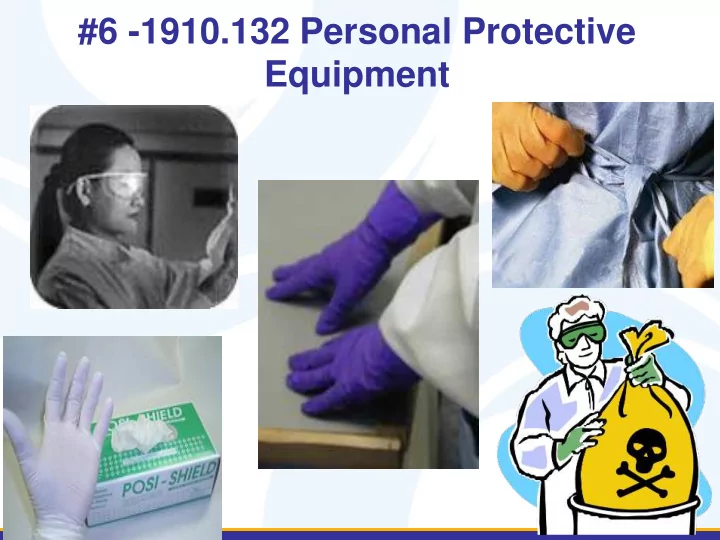
#6 -1910.132 Personal Protective Equipment
SLIDE 2 Eye and Face Protection
- If you buy cheap, goofy looking safety glasses,
nobody is going to use them.
SLIDE 3
#7- 1910.305 Electrical Wiring Methods
SLIDE 4
SLIDE 5
#8 -1910.37 Maintaining exit routes
SLIDE 6 45
Fire Door & Frame Labels
SLIDE 7
#9 - 1910.134 Respiratory protection program
SLIDE 8 Written Respirator Program
- The program shall include respirator
selection, medical fitness, maintenance, training, fit testing, use, program evaluation, etc.
SLIDE 9 #10 - The General Duty Clause. Section 5(a)(1)
Section 5(a)(1) of the OSHA Act: The employer did not furnish the employment and place of employment which were free from recognized hazards that were causing or likely to cause serious physical harm to employees, in that employees were required to perform lifting tasks resulting in stressors that have caused or were likely to cause musculoskeletal disorders (MSDs):
- Exposed employee
- Recognized hazard
- Employer knowledge
- Feasible method to abate hazard
SLIDE 10 T
en Violations
Most frequently cited OSHA standards during FY 2017 inspections
We Can Help
w w w.osha.gov
- 1. Fall Protection, 1926.501, 6072 Violations
- 2. Hazard Communication, 1910.1200, 4,176
- 3. Scaffolding , 1926.451, 3,288
- 4. Respiratory Protection, 1910.134, 3,097
- 5. Lockout/T
agout, 1910.147, 2,877
- 6. Ladders, 1926.1053, 2,241
- 7. Powered Industrial Trucks, 1910.178, 2,162
- 8. Machine Guarding, 1910.212, 1,933
- 9. Fall Protection Training, 1926.503, 1,523
- 10. Electrical Wiring Methods, 1910.305, 1,405
SLIDE 11 It’s Everyone’s Problem!!!
– Who took the guard off?
– Who’s employee is around the motor?
– Who was to install correctly?
– Who has
the project?
and Pulley on Motor….
SLIDE 12 OSHA Penalty Adjustment
- First time OSHA’s penalties were
adjusted since 1990
- OSHA will adjust its civil monetary
penalties annually to account for inflation
SLIDE 13 New Penalty Levels
Adjusted Jan 17, 2017
Type of Violation New Maximum*
Serious and Other-Than-Serious Posting Requirements
$12,675 per violation Willful or Repeated $126,749 per violation Failure to Abate $12,675 per day beyond the abatement date
*Maximum penalties will be readjusted annually for inflation.
SLIDE 14
- No new data collection required;
employers will send what they already have
- OSHA will make some of this data
publicly available
- Most manufacturing, construction and utilities
will be required to submit data.
Improve Injury Tracking Rule
SLIDE 16
SLIDE 17 Where Would You Prefer to Work?
1 2 3 miles
Injury rates can vary widely within same industry and city
DART Case Rate: Days Away, Restrictions, and Transfers
Nursing Home A DART RATE: 2.2 Nursing Home B DART RATE: 11.3
SLIDE 18 Which Would You Choose for Your Elderly Parent?
Injury rates can vary widely within same industry and city
DART Case Rate: Days Away, Restrictions, and Transfers
Nursing Home A DART RATE: 2.2 Nursing Home B DART RATE: 11.3
1 2 3 miles
SLIDE 19 Calculating Rates
- DART – cases for days away from work,
restricted work or transferred to another job
- DART = Column H + I x 200,000
Number of hours worked
SLIDE 20 Revised Standards
Employee involvement
Prohibition against discrimination
Electronic submission of injury and illness records to OSHA
High-risk industries with 20-249 employees
SLIDE 21 Who Does the Regulation Apply To?
- Establishments with 250 or more
employees covered by the recordkeeping regulation
- Establishments with 20-249 employees in
certain high-risk industries
SLIDE 22 High-Risk Industries
NAICS Industry 5629 Remediation and other waste management services 6219 Other ambulatory health care services 6221 General medical and surgical hospitals 6222 Psychiatric and substance abuse hospitals 6223 Specialty (except psychiatric and substance abuse) hospitals 6231 Nursing care facilities 6232 Residential mental retardation, mental health and substance abuse facilities 6233 Community care facilities for the elderly 6239 Other residential care facilities 6242 Community food and housing, and emergency and other relief services 6243 Vocational rehabilitation services
SLIDE 23 Injury Tracking Application (ITA)
The IT A was successfully launched August 1, 2017
- Employers can access the application from the ITA
landing page at https://www.osha.gov/injuryreporting/index.html
SLIDE 24 Injury Tracking Application (ITA)
IT A is a secure website with 3 options for data submission:
- Manually enter data into a webform
- Upload Comma Separated V
alue (CSV) file to process single of multiple establishments at the same time
- Users of automated recordkeeping systems can
transmit data electronically via an Application Programming Interface (API)
SLIDE 25 Injury Tracking Application (ITA): Help Request Form
- The application has a Help Request Form link at
the bottom of each page
- If you have questions concerning any technical or
policy aspects of the data collection, please use the Help Request Form to ask your question.
- That way, OSHA can coordinate our responses
and quickly learn of any problems the regulated community may be experiencing with the system.
SLIDE 26
Injury Tracking Application (ITA): Create Account
SLIDE 27
Injury Tracking Application (ITA): Get Started
SLIDE 28
Injury Tracking Application (ITA): Create Establishment
SLIDE 29
Injury Tracking Application (ITA): Add 300A Summary
SLIDE 30
Injury Tracking Application (ITA): Submit Data to OSHA
SLIDE 31 If you have 250 or more employees:
- By December 1, 2017 - submit 300A info
- By July 1, 2018 - submit 300A, 300, and 301 info
- Beginning in 2019 - submit info every year by March 2
If you have 20-249 employees (certain high-risk industries):
- By December 1, 2017 - submit 300A info
- By July 1, 2018 - submit 300A info
- Beginning in 2019 – submit info every year by March 2
Anti-retaliation provisions went into effect December 1, 2016
When Must Employers Act?
SLIDE 32
Visit our improved homepage: OSHA.gov
SLIDE 33
Multi-language Worker Outreach
SLIDE 34
delivered twice monthly to more than 170,000 subscribers
initiatives and products to help employers and workers find and prevent workplace hazards
OSHA QuickT
akes
SLIDE 35 OSHA’s on Twitter @OSHA_DOL
Learn about:
- Coming events
- Resources
- Regulations
SLIDE 36 http://www.osha.gov/dte/index.html
SLIDE 37 Atlantic OSHA Training Center (Consortium) SUNY Buffalo T
Buffalo, NY (716) 829-2125 www.smbs.buffalo.edu/CENTERS/trc/ RIT OSHA Education Center Rochester Institute of T echnology Rochester, NY (866) 385-7470 ext. 2919 www.rit.edu/osha
SLIDE 38 Onsite Consultation: Overview
- Who are they?
- Invited consultation – you define scope
- Not an enforcement agency – no fines, no fees
- Company must comply if we find serious hazards
- Part of the “OSHA Family”
- What do they do?
- Personal sampling – noise & air toxins
- Physical hazards
- Review documents
- Training
78
SLIDE 39
- Consultation Programs
- New York: NYS Department of Labor/OSHA
- Syracuse, (315-479-3350), Keith Gillette,
Gillette.Keith@labor.ny.gov
- Buffalo, (716-847-7166), Greg Mazikowski,
Gregory.Mazikowski@labor.ny.gov
- Albany & Utica, (518-457-2810), Bob Francis,
robert.francis@labor.ny.gov
- www.labor.state.ny.us/workerprotection/safetyhe
alth/DOSH_ONSITE_Consultation.shtm
OSHA Consultation Programs
79
SLIDE 40 Working T
, We Can Help
www.osha.gov 800-321-OSHA (6742) RonaldWilliams (315) 451-0808 ext. 3002 williams.ronald@dol.gov