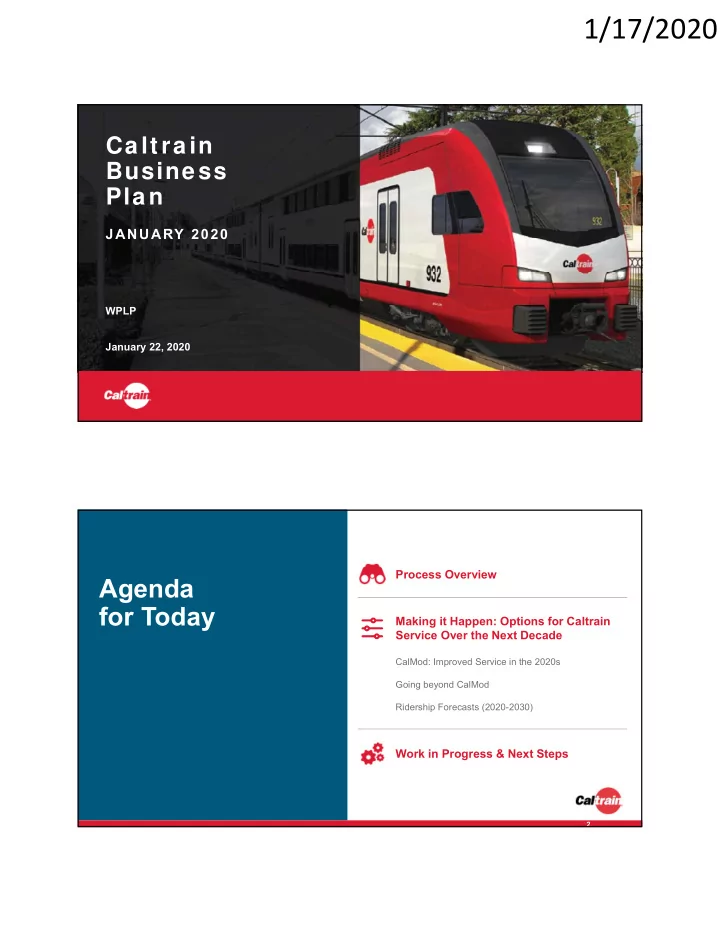
1/17/2020 Caltrain Business Plan JANUARY 2020 WPLP January 22, - - PDF document

1 17 2020
SMART_READER_LITE
LIVE PREVIEW

1/17/2020 Caltrain Business Plan JANUARY 2020 WPLP January 22, - - PDF document

1/17/2020 Caltrain Business Plan JANUARY 2020 WPLP January 22, 2020 Process Overview Agenda for Today Making it Happen: Options for Caltrain Service Over the Next Decade CalMod: Improved Service in the 2020s Going beyond CalMod


slide-1
SLIDE 1

1/17/2020

Caltrain Business Plan

JANUARY 2020

January 22, 2020 WPLP

Agenda for Today

2

Process Overview Work in Progress & Next Steps

CalMod: Improved Service in the 2020s Going beyond CalMod Ridership Forecasts (2020-2030)

Making it Happen: Options for Caltrain Service Over the Next Decade

slide-2
SLIDE 2

1/17/2020

Process Overview

3

What Why

What is the Caltrain Business Plan?

Addresses the future potential of the railroad over the next 20-30

  • years. It will assess the benefits,

impacts, and costs of different service visions, building the case for investment and a plan for implementation. Allows the community and stakeholders to engage in developing a more certain, achievable, financially feasible future for the railroad based on local, regional, and statewide needs.

slide-3
SLIDE 3

1/17/2020

Service

  • Number of trains
  • Frequency of service
  • Number of people

riding the trains

  • Infrastructure needs

to support different service levels

Business Case

  • Value from

investments (past, present, and future)

  • Infrastructure and
  • perating costs
  • Potential sources of

revenue

What Will the Business Plan Cover?

Organization

  • Organizational structure
  • f Caltrain including

governance and delivery approaches

  • Funding mechanisms to

support future service

Community Interface

  • Benefits and impacts to

surrounding communities

  • Corridor management

strategies and consensus building

  • Equity considerations

Technical Tracks

Timeline

6

Development and Evaluation

  • f Growth

Scenarios Adoption of Long-Range Service Vision Completion of Business Plan July 2018 – July 2019 October 2019 Fall 2019 Spring 2020 Winter 2019-2020 Rounding Out the Vision and Implementation Planning

slide-4
SLIDE 4

1/17/2020

Remaining Technical Analysis

Making it Happen

7

With a 2040 Service Vision adopted, what will the next 10 years look like for Caltrain? What are the key actions and steps we need to focus on next? Additional technical and policy analysis is underway to focus on what Caltrain can achieve

  • ver the next decade and they key near term

steps and work that will be needed to make it happen Accompanying financial projections and funding plan Building towards the Vision with service concepts for initial electrification and options for growth and investment through 2020s Identification of a program of key planning, policy and

  • rganizational next steps

Remaining Technical Analysis

Rounding Out the Vision

8

Equity analysis & focus on making Caltrain accessible to all Analysis of connections to

  • ther systems & station access
  • ptions

With a 2040 Service Vision adopted, how can Caltrain “Round Out” its vision for the future? Additional technical and policy analysis are underway with a focus on areas that that were highlighted as important through stakeholder

  • utreach and help complete the picture of the

railroad Caltrain hopes to become Review of funding options and revenue generation opportunities to support the Vision

slide-5
SLIDE 5

1/17/2020

Making it Happen

9

Caltrain’s 2040 Service Vision

Illustrative Service Details

10

Trains per Hour, per Direction

Peak: 8 Caltrain + 4 HSR Off-Peak: Up to 6 Caltrain + 3 HSR

Stopping Pattern

Local / Express with timed transfer in Mid Peninsula

Travel Time, STC-Diridon

61 Min (Express) 85 Min (Local)

New Passing Tracks

Millbrae, Hayward Park-Hillsdale, Redwood City area, Northern Santa Clara County, Blossom Hill

Service Plan Description

  • Local and Express trains each operating at 15-

minute frequencies with timed cross-platform transfer at Redwood City

  • All trains serve Sales For Transit Center
  • Trains serve Capitol and Blossom Hill every 15

minutes and Morgan Hill and Gilroy every 30 minutes

  • Skip stop pattern for some mid-Peninsula stations
slide-6
SLIDE 6

1/17/2020

11

Caltrain’s 2040 Service Vision - Investments

12

Amount of Investment / Number of Trains Design Year

2018

Diesel Fleet

2040

Service Vision

  • 5 Caltrain trains per

hour, per direction (phpd), existing varied schedule

  • Hourly off peak

service

2022

Start of Electrified Operations

  • 6 Caltrain trains phpd,

skip stop service

  • Expansion to 7-car

trains

  • 30 minute off peak

service

2029

HSR Valley to Valley & Downtown Extension

  • 6 Caltrain trains phpd, skip

stop service

  • Full electrification and

expansion to 8- car trains

  • 30 minute off peak service
  • Service to Downtown SF via

DTX

  • Up to 2 HSR phpd

2033

High Speed Rail Phase 1, SF to LA

  • 6 Caltrain trains phpd
  • 8- car trains
  • Skip stop service
  • 30 minute off peak service
  • Service to Downtown SF via

DTX

  • Up to 4 HSR phpd
  • 8 Caltrain trains phpd, regular

express + local service

  • Up to 10-car train lengths
  • Up to 10 min off peak service
  • Service to Downtown SF via DTX
  • Significantly increased service to

South San Jose and South Santa Clara County

  • Up to 4 HSR phpd

The “path” of milestone service improvements and investments used in initial Business Plan work was based on a simplified version of the existing plans of Caltrain and its partner agencies

Getting to the 2040 Vision

slide-7
SLIDE 7

1/17/2020

13

Amount of Investment / Number of Trains Design Year

2020

Diesel Fleet

2040

Service Vision

2022

Start of Electrified Operations

The path Caltrain ultimately takes will be based

  • n our ability, and the ability of our partners, to

fund and implement key investments With a long-range Service Vision established, we can optimize

  • ur approach. We can explore different “paths” or incremental

steps that allow us to deliver improved service sooner

Getting to the 2040 Vision

Key Questions for the Next Decade

14

What is the potential market demand for Caltrain service over the next 10 years – how can we grow to satisfy it? Which benefits of the 2040 Service Vision could Caltrain deliver before 2030?

  • How can we use the initial electrified system

(CalMod) to deliver near-term service benefits and best meet market demand?

  • How could we improve service further

through subsequent incremental investments? Insert generic corridor picture – ideally one showing tracks (but not diesel trains)

slide-8
SLIDE 8

1/17/2020

CalMod: Improved Service in the 2020s

Market Analysis

Market Analysis Planning Priorities Service Concepts & Evaluation Illustrative Service Plans Service Levels at Stations Additional Slides Included In Appendix

slide-9
SLIDE 9

1/17/2020

Understanding Demand

Daily ridership demand for Caltrain service will likely exceed 90,000 passengers in the next

  • decade. This growth is driven by several factors:

Latent Demand Improving Caltrain service and increasing capacity will make Caltrain more appealing for a wider range of trips Improved Connectivity New connections like the Central Subway will extend Caltrain’s reach Population and Employment Growth Station areas will add over 100,000 new residents and employees within ½ mile of Caltrain stations, a ~30% increase over existing

Caltrain Corridor – Approved Growth

Job Growth Population Growth

slide-10
SLIDE 10

1/17/2020

2020s Outlook

Total Jobs Total Population

2020s Outlook – South of Tamien

Total Jobs Total Population Total Jobs

Unmet Demand

Capitol and Blossom Hill have large populations that are underserved by Caltrain, while Morgan Hill, San Martin, and Gilroy have comparatively lower demand.

Operational Constraints

Under the current agreement with Union Pacific, Caltrain can add up to two additional roundtrips to Gilroy to reach five trips per day. There is limited flexibility in when these trips can be added without affecting mainline service. Two of these roundtrips could be extended south to Salinas subject to further planning and agreement by both the Caltrain Board and Union Pacific.

slide-11
SLIDE 11

1/17/2020

Existing Ridership by Station

Highest Ridership

>4,000 Daily Riders

Moderate Ridership

2,000 – 4,000 Daily Riders

Lower Ridership

<2,000 Daily Riders 4th & King 22nd Street Millbrae Redwood City Palo Alto Mountain View Sunnyvale San Jose Diridon Bayshore South San Francisco San Mateo Hillsdale Menlo Park California Ave San Antonio Lawrence Santa Clara San Bruno Broadway Burlingame Hayward Park Belmont San Carlos Atherton Tamien Capitol Blossom Hill Morgan Hill San Martin Gilroy

5 4 20

Potential 2020s Demand by Station

Highest Ridership Potential

>4,000 Daily Riders

Moderate Ridership Potential

2,000 – 4,000 Daily Riders

Lower Ridership Potential

<2,000 Daily Riders 4th & King 22nd Street Millbrae Redwood City Palo Alto Mountain View Sunnyvale San Jose Diridon Bayshore South San Francisco San Mateo Hillsdale Menlo Park California Ave San Antonio Lawrence Santa Clara San Bruno Broadway Burlingame Hayward Park Belmont San Carlos Atherton Tamien Capitol Blossom Hill Morgan Hill San Martin Gilroy

8 9 13

slide-12
SLIDE 12

1/17/2020

Potential 2020s Demand by Station

Highest Ridership Potential

>4,000 Daily Riders

Moderate Ridership Potential

2,000 – 4,000 Daily Riders

Lower Ridership Potential

<2,000 Daily Riders 4th & King 22nd Street Millbrae Redwood City Palo Alto Mountain View Sunnyvale San Jose Diridon Bayshore South San Francisco San Mateo Hillsdale Menlo Park California Ave San Antonio Lawrence Santa Clara San Bruno Broadway Burlingame Hayward Park Belmont San Carlos Atherton Tamien Capitol Blossom Hill Morgan Hill San Martin Gilroy

8 9 13

Stations experiencing significant changes

Train Capacity and Crowding

Even with increased service, crowding will continue to be an issue for Caltrain over the next decade as demand for service increases

  • Caltrain provides approximately 3,800 seats per direction per peak hour today, which will increase to 4,144 with electrification.
  • With standing room, Caltrain's hourly capacity peak hour capacity will increase from about 4,500 passengers per direction today to 5,400 with

electrification, assuming even distribution of passengers between trains.

slide-13
SLIDE 13

1/17/2020

Planning Priorities

Market Analysis Planning Priorities Service Concepts & Evaluation Illustrative Service Plans Service Levels at Stations

How Can we Improve Service and Meet Market Demand Using CalMod?

26

The electrification of the Caltrain service between San Francisco and San Jose provides a transformative, near-term opportunity to improve service. With this investment, Caltrain can begin delivering many, but not all, of the service improvements described 2040 Service Vision while also attempting to keep pace with growing market demand. While CalMod provides an overwhelming improvement to the system as a whole we will still need to make choices about which service benefits and improvements we prioritize – there are tradeoffs

Increasing frequency at more stations Reducing travel times between major stations Customized and tailored schedules Maximizing peak hour throughput Providing differentiated Service types Standardized intuitive schedules

slide-14
SLIDE 14

1/17/2020

Building Blocks of Service Planning:

Mainline Stopping Patterns

Local 80 Minutes Connects all stations regardless of demand Skip Stop or Zone 70-75 Minutes Varied patterns connect some stations with higher demand Express 60-67 Minutes Connects a few stations with highest demand

Mainline times shown for San Francisco (4th & King) to San Jose (Diridon)

Analytical Approach: Combinations of Skip Stop, Zone, and Express patterns were evaluated for peak service. While local service is part of the 2040 Service Vision, it is not yet viable during peak hours due to infrastructure and fleet limitations.

Zone Skip Stop

Building Blocks of Service Planning:

Travel Time vs. Frequency

Reduce Travel Times between Major Stations

  • Minimize stops to save a few minutes in travel times for

many passengers

  • Demand in growing markets continues to be

underserved Increase Frequency at More Stations

  • Add stops and keep travel times about the same
  • Serve more demand in growing markets

Analytical Approach: Service concepts tend to prioritize improving frequency over travel time given recent and projected growth patterns along the Caltrain corridor.

slide-15
SLIDE 15

1/17/2020

Building Blocks of Service Planning:

Standardization vs. Customization

Standardized Schedule

  • Repeating clockface patterns
  • Symmetrical in both directions
  • Typically communicated as “lines”

(eg the “A Line”) Customized Schedule

  • Complex patterns that may vary by time of day
  • May not be symmetrical in both directions
  • Typically communicated as individual train

numbers Analytical Approach: Concepts developed focus on standardized, bi-directional schedules to create a more user-friendly experience and facilitate coordination with the region’s larger transit network.

Line A Line B Line C 105 107 109 209 211 213 Each Line 2x per Hour Each Train 1x per Hour

Building Blocks of Service Planning:

Combining Service Patterns

Mixing Different Service Patterns

  • Passengers choose between different train types
  • Demand can be concentrated on some very crowded

trains, while other trains may be half empty Similar Service Patterns

  • Train types are broadly similar in terms of overall

stopping structure and time between major stations

  • Demand is more evenly distributed between trains –

helping maximize overall throughput Analytical Approach: Both parallel and differentiated service patterns have been considered.

65 Mins 75 Mins 70 Mins 70 Mins Travel Time Travel Time

slide-16
SLIDE 16

1/17/2020

Service Concepts & Evaluation

Market Analysis Planning Priorities Service Concepts & Evaluation Illustrative Service Plans Service Levels at Stations Additional Slides Included In Appendix

Introducing Four Service Concepts

Two Zones with Express Three Zones Skip Stop with Express Distributed Skip Stop

74 min 70 min 67 min 71 min 71 min 71 min 71 min 71 min 70 min 75 min 75 min 60 min

slide-17
SLIDE 17

1/17/2020

Service Concept Evaluation Metrics

1 - Service Metrics

I. Travel Time II. Maximum Wait Time

2 - Capacity Metrics I. Crowding II. Ability to Support Ridership Growth 3 - User Experience I. Internal Connectivity II. External Connectivity

Summary – Comparison to Existing Service

Metric Two Zone with Express Three Zone Skip Stop with Express Distributed Skip Stop Travel Time Similar Similar Similar Similar Maximum Wait Time Slightly Better Slightly Better Slightly Better Better Throughput Capacity & Crowding Slightly Better Slightly Better Similar Better Able to Support Significant Ridership Growth Partially Partially No Yes Internal Connectivity Similar Similar Similar Similar External Connectivity Slightly Better Slightly Better Slightly Better Better

slide-18
SLIDE 18

1/17/2020

Summary – Comparison to Existing Service

Metric Two Zone with Express Three Zone Skip Stop with Express Distributed Skip Stop Travel Time Similar Similar Similar Similar Maximum Wait Time Slightly Better Slightly Better Slightly Better Better Throughput Capacity & Crowding Slightly Better Slightly Better Similar Better Able to Support Significant Ridership Growth Partially Partially No Yes Internal Connectivity Similar Similar Similar Similar External Connectivity Slightly Better Slightly Better Slightly Better Better Removed from Consideration

Service Levels at Stations

Market Analysis Planning Priorities Service Concepts & Evaluation Illustrative Service Plans Service Levels at Stations

slide-19
SLIDE 19

1/17/2020

Service Frequency Improvements

All service concepts double the number of stations that receive at least four trains per hour, per direction. All service concepts provide at least two trains per hour, per direction to all mainline, regularly served stations.

To aid in comparison, all of the service concepts have been developed using a uniform set of illustrative frequency assumptions (eg there is no difference between concepts in the number of stops a specific station receives)

6 12 18 24

6 Train Service Plans Existing - NB AM/SB PM Existing - SB AM/NB PM

Service Comparison at Stations

<2 TPH 2-3 TPH 4-5 TPH <2 TPH 2-3 TPH 4-5 TPH 2 TPH 4 TPH 6 TPH

Illustrative Service Levels

Current Market Demand and Ridership Patterns Approved Station Area Growth Transportation Demand Management Policies Station Access and Connectivity Opportunities

Service levels shown are illustrative. Final service planning and schedule development for CalMod will involve consideration of additional data and public input and may include considerations related to:

Social Equity and Geographic Equality

slide-20
SLIDE 20

1/17/2020

Illustrative Peak Period Service Levels by Station (Mainline)

Change in Peak Period Service Levels

Service Increases (17 Stations) No Change (4 Stations) Service Reduction (3 Stations) Existing NB AM/SB PM Existing SB AM/NB PM Hourly Service levels are the same for all service concepts Trains per Hour, per Direction

2 4 6

Trains per Hour per Direction by Station

TBD

Illustrative Service Plans

Market Analysis Planning Priorities Service Concepts & Evaluation Illustrative Service Plans Service Levels at Stations

slide-21
SLIDE 21

1/17/2020

Illustrative Service Plans

San Francisco 22nd St Bayshore South San Francisco San Bruno Millbrae Broadway Burlingame San Mateo Hayward Park Hillsdale Belmont San Carlos Redwood City Palo Alto California Ave San Antonio Mountain View Sunnyvale Lawrence Santa Clara San Jose Diridon Menlo Park College Park Tamien San Francisco 22nd St Bayshore South San Francisco San Bruno Millbrae Broadway Burlingame San Mateo Hayward Park Hillsdale Belmont San Carlos Redwood City Palo Alto California Ave San Antonio Mountain View Sunnyvale Lawrence Santa Clara San Jose Diridon Menlo Park College Park Tamien

Caltrain has prepared two sets of illustrative service plans to carry forward for further analysis. Two Zone with Express – two zone patterns (north and south of Redwood City) with a regional express pattern offering different travel times and wait times Distributed Skip Stop – three skip stop patterns offering similar travel times and regular wait times at major stations

Two Zone with Express Distributed Skip Stop

PEAK PERIOD 2 Trains / Hour 2 Trains / Hour 2 Trains / Hour PEAK PERIOD 2 Trains / Hour 2 Trains / Hour 2 Trains / Hour SF to SJ 67 min 70 min 74 min SF to SJ 71 min 71 min 71 min

Hourly stop EMU Half-hourly stop Express Zone Express Skip - Stop

Runtime

Diesel

Atherton* Atherton* *Service level TBD

Service South of Tamien

San Francisco 22nd St Bayshore South San Francisco San Bruno Millbrae Broadway Burlingame San Mateo Hayward Park Hillsdale Belmont San Carlos Redwood City Palo Alto California Ave San Antonio Mountain View Sunnyvale Lawrence Santa Clara San Jose Diridon Menlo Park College Park Tamien

Gilroy Diesel Service 4x/Day

San Francisco 22nd St Bayshore South San Francisco San Bruno Millbrae Broadway Burlingame San Mateo Hayward Park Hillsdale Belmont San Carlos Redwood City Palo Alto California Ave San Antonio Mountain View Sunnyvale Lawrence Santa Clara San Jose Diridon Menlo Park College Park Tamien

Gilroy Diesel Service 4x/Day

Caltrain will increase service to Gilroy to four roundtrips per day. Passengers from south of Tamien would have a

  • ne-seat ride to major stations and a

transfer at Diridon Station to reach minor stations. Arrival and departure times would be similar to today, with one later AM train and one later PM train. Service may be extended to Salinas, pending key agreements and funding, adding about

  • ne hour to travel times.

Two Zone with Express Distributed Skip Stop

Atherton* Atherton* *Service level TBD

slide-22
SLIDE 22

1/17/2020

Off-Peak and Weekend Service

Goals

  • Increase Caltrain’s market share during off-peak

and weekend periods

  • Offer competitive travel times between major

stations

  • Provide a legible schedule transition between peak

and off-peak (Two Zone with Express concept has some advantages in this regard)

  • Maintain flexibility to accommodate construction

and maintenance windows With electrification, Caltrain has the

  • pportunity to increase off-peak and weekend

service levels to better meet corridor demand. However, operational and financial constraints may affect what kind of service Caltrain is able to provide and when.

Example Off- Peak Pattern

Implementation Process and Next Steps

Developing a Final Service Plan for CalMod

  • Preferred Service Concepts shown are

illustrative and are intended to help advance analysis and planning

  • As the PCEP approaches completion,

Caltrain will undertake a supplemental planning process to determine the final 6tph schedule that the railroad will operate – this will include;

  • Selecting the ultimate concept or “style”
  • f service to be operated
  • Determining individual station service

levels

  • Confirming off-peak and weekend

service levels

  • This process will include additional public and

stakeholder input as well as analysis of updated ridership and survey data This analysis has been developed to provide updated concepts for how the investments currently being made as part of CalMod can be used to serve market demand and begin delivering some of the key benefits of the 2040 Service Vision Preferred concepts shown will be used to continue planning for various aspects of CalMod implementation and launch of electrified service in 2022.

slide-23
SLIDE 23

1/17/2020

Going Beyond CalMod

Paths to Incrementally Improving and Increasing Service CalMod will provide tremendous service benefits to the corridor. However regional growth projections suggest that there is medium-term demand for even more service and capacity

46

Amount of Investment / Number of Trains Design Year

2018

Diesel Fleet

2040

Service Vision

Getting to the 2040 Vision

2022

Start of Electrified Operations

The following analysis considers options for how Caltrain could accelerate the delivery of key elements of the 2040 Service Vision to better meet demand by the late 2020s

slide-24
SLIDE 24

1/17/2020

Adding Capacity and Increasing Service to Grow Ridership

Toward the end of the 2020s, Caltrain is expected to reach capacity during peak hours. Caltrain will not be able to accommodate additional ridership growth in the 2030s without adding capacity. This poses a challenge for accomodating land use growth, DTX, Dumbarton rail, and other potential changes on the corridor. While smaller, interim improvements may ease capacity, the most significant improvement to service and capacity involves expanding service to eight trains per hour, per direction.

An Interim Step- Not the Full 2040 Service Vision

Making near-term, tactical investments to increase service to 8 trains per hour per direction would precede the full buildout of the 2040 Service Vision. As such, many important aspects of the 2040 Service Vision would not yet be fully achieved, including:

  • Ability to operate a peak-hour express / local

service pattern with timed transfers

  • Ability to lengthen trains to 8- or 10-cars
  • Direct service to downtown San Francisco
  • Greatly expanded and electrified service south of

Tamien Station to Gilroy Fully achieving the 2040 Service Vision would require the overall buildout discussed and documented in the Business Plan process to date. Increasing mainline service in the mid- to late 2020’s would be an interim step- not the full implementation of the 2040 Service Vision. Major investments at terminals and in passing tracks infrastructure are not assumed.

slide-25
SLIDE 25

1/17/2020

8 Train Illustrative Service Plan

  • An 8-train Caltrain service would likely look like a hybrid of the zone express and skip stop patterns with 8 trains

per hour, per direction.

  • There is limited flexibility in the service structure due to lack of new passing tracks and the constraints of

Caltrain’s existing signal system.

  • Diesel service to/from Gilroy would terminate at San Jose with a timed transfer mainline service. This service

could be increased to 5 round trips per day and would have more flexibility to customize departure and arrival times based on public input.

San Francisco 22nd St Bayshore South San Francisco San Bruno Millbrae Broadway Burlingame San Mateo Hayward Park Hillsdale Belmont San Carlos Redwood City Palo Alto California Ave San Antonio Mountain View Sunnyvale Lawrence Santa Clara San Jose Diridon Menlo Park College Park Tamien PEAK PERIOD PEAK PERIOD 4 Trains / Hour 4 Trains / Hour 70 min 68 min

Diesel Shuttle to Gilroy

Atherton* *Service level TBD

Increasing Service at Stations

Increasing service from six to eight trains per hour, per direction enables more frequent service to more stations.

With an interim 8 tphpd service, 20 of 24 mainline stations would receive at least four trains per hour, per direction, and nearly half of stations would receive eight trains per hour, per direction.

6 12 18 24

8 Train Service Plans 6 Train Service Plans Existing

Number of Stations

<4 TPH 4-5 TPH <4 TPH 4-6 TPH <4 TPH 4 TPH 8 TPH

slide-26
SLIDE 26

1/17/2020

Increasing Service to Stations

Trains per Hour, per Direction

20 stations could receive at least four trains per hour, per direction.

2 4 6 8

Trains Trains per Hour per Dir per Hour per Direction ection by Stat by Station ion

Illustrative Change in Peak Period Service Levels

Illustrative service at expanded “8tph plan” Illustrative service at initial CalMod level Existing NB AM/SB PM Existing SB AM/NB PM

TBD

Overall Investments

Grade Separations Major Investments Station Improvements

Planning and construction of grade separations and grade crossing improvements Programmatic improvements to Caltrain stations and investments in station access and connectivity Work on major terminal projects (including Diridon and DTX), major station investments, and partner projects including HSR

The following parallel and programmatic investments are assumed to be occurring throughout the 2020’s- they are needed to support the overall success of the system and the full implementation of the 2040 Service Vision

slide-27
SLIDE 27

1/17/2020

What Specific Incremental Investments and Changes Would be Needed?

Expanded EMU Fleet Holdout Rule Elimination More Train Storage

To provide 8 tphpd direction mainline service, Caltrain will need to expand its EMU fleet The railroad will need to add storage capacity to accommodate additional trainsets Once 8 trains per hour per direction are operating on the corridor, remaining “holdout” rule stations will need to be rebuilt or closed

The following key investments would specifically be needed to implement an interim 8-tph

  • service. These investments are consistent with the overall program assumed in the 2040 Service

Vision

What Specific Incremental Investments and Changes Would be Needed?

Level Boarding Minor Track Work Gilroy-SJ Shuttle Service

Level boarding is needed to ensure reliability and to keep dwell times as short as possible Remaining diesel service south of Tamien would be converted to a shuttle service until the UP corridor is rebuilt and electrified. Service levels could be increased to 5 round trips per day under existing agreements with UP Minor track work would be needed to accommodate increased train volumes around Diridon Station

The following key investments would specifically be needed to implement an interim 8-tph

  • service. These investments are consistent with the overall program assumed in the 2040 Service

Vision

slide-28
SLIDE 28

1/17/2020

Ridership Forecasts

2020-2030

50,000 60,000 70,000 80,000 90,000 100,000 110,000 120,000 2017 2018 2019 2020 2021 2022 2023 2024 2025 2026 2027 2028 2029 2030

Daily Ridership

Year

Electrification Service Plans (6 TPH Peak in 2022) Expanded Service (8 TPH in 2027)

Change in Weekday Ridership Over Time

Service improvements from electrification adds 21,000 riders over three years Increasing service to 8 trains adds 20,000 riders over three years Caltrain is near-capacity today, which limits ridership growth

slide-29
SLIDE 29

1/17/2020

Ridership Forecasts, 2019-2030

Ridership Unit 2019 5 TPH 2025 6 TPH 2030 6 TPH 8 TPH Average Weekday 63,400 86,500 92,900 113,200 Average Weekend Day 11,800 23,600 25,200 25,200 Annual 18.4M 26.1M 28.1M 33.6M Over the next decade, Caltrain could nearly double ridership by increasing service from five to eight trains and doubling to quadrupling service at many stations By 2025, Caltrain could serve about 35% more passengers than today with either zone express or skip stop service

Note: Ridership forecasts are relatively comparable between zone express and skip stop patterns in 2025. 2030 Forecasts assume no DTX, which may add another 30,000 weekday riders (~9M annually) after opening.

Work in Progress

58

slide-30
SLIDE 30

1/17/2020

Station Access Work Plan

What role does Caltrain play in station access? What is Caltrain’s station access vision? How do we get there?

  • Review existing programs

and investments

  • Consider several paths forward:

a. A hands-off approach b. A proactive investment in parking c. A proactive investment in multimodal access

  • Identify most pressing access

needs and priorities

59 DRAFT

The Business Plan presents an opportunity to evaluate Caltrain's current role in station access and how this role may need to change

  • ver time to support the service vision.

The Business Plan will provide a high-level assessment of potential paths forward at a system-level, but will not address investment needs at individual stations.

Equity Assessment Work Plan

Opportunities & Challenges Analysis of the Service Vision

Recommend ations

  • Review of existing plans
  • Stakeholder interviews
  • Market assessment
  • Qualitative & quantitative

evaluation of the Service Vision

  • Context-specific recommendations as
  • utcomes from the analysis of the

Service Vision and opportunities and challenges.

60 DRAFT

The equity assessment is intended to help us understand how the Service Vision could improve equitable access to Caltrain and develop a series of policy interventions that would improve equitable access further.

slide-31
SLIDE 31

1/17/2020

Funding Work Plan

Service Vision includes $25.3 Billion in corridor investments by Caltrain, cities and partner agencies and operating costs of $370 M/year by 2040 This phase of work will identify new funding and revenue sources to support the increase in capital and operating costs. The funding work plan will develop:

  • 10-year Funding Plans to support incremental

increases in service from 2019-2029

  • A Funding and Revenue Strategy to support the

full implementation of the Service Vision by 2040

61 DRAFT

F O R M O R E I N F O R M AT I O N W W W . C A LT R A I N 2 0 4 0 . O R G B U S I N E S S P L A N @ C A LT R A I N . C O M 6 5 0 - 5 0 8 - 6 4 9 9

slide-32
SLIDE 32

1/17/2020

Appendix

63

Market Analysis

Market Analysis Planning Priorities Service Concepts & Evaluation Illustrative Service Plans Service Levels at Stations Additional Slides Included In Appendix

slide-33
SLIDE 33

1/17/2020

Near-Term Growth: County-Level Findings

County Population Growth Pipeline Job Growth Pipeline Total Population + Job Growth % Growth

  • ver

Existing % of Growth within ½ mile of Caltrain % of Growth within 2 miles of Caltrain San Francisco 99,600 78,000 177,600 11% 23% 82% San Mateo 30,400 56,700 87,100 7% 37% 87% Santa Clara 82,700 122,600 205,300 7% 17% 64% Total 212,700 257,300 470,000 8% 23% 75%

Inventory of all development projects that are approved or under construction in cities along the Caltrain Corridor to assess mid-2020s demand:

  • Based on review of City planning websites
  • Excludes developments proposed/under review and growth allowed under specific plans that has not resulted in individual project entitlements
  • Prorates major SF developments like Candlestick Point based on latest information on phasing

Near-Term Growth: Corridor-Level Findings

Distance Category Existing Under Construction Approved Total Growth Mid-2020s Estimate % Growth

  • ver

Existing Within ½ Mile of Stations Population 195,000 24,600 32,100 56,800 251,800 +29% Jobs 196,300 28,200 28,500 56,700 253,000 +29% Population + Jobs 391,300 52,800 60,600 113,400 504,800 +29% Within 2 Miles of Stations Population 1,599,700 85,000 98,500 183,500 1,783,100 +11% Jobs 1,423,100 132,800 68,600 201,400 1,624,500 +14% Population + Jobs 3,022,700 217,900 167,100 384,900 3,407,600 +13%
slide-34
SLIDE 34

1/17/2020

  • Today, Caltrain carries up to 3,900 passengers per hour at

its peak load points. 7 trains exceed a comfortable crowding level of 900 passengers during peak periods

  • Caltrain would need to accommodate 4,500-5,000

passengers per peak hour at 80,000-90,000 daily riders, which approaches the throughput capacity of a six-train mixed fleet (5,400)

  • The effective capacity of the system may be lower

depending on the degree to which trains are differentiated:

  • Differentiating faster and slower trains reduces

Caltrain’s effective capacity by concentrating demand

  • n a few trains
  • Similar service patterns across all trains maximizes

the effective capacity by spreading demand evenly across all trains 4,144

Future Seated Capacity

3,800

Existing Seated Capacity

Daily Riders

Existing & Future Crowding Capacity

3,900

Existing

Passengers per Hour per Direction 63,000 Existing 4,500

Future

5,000

Future

80,000 Future 90,000 Future

Off-Peak & Weekend Service

  • 4,000

8,000 12,000 16,000 20,000 24,000 1000 2000 3000 4000 5000 6000 1 2 3 4 5 6 7 8 9 10 11 12 13 14 15 16 17 18 19 20 21 22 23 24 US-101 Caltrain BART

People per Hour in/out of San Francisco (public transit) People per Hour in/out of San Francisco (US-101)

There is substantial unmet demand for midday and weekend Caltrain service, although this demand is difficult to measure

Time

slide-35
SLIDE 35

1/17/2020

Off-Peak & Weekend Service

  • 4,000

8,000 12,000 16,000 20,000 24,000 1000 2000 3000 4000 5000 6000 1 2 3 4 5 6 7 8 9 10 11 12 13 14 15 16 17 18 19 20 21 22 23 24 US-101 Caltrain BART

People per Hour in/out of San Francisco (public transit) People per Hour in/out of San Francisco (US-101)

Measured Against US-101 Trips Traffic volumes on US-101 no longer experience peak periods; there is all-day bidirectional travel and intermittent congestion. Yet, Caltrain’s share of US-101 in/out of San Francisco is 10 times higher during peak periods than off- peak and weekend periods.

Time

Off-Peak & Weekend Service

1000 2000 3000 4000 5000 6000 1 2 3 4 5 6 7 8 9 10 11 12 13 14 15 16 17 18 19 20 21 22 23 24 Caltrain BART

People per Hour in/out of San Francisco (public transit)

Measured Against BART Ridership Caltrain serves more peak period passengers than BART traveling between the Peninsula and San Francisco, but BART serves three times more passengers during off- peak times. BART provides six times more service than Caltrain during off-peak times, but connects fewer people and jobs

  • n the Peninsula than Caltrain.

Time

slide-36
SLIDE 36

1/17/2020

Service Concepts & Evaluation

Market Analysis Planning Priorities Service Concepts & Evaluation Illustrative Service Plans Service Levels at Stations Additional Slides Included In Appendix

Introducing Four Service Concepts

Two Zones with Express Three Zones Skip Stop with Express Distributed Skip Stop

74 min 70 min 67 min 71 min 71 min 71 min 71 min 71 min 70 min 75 min 75 min 60 min

slide-37
SLIDE 37

1/17/2020

Service Concept Evaluation Metrics

1 - Service Metrics

I. Travel Time II. Maximum Wait Time

2 - Capacity Metrics I. Crowding II. Ability to Support Ridership Growth 3 - User Experience I. Internal Connectivity II. External Connectivity

Detailed Slides Included In Appendix

0% 10% 20% 30% 40% 50% 60% 70% 80% 90% 100% Two Zone with Express Three Zone Skip-Stop with Express Distributed Skip Stop Existing Percent of Total Ridership

Riders with Direct Service

No Direct Service Direct Service 0% 10% 20% 30% 40% 50% 60% 70% 80% 90% 100% Two Zone with Express Three Zone Skip-Stop with Express Distributed Skip Stop Existing Percent of OD Pairs

Trip Pairs with Direct Service

No Direct Service Direct Service

Internal Connectivity

83% 82% 89% 81% 93% 97% 98% 99% 98% 99%

slide-38
SLIDE 38

1/17/2020

1 - Travel Time to/from San Francisco

Change in Travel Time by Station Two Zone with Express Three Zone Skip Stop with Express Distributed Skip Stop Better (≥4 mins faster) 5 4 3 4 About the Same (+- 3 mins) 15 16 14 17 Worse (≥4 mins slower) 3 3 6 2

All four concepts offer mostly similar travel times to San Francisco compared to the ‘typical best’ existing travel time

Typical best defined as the median fastest time in the current timetable. For example, 4th & King to Diridon Baby Bullet travel times vary from 62 to 69 minutes, with a median time of 66 minutes.

1 - Change in Travel Time and Wait Time by Existing Ridership

10,000 20,000 30,000 40,000 50,000 60,000 Two Zone with Express Three Zone Skip-Stop with Express Distributed Skip Stop Ridership

Change in Maximum Headway by OD Pair (By Total Ridership)

11% 24% 21% 40% 23% 16% 26% 14% 75% 65% 50% 51% 30% 32% 38% 30% 47% 51% 36% 56% 14% 11% 29% 9% 10% 13% 17% 28% 72% 65% 48% 59% 18% 22% 35% 13%

10,000 20,000 30,000 40,000 50,000 60,000 Two Zone with Express Three Zone Skip-Stop with Express Distributed Skip Stop Ridership

Change in Average Travel Time by OD Pair (By Total Ridership)

Worse (≥4 mins slower) About the Same (±3 mins) Better (≥4 mins faster)

8% 6% 12% 17% 70% 78% 49% 71% 23% 15% 38% 12%

slide-39
SLIDE 39

1/17/2020

1- Travel Time & Wait Time Systemwide

15 20 25 30 35 40 Two Zone with Express Three Zone Skip-Stop with Express Distributed Skip Stop Existing Minutes

Average Travel Time (Weighted by Ridership)

15 20 25 30 35 40 Two Zone with Express Three Zone Skip-Stop with Express Distributed Skip Stop Existing Minutes

Average Maximum Headway (Weighted by Ridership)

1 – Service Comparison to Existing

Metric Two Zone with Express Three Zone Skip Stop with Express Distributed Skip Stop Travel Time Similar Similar Similar Similar Maximum Wait Time Slightly Better Slightly Better Slightly Better Better

Travel Times

All concepts provide similar travel times to existing, although each pattern preferences different station pairs

Maximum Wait Times

All concepts provide a similar reduction in maximum wait times, although the Distributed Skip Stop is the only concept to provide regular intervals at major stations

slide-40
SLIDE 40

1/17/2020

1 – Service Comparison to Existing

Metric Two Zone with Express Three Zone Skip Stop with Express Distributed Skip Stop Travel Time Similar Similar Similar Similar Maximum Wait Time Slightly Better Slightly Better Slightly Better Better

Travel Times

All concepts provide similar travel times to existing, although each pattern preferences different station pairs

Maximum Wait Times

All concepts provide a similar reduction in maximum wait times, although the Distributed Skip Stop is the only concept to provide regular intervals at major stations

2 – Capacity Metrics

Internal Connectivity External Connectivity

slide-41
SLIDE 41

1/17/2020

2 – Crowding Effects of Irregular Wait Times and Differentiated Service

900 – Comfortable EMU/Bombardier Capacity 760 – Bombardier Seated Capacity 656 – EMU Seated Capacity

370 272 376 274

Passenger Loads: PM Peak

Crowding Effects – Skip Stop with Express

Skip Stop with Express has the lowest effective capacity and least room for ridership growth.

slide-42
SLIDE 42

1/17/2020

Crowding Effects – Distributed Skip Stop

Distributed Skip Stop has the highest effective capacity and most room for ridership growth.

Wait Times at Major Stations

84 DRAFT

Depending on the service concept, Caltrain may still experience irregular wait times at major stations served by all trains. This has ramifications for Caltrain's ability to manage crowding for trains and stations, coordinate transfers, and provide a user-friendly experience. Only the Distributed Skip Stop concept would maintain regular 10 minute intervals serving all major stations.

5 10 15 20 Two Zone with Express Three Zone Skip Stop with Express Distributed Skip Stop

Maximum Wait Time

Regular 10 Minute Intervals Irregular Intervals up to 15 Minutes Irregular Intervals up to 20 Minutes

slide-43
SLIDE 43

1/17/2020

2 – Crowding Comparison to Existing

Metric Two Zone with Express Three Zone Skip Stop with Express Distributed Skip Stop Throughput Capacity & Crowding Slightly Better Slightly Better Similar Better Ability to Support Significant Ridership Growth Partially Partially No Yes

  • The Two Zone with Express and Three Zone concepts would spread riders somewhat

evenly across trains, but would still experience some capacity issues due to bunching

  • The Skip Stop with Express would concentrate riders on express trains, which will not

alleviate current crowding conditions or provide room for growth

  • The Distributed Skip Stop would spread riders across trains relatively evenly and

maximize effective capacity

3 - Rider Experience Metrics

Photo credit SPUR

Internal Connectivity External Connectivity

slide-44
SLIDE 44

1/17/2020

3 - User Experience Comparison to Existing Service

Metric Two Zone with Express Three Zone Skip Stop with Express Distributed Skip Stop Internal Connectivity Similar Similar Similar Similar External Connectivity Slightly Better Similar Similar Better

Existing Riders

All concepts serve nearly all existing riders with more frequent direct service, although none serve all existing riders

Intermodal Transfers

The Distributed Skip Stop provides efficient transfers at key intermodal stations, while the Two Zone Express provides a good transfer to BART at Millbrae

Two Zone with Expresss

PEAK PERIOD PEAK PERIOD San Francisco 22nd St Bayshore South San Francisco San Bruno Millbrae Broadway Burlingame San Mateo Hayward Park Hillsdale Belmont San Carlos Redwood City Palo Alto California Ave San Antonio Mountain View Sunnyvale Lawrence Santa Clara San Jose Diridon Menlo Park College Park Tamien 2 Trains / Hour 2 Trains / Hour 2 Trains / Hour SF to SJ 67 min 70 min 74 min

Hourly stop EMU Half-hourly stop Express Local Zone Express Skip - Stop

XX min

Runtime Tam – 4th&K Diesel

slide-45
SLIDE 45

1/17/2020

Distributed Skip Stop

PEAK PERIOD PEAK PERIOD San Francisco 22nd St Bayshore South San Francisco San Bruno Millbrae Broadway Burlingame San Mateo Hayward Park Hillsdale Belmont San Carlos Redwood City Palo Alto California Ave San Antonio Mountain View Sunnyvale Lawrence Santa Clara San Jose Diridon Menlo Park College Park Tamien 2 Trains / Hour 2 Trains / Hour 2 Trains / Hour SF to SJ 71 min 71 min 71 min

Hourly stop EMU Half-hourly stop Express Local Zone Express Skip - Stop

XX min

Runtime Tam – 4th&K Diesel