zyxwvutsrqponmlkjihgfedcbaZYXWVUTSRQPONMLKJIHGFEDCBA PS20-2001: - - PDF document

zyxwvutsrqponmlkjihgfedcbazyxwvutsrqponmlkjihgfedcba
SMART_READER_LITE
LIVE PREVIEW

zyxwvutsrqponmlkjihgfedcbaZYXWVUTSRQPONMLKJIHGFEDCBA PS20-2001: - - PDF document

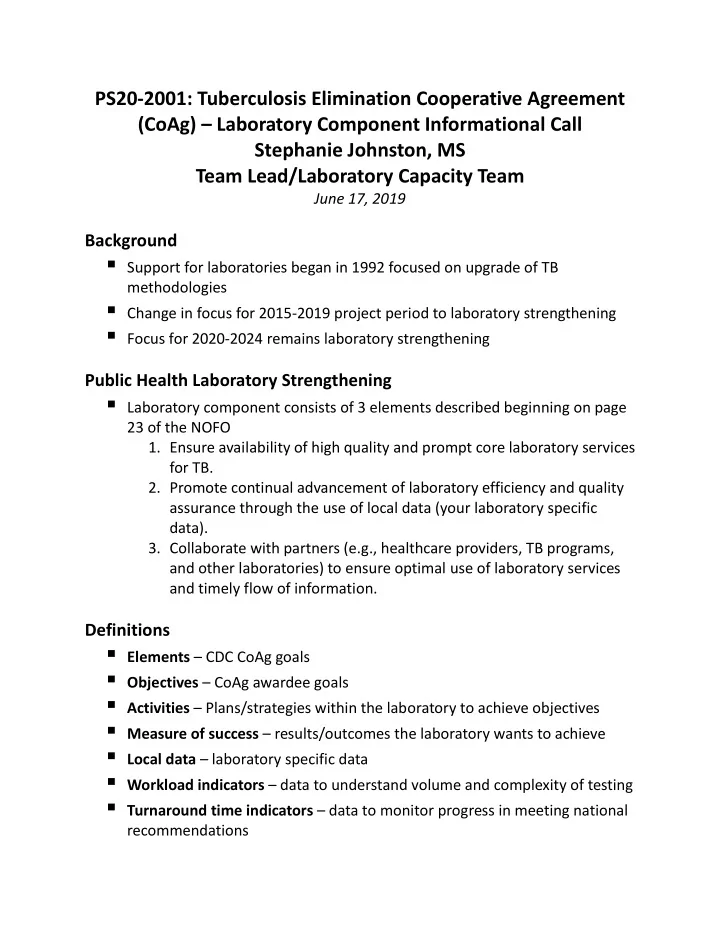
zyxwvutsrqponmlkjihgfedcbaZYXWVUTSRQPONMLKJIHGFEDCBA PS20-2001: Tuberculosis Elimination Cooperative Agreement (CoAg) Laboratory Component Informational Call Stephanie Johnston, MS Team Lead/Laboratory Capacity Team June 17, 2019


slide-1
SLIDE 1

zyxwvutsrqponmlkjihgfedcbaZYXWVUTSRQPONMLKJIHGFEDCBA

PS20-2001: Tuberculosis Elimination Cooperative Agreement (CoAg) – Laboratory Component Informational Call Stephanie Johnston, MS Team Lead/Laboratory Capacity Team

June 17, 2019

Background

  • Support for laboratories began in 1992 focused on upgrade of TB

methodologies

  • Change in focus for 2015-2019 project period to laboratory strengthening
  • Focus for 2020-2024 remains laboratory strengthening

Public Health Laboratory Strengthening

  • Laboratory component consists of 3 elements described beginning on page

23 of the NOFO

  • 1. Ensure availability of high quality and prompt core laboratory services

for TB.

  • 2. Promote continual advancement of laboratory efficiency and quality

assurance through the use of local data (your laboratory specific data).

  • 3. Collaborate with partners (e.g., healthcare providers, TB programs,

and other laboratories) to ensure optimal use of laboratory services and timely flow of information.

Definitions

  • Elements – CDC CoAg goals
  • Objectives – CoAg awardee goals
  • Activities – Plans/strategies within the laboratory to achieve objectives
  • Measure of success – results/outcomes the laboratory wants to achieve
  • Local data – laboratory specific data
  • Workload indicators – data to understand volume and complexity of testing
  • Turnaround time indicators – data to monitor progress in meeting national

recommendations

slide-2
SLIDE 2

Laboratory Element 1: Availability of High Quality and Prompt Core Laboratory Services

Workload Indictors Turnaround Time Indicators

  • Focused on understanding the volume

and complexity of testing

  • Data should be included for testing

performed in house or through referral New for 2020-2024

  • Indicator added to capture volume of

individual patients for whom in-house molecular DST performed by PHL

  • Clinical specimens/sediments
  • MTBC isolates
  • Used for monitoring progress in

meeting national recommendations

  • Facilitates the identification of effective

testing practices and algorithms and those possibly needing examination New for 2020-2024

  • Indicator added to capture mean and

range TAT in days for in-house molecular DST

  • Clinical specimens/sediments
  • MTBC isolates
  • Indicator added to capture mean

number of days between specimen collection and test result for IGRA

Volume Considerations for Laboratory Elements 2 and 3

  • Different level of required activities based on volume
  • Consideration for differences in level of funding, staff, and capacity to

support activities

  • Description of requirements on page 20 of NOFO

New Tiers For Each Element Based on Volume Work Plan Requirement

  • 1. ≤1,000 clinical specimens/year
  • 2. 1,001 – 5,000 clinical specimens/year
  • 3. ≥ 5,001 clinical specimens/year

Tier 1 ̶ Provide at least one measurable

  • bjective

Tier 2 ̶ Provide at least two measurable

  • bjectives

Tier 3 ̶ Provide at least three measurable

  • bjectives
slide-3
SLIDE 3

zyxwvutsrqponmlkjihgfedcbaZYXWVUTSRQPONMLKJIHGFEDCBA Laboratory Element 2: Promote Continual Advancement of Laboratory Efficiency and Quality Assurance through the Use of Local Data (Your Laboratory-Specific Data)

  • Different level of required activities based on volume for this element

Potential Areas of Focus

  • Assessment of testing algorithms and workload trends to identify potential

sources of delay Examine or develop written policies to eliminate redundant testing Examine business practices for process improvements Conduct laboratory assessments using standard tool

Laboratory Element 3: Collaborate with Partners to ensure Optimal Use of Laboratory Services and Timely Flow of Information

  • Different level of required activities based on volume for this element

Potential Areas of Focus

  • Develop and initiate educational opportunity for TB Program or clinical

laboratory partners Collaborative development of specimen collection guidelines Promotion of laboratory services to improve test ordering Collaborative development of nuclei acid amplification testing guidelines for jurisdiction Incorporate more providers into electronic ordering and reporting systems across the jurisdiction

slide-4
SLIDE 4

zyxwvutsrqponmlkjihgfedcbaZYXWVUTSRQPONMLKJIHGFEDCBA

S.ll~h Carey

  • Dr. KC'll POie

Nick M:,tluk

QAQCOffim

CLIA LaboratOI)' Director-

CLIA Tcclmic:,l Supcr.-i~

Clinic.,! Microbiology $upc1''iwr

  • I

N~neyF.llnin Mic-robiologi\t m

TS Supcl'\i\.Of'

.

I I I

VaCI\J.il

Ro~Bamcn Eri~Kilhlllll Microbioloii')l I1 Microbiolojht I1 ~·ticrobiolo3l$t I

Application Process

  • 20 page limit for the entire application, due to CDC 9/5/2019
  • To include (page 44):
  • Laboratory CoAg Point of Contact (telephone number & email)
  • Laboratory Organizational Chart
  • Overview of Testing Algorithms and Methods
  • Work Plan Spreadsheet (Year 1 only)
  • Line item budget (true needs not required)
  • Will not include for Year 1:
  • Workload volume and performance measure TAT data

Contact, Organizational Chart, & Testing Algorithm/Methods

  • Laboratory CoAg Point of Contact (telephone number & email)
  • Laboratory Organizational Chart
  • Overview of Testing Algorithms (visual if possible) and Methods
slide-5
SLIDE 5

zyxwvutsrqponmlkjihgfedcbaZYXWVUTSRQPONMLKJIHGFEDCBA

  • ..........

1'0f'.Cfil,l,tt0llto, l,ll'olJIICt,i)I'~

Public Health Laboratory Strengthening W ork Plan Laboratory E lement 1: E nsure avallablllt'/ of high guallt/ and prompt core laboratory services for rubcrculosls (TB).

Wllat i re your ~ boratorv obiectNe; fOf' l:Jem ent 1 dumw:: thi!i five- , ·e..r Cooi,er.nNe N;reemerrt perfodi>

!\II

labor.nortes , re(;~rdles.s of vok.:me , & hot.Id prov :de

  • bjec111.

·es relirtec!to lmprovlnt eKh

  • f 1hE- n~ lonal

bEndlmark l u111 dllu u11 d t i,u~ 1~ 1nu 1 ~ 11 d dl io1~.

  • .edu:E- t M

rnarou"ld tm e;; ! 1

r.11 .

Ji:1.l l lwAil iwili'"" lli.11 Yum l 11lu r..tl111y

Will llv-t n .\t:.h;M-.,.. t h,.. Ahm,.-- Obicd iYcs. Lht Wh.lt Vot. r M c~:.urc ot Succcs:. Y/il Bc.

liit .JnV Antici,.nc-d ot»t.xii:~

to Sua:css,

i-'1lot u;;e of ovi!rn1

j"t cO\..rie· fo• ~ · ~ h ~

.e:e1 p: wrtrrn one da'{ of : ollect 1 :m ,t,Je-~ endt/hoh : ays. ·~olume ~ubmltte•·

;;.

"10...c ch=n~ s to OOTwor~ .flow h creased n. mbcr of CY.IT rest.lb Jtcff :Jrn:;,v=r. b llo\'\'in~ , : at.

::. e na lysi:s. Monitor

tor :, ev=iila blc wi:hin rc-commen:k-d TA T

~ ~ ¾

  • f SP£-C

lmi!n:: will be re: er,ec \l,/lt · 1 n l da· 1 of : 0Uect1 :m, we t-opet o 1

mpro·JE t:t-1

s t o b~¾. !'ch1 eve drUJ '::.L!:

  • : ept l ::>llty

: ~ t ing IOSTI within 17 day ;; ::rl !:ientlf lG;tlO"I (ID) f:.r ;s~ :If l· ;;c-lati! ~. To1r: ct Corna;k:t:on Doltc/limclinc . ulv 2021

Work Plan

  • New
  • Excel document provided on the DTBE NOFO webpage under Sample

Work Plans/Laboratory Work Plan

  • https://www.cdc.gov/tb/education/funding-opportunity-notice.ht

m

  • CDC-RFA-PS20-2001 applicants may use this layout if
  • desired. Alternatively, applicants may choose to format their required

work plan in a different manner, as long as it contains all of the required elements for each strategy.

  • Laboratory objectives for Elements 1, 2, and 3 over 5 years (2020-2024)

with activities to achieve the objectives listed

https://www.cdc.gov/tb/education/funding-opportunity-notice.htm

slide-6
SLIDE 6

zyxwvutsrqponmlkjihgfedcbaZYXWVUTSRQPONMLKJIHGFEDCBA

L aboratories receiving ~ 1,000 clinical specimens each year should provide at least one measurable objective for both E lements 2 and 3 as described below. Those laboratories receiving 1,001- 5,000 clinical specimens each year should provide at least two measurable objectives, and those receiving ? 5,001 clinical specimens each year should provide at least three measurable obiectives for E lement 2 and 3. laboratory Element 2: Promote continual advancement of laboratory efficiency and quality assurance through the use of local data (i.e., your laboratory-specific data).

What are your laboratory objectives for Element 2 during this five-year Cooperative Agreement period? How will your laboratory measure sua:ess related to these objectives? Reduce contamination rate Reduce contaminat ion rate from 12% to 8% by 2022 List the Activities that Your laboratory List What Your Measure of Success list any Anticipat ed Obstacles to Will Use to Achieve the Above Will Be. Success. Responsible L aboratory Staff Target Completion Date{Timeline Objectives. Stratify contaminated cultures by Identification of a target for Possible missing data. John, TB L aboratorian June 2020 submitter and transoorttime. intervention. Meet with submitter(s) to discuss Interventions identified Ava ilability

  • f resourses (e.g.,

Na ncy, T8 L ab Supervisor Dec 2020 possible reasons for contamination and courier, personnel)

  • tential interventions.

laboratory Element 3: Collaborate with partners (e.g. healt hcare providers, TB Programs, and other laboratories) to ensure optimal use of laboratory services and t imely flow

  • f

information.

What are your laboratory

  • bjectives for Dement 3 during this five-year Cooperative Agreement period?

How will your laboratory measure success related to these objectives? Strenthen relationships with other laboratories within the state and state-wide to evaluate optimal use of TB Improved communication with laboratory partners and development of a document describing the TB laboratory services. laboratory services network within the state. List the Activities that Your Laboratory List What Your Measure of Soocess List any Anticipated Obstades to Will Use to Achieve the Above Will Be. Success. Responsible L aboratory Staff Target Completion Date/Timeline Objectives. Perform site-visit(s) to V isit >90% of laboratories A vaila bility of staff and Jim, TB L ab Supervisor Dec 2020 mycobacterioloEV laboratories coordination of schedules throughout the state to assess TB services and to strengthen relat ionships. Develop one-pager illustrating the TB Distribution of the document to None. L ucy, TB L aboratorian August 2020 laboratorv network within the state. state na rtners.

Budget

  • Line-item budget only (reflects anticipated funding level)
  • Estimate anticipated using 2019 funding levels + 20% increase
  • To include:
  • Salaries & Wages (e.g., name or vacant)
  • Fringe Benefits (supply the percentage)
  • Consultant Costs
  • Equipment
  • Supplies (per unit cost for items)
  • Travel (e.g., flights, hotel, per diem)
  • Other (e.g., conference or training registration fees)
  • Total Direct Costs
  • Total Indirect Costs (supply the percentage)
  • Contractual Costs
slide-7
SLIDE 7

zyxwvutsrqponmlkjihgfedcbaZYXWVUTSRQPONMLKJIHGFEDCBA Laboratory Specific Funding Restrictions

  • Laboratories performing first-line drug susceptibility testing for <50 patient

isolates/year should refer isolates to National DST Reference Center

  • As such, laboratories reporting, as part of this application, DST for <50

patient isolates/year may not request funding support for reagents and supplies associated with growth-based DST.

  • Laboratories within this category may request the use of funds for shipping

supplies and costs for access to referral services such as those available at the National DST Reference Center for MTB.

Laboratory Funding Formula Remains Unchanged for 2020-2024

Per patient basis Total # specimens TB culture inoculated Isolates received for ID NAA testing

  • f clinical

specimen DST for first-line drugs Lab System – Equal Amounts FY2020 10% 15% 15% 25%* 25% 10% *Base amount determined by number of patients for whom clinical specimen is received with remaining funds distributed by number of patients positive by direct detection for M. tuberculosis.

Workload Volume and Turnaround Time (TAT) Data

  • LCT will ask awardees to collect 2018 and the first half of 2019 data

separately from the application

  • Using new OMB template documents provided to awardees
  • Sent by Laboratory Consultants
  • Due August 2nd
slide-8
SLIDE 8

PERFORMANCE PROGRESS and MONITORING REPORT Table of Activity Results

F

  • rai.Approt'R

0MB No: O!>lO-llll E:q,. Datt: 0Sllln019 P!tilit~hrdi11.~!m£,~llt,::.cio.4()!~Wt11itim:~1 01\Vl!!l~~p&tllt~:.1.~b!iagcbttim•fi!r11\il•~imN~acll,Wffhm&tsi'.mgd.s!1 10wm,plilrillglDd~d

1tG.11.1...W.micoq,lit~.aaim~dllc

  • llKtiG11<1!i11fanm:;io~ AAl!iQCJ';.ay110tcOAd..t01~;or,&Dd.1PfflQlil110l

rt4mdl0!1lpoadto1 t(lu-.t°!io11.~!in!ot'm-'l!C!:a'ell•u itd»pllY' l(Utrur Jynlit~fflffOIJIUd!tr. Stad com:.otm !l!,LqW, b'!!dt.11 H!il!:.m

C!t l:Jl'JOWl!°Hptt1

  • !tb..1,~9fiD.bm.lti;,11.i.ai;lr.wbi~11ii••'lio~ikrnrb,;!lf!lii.l~oa;,COO'ATSD~~C\a;n;(•Of5,w; l600Cbft9.iS.O.dNtMSt>-H,.¼:t.1,~:;;i1

Jl)JH' A. "ID..0MB·PllA(0920-lll2)

..

IP••·

  • f

Pati@S I.Federal Agency a.nd Org.1nization

1 2 .

Feder•! Grant or Olhor 13•. DUNS

  • 4. Reporting Period

Element to Which Repon i,; Subm itied Iden tifyin g Number Assigned End D

ate

b y

F•d•rol Agonoy

1

3b.

EIN

(Uonth, Day, Year )

  • D. Table of Activities and Results

1 1) 1

21

(3.1) (3.2) Activity Activity Description Result Resull

Number

I.ab~:~ La~: ~

  • r labe-1

....

l

~otal number of

linical specimens

process,,d for smear ~nd

  • culture. Do not

include isolates referred from another laboratory.

2

Number of individual patients for whom a linlcal specimen was

processed for smear ~nd culture. ia

Kif these, report

the number of individual patients for whom at

least one culture was positive for MTBC.

2b

Pf these individuals positive for MTBC by ulture, report the number initially positive by NAAT from

~ c

linical specimen in ~our laboratory.

slide-9
SLIDE 9

zyxwvutsrqponmlkjihgfedcbaZYXWVUTSRQPONMLKJIHGFEDCBA

PERFORMANCE PROGRESS and MONITORING REPORT Pertorman<:e Measures

  • ~mF~~~g:ji~

E:ii:p.Da!e: 0&'31/2019 Pt1\ lic ropo:rtul,!bwda oftl: 1 .h c.alKma ofmi:ll:lll:io11 i, Mtmlltid.

IOl'L 'lffel

2 bDun f'lr

tt~pOlU I , illcl 11dia,!W tina i,rn,,,•

, n'UI,! ila.:l:nlttian,,"adwiguatlli@;

d.11.110-'l:ffM, g•~

::=~=~,

t:~~~4;4~:to~c:=.:.

0~°'t

~

=~Jdl•~~,~~-a:~;~

:r.

11

  • 1;.:!r'Cr!;3::r~~:l:1~~~

~

~~

.,,

l'Uri.cia~ l ~h bu.d.• 1 0COO'ATS0J. ltlport.1

ci-

e•OS:cer . 1eoo OltOll lo~ m . MS.0-i4.Atl• t.a. o-gi1 , om : A,:m,. 0M!I.PJ.o\(0920-1 l J2)

I

I Paa• I I

Elemen t10 Which Report is Submir.ed

I.Fede,al '<l•ncy and Cxgani,ation

I 1 •·

Repornng

I I

Period End OJ1te

(Mondt, Doy , YNr) I I

(11

(2)

(31 (41

(5) (6)

Pti.~AT:

(81 (9)

........

et:;e,ciN•JGoal Measlft N.ltional Testing I'll.

  • PH. TAT:

Obst.1Clesto MeeiingT~ tJ'Goal MJmbu

Targ•t(.,.. Method - FY2018

FY2019 1

Promote ,.icldelM!ry Percent~of ,.,,. NA

lof sl)Kimens

10 the

specimes la bora tory.

receivedwithir,

  • n,

day

  • f

Spt,ciff'M!n colleC1iol\

"

Percentage of SptclmtN

NA rece ived

widwi two daYJof specltnM collection. l b Percentage of

NA

Sptclmtr& received withiri three da"tS of Sptclmtn collection

'

u se ftuoresart acid..f3s Perce ntage

  • f ,.,,.

m inin1u.t pcomp:~ smur results ~ransmi results. reportedwittir

  • ne davof

rtc.Jp,:of

specimen

,.

P• rt.• ntagfof

NA

smear results rtpont<lwittir two davsof receiptof sped men.

"

Ptrtt ntactOT

NA

smear results rtpottt<twitllr thrH da.,sot receipt of speclmtn.

Important Upcoming Dates

  • August 2, 2019: 2018/First Half of 2019 Workload Volume and TAT Data Due
  • September 5, 2019: TB CoAg Application Due
  • March 31, 2020: 2018/2019 Closeout Report Due
  • August 31, 2020: January 2020 – June 30, 2020 Annual Performance Report

Due

Questions?

  • After this call, questions concerning the NOFO application must be sent to

2020nofo@cdc.gov