Zero topological entropy and asymptotic pairs - - PowerPoint PPT Presentation

zero topological entropy and asymptotic pairs
SMART_READER_LITE
LIVE PREVIEW

Zero topological entropy and asymptotic pairs - - PowerPoint PPT Presentation

Zero topological entropy and asymptotic pairs Czech-Slovak-Spanish-Polish Workshop on Discrete Dynamical Systems in honor of Francisco Balibrea Gallego La Manga del Mar Menor 2010 Tomasz Downarowicz Institute of Mathematics and Computer


slide-1
SLIDE 1

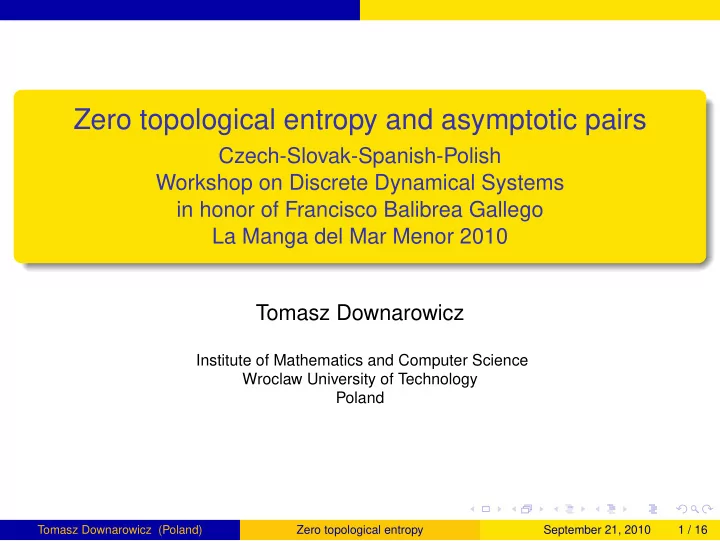
Zero topological entropy and asymptotic pairs

Czech-Slovak-Spanish-Polish Workshop on Discrete Dynamical Systems in honor of Francisco Balibrea Gallego La Manga del Mar Menor 2010 Tomasz Downarowicz

Institute of Mathematics and Computer Science Wroclaw University of Technology Poland

Tomasz Downarowicz (Poland) Zero topological entropy September 21, 2010 1 / 16

slide-2
SLIDE 2

Introduction

This is joint work with Yves Lacroix

Tomasz Downarowicz (Poland) Zero topological entropy September 21, 2010 2 / 16

slide-3
SLIDE 3

Introduction

A pair of points x, y in X is said to be:

Tomasz Downarowicz (Poland) Zero topological entropy September 21, 2010 3 / 16

slide-4
SLIDE 4

Introduction

A pair of points x, y in X is said to be: asymptotic, whenever lim

n→∞ d(T nx, T ny) = 0;

Tomasz Downarowicz (Poland) Zero topological entropy September 21, 2010 3 / 16

slide-5
SLIDE 5

Introduction

A pair of points x, y in X is said to be: asymptotic, whenever lim

n→∞ d(T nx, T ny) = 0;

mean proximal, whenever lim

n→∞

1 2n + 1

n

  • i=−n

d(T ix, T iy) = 0 (applies to homeomorpshisms only);

Tomasz Downarowicz (Poland) Zero topological entropy September 21, 2010 3 / 16

slide-6
SLIDE 6

Introduction

A pair of points x, y in X is said to be: asymptotic, whenever lim

n→∞ d(T nx, T ny) = 0;

mean proximal, whenever lim

n→∞

1 2n + 1

n

  • i=−n

d(T ix, T iy) = 0 (applies to homeomorpshisms only); forward mean proximal, whenever lim

n→∞

1 n + 1

n

  • i=0

d(T ix, T iy) = 0.

Tomasz Downarowicz (Poland) Zero topological entropy September 21, 2010 3 / 16

slide-7
SLIDE 7

Introduction

The system (X, T) is:

Tomasz Downarowicz (Poland) Zero topological entropy September 21, 2010 4 / 16

slide-8
SLIDE 8

Introduction

The system (X, T) is: NAP , if it contains no nontrivial asymptotic pairs;

Tomasz Downarowicz (Poland) Zero topological entropy September 21, 2010 4 / 16

slide-9
SLIDE 9

Introduction

The system (X, T) is: NAP , if it contains no nontrivial asymptotic pairs; mean distal (MD), if it contains no nontrivial mean proximal pairs (applies to homeomorpshisms only).

Tomasz Downarowicz (Poland) Zero topological entropy September 21, 2010 4 / 16

slide-10
SLIDE 10

Introduction

The system (X, T) is: NAP , if it contains no nontrivial asymptotic pairs; mean distal (MD), if it contains no nontrivial mean proximal pairs (applies to homeomorpshisms only). forward mean distal (FMD), if it contains no nontrivial forward mean proximal pairs;

Tomasz Downarowicz (Poland) Zero topological entropy September 21, 2010 4 / 16

slide-11
SLIDE 11

Introduction

The system (X, T) is: NAP , if it contains no nontrivial asymptotic pairs; mean distal (MD), if it contains no nontrivial mean proximal pairs (applies to homeomorpshisms only). forward mean distal (FMD), if it contains no nontrivial forward mean proximal pairs; NBAP, if there are pairs which are asymptotic under both T and T −1 (applies to homeomorpshisms only).

Tomasz Downarowicz (Poland) Zero topological entropy September 21, 2010 4 / 16

slide-12
SLIDE 12

Introduction

The system (X, T) is: NAP , if it contains no nontrivial asymptotic pairs; mean distal (MD), if it contains no nontrivial mean proximal pairs (applies to homeomorpshisms only). forward mean distal (FMD), if it contains no nontrivial forward mean proximal pairs; NBAP, if there are pairs which are asymptotic under both T and T −1 (applies to homeomorpshisms only). Convention: the system is µ-something if it satisfies “something” after removing µ-null set.

Tomasz Downarowicz (Poland) Zero topological entropy September 21, 2010 4 / 16

slide-13
SLIDE 13

Introduction

Obvious implications: FMD = ⇒ MD and NAP MD = ⇒ µ-MD and NBAP NAP = ⇒ NBAP and µ-NAP

Tomasz Downarowicz (Poland) Zero topological entropy September 21, 2010 5 / 16

slide-14
SLIDE 14

Introduction

Obvious implications: FMD = ⇒ MD and NAP MD = ⇒ µ-MD and NBAP NAP = ⇒ NBAP and µ-NAP Lack of implications: NAP \ ⇐ ⇒ MD µ-NAP \ ⇐ ⇒ µ-MD

Tomasz Downarowicz (Poland) Zero topological entropy September 21, 2010 5 / 16

slide-15
SLIDE 15

Introduction

Four theorems connect the above notions with entropy:

Tomasz Downarowicz (Poland) Zero topological entropy September 21, 2010 6 / 16

slide-16
SLIDE 16

Introduction

Four theorems connect the above notions with entropy: Theorem 1 [O-W] A system (X, T) (with T a homeomorphism) which is µ-MD (i.e. tight) has zero measure-theoretic entropy of µ.

Tomasz Downarowicz (Poland) Zero topological entropy September 21, 2010 6 / 16

slide-17
SLIDE 17

Introduction

Four theorems connect the above notions with entropy: Theorem 1 [O-W] A system (X, T) (with T a homeomorphism) which is µ-MD (i.e. tight) has zero measure-theoretic entropy of µ. Theorem 2 [B-H-R] A system (X, T) which is µ-NAP has has zero measure-theoretic entropy of µ.

Tomasz Downarowicz (Poland) Zero topological entropy September 21, 2010 6 / 16

slide-18
SLIDE 18

Introduction

Four theorems connect the above notions with entropy: Theorem 1 [O-W] A system (X, T) (with T a homeomorphism) which is µ-MD (i.e. tight) has zero measure-theoretic entropy of µ. Theorem 2 [B-H-R] A system (X, T) which is µ-NAP has has zero measure-theoretic entropy of µ. Theorem 3 [O-W] Every topological dynamical system (X, T) of topological entropy zero has a topological extension (Y, S) (in form of a subshift) which is MD.

Tomasz Downarowicz (Poland) Zero topological entropy September 21, 2010 6 / 16

slide-19
SLIDE 19

Introduction

Four theorems connect the above notions with entropy: Theorem 1 [O-W] A system (X, T) (with T a homeomorphism) which is µ-MD (i.e. tight) has zero measure-theoretic entropy of µ. Theorem 2 [B-H-R] A system (X, T) which is µ-NAP has has zero measure-theoretic entropy of µ. Theorem 3 [O-W] Every topological dynamical system (X, T) of topological entropy zero has a topological extension (Y, S) (in form of a subshift) which is MD. Theorem 4 [D-L] Every topological dynamical system (X, T) of topological entropy zero has a topological extension (Y, S) which is NAP .

Tomasz Downarowicz (Poland) Zero topological entropy September 21, 2010 6 / 16

slide-20
SLIDE 20

Introduction

FMD ւ ց MD − → NBAP ← − NAP ↓ ↓ µ-MD µ-NAP ց ւ h(µ) = 0 htop = 0

extւ

ցext MD NAP

Tomasz Downarowicz (Poland) Zero topological entropy September 21, 2010 7 / 16

slide-21
SLIDE 21

Introduction

FMD ւ ց MD − → NBAP ← − NAP ց ւ htop = 0

extւ

ցext MD NAP

Tomasz Downarowicz (Poland) Zero topological entropy September 21, 2010 8 / 16

slide-22
SLIDE 22

Introduction

FMD ւ ց MD − → NBAP ← − NAP ց ւ htop = 0

ext ↓

FMD

Tomasz Downarowicz (Poland) Zero topological entropy September 21, 2010 8 / 16

slide-23
SLIDE 23

Introduction

Attention: BNAP does not imply htop = 0 (all the more µ-BNAP does not imply h(µ) = 0) Example: Bilaterally deterministic systems with positive entropy (a topological version) (if we have time)

Tomasz Downarowicz (Poland) Zero topological entropy September 21, 2010 9 / 16

slide-24
SLIDE 24

The results

Theorem 5 (D-L, September 2010) Every topological dynamical system (X, T) of topological entropy zero has a topological extension (Y, S) which is FMD. The proof is a combination of the methods of [O-W] and [D-L].

Tomasz Downarowicz (Poland) Zero topological entropy September 21, 2010 10 / 16

slide-25
SLIDE 25

The results

Theorem 5 (D-L, September 2010) Every topological dynamical system (X, T) of topological entropy zero has a topological extension (Y, S) which is FMD. The proof is a combination of the methods of [O-W] and [D-L]. REMARK: We cannot hope to have (Y, S) in form of a subshift.

Tomasz Downarowicz (Poland) Zero topological entropy September 21, 2010 10 / 16

slide-26
SLIDE 26

The results

Theorem 5 (D-L, September 2010) Every topological dynamical system (X, T) of topological entropy zero has a topological extension (Y, S) which is FMD. The proof is a combination of the methods of [O-W] and [D-L]. REMARK: We cannot hope to have (Y, S) in form of a subshift. Corollary The following conditions are equivalent for a topological dynamical system (X, T): htop(T) = 0, (X, T) is a topological factor of a NAP system [D-L, 2009], (X, T) is a topological factor of a subshift via a map that collapses asymptotic pairs [D-L, 2009], (X, T) is a topological factor of an FMD system [D-L, 2010], (X, T) is a topological factor of a subshift via a map that collapses forward mean proximal pairs [D-L, 2010].

Tomasz Downarowicz (Poland) Zero topological entropy September 21, 2010 10 / 16

slide-27
SLIDE 27

The proof

Key fact from the theory of symbolic extensions Every topological dynamical system with topological entropy zero is a topological factor of a bilateral subshift also with topological entropy zero.

Tomasz Downarowicz (Poland) Zero topological entropy September 21, 2010 11 / 16

slide-28
SLIDE 28

The proof

Key fact from the theory of symbolic extensions Every topological dynamical system with topological entropy zero is a topological factor of a bilateral subshift also with topological entropy zero. Thus it suffices to prove the theorem for bilateral subshifts (X, T).

Tomasz Downarowicz (Poland) Zero topological entropy September 21, 2010 11 / 16

slide-29
SLIDE 29

The proof

Key fact from the theory of symbolic extensions Every topological dynamical system with topological entropy zero is a topological factor of a bilateral subshift also with topological entropy zero. Thus it suffices to prove the theorem for bilateral subshifts (X, T). Key definition Two binary blocks A, B of the same length n are said to be well separated if they disagree at at least n

3 and agree at least n 3 positions.

Tomasz Downarowicz (Poland) Zero topological entropy September 21, 2010 11 / 16

slide-30
SLIDE 30

The proof

Key fact from the theory of symbolic extensions Every topological dynamical system with topological entropy zero is a topological factor of a bilateral subshift also with topological entropy zero. Thus it suffices to prove the theorem for bilateral subshifts (X, T). Key definition Two binary blocks A, B of the same length n are said to be well separated if they disagree at at least n

3 and agree at least n 3 positions.

In other words dH(A, B) ∈ [ 1

3, 2 3] or (dH(A, B) ≥ 1 3 and dH(A, ¯

B) ≥ 1

3).

Tomasz Downarowicz (Poland) Zero topological entropy September 21, 2010 11 / 16

slide-31
SLIDE 31

The proof

Key fact from the theory of symbolic extensions Every topological dynamical system with topological entropy zero is a topological factor of a bilateral subshift also with topological entropy zero. Thus it suffices to prove the theorem for bilateral subshifts (X, T). Key definition Two binary blocks A, B of the same length n are said to be well separated if they disagree at at least n

3 and agree at least n 3 positions.

In other words dH(A, B) ∈ [ 1

3, 2 3] or (dH(A, B) ≥ 1 3 and dH(A, ¯

B) ≥ 1

3).

Key combinatorial fact Ther exists a positive number s such that for each n ≥ 2 there exists a family of at least 2sn pairwise well-separated binary blocks.

Tomasz Downarowicz (Poland) Zero topological entropy September 21, 2010 11 / 16

slide-32
SLIDE 32

The proof

It the first part of the proof we build a symbolic extension which is not FMD yet, but which has entropy zero and collapses all forward proximal pairs. By taking a direct product, we can assume that (X, T) has an odometer factor. The odometer will be used to cut every x ∈ X into blocks of equal lengths. To each x ∈ X we will associate its “preimages” y ∈ Y.

Tomasz Downarowicz (Poland) Zero topological entropy September 21, 2010 12 / 16

slide-33
SLIDE 33

The proof

It the first part of the proof we build a symbolic extension which is not FMD yet, but which has entropy zero and collapses all forward proximal pairs. By taking a direct product, we can assume that (X, T) has an odometer factor. The odometer will be used to cut every x ∈ X into blocks of equal lengths. To each x ∈ X we will associate its “preimages” y ∈ Y. STEP 1

Tomasz Downarowicz (Poland) Zero topological entropy September 21, 2010 12 / 16

slide-34
SLIDE 34

The proof

It the first part of the proof we build a symbolic extension which is not FMD yet, but which has entropy zero and collapses all forward proximal pairs. By taking a direct product, we can assume that (X, T) has an odometer factor. The odometer will be used to cut every x ∈ X into blocks of equal lengths. To each x ∈ X we will associate its “preimages” y ∈ Y. STEP 1 We choose n1 such that the number of all n1-blocks appearing in X is smaller than 2sn1. This allows to injectively associate to every n1-block B of X a binary block φ(B) from a pairwise well separated family.

Tomasz Downarowicz (Poland) Zero topological entropy September 21, 2010 12 / 16

slide-35
SLIDE 35

The proof

It the first part of the proof we build a symbolic extension which is not FMD yet, but which has entropy zero and collapses all forward proximal pairs. By taking a direct product, we can assume that (X, T) has an odometer factor. The odometer will be used to cut every x ∈ X into blocks of equal lengths. To each x ∈ X we will associate its “preimages” y ∈ Y. STEP 1 We choose n1 such that the number of all n1-blocks appearing in X is smaller than 2sn1. This allows to injectively associate to every n1-block B of X a binary block φ(B) from a pairwise well separated family. Using the odometer, we represent every x ∈ X as a concatenation

  • f n1-blocks. We let y be a “candidate for a preimage” of x if it

has, above each n1-block B of x, either φ(B) or its negation ¯ φ(B).

Tomasz Downarowicz (Poland) Zero topological entropy September 21, 2010 12 / 16

slide-36
SLIDE 36

The proof

INDUCTIVE STEP

Tomasz Downarowicz (Poland) Zero topological entropy September 21, 2010 13 / 16

slide-37
SLIDE 37

The proof

INDUCTIVE STEP In step k, using the odometer, we represent x as a concatenation of nk-blocks: every nk-block B is a concatenation of nk−1-blocks B = B1B2 . . . Bqk. Then we build binary nk-blocks φ(B) in such a way that:

Tomasz Downarowicz (Poland) Zero topological entropy September 21, 2010 13 / 16

slide-38
SLIDE 38

The proof

INDUCTIVE STEP In step k, using the odometer, we represent x as a concatenation of nk-blocks: every nk-block B is a concatenation of nk−1-blocks B = B1B2 . . . Bqk. Then we build binary nk-blocks φ(B) in such a way that: φ(B) is a concatenation φ1(B1)φ2(B2) . . . φqk(Bqk), where each φi(Bi) is either φ(Bi) or ¯ φ(Bi),

Tomasz Downarowicz (Poland) Zero topological entropy September 21, 2010 13 / 16

slide-39
SLIDE 39

The proof

INDUCTIVE STEP In step k, using the odometer, we represent x as a concatenation of nk-blocks: every nk-block B is a concatenation of nk−1-blocks B = B1B2 . . . Bqk. Then we build binary nk-blocks φ(B) in such a way that: φ(B) is a concatenation φ1(B1)φ2(B2) . . . φqk(Bqk), where each φi(Bi) is either φ(Bi) or ¯ φ(Bi), φ(B) depends injectively not only on B but in fact also on the preceding nk-block in x (formally it should be denoted as φ(AB) but for simplification I will cheat).

Tomasz Downarowicz (Poland) Zero topological entropy September 21, 2010 13 / 16

slide-40
SLIDE 40

The proof

INDUCTIVE STEP In step k, using the odometer, we represent x as a concatenation of nk-blocks: every nk-block B is a concatenation of nk−1-blocks B = B1B2 . . . Bqk. Then we build binary nk-blocks φ(B) in such a way that: φ(B) is a concatenation φ1(B1)φ2(B2) . . . φqk(Bqk), where each φi(Bi) is either φ(Bi) or ¯ φ(Bi), φ(B) depends injectively not only on B but in fact also on the preceding nk-block in x (formally it should be denoted as φ(AB) but for simplification I will cheat). the images of all (pairs of) nk-blocks appearing in X form a pairwise well separated family. (the construction of such an assignment is too technical for this presentation)

Tomasz Downarowicz (Poland) Zero topological entropy September 21, 2010 13 / 16

slide-41
SLIDE 41

The proof

INDUCTIVE STEP In step k, using the odometer, we represent x as a concatenation of nk-blocks: every nk-block B is a concatenation of nk−1-blocks B = B1B2 . . . Bqk. Then we build binary nk-blocks φ(B) in such a way that: φ(B) is a concatenation φ1(B1)φ2(B2) . . . φqk(Bqk), where each φi(Bi) is either φ(Bi) or ¯ φ(Bi), φ(B) depends injectively not only on B but in fact also on the preceding nk-block in x (formally it should be denoted as φ(AB) but for simplification I will cheat). the images of all (pairs of) nk-blocks appearing in X form a pairwise well separated family. (the construction of such an assignment is too technical for this presentation) We allow y be a “candidate” for a preimage of x if above each nk-block B of x if it has either φ(B) (in fact depending also on the preceding block) or its negation ¯ φ(B) (the preimages decrease).

Tomasz Downarowicz (Poland) Zero topological entropy September 21, 2010 13 / 16

slide-42
SLIDE 42

The proof

In the end, above “almost every” x there are only two elements: some y and its negation ¯ y. This is not true for those elements x in which the division into nk-blocks has a “cut of infinite order”. Such x has four preimages y|z, ¯ y|z, y|¯ z and ¯ y|¯

  • z. Note that we have here two asymptotic pairs! But

such asympotic pairs are collapsed by the factor map.

Tomasz Downarowicz (Poland) Zero topological entropy September 21, 2010 14 / 16

slide-43
SLIDE 43

The proof

In the end, above “almost every” x there are only two elements: some y and its negation ¯ y. This is not true for those elements x in which the division into nk-blocks has a “cut of infinite order”. Such x has four preimages y|z, ¯ y|z, y|¯ z and ¯ y|¯

  • z. Note that we have here two asymptotic pairs! But

such asympotic pairs are collapsed by the factor map. We must verify, that there are no other forward mean proximal pairs.

Tomasz Downarowicz (Poland) Zero topological entropy September 21, 2010 14 / 16

slide-44
SLIDE 44

The proof

In the end, above “almost every” x there are only two elements: some y and its negation ¯ y. This is not true for those elements x in which the division into nk-blocks has a “cut of infinite order”. Such x has four preimages y|z, ¯ y|z, y|¯ z and ¯ y|¯

  • z. Note that we have here two asymptotic pairs! But

such asympotic pairs are collapsed by the factor map. We must verify, that there are no other forward mean proximal pairs. If y, y′ map to x, x′ which map to different elements of the

  • dometer then, since the odometer is equicontinuous, the pair

y, y′ is distal, so cannot be forward mean proximal.

Tomasz Downarowicz (Poland) Zero topological entropy September 21, 2010 14 / 16

slide-45
SLIDE 45

The proof

In the end, above “almost every” x there are only two elements: some y and its negation ¯ y. This is not true for those elements x in which the division into nk-blocks has a “cut of infinite order”. Such x has four preimages y|z, ¯ y|z, y|¯ z and ¯ y|¯

  • z. Note that we have here two asymptotic pairs! But

such asympotic pairs are collapsed by the factor map. We must verify, that there are no other forward mean proximal pairs. If y, y′ map to x, x′ which map to different elements of the

  • dometer then, since the odometer is equicontinuous, the pair

y, y′ is distal, so cannot be forward mean proximal. Suppose y, y′ map to different points x, x′ mapping to the same element of the odometer. Then x, x′ have the same division into nk-blocks. There is a coordinate n where x differs from x′. Then, for every k, n is covered by two different nk-blocks, say, in x it is B and in x′ it is B′. This implies that the FOLLOWING nk-blocks in y and y′ are well separated. It is now easy to see that y and y′ are not forward mean proximal (the density of differences is at least 1

6).

Tomasz Downarowicz (Poland) Zero topological entropy September 21, 2010 14 / 16

slide-46
SLIDE 46

The proof

We now describe how to build an FMD extension.

Tomasz Downarowicz (Poland) Zero topological entropy September 21, 2010 15 / 16

slide-47
SLIDE 47

The proof

We now describe how to build an FMD extension. We already have the symbolic extension Y → X, Y has entropy zero and the map collapses all forward mean proximal pairs. We denote Y as Y1.

Tomasz Downarowicz (Poland) Zero topological entropy September 21, 2010 15 / 16

slide-48
SLIDE 48

The proof

We now describe how to build an FMD extension. We already have the symbolic extension Y → X, Y has entropy zero and the map collapses all forward mean proximal pairs. We denote Y as Y1. Analogously, there is a symbolic extension Y2 → Y1, where Y2 has entropy zero and the map collapses all forward mean proximal pairs.

Tomasz Downarowicz (Poland) Zero topological entropy September 21, 2010 15 / 16

slide-49
SLIDE 49

The proof

We now describe how to build an FMD extension. We already have the symbolic extension Y → X, Y has entropy zero and the map collapses all forward mean proximal pairs. We denote Y as Y1. Analogously, there is a symbolic extension Y2 → Y1, where Y2 has entropy zero and the map collapses all forward mean proximal pairs. By induction, we have a sequence of symbolic extensions Yk → Yk−1, where each map collapses all forward mean proximal pairs.

Tomasz Downarowicz (Poland) Zero topological entropy September 21, 2010 15 / 16

slide-50
SLIDE 50

The proof

We now describe how to build an FMD extension. We already have the symbolic extension Y → X, Y has entropy zero and the map collapses all forward mean proximal pairs. We denote Y as Y1. Analogously, there is a symbolic extension Y2 → Y1, where Y2 has entropy zero and the map collapses all forward mean proximal pairs. By induction, we have a sequence of symbolic extensions Yk → Yk−1, where each map collapses all forward mean proximal pairs. We let Y be the inverse limit of this sequence. It is obvious that Y is an extension of X. By an elementary argument, Y has no forward mean proximal pairs, i.e., it is FMD.

Tomasz Downarowicz (Poland) Zero topological entropy September 21, 2010 15 / 16

slide-51
SLIDE 51

Appendix

If there is 10 minutes left, describe (manually) the “permutation shift” – an example of a bilaterally deterministic system with positive entropy.

Tomasz Downarowicz (Poland) Zero topological entropy September 21, 2010 16 / 16

slide-52
SLIDE 52

Appendix

If there is 10 minutes left, describe (manually) the “permutation shift” – an example of a bilaterally deterministic system with positive entropy. Otherwise

Tomasz Downarowicz (Poland) Zero topological entropy September 21, 2010 16 / 16

slide-53
SLIDE 53

Appendix

If there is 10 minutes left, describe (manually) the “permutation shift” – an example of a bilaterally deterministic system with positive entropy. Otherwise Thank you, that’s all.

Tomasz Downarowicz (Poland) Zero topological entropy September 21, 2010 16 / 16