Yuqing Ariel Yu Senior Policy Researcher and Task Manager Climate - - PowerPoint PPT Presentation

yuqing ariel yu senior policy researcher and task manager
SMART_READER_LITE
LIVE PREVIEW

Yuqing Ariel Yu Senior Policy Researcher and Task Manager Climate - - PowerPoint PPT Presentation

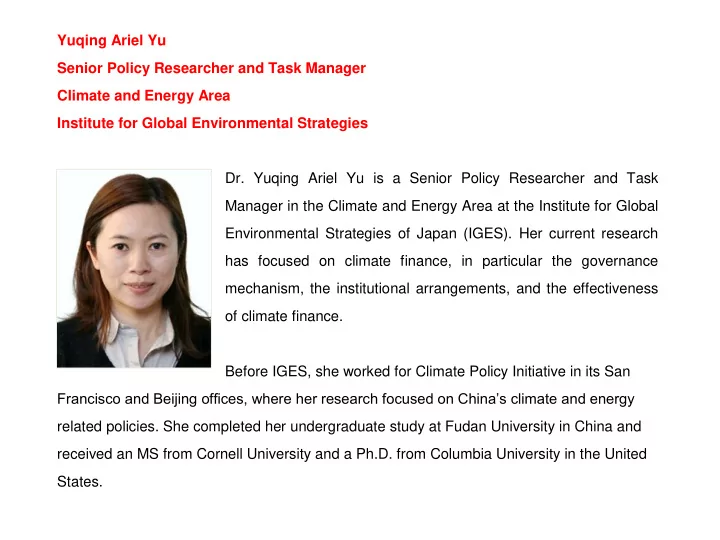
Yuqing Ariel Yu Senior Policy Researcher and Task Manager Climate and Energy Area Institute for Global Environmental Strategies Dr. Yuqing Ariel Yu is a Senior Policy Researcher and Task Manager in the Climate and Energy Area at the Institute


slide-1
SLIDE 1

Yuqing Ariel Yu Senior Policy Researcher and Task Manager Climate and Energy Area Institute for Global Environmental Strategies

  • Dr. Yuqing Ariel Yu is a Senior Policy Researcher and Task

Manager in the Climate and Energy Area at the Institute for Global Environmental Strategies of Japan (IGES). Her current research has focused on climate finance, in particular the governance mechanism, the institutional arrangements, and the effectiveness

  • f climate finance.

Before IGES, she worked for Climate Policy Initiative in its San Francisco and Beijing offices, where her research focused on China’s climate and energy related policies. She completed her undergraduate study at Fudan University in China and received an MS from Cornell University and a Ph.D. from Columbia University in the United States.

slide-2
SLIDE 2

Institute for Global Environmental Strategies Supporting the transfer and diffusion of low carbon technologies: Japan’s initiatives

Yuqing Ariel YU, Senior Researcher Climate and Energy Area Institute for Global Environmental Strategies

24 March, 2015 Changsha, Hunan, PRC

slide-3
SLIDE 3

Institute for Global Environmental Strategies

3

Outline

  • Japanese leading low carbon technologies
  • Programmes for technological renovation

provided by Japanese NGOs/research institutes

  • Japanese initiative on the Joint Crediting

Mechanism (JCM)

  • Financial schemes provided by the Japan

International Cooperation Agency (JICA) and the Japan Bank for International Cooperation (JIBC)

slide-4
SLIDE 4

Institute for Global Environmental Strategies

  • 1. Japanese low carbon technologies
slide-5
SLIDE 5

Institute for Global Environmental Strategies

5

1-1. The Leading Low Carbon Technology (L2-Tech) JAPAN Initiative

  • The L2-Tech JAPAN Initiative was launched in March

2014 by the Ministry of the Environment of Japan.

  • L2-Tech represents a list of leading low carbon

technologies that are classified into six fields.

Field Sector Industrial and commercial sector (cross-cutting) Air conditioning, heat sources, etc. Industry (sector-specific manufacturing equipment) Iron and steel, chemical industry, paper and pulp manufacturing, petrochemical, glass manufacturing, automobile manufacturing, machinery, agriculture, horticulture, etc. Transportation Automobiles (passenger, commercial and heavy duty vehicles), bicycles, railways, shipping, and airplanes Residential Electrical appliances, water heaters, window glass, etc. Energy conversion Renewable energy, coal-fired power plants, natural gas fired power plants, etc. Waste treatment and recycling Municipal waste, industrial waste, material recycling, sewage treatment, sewage sludge treatment, etc. Source: MOEJ (https://www.env.go.jp/en/headline/2133.html)

slide-6
SLIDE 6

Institute for Global Environmental Strategies

6

1-2. Japanese Business Alliance for Smart Energy Worldwide (JASE-W)

JASE-W categorisation:

  • Factory
  • Office, building
  • Residence
  • Industries
  • Smart Community
  • Construction,

transportation & logistic

  • Power generation &

distribution

  • Renewable energy &

storage battery

Source: JASE-W (http://www.jase-w.eccj.or.jp/technologies/overview.html)

slide-7
SLIDE 7

Institute for Global Environmental Strategies

  • 2. Support initiatives provided by

Japanese NGOs/research institutes

slide-8
SLIDE 8

Institute for Global Environmental Strategies

8

2-1. A matching platform for stakeholders between Japan and developing countries

An IGES-TERI initiative for matching stakeholders in Japan and India to promote the application of Japanese low carbon technologies in Indian SMEs.

slide-9
SLIDE 9

Institute for Global Environmental Strategies

9

2-2. A subsidy programme for the localisation of low carbon technologies in developing countries

Source: OECC (http://oecc.or.jp/English/contents/contact/index.html)

  • The subsidy program of the Overseas Environmental Cooperation Centre

(OECC) provides subsidies to private companies for the improvement of low carbon technologies to meet various requirements of developing countries, such as environmental regulations, cultural practices and restriction of energy resources.

slide-10
SLIDE 10

Institute for Global Environmental Strategies

  • 3. The Joint Crediting Mechanism (JCM)
slide-11
SLIDE 11

Institute for Global Environmental Strategies

11

3-1. Basic concept of the Joint Crediting Mechanism (JCM)

JAPAN Host Country

Leading low carbon technologies, etc, and implementation of mitigation actions MRV

JCM Projects

GHG emission reductions/ removals

MRV Methodologies will be developed by the Joint Committee

Used to achieve Japan’s emission reduction target

Credits

  • Facilitating diffusion of leading low carbon technologies, products, systems, services, and

infrastructure as well as implementation of mitigation actions, and contributing to sustainable development of developing countries.

  • Appropriately evaluating contributions from Japan to GHG emission reductions or

removals in a quantitative manner, by applying measurement, reporting and verification (MRV) methodologies, and use them to achieve Japan’s emission reduction target.

  • Contributing to the ultimate objective of the UNFCCC by facilitating global actions for GHG

emission reductions or removals, complementing the CDM.

slide-12
SLIDE 12

Institute for Global Environmental Strategies

12

3-2. Japan signed the bilateral document for the JCM with 12 developing countries

Mongolia

  • Jan. 8, 2013

(Ulaanbaatar) Bangladesh

  • Mar. 19, 2013

(Dhaka) Ethiopia May 27, 2013 (Addis Ababa) Kenya

  • Jun. 12,2013

(Nairobi) Maldives

  • Jun. 29, 2013

(Okinawa) Viet Nam

  • Jul. 2, 2013

(Hanoi) Lao PDR

  • Aug. 7, 2013

(Vientiane) Indonesia

  • Aug. 26, 2013

(Jakarta) Costa Rica

  • Dec. 9, 2013

(Tokyo) Palau

  • Jan. 13, 2014

(Ngerulmud) Cambodia

  • Apr. 11, 2014

(Phnom Penh) Mexico

  • Jul. 25, 2014

(Mexico City)

slide-13
SLIDE 13

Institute for Global Environmental Strategies

13

3-3. Two kinds of support for JCM projects: Financing programme and feasibility studies

  • I. Financing programme

for JCM model projects

Government of Japan International consortiums

(which include Japanese entities)

Finance part of an investment cost (up to the half) Conduct MRV and expected to deliver at least half of JCM credits issued The draft budget for FY 2015 2.4 billion JPY (approx. USD24 million) per year by FY2017 (total 7.2 billion JPY) ※Budget will be fixed after approval by the Parliament

Objective

Elaborating investment plan on JCM projects, developing MRV methodologies and investigating feasibility on potential JCM projects,

Reports

Available at GEC (Global Environment Centre Foundation ) website <URL: http://gec.jp >

JCM Project Planning Study (PS) JCM Feasibility Study (FS)

Type of studies

Large Scale JCM Feasibility Study

To develop a JCM Project in the next fiscal year

To survey feasibility of potential large scale JCM projects including city level cooperation To survey feasibility of potential JCM projects

Feasibility Studies

  • II. Feasibility studies and

capacity building activities

slide-14
SLIDE 14

Institute for Global Environmental Strategies

14

3-4. Financial support for leapfrog development under the JCM through the ADB

  • The MOEJ makes financial contributions to ADB’s Trust Fund to assist ADB member

countries which are also JCM countries in implementing superior and advanced low carbon technologies.

  • These ADB projects will lead to leapfrog development in host countries and allow Japan to

acquire credit using the JCM scheme.

  • Draft budget for FY 2015 is JPY 1.8 billion (approximately USD 18 million).
slide-15
SLIDE 15

Institute for Global Environmental Strategies

15

3-5. Financial support for leapfrog development under the JCM through the JICA

  • To finance the projects which have the better efficiency of reducing GHG emissions in

collaboration with other projects supported by JICA and other governmental-affiliated financial institutes.

  • To expand superior and advanced low carbon technologies for building the low carbon

society as the whole city wise and area wise in the wider fields and to acquire credits by the JCM.

  • Draft budget is JPY 1.8 billion per year by FY 2018 (total JPY 7.2 billion).
slide-16
SLIDE 16

Institute for Global Environmental Strategies

  • 4. Financial schemes of JICA and JIBC
slide-17
SLIDE 17

Institute for Global Environmental Strategies

17

4-1. Japan International Cooperation Agency (JICA)

Source: COP20 side event,6th

  • Dec. 2014, Japan Pavillion,

Tomonori Sudo. Ph.D.,

  • JICA supports low carbon and climate resilient development of partner

countries, taking advantage of Japan’s technologies and experience, and provides financial and technical assistance that responds to diverse and multifaceted needs of developing countries.

slide-18
SLIDE 18

Institute for Global Environmental Strategies

18

4-2. Japan Bank for International Cooperation (JIBC)

  • A. Overseas investment loans
  • B. Export loans
  • C. Green united loans
  • JIBC launched Global Action for Reconciling Economic Growth and

Environmental Preservation (GREEN) operations that focus its financing on projects seeking to preserve the global environment, such as those reduce GHG emissions by propagating advanced Japanese environmental technologies across the world.

Source: IGES (2015). Supporting the transfer and diffusion of low carbon technologies: Japan’s initiatives

slide-19
SLIDE 19

Thank you very much for your attention

19

Institute for Global Environmental Strategies (IGES) 2108-11 Kamiyamaguchi, Hayama, Kanagawa,240-0115 Japan http://www.iges.or.jp/en/index.html