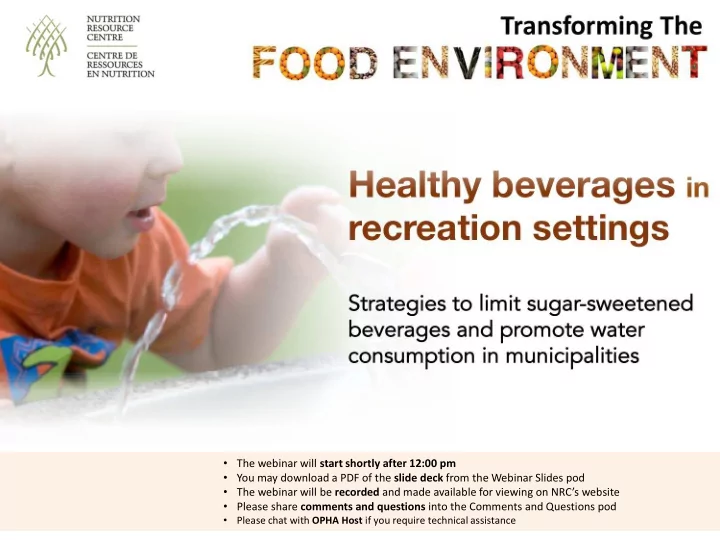
- The webinar will start shortly after 12:00 pm
- You may download a PDF of the slide deck from the Webinar Slides pod
- The webinar will be recorded and made available for viewing on NRC’s website
- Please share comments and questions into the Comments and Questions pod
- Please chat with OPHA Host if you require technical assistance
You may download a PDF of the slide deck from the Webinar Slides pod - - PowerPoint PPT Presentation
The webinar will start shortly after 12:00 pm You may download a PDF of the slide deck from the Webinar Slides pod The webinar will be recorded and made available for viewing on NRCs website Please share comments and questions
Donna Smith, MPH, RD, Policy and Program Coordinator, Nutrition
Resource Centre, Ontario Public Health Association
Lisa Swimmer, MHSc., RD, Manager, Chronic Disease and Injury
Prevention, Toronto Public Health
Jason Boyer, RRFS, CIT, Manager of Park & Recreation, Township of
Lucan Biddulph
Kim Bergeron, PhD, Health Promotion Consultant, By-law and Policy
Development Health Promotion Capacity Building, Public Health Ontario
Why Focus on Food Environments within Recreation Settings?
- Potential to influence eating and drinking behaviours of community
members of all ages, specifically children
- Food environment in rec spaces determines access, availability and quality
- r “healthfulness” foods and beverages in these settings
Recreation settings are gathering places for community to engage in physical activity, leisure activities and organized sports
Components of the Recreation Setting Food Environment
- Foods/beverages offered for sale
- vending machines, canteens,
concessions, restaurants
- Foods/beverages served
- meetings, recreation programs,
- rganized sporting events
- Foods involved in/tied to fundraising
- Foods that are advertised
How Healthy are the Beverages in Recreation Settings?
Recreation settings serve as key community hubs that promote active living Yet, Canadian research verifies that the majority of beverages served in recreation settings are high in calories and of low nutritional value Opportunity to promote health by increasing access to healthy beverage choices, such as water, in local recreation and sports facilities
How can we increase healthier beverage options in recreation settings?
Patrons desire healthier options in recreation settings Common concern from food service operators: “Healthy foods/beverages sold in recreation settings are not profitable” Some municipalities have policy prohibiting the sale of bottled water… Potential to unintendedly increase sales /consumption of unhealthy beverages Across Canada, very low policy adoption rate to regulate the nutrient quality of food and beverages within the recreation settings How can we take action to improve this key food environment by limiting access to SSBs and promoting water consumption for healthy hydration?
References: 1. Ontario Society of Nutrition Professionals in Public Health: Healthy Eating in the Recreation Setting Work Group. Building Healthier Food Environments within Recreation Settings. Available from http://www.osnpph.on.ca/healthy-eating-in-the-recreation-setting 2. Phorson, J. (2015) Initiatives Shaping Recreation Centre Food Environments in Canada. Available from http://www.opha.on.ca/getmedia/9d7257e6-026c-4c4a-bff4-bd9ea4b6a2c9/2- Page-Fact-Sheet-Rec-Centre-Programs.pdf.aspx 3. Ontario Society of Nutrition Professionals in Public Health: Healthy Eating in the Recreation Setting Work Group. (2015) Make the Healthy Choice the Easy Choice at Recreation Centres
Efforts to Improve the Food Environment in Toronto Recreation Settings
Lisa Swimmer, MHSc, RD Manager, Chronic Disease and Injury Prevention Toronto Public Health
Foods and beverages are sold at Toronto Parks Forestry & Recreation (TPF&R) facilities through:
- Cold beverage vending
- Snack vending (includes hot beverage vending)
- Concession stands/snack bars
- Restaurants
There is a range of TPF&R facilities including:
- Community centres
- Recreation centres
- Arenas
- Parks
Opportunities for creating healthier food environments in recreation settings
- Inter-divisional collaboration
- Policy levers
- Political leadership
- Ability to reach a broad cross section of the population, including
higher needs individuals and neighbourhood improvement areas
- A food environment that is theoretically within our control
- Healthy food marketing opportunities
Changes towards healthier food environments in Toronto recreation settings
1. Voluntary participation in a project to offer and promote healthier food/beverage choices for concession stand vendors (2002). 2. RFP process for cold beverage vending machine contracts included a requirement for 50% healthier beverage choices (starting in 2005). 3. RFP process for new snack vending machine contract included a requirement for 20% healthier snack choices across the city (with progression to 50% healthier snack choices) and a 100% healthy vending choices pilot project in 20 TPF&R sites (2008).
Barriers to achieving healthy food environments in recreation settings
- Revenue generation mandate vs. health mandate
- Competing political interests
- Defining “healthy choice”
- Availability of vendible items that meet the definition of healthy
choice (items labeled for individual sale, shelf life, refrigeration)
- Multiple contracts, multiple vendors, multiple settings
- Voluntary vs. mandatory approaches
- Implementation plan vs. actual implementation
- Incorrect promotion of healthier items
- Ability to monitor compliance and take corrective action
- Consumer demand for/ competition from less healthy items
Sample Planogram for Healthy Vending Machine (provided by Vending Company)
Sample Marketing Materials
For Further Details: Cold Beverage Vending
Staff Report: Healthy Vending Criteria - Cold Drink Vending Request for Proposal
- http://www.toronto.ca/legdocs/mmis/2010/gm/bgrd/backgroundfile-30121.pdf
Staff Report: License Agreement for the Operation of Beverage Services for Cold Drink Vending and Pouring Rights
- http://www.toronto.ca/legdocs/mmis/2011/gm/bgrd/backgroundfile-41282.pdf
Staff Report: The Health Rationale for Offering Healthy Choices in Beverages
- http://www.toronto.ca/legdocs/mmis/2011/gm/bgrd/backgroundfile-36766.pdf
Government Management Committee Item 31.19 - Healthy Vending Criteria - Cold Drink Vending Request for Proposal (Ward: All)
- http://app.toronto.ca/tmmis/viewAgendaItemHistory.do?item=2011.GM2.16
For Further Details: Snack and Hot Beverage Vending
Staff Report: Request for Proposal for Snack and Hot Drink Vending
- http://www.toronto.ca/legdocs/mmis/2008/gm/bgrd/backgroundfile-14469.pdf
Staff Report: Contract Award – Request for Proposal (RFP) 0612-08-0248 Supply, Installation and Operation of Snack and Hot Drink Vending
- http://www.toronto.ca/legdocs/mmis/2008/gm/bgrd/backgroundfile-17384.pdf
Toronto City Council Decision
City Council on April 12 and 13, 2011, adopted the following: 1. City Council request the General Manager of Parks, Forestry and Recreation to issue a Request for Proposal (RFP) for a five-year term for the purpose of entering into a license agreement for the operation of beverage services for cold drink vending machines and pouring within Parks and Recreation facility locations. 2 City Council direct that the criteria for cold drink vending sales and distributions be limited to 50 percent healthy vending. 3. City Council request the Medical Officer of Health to periodically review and report to the Board of Health on the content of the 50 percent healthy criteria. 4. City Council request the General Manager, Parks, Forestry and Recreation to ensure there is an abundant supply
- f drinking water available in all recreation centres and arenas prior to its proposed elimination from vending
machines in December 2011. For further information: http://app.toronto.ca/tmmis/viewAgendaItemHistory.do?item=2011.GM2.16
Changings in the Environment
- Eliminate advertising of non-nutritional foods
- Removed 25 cent candy machine, slushy machine, nacho machine
- Reduced beverage vending machines from 3 down to 1, size of chip bags and pop cans
- Increased the price of pop to offset the lower price of water
- Put in a water bottle filling station in main lobby
- Added milk, chocolate milk, fruits, and eggs to the menu
PROCESS AND BARRIERS
- 3 year process, slow changes
- Getting out of contracts and being in control of our facility
- Education (Council, Staff, Citizens)
- Take action (Active member in both
Middlesex Active Communities and HKCC)
- Pricing and working with our supplies
“BE THE CHANGE THAT YOU WISH TO SEE IN THE WORLD” Mahatma Gandhi
Key Lessons/Advice
- Think about the big picture, and what the overall goal is
- Always revert back to it and make sure you are staying on track
- Ask the question(s) “Is that the best decision” or “Are we doing this because”
1) It’s the best business decision 2) It’s the best for our residents/kids/seniors
May 19, 2016
Strategies, resources and tools to support healthy beverages in recreation settings: What does the evidence say?
Your level of familiarity with influencing recreation decision makers
How would you rate your level of familiarity with influencing recreation decision makers? a) I’m a beginner b) I have some idea of what could be done c) I am very familiar with how to influence these decision makers
22
Evidence
Canadian: From B.C., Canada
- Three studies were conducted related to the Healthy Food and
Beverages Sales (HFBS) in Recreation Facilities and Local Government Buildings initiative.1,2,3 Key findings:
- Recreation settings are obesogenic environments
- Stakeholders were interested in change and technical support:
resources and education are needed
- Few facilities had committees and/or initiatives underway to
help promote and provide healthier choices. 1
23
Evidence
Key findings:
- Facilities involved in the pilot phase reported significant changes
in their facility environment across all categories (strategic planning/policy, supportive environments and communication and education).2
- HFBS showed greater progress related to strategic planning,
creating supportive environments and providing information and education related to healthy eating.3
- The HFBS initiative appears to have served as a catalyst for
positive change in recreation and sport facility food environments.3
24
Evidence
Implications for practice:
- Focus capacity building activities on improving problem
recognition, engaging key stakeholders, and providing training, resources and technical support.3
- Provide education and support for healthy eating and the
rationale for the changes needed.1
- Conducting an assessment of both organizational capacity and
the actual food environments helps to garner support for action at all levels and facilitates planning.2
25
Evidence
Implications for practice:
- Make a purposeful effort to gain
cooperation from industry.3
- Build support from local decision
makers, recreation managers, food suppliers, staff and patrons.2
- Once the change has happened in
- ne facility, create knowledge
transfer opportunities.1
26
Strategies
- Consider using a step-by-step
approach that includes:
1) performing a facility assessment and audit; 2) presenting assessment results and setting goals; 3) creating a plan for change; 4) offering and promoting healthy choices; and 5) evaluating and monitoring.4
All of the resources from the B.C. initiative are available at http://stayactiveeathealthy.ca/
27
Evidence
King County, Washington
- Assessed how one local board of health (BOH) developed a
policy approach for healthy food access through vending machine guidelines (rather than regulations) and impact on the approach. Key findings:
- Developed guidelines and recommendations as a means to
provide ‘policy guidance’ in settings where the BOH does not have regulatory authority.
- The guidelines categorized food as limited, healthier and
healthiest and identified ‘early adopter’ organizations 5
28
Evidence
Implications for practice:
- Consider a ‘guideline and
recommendations’ approach to creating healthy beverage environments.5 The King County Healthy Vending Guidelines are available at https://www.cspinet.org/new/pdf/kc_ve nding_guidelines.pdf
29
Evidence
Boston, Massachusetts
- Evaluating the impact of the Healthy Beverage
Executive Order for city agencies. Key findings:
- Policies supporting access to healthy
beverages on city-owned properties can make healthier beverage options more accessible. 6 Implication for practice:
- Consider working to develop a city-owned
properties policy to make healthier beverage
- ptions more accessible to residents and
- employees. 6
30
Evidence
Arguments for and against limiting sugar-sweetened beverages (SSB)
- Identify common arguments for and against SSP portion limit
policy; content analysis of the New York City SSB portion cap policy. Key findings:
- For every pro-policy response there appears to be an anti-policy
argument. Implications for practice:
- Understand both sides of the argument. 7
31
Strategies
32
Understand the different levels of readiness:
- 1. Innovator
- 2. Majority
- 3. Late Adopter8
33
Resources
- Public Health Law Centre: Sugar sweetened beverages
- Centre for Disease Control and Prevention guide for strategies for
reducing the consumption of sugar sweetened beverages
- ChangeLab Solutions: Healthier vending for municipalities
- Centre for Science in the Public Interest: Examples of policies to
increase access to healthier food choices for public places: national, state, and local food and nutrition guidelines.
Take Home Messages
- Consider the evidence to
inform your efforts
- Utilize tools and resources
that are available
- Assess readiness of
recreation facility staff and decision makers
34
35
Kim Bergeron kim.bergeron@oahpp.ca
References
1. Naylor, P, Bridgewater, L, Purcell, M, Ostry, A, Vander Wekken, S. Publically funded recreation facilities: Obesogenic environments for children and families? Int. J. Envrion. Res. Public Health. 2010a;7:2208-2221. 2. Naylor P, Vander Wekken S, Trill D, Kirbyson A. Facilitating healthier food environments in public recreation facilities: Results of a pilot project in British Columbia, Canada. Journal of Park and Recreation Administration. 2010b;28(4):37-58. 3. Naylor P, Olstad DL, Therrien S. An intervention to enhance the food environment in public recreation and sport settings: A natural experiment in British Columbia, Canada. Childhood Obesity. 2015;11(4):364-374. 4. BC Recreation and Parks Association. Stay active, eat healthy: Steps for offering healthy choices. 2015 [Internet]. Available from: http://stayactiveeathealthy.ca/managers/steps_for_offering_healthy_choices.html 5. Quinn E, Johnson DB, Krieger J, MacDougall E, Payne E, Chan NL. Developing local Board of Health guidelines to promote healthy food access- King County, Washington, 2010-2012. Preventing Chronic Disease Public Health Research, Practice, and Policy. 2015;12(E58):1-10. 6. Cradock AL, Kenney EL, McHugh A, Conley L, Mozaffarian RS, Reiner JF, Gortmaker SL. Evaluating the impact of the Healthy Beverage Executive Order for city agencies in Boston, Massachusetts, 2011-2013. Preventing Chronic Disease Public Health Research, Practice, and Policy. 2015;12(E147):1-10. 7. Roberto CA, Pomeranz JL. Public health and legal arguments in favor of a policy to cap the portion sizes of sugar-sweetened beverages. American Journal of Public Health. 2015;105(11):2183-2190. 8. Nykiforuk CIJ, Atkey KM, Nieuwendyk LM, Raine KD, Reed S, Kyle S. Policy readiness tool: understanding a municipality’s readiness for policy change and strategies for taking action.[Internet]. Edmonton, AB: School of Public Health, University of Alberta; 2014. Available from: http://policyreadinesstool.com/en/
36
Disclaimer
This document may be freely used without permission for non- commercial purposes only and provided that appropriate credit is given to Public Health Ontario. No changes and/or modifications may be made to the content without explicit written permission from Public Health Ontario.
37