[Year] Southampton University Canoe Club Southampton University - - PowerPoint PPT Presentation

year
SMART_READER_LITE
LIVE PREVIEW

[Year] Southampton University Canoe Club Southampton University - - PowerPoint PPT Presentation

SUCC RIVER SAFETY TALK [Year] Southampton University Canoe Club Southampton University Canoe Club Southampton University Canoe Club Getting Ready What To Wear Wetsuit and/or Thermals Dry Cag Spray Deck Buoyancy Aid


slide-1
SLIDE 1

Southampton University Canoe Club
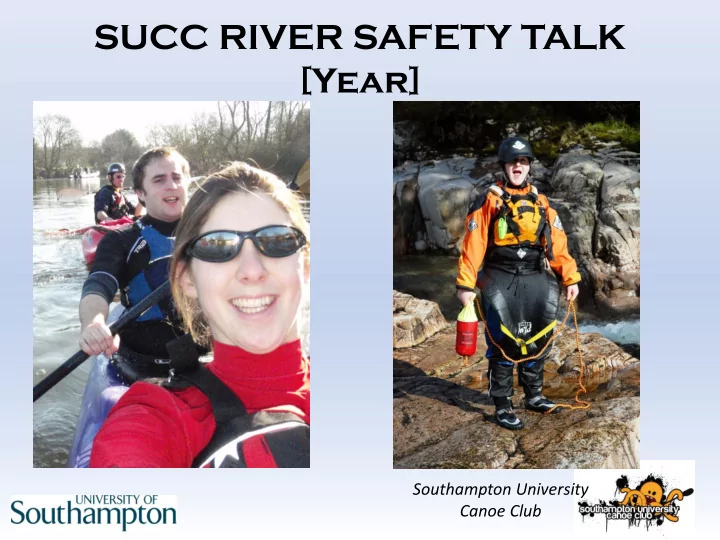
SUCC RIVER SAFETY TALK [Year]

slide-2
SLIDE 2

Southampton University Canoe Club

slide-3
SLIDE 3

Southampton University Canoe Club

slide-4
SLIDE 4

Getting Ready – What To Wear

  • Wetsuit and/or Thermals
  • Dry Cag
  • Spray Deck
  • Buoyancy Aid
  • Helmet
  • Shoes

If at any time you feel very cold please make sure you notify your river leader.

Southampton University Canoe Club

slide-5
SLIDE 5

Communication On The River

  • Each group will have a briefing on dry land before you start to paddle,

pointing out hazards, order, leaders, etc.

  • Important to learn river signals as you won’t always be in hearing

range.

  • Maintain eye contact – essential for giving the right person the right

command.

  • Acknowledge signals!
  • Signals –

Stop Come to me Eddy out Move left/right

Southampton University Canoe Club

slide-6
SLIDE 6

Reading Rivers – Basic Terminology

Main Flow Eddy Line Eddy Zone

Recirculation

Rock Eddy

River Right River Left Downstream Upstream

Southampton University Canoe Club

slide-7
SLIDE 7

Paddling – Top Tips

  • Keep Paddling – Paddle strokes provide support and momentum. You are far

more stable if you keep paddling through a feature.

  • Lean Forward – Your boat is most stable when you lean forward. Don’t lean back

when you paddle into a wave

Southampton University Canoe Club

slide-8
SLIDE 8

Reading Rivers – Features

  • Standing Waves / Wave Chains – Formed from fast moving water hitting a layer of

slow moving water. Just paddle through or stop and play….!

  • Stoppers – Surface (Noisy) Deep (Quiet)

Slot Slot Face Towback Face Towback Boil Line

Noisy Stopper Quiet Stopper

Weirs:

  • Weirs can produce dangerous stoppers. This is due to being man made, hence

symmetrical and often without a weakness.

  • Weirs are noticeable by the calm water above, an event horizon, buildings and concrete

constructions.

  • Be wary of playboaters playing in the wave below Southampton University

Canoe Club

slide-9
SLIDE 9

Reading Rivers – Hazards

Rocks:

  • It is possible to get stuck against or ‘pinned on’ a rock or any object in the

water.

  • The current can hold you firmly onto the rock and try and tip you over.
  • To avoid this, hug the rock and lift your upstream edge.

Strainers:

  • Any obstruction that will allow water to pass through, but not a boat or a

swimmer. Examples are: Branches, Roots, Fences, Steel Reinforcing ….. If you are going to hit one…. DO NOT HOLD ON TO BRANCHES - HUG ROCKS, HATE TREES

Southampton University Canoe Club

slide-10
SLIDE 10

Swimming

slide-11
SLIDE 11
  • When swimming, the first and greatest risk is a hand or foot

entrapment.

  • DO NOT EVER stand up in the middle of a flow.
  • Only hold on to equipment in slow, safe conditions. Otherwise, leave

it and get out. Kit can be replaced. You cannot.

  • Defensive swimming:

Lying on back, using your hands to steady yourself. This allows you to see what’s going on, push off rocks with your feet, protect your head from impact, and absorb knocks on your bum and buoyancy aid rather than knees.

Swimming Techniques - Defensive

Southampton University Canoe Club

slide-12
SLIDE 12

Swimming Techniques - Aggressive

Aggressive Swimming:

  • When you see an eddy you have to make, turn on your front and

front crawl like mad! Cross eddy lines in a similar way as boating – high up and at 45 degrees Roll over on the eddy line

  • Follow the line your leader leads you down the same as if you were

still in your boat. They can see better and will lead to down the safest lines.

Southampton University Canoe Club

slide-13
SLIDE 13

Rescuing Using Throwlines

Fig 15 – Receiving a Line [Courtesy of Graeme Brautigam] Fig 16 – Holding a Line [Courtesy of Graeme Brautigam]

  • Throwlines – Receiving

Lie on your back, hold line over your shoulder.

Southampton University Canoe Club

slide-14
SLIDE 14

Southampton University Canoe Club

After A Swim...

  • Eat some river chocolate or have

some Relentless!!

  • Hug and Thank your rescuer (if he

asks you for your phone number say no – he has to do better than that!!).

  • Get back in your boat and prepare

for the next awesome rapid : )

slide-15
SLIDE 15

The End – Now Go and Paddle!

Southampton University Canoe Club

slide-16
SLIDE 16

Southampton University Canoe Club

Acknowledgments:

  • Photos from SUCC members and Graeme Brautigam
  • Sheffield University Canoe Club
  • Tripper for useful discussion about the presentation

References:

  • Franco Ferrero: White Water Safety and Rescue [Pesado Press]
  • http://www.tomparkercoaching.co.uk/

http://www.ukwhitewater.co.uk/ http://www.bcu.org.uk

Acknowledgments and References

If you want to learn more about safety and rescue on rivers, watch out for future courses which will be advertised on the mailing list.