x ? ? ? ? computation easy One Way Hash Function (OWHF) h - - PDF document

x computation easy one way hash function owhf h h h h h
SMART_READER_LITE
LIVE PREVIEW

x ? ? ? ? computation easy One Way Hash Function (OWHF) h - - PDF document

ECRYPT Bart Preneel Emerging Topics in Cryptographic Design and Cryptanalysis Generic Constructions 30 April- 4 May 2007, Samos Greece for Iterated Hash Functions Outline Generic Constructions Generic Constructions for Iterated Hash


slide-1
SLIDE 1

ECRYPT Emerging Topics in Cryptographic Design and Cryptanalysis 30 April- 4 May 2007, Samos Greece

Bart Preneel Generic Constructions for Iterated Hash Functions

1

Generic Constructions for Iterated Hash Functions Generic Constructions for Iterated Hash Functions

Bart Preneel COSIC – Kath. Univ. Leuven, Belgium & ABT Crypto bart.preneel(AT)esat.kuleuven.be April 2007 Bart Preneel COSIC – Kath. Univ. Leuven, Belgium & ABT Crypto bart.preneel(AT)esat.kuleuven.be April 2007

Outline

  • definitions
  • applications
  • generic attacks
  • attacks on iterated constructions
  • attacks on custom designed hash functions: MD5, SHA, SHA-1
  • alternative constructions
  • pseudo-randomness
  • conclusions

Hash functions

  • (MDC-2)
  • (MD5)
  • (SHA-1)
  • RIPEMD-160
  • SHA-256, SHA-512
  • MDC (manipulation

detection code)

  • Protect short hash value

rather than long text

This is an input to a crypto- graphic hash function. The input is a very long string, that is reduced by the hash function to a string of fixed length. There are additional security conditions: it should be very hard to find an input hashing to a given value (a preimage) or to find two colliding inputs (a collision). 1A3FD4128A198FB3CA345932

h

Hash function flavours

cryptographic hash function MDC MAC OWHF CRHF UOWHF (TCR) this talk

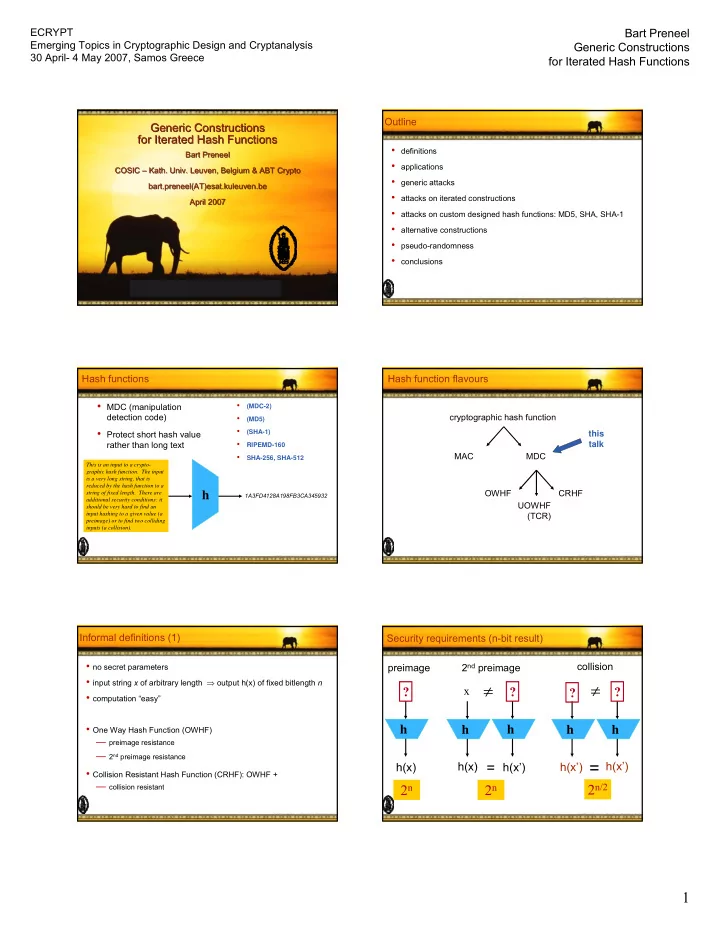
Informal definitions (1)

  • no secret parameters
  • input string x of arbitrary length ⇒ output h(x) of fixed bitlength n
  • computation “easy”
  • One Way Hash Function (OWHF)

— preimage resistance — 2nd preimage resistance

  • Collision Resistant Hash Function (CRHF): OWHF +

— collision resistant Security requirements (n-bit result)

h ?

h(x)

h

x h(x)

h ?

h(x’)

h ? h ?

= ≠

=

preimage 2nd preimage collision

2n 2n 2n/2

h(x’) h(x’)

slide-2
SLIDE 2

ECRYPT Emerging Topics in Cryptographic Design and Cryptanalysis 30 April- 4 May 2007, Samos Greece

Bart Preneel Generic Constructions for Iterated Hash Functions

2

Informal definitions (2)

  • preimage resistant ⇒ 2nd preimage resistant

— take a preimage resistant hash function; add an input bit b and replace one

input bit by the sum modulo 2 of this input bit and b

  • 2nd preimage resistant ⇒ preimage resistant

— if h is OWHF, h is 2nd preimage resistant but not preimage resistant:

h(x) = 0 || x if |x| ≤ n 1 || h(X) otherwise

  • collision resistant ⇒ 2nd preimage resistant
  • [Simon 98] one cannot derive collision resistance from “general” preimage

resistance (there exists no black box reduction)

h

xm-1 x0…x m-2

h

xm-1 x0…x m-2 ⊕ xm x x

Formal definition: (2nd) preimage resistance

Notation: Σ = {0,1}, l(n)>n A one-way hash function (OWFH) H is a function with domain D=Σl(n) and range R=Σn that satisfies the following conditions:

  • preimage resistance: let x be selected uniformly in D and let M be

an adversary that on input h(x) uses time ≤ t and outputs M(h(x)) ∈

  • D. For each adversary M,

Prx ∈ D { h(M(h(x)))=h(x) } < ε

Here the probability is also taken over the random choices of M.

  • 2nd preimage resistance: let x be selected uniformly in D=Σl(n)

and let M' be an adversary who on input x uses time ≤ t and

  • utputs x' ∈ D with x' ≠ x. For each adversary M',

Prx ∈ D { h(M'(x))=h(x) } < ε

Here the probability is taken over the random choices of M'.

Formal definitions: collision resistance

A collision-resistant hash function (CRHF) H is a function family {hS} with domain D=Σl(n) and range R=Σn that that satisfies the following conditions:

  • the functions hS are preimage resistant and second preimage

resistant)

  • collision resistance: let F be a collision string finder that on input

S ∈ Σs uses time ≤ t and outputs either “?” or a pair x, x' ∈ Σl(n) with x' ≠ x such that hS(x‘)=hS(x). For each F, PrS { F(H) ≠ “?‘” } < ε Here the probability is also taken over the random choices of F.

Formal definitions - continued

  • For collision resistance: considering a family of hash functions

indexed by a parameter (“key”) is essential for formalization (but see Rogaway ’06: “formalizing human ignorance”)

  • For (2nd) preimage resistance, one can choose the challenge (x)

and/or the key that selects the function.

  • This gives three flavours [Rogaway-Shrimpton’04]

— random challenge, random key (Pre and Sec) — random key, fixed challenge (ePre and eSec everywhere)

(eSec=UOWHF)

— fixed key, random challenge (aPre and aSec - always)

  • Complex relationship (see figure on next slide).

Relation between formal definitions

[Rogaway-Shrimpton’04]

Applications

  • digital signatures: OWHF/CRHF, `destroy algebraic structure‘
  • information authentication: protect authenticity of hash result
  • protection of passwords: preimage resistant
  • confirmation of knowledge/commitment: OWHF/CRHF
  • pseudo-random string generation/key derivation
  • micropayments (e.g., micromint)
  • construction of MACs, stream ciphers, block ciphers
  • (redundancy: hash result appended to data before encryption)
slide-3
SLIDE 3

ECRYPT Emerging Topics in Cryptographic Design and Cryptanalysis 30 April- 4 May 2007, Samos Greece

Bart Preneel Generic Constructions for Iterated Hash Functions

3

Applications (2)

  • Collision resistance is not always necessary
  • Other properties are needed:

— pseudo-randomness if keyed (with secret key) — near-collision resistance — partial preimage resistance — multiplication freeness — random oracle property

  • how to formalize these requirements and the relation between

them?

Brute force (2nd) preimage

  • If one can attack 2t simultaneous targets, the effort to find a

single preimage is 2n-t

— note for t = n/2 this is 2n/2

  • [Hellman80] if one has to find (second) preimages for many

targets, one can use a time-memory trade-off with Θ(2n) precomputation and storage Θ(22n/3)

— inversion of one message in time Θ(22n/3)

  • [Wiener02] if Θ(23n/5) targets are attacked, the full cost per (2nd)

preimage decreases from Θ(2n) to Θ(22n/5)

  • answer: randomize hash function

—salt, spice, “key”: parameter to index family of functions Birthday paradox for collisions

  • How hard is it to find a collision for a hash

function with an n-bit result?

  • 2n/2 evaluations of the hash function
  • Indeed, the number of pairs of outputs =

(1/2) 2n/2 . 2n/2

  • conclusion: n ≥ 256 or more for long-term

security

The birthday paradox (2)

  • Given a set with S elements
  • Choose r elements at random (with replacements) with r « S
  • The probability p that there are at least 2 equal elements (a

collision) is 1 - exp (- r(r-1)/2S)

  • The number of collisions follows a Poisson distribution with λ = r(r-1)/2S

—The expected number of collisions is equal to λ —The probability to have c collision is e -λ λc / c!

  • S large, r = √S, p = 0.39
  • S = 365, r = 23, p = 0.50

The birthday paradox (3) - proof

q = 1-p = 1 . ((S-1)/S) . ((S-2)/S) …. ((S-(r-1))/S)

  • r q = Πk=1

r-1 (S-k/S)

ln q = Σk=1

r-1 ln (1-k/S) ≅ Σk=1 r-1 -k/S = -r(r-1)/2S

  • hence p = 1 – q = 1 - exp (- r(r-1)/2S)

r terms

Taylor: if x « 1: ln (1-x) ≅ x summation: Σk=1r-1 k = r (r-1)/2 Brute force collision search

  • Consider the functional graph of f

f(x) x

f collision

slide-4
SLIDE 4

ECRYPT Emerging Topics in Cryptographic Design and Cryptanalysis 30 April- 4 May 2007, Samos Greece

Bart Preneel Generic Constructions for Iterated Hash Functions

4

Brute force collision search (2)

  • Efficient implementation of the birthday attack

[Pollard78][Quisquater89]

— very little memory (cycle finding algorithm) — full parallelism [Wiener94]

  • Distinguished point (d bits)

— Θ(e2n/2 + e 2d+1) steps — Θ(n2n/2-d) memory — with e the cost of one

function evaluation

  • [Wiener02] full cost: Θ(e n2n/2)

l c

l = c = (π/8) 2n/2

f(x) x

f

Brute force attacks in practice

  • (2nd) preimage search

— n = 128: 500 M$ for 1 year if one can attack 248 targets in

parallel

— n = 128: 500 B$ for 1 year if one can attack 238 targets in

parallel

  • parallel collision search

— n = 128: 100 K$ for 1 month

— n = 160: 500 M$ for 1 year — need 256-bit result for long term security (25 years or more)

Can we get rid of collision resistance?

  • collision resistance

— requires double output lengths — requires family of functions for formalization — is hard to achieve (e.g., not by black box reduction from one-

wayness)

  • UOWHF (TCR, eSec) randomize hash function after choosing the

message

  • [Halevi-Krawczyk05] randomized hashing = RMX mode:

H( r || x1 ⊕ r || x2 ⊕ r || … || xt ⊕ r )

  • needs e-SPR (not met by MD5 and SHA-1 reduced to 53 rounds)
  • issues with insider attacks (i.e. attacks by the signer)

Hash function: iterated structure

Split messages into blocks of fixed length and hash them block by block with a compression function f Efficient and elegant But many problems…

f

x1 IV

f

x2 H1

f

x3 H2

f

x4 H3

g

Security relation between f and h

  • Iterating f can degrade its security

— example: removing x1 and replacing IV by H1 leads to a

trivial collision or 2nd preimage

  • Solution: Merkle-Damgard (MD) strengthening (popular!)

fix IV, use unambiguous padding and insert length at the end

  • [MD89] f is collision resistant ⇒ h is collision resistant
  • [Lai-Massey92] f is 2nd preimage resistant ⇔ h is 2nd preimage

resistant

?

Construction: relation between f and h (2)

[Damgård-Merkle 89] Let f be a collision resistant function mapping l to n bits (with l > n).

  • If the padding contains the length of the input string, and if f is

preimage resistant, the iterated hash function h based on f will be a CRHF.

  • If an unambiguous padding rule is used, the following construction

will yield a CRHF (l-n>1):

H1 = f(H0 || 0 || x1) Hi = f(Hi-1 || 1 || xi ) i=2,3,…t.

slide-5
SLIDE 5

ECRYPT Emerging Topics in Cryptographic Design and Cryptanalysis 30 April- 4 May 2007, Samos Greece

Bart Preneel Generic Constructions for Iterated Hash Functions

5

Comment: tree structure

already suggested by Damgård in 1989; further work by Sarkar et al.

f

x1

f f f

x2 x3 x4 x5

f f f

x6 x7 x8

Construction: relation between f and h (3)

[Lai-Massey’92] Assume that the padding contains the length of the input string, and that the message x (without padding) contains at least two blocks. Then finding a second preimage for h with a fixed IV requires 2n

  • perations iff finding a second preimage for f with arbitrarily

chosen Hi-1 requires 2n operations.

  • this theorem is not quite right (see below)
  • very few hash functions have a strong compression function
  • very few hash functions are designed based on a strong

compression function in the sense that they treat xi and Hi-1 in the same way.

Security relation between f and h (4)

  • MD does not work for UOWHF [BR97]
  • MD with envelope method (prepend and append secret key) works

for pseudo-randomness/MAC [BCK96]

— but there are some problems and HMAC is a better construction

  • MD needs output transformation for random oracle properties

[Coron+05]

— if one knows h(x), easy to compute h( x || y) without knowing x

f

x1 IV

f

x2 H1

f

x3 H2

f

x4 H3

g

Defeating MD for 2nd preimages

[Dean-Felten-Hu'99] and [Kelsey-Schneier’05]

  • Known since Merkle: if one hashes 2t messages, the average effort

to find a second preimage for one of them is 2n-t.

  • New: if one hashes 2t message blocks with an iterated hash

function, the effort to find a second preimage is only t 2n/2+1 + 2n-t+1.

  • Idea: create expandable message using fixed points

—Finding fixed points can be easy (e.g., Davies-Meyer).

  • find 2nd preimage that hits any of the 2t chaining values in the

calculation

  • stretch the expandable message to match the length (and thus the

length field)

  • But still very long messages for attack to be meaningful

— n=128, t=32, complexity reduced from 2128 to 297, length is 256 Gigabyte x2t =length (x) H2t

f

H2 x1

f

H3 x2

f

H4 x3

f

H2t-2 x2t-1

f

H2t-1

f

H0 x’1

f

H’1 x’2

f

H’1 x’3

expandable message success probability ∗ 2t h( x’1 || x’2 || x’2 || x’2 || x’2 || x’3 ||…|| x2t-1 || x2t ) = h( x1 || x2 || x3 ||…|| x2t-1 || x2t )

Defeating MD for 2nd preimages (2)

How (NOT) to strengthen a hash function?

[Joux ’04]

  • Answer: concatenation
  • h1 (n1-bit result) and h2 (n2-bit result)

h2 h1

g(x) = h1(x) || h2(x)

  • Intuition: the strength of g against

collision/(2nd) preimage attacks is the product of the strength of h1 and h2

—if both are “independent”

  • But….
slide-6
SLIDE 6

ECRYPT Emerging Topics in Cryptographic Design and Cryptanalysis 30 April- 4 May 2007, Samos Greece

Bart Preneel Generic Constructions for Iterated Hash Functions

6

Multi-collisions [Joux ’04]

  • Consider h1 (n1-bit result) and h2 (n2-bit result), with n1 ≥ n2.
  • The concatenation of two iterated hash functions (g(x)= h1(x)

|| h2(x)) is as most as strong as the strongest of the two (even if both are independent).

  • Cost of collision attack against g at most

n1 . 2n2/2 + 2n1/2 << 2(n1 + n2)/2

  • Cost of (2nd) preimage attack against g at most

n1 . 2n2/2 + 2n1 + 2n2 << 2n1 + n2

  • If either of the functions is weak, the attacks may work

better.

  • Main observation: finding multiple collisions for an iterated

hash function is not much harder than finding a single collision.

Multi-collisions (2) [Joux ’04]

  • Now h(x1||x2||x3||x4) = h(x’1||x2||x3||x4) = h(x’1||x’2||x3||x4) =

… = h(x’1||x’2||x’3||x’4) a 16-fold collision

f

x1, x’1

IV H1

f

x2, x’2

H2

f

x4, x’4 x3, x’3

H3

f

  • For IV: collision for block 1: x1, x’1
  • For H1: collision for block 2: x2, x’2
  • For H2: collision for block 3: x3, x’3
  • For H3: collision for block 4: x4, x’4

Other issues with iteration: herding

  • Herding attack [Kelsey,Kohno’06]

— reduces security of commitment using a hash function — example (n=128, t=42): with a storage of 100

Terabyte and a precomputation of 286 steps, a 128-bit commitment computed using an iterated hash function can be spoofed with effort 286 steps

Herding attack (2)

  • protocol: publish h(x), reveal x at later date
  • find second preimage x'= z || y || x with z and y selected in 2020
  • approach: generate collision tree (diamond structure) of 2t values Hi-1

and xi hashing to the same value (cost 2 . 2t/2 . 2n/2)

  • z = result of all Australia cricket games between 2010 and 2020
  • try in 2020 random strings y until h(z || y) = Hj-1 for some j (cost 2n-t)
  • then h(z || y || xj ) = h(x), so you can claim that you “knew” z in 2006

h( z || y || x ) = committed value

f

H0 z

f

H1 y H2

new message success probability ∗ t

H’’’2 H2

f

x3

f

H3 x4

f

H’2 x’3

f

H’3 x4’

f

x’’’3 H’’2

f

x’’3 H4

Herding attack (3) Improving MD iteration

  • add salting (family of functions, randomization)
  • add a strong output transformation g (which includes total

length and salt)

  • preclude fix points: counter f → fi (Biham) or dithering

(Rivest)

  • multi-collisions, herding: avoid breakdown at 2n/2 with larger

internal memory (e.g., RIPEMD, [Lucks05])

  • rely on principles of block cipher design, but with larger

security margins

  • be careful when combining smaller building blocks (à la

MDC-2/MDC-4)

  • can we build in parallelism and incrementality in an elegant

way?

slide-7
SLIDE 7

ECRYPT Emerging Topics in Cryptographic Design and Cryptanalysis 30 April- 4 May 2007, Samos Greece

Bart Preneel Generic Constructions for Iterated Hash Functions

7

Some ideas

length(x)

H1 Ht-1 H0

f1

x1

f2

x2

ft

xt

g

length(x)

H0

f1

x1

f’1

H’0

m

f2

x2

f’2

H’1

m

H1

ft

xt

f’t

H’t-1

m

Ht-1

g

Many more ideas….

  • [Biham-Dunkelman 06] Haifa: bit counter and salt input to f
  • [Bellare-Ristenpart 06] EMD transform (envelope MD):

preserves CR, PRF, RO

  • [Andreeva+06] analysis of preservation of CR, (e/a/-)PR, (e/a/-)

SPR, (RO, PRF)

f

x1 IV1

f

x2 H1

f

x3 H2 x4 H3

f

IV2 ||

Hash function constructions

  • many (50+) broken schemes:

— Rabin, Jueneman,X.509 Annex D, FFT-hash I and II,

N-hash, Snefru, MD2, …

  • fast schemes for 32-bit machines:

— most popular designs: MD4 and MD5 — US government (NIST): SHA (aka SHA-0) and SHA-1 — Europe: RIPEMD-160

  • the next generation: SHA-256, SHA-512, Whirlpool,…
  • block cipher based
  • based on algebraic constructions

MD4

  • designed by Rivest in 1990
  • 3 rounds
  • collisions for 2 rounds [Merkle’90, denBoerBosselaers’91]
  • collisions for full MD4 in 220 steps [Dobbertin’96]
  • (second) preimage for 2 rounds [Dobbertin’97]
  • collisions for full MD4 by hand [Wang+’04]
  • practical preimage attack for 1 in 256 messages [Wang+’05]
  • abandoned since 1993

MD5

  • designed by Rivest in 1991
  • 4 rounds
  • “collisions” for compression function f

[denBoerBosselaers93] - ΔIV

  • real collisions for compression function f [Dobbertin96]

– wrong IV

  • real collisions in 239 steps [Wang+’04]

… now in minutes (230)!!

MD5

  • Advice (RIPE since 1992,

RSA since 1996): stop using MD5

  • Largely ignored by industry

(click on a cert...)

  • Collisions for MD5 are within

range of a brute force attack anyway (264)

  • But now in minutes…
slide-8
SLIDE 8

ECRYPT Emerging Topics in Cryptographic Design and Cryptanalysis 30 April- 4 May 2007, Samos Greece

Bart Preneel Generic Constructions for Iterated Hash Functions

8

SHA-1

  • SHA designed by NIST (NSA) in ‘93
  • 5 rounds
  • redesign after 2 years (’95) to SHA-1
  • Collisions for SHA-0 in 251 [Joux+’04]
  • Collisions for SHA-0 in 239 [Wang+’05]
  • Collisions for SHA-1 in 263 [Wang+’05]

(full details have not been independently verified)

SHA-1 (continued)

  • De Cannière-Rechberger 06:

— automated search for characteristics — collision for 64 out of 80 rounds in 235 – highly structured

  • Jun Yajima, Yu Sasaki, Teruyoshi Iwasaki, Yusuke Naito, Takeshi

Shimoyama, Noboru Kunihiro, Kazuo Ohta (rump Crypto ‘06)

  • Hawkes-Paddon-Rose
  • Sugita-Kawazoe-Imai – Gröbner basis (no improvement)

From: “Cryptography Simplified in Microsoft .NET” Paul D. Sheriff (PDSA.com) [Nov. 2003]

How to Choose an Algorithm

  • For example, SHA1 uses a 160-bit encryption key, whereas MD5

uses a 128-bit encryption key; thus, SHA1 is more secure than MD5 and thus is a much harder hash to break.

  • Another point to consider about hashing algorithms is whether or

not there are practical or theoretical possibilities of collisions. Collisions are bad since two different words could produce the same hash. SHA1, for example, has no practical or theoretical possibilities of collision. MD5 has the possibility of theoretical collisions, but no practical possibilities. So choosing an algorithm comes down to the level of security you need.

In April 2007 this information is still available on MSDN MDx-type hash function history

MD5 SHA SHA-1 SHA-256 SHA-512 HAVAL

  • Ext. MD4

RIPEMD RIPEMD-160 MD4

90 91 92 93 94 95 02

MDx-type cryptanalysis

  • Serious flaws in MD4 and MD5 [RIPE ’91-’92]
  • SHA replaced by SHA-1 [NSA ’94]
  • Collisions for MD4, problem in ext.-MD4 [Dobbertin ’96]
  • More problems of MD5 and RIPEMD [Dobbertin ’96]
  • Collisions for Haval [Biryukov, Van Rompay, Preneel ’02]
  • Collisions for SHA-0 [Joux ’04]
  • Collisions for MD4 (by hand), MD5, and RIPEMD [Wang, Feng, Lai,

Yu ’04]

  • Attack on 53 out of 80 rounds of SHA-1 [Oswald-Rijmen’04 and

Biham-Chen] ’04]

  • 239 attack on SHA-0 [Wang,Yu,Yin ’05]
  • 269 attack on SHA-1 [Wang, Yin, Yu ’05]
  • 263 attack on SHA-1 [Wang, Yao, Yao ’05]
slide-9
SLIDE 9

ECRYPT Emerging Topics in Cryptographic Design and Cryptanalysis 30 April- 4 May 2007, Samos Greece

Bart Preneel Generic Constructions for Iterated Hash Functions

9

Impact of collisions (1)

  • collisions for MD5, SHA-0, SHA-1

— two messages differ in a few bits in 1 to 3 512-bit input

blocks

— limited control over message bits in these blocks — but arbitrary choice of bits before and after them

  • what is achievable?

— 2 colliding executables

— 2 colliding postscript/gif/… documents [Lucks, Daum ’05] — 2 colliding RSA public keys – thus with colliding X.509

certificates [Lenstra, Wang, de Weger ’04]

— 2 arbitrary colliding files (no constraints) for 100K$

Impact of collisions (2)

  • digital signatures: only an issue if for non-repudiation
  • none for signatures computed before attacks were

public (1 August 2004)

  • none for certificates if public keys are generated at

random in a controlled environment

  • substantial for signatures after 1 August 2005 (cf. traffic

tickets in Australia)

And (2nd) preimages?

  • security degrades with number of applications
  • for large messages even with the number of blocks (cf.

supra)

  • specific attacks exist for MD2/MD4
  • For MD5/SHA-1: not a threat for current applications

Fixes/Alternatives (1)

  • RIPEMD-160 seems more secure than SHA-1 ☺
  • message precoding
  • small patches to SHA-1
  • use more recent standards (slower on 32-bit machines)

— SHA-256, SHA-512

— Whirlpool

  • block cipher based schemes:

— well studied — due to key schedule for every encryption at least 3-4

times slower than AES encryption

Fixes/Alternatives (2)

  • number theoretic schemes

— secure but very slow (1 multiplication per bit)

— speedup by [Contini,Lenstra,Steinfeld 05] VSH

  • still 20 times slower than SHA-1
  • only collision resistance; some other weaknesses

— topic for further research (lattices, matrices)

  • use older schemes: Tiger, Snefru with more rounds,

block cipher based schemes (slow)

  • start from scratch?

Performance of hash functions (cycles/byte) Pentium III

10 20 30 40 50 60 70 80

MD4 R MD

  • 160

SH A

  • 256

W hirlp. BC /A ES MD5 SHA-1 SHA

  • 512

Tiger AES

slide-10
SLIDE 10

ECRYPT Emerging Topics in Cryptographic Design and Cryptanalysis 30 April- 4 May 2007, Samos Greece

Bart Preneel Generic Constructions for Iterated Hash Functions

10

Hash function: pseudorandom function (1)

  • MDx are based on a block cipher with a

feedforward: where to put the key?

  • if keyed to the message input: related key

boomerang distinguisher attacks apply [Kim+06] 270.3 RK-CP + 268.3 RK-ACC 59 of 80 SHA-1 213.6 RK-CP + 211.6 RK-ACC 64 MD5 26 RK-CP + 26 RK-ACC 48 MD4 211.6 RK-CP + 26 RK-ACC 96 Haval-4 Data complexity Rounds of attack

many hash functions are based on pretty weak block ciphers

E

Hash function: pseudorandom function (2)

  • HMAC keys through the IV (plaintext) [Kim+06]

— collisions for MD5 invalidate current security proof of HMAC-MD5 — new attacks on reduced version of HMAC-MD5 and HMAC-SHA-1

2154.9 CP 43 of 80 80 SHA-1 2109 CP 80 80 SHA 2126.1 CP 33 of 64 64 MD5 274 CP 48 48 MD4 2254 CP 102 of 128 128 Haval-4 Data complexity Rounds in f1 Rounds in f2

no problem yet for most widely used schemes

f2 f1

x K1 K2

Hash function: pseudorandom function (3)

  • Recent improvements: HMAC/NMAC attacks

— [Yin-Contini06] better attack on HMAC-MD4 and key recovery attack

  • n NMAC-MD5 (Asiacrypt 2006)

— [Rechberger-Rijmen06] eprint.iacr.org and Financial Crypto — Further improvements announced [Biham-Yin]

298.5 CP 53 of 80 80 SHA-1 Data complexity Rounds in f1 Rounds in f2

Hash functions: conclusions

  • hash functions such as SHA-1 would have needed 128-

160 rounds instead of 80

  • recent attacks are not dramatic for all applications, but

they form a clear warning: upgrade asap

  • limited understanding (theory and practice)
  • use weaker security assumptions if possible

(UOWHF??)

  • research on new and more robust designs with extra

features

Hash functions: further reading

  • ECRYPT workshops in May 2007 and June 2005 +

statement on hash functions at http://www.ecrypt.eu.org

  • NIST workshop October 31-November 1, 2005 and August

24-25, 2006 http://www.csrc.nist.gov/pki/HashWorkshop/index.html

  • The IACR eprint server http://eprint.iacr.org
  • My 1993 PhD thesis http://homes.esat.kuleuven.be/~preneel
  • Overview paper from 1998 (LNCS 1528)

http://www.cosic.esat.kuleuven.be/publications/article- 246.pdf

Thank you for your attention