Wundts problem : how to deal with introspection Cricks problem : - - PDF document

wundt s problem how to deal with introspection crick s
SMART_READER_LITE
LIVE PREVIEW

Wundts problem : how to deal with introspection Cricks problem : - - PDF document

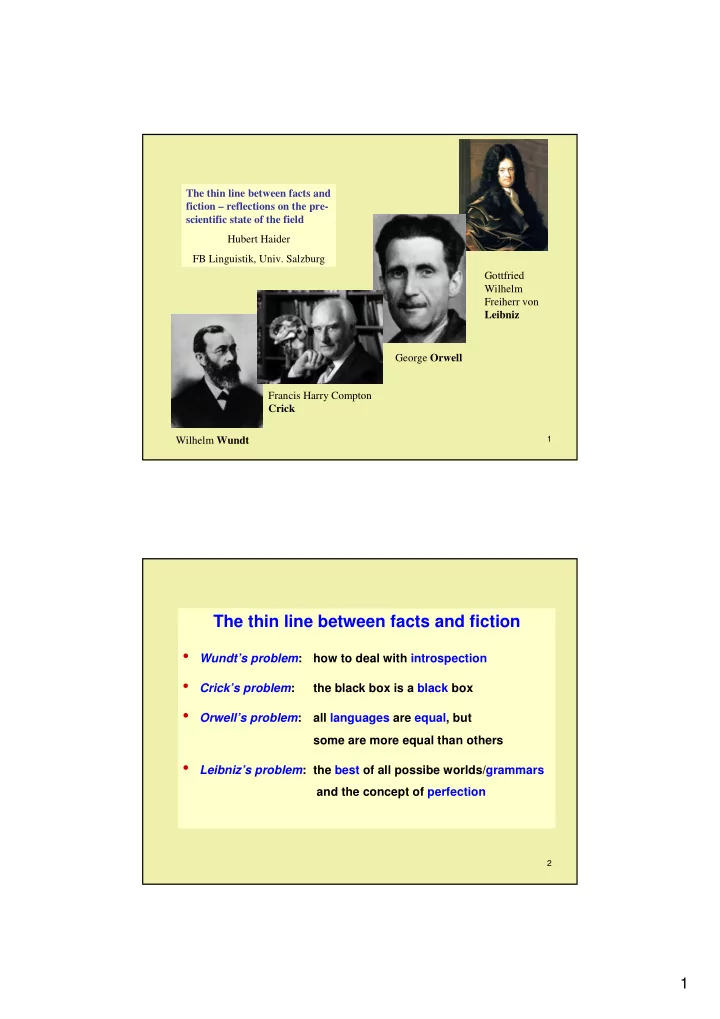
The thin line between facts and fiction reflections on the pre- scientific state of the field Hubert Haider FB Linguistik, Univ. Salzburg Gottfried Wilhelm Freiherr von Leibniz George Orwell Francis Harry Compton Crick 1 Wilhelm Wundt


slide-1
SLIDE 1

1

1

The thin line between facts and fiction – reflections on the pre- scientific state of the field Hubert Haider FB Linguistik, Univ. Salzburg Gottfried Wilhelm Freiherr von Leibniz George Orwell Francis Harry Compton Crick Wilhelm Wundt

2

The thin line between facts and fiction

  • Wundt’s problem: how to deal with introspection
  • Crick’s problem:

the black box is a black box

  • Orwell’s problem: all languages are equal, but

some are more equal than others

  • Leibniz’s problem: the best of all possibe worlds/grammars

and the concept of perfection

slide-2
SLIDE 2

2

3

Prescientific status Prescientific is meant to refer to what defines the legitimate operations in a given theory, that is, the the core convictions and premises for the research programme. These premises are, by definition, prescientific statements because it is not possible to derive them using empirical means. They are postulated.

4

Wundt‘s Problem

  • Introspective data = results of self-informant work

(Newmeyer 1983:48)

  • Introspective data = metalinguistic judgements by

informants (including the self-informant) Why do we happily rely on self-informant work data?

  • This paradigm has proven productive to a large extent
  • These data are the easiest to obtain (Newmeyer 1983:50)

F.Newmeyer. 1983. Grammatical Theory. Univ. Of Chicago Press

slide-3
SLIDE 3

3

5

Is this a Problem? - Sometimes

Clearly unacceptable Clearly acceptable Falsely positive? (‚red‘?) Falsely negative? (‚green‘) green

  • r

red

6

The ‚unclear cases‘

  • Competing theories/hypotheses often account for the ‚clear cases‘ equally well.

Counterevidence (by opponents) or defensive evidence (by supporters), however, is not always recruited from the clear cases.

  • In defense, counterevidence may be ‚expained‘ away as ungrammatical

although it is not (falsely negative). The specific examples used in the argument may indeed be ungrammatical or merely degraded by intervening factors that are

  • irrelevant. In the latter case, they are wrongly dismissed.
  • On the other hand, the evidence that is raised against a hypothesis may be

indeed irrelevant or mistaken as grammatical and judged falsely positive. In both cases, the evidence needs to be assessed independently. Does this happen in reality? – See slide on superiority data from Dutch

slide-4
SLIDE 4

4

7

Wundt‘s Problem

Present day theoretic syntax is largely built on the acceptability intuitions of syntacticians. This is a special subset of natives whose grammar competence has not been shown to be repre- sentative for the grammar competence of a native speaker without an inclination for, and training in, formal syntax.

  • “Good practice in the more advanced sciences distrusts most of all the

memory and impressions of the investigator himself” (Labov 1978, Sociolinguistics).

  • “But, for an in-depth syntactic investigation, native command of the given

language is indispensable: Only the most sophisticated speakers can supply the exquisite judgements required for writing a grammar” (Gleitman & Gleitman 1970. Phrase and Paraphrase).

8

Questionaire data on Dutch superiority, gathered and shared by Gisbert Fanselow 22 Raters (professional linguists) ⇓ ⇓ ⇓ ⇓

Falsely negative? - Falsely positive?

slide-5
SLIDE 5

5

9

Wundt‘s Problem

Much of the criticism of intuitions suggests that they represent ‘invented’ data.

  • Stubbs (Text & Corpus Analysis. 1996. 29,31): much linguistics is

based on invented sentences; data often means invented data.

  • Borsley (Lingua 2005.115:1477): “This is seriously confused. The

sentences that linguists investigate may well be invented, but the speaker’s judgements are not invented and it is in these that are the data with which theoretical linguists work”.

  • “It is hard to escape the feeling that many objections to

intuitions are just a convenient excuse for ignoring a large body

  • f often rather difficult literature.” (Borsley 2005, Fn 4).

10

Wundt‘s Problem

Linguists continue to insist that the ease of obtaining data is the reason for preferring oneself as a subject, ignoring the inferior quality of the data so obtained. (Schütze: p.187). Parallels to the history of psychology For the (late) 19th century psychology, introspection was the main access road to insights about the mind. It was Wilhelm Wundt (1832-1920) who argued that introspection needs to be controlled and integrated into a systematic program of psycho- logical experimentation.

slide-6
SLIDE 6

6

11

Wundt‘s Problem

  • For Wundt, ‚Introspection’ is ambiguous and he dis-

tinguishes self observation (‘Selbstbeobachtung’) from internal perception (‚Innere Wahrnehmung’)

  • The introspectionist [in the sense of self observation]

he contemptuously likens to Baron Münchhausen attempting to pull himself out of the bog by his own pigtail, but he emphasized introspection [in the sense of internal perception, that is Innere Wahrnehmung] as the foundation of psychology.”

12

Wundt‘s Problem

What do I perceive or observe if I ask myself how I as a native speaker judge sentences like the following:

(1) Der Mann hat sich angefangen, -- für alles zu interessiern the man has himself begun, for everything to interest (2) * Der Mann hat sich zugegeben, -- für alles zu interessieren the man has himself admitted, for everything to have-taken-interest-in

I ‘observe’ myself while ‘perceiving’ a feeling of un- easiness when I process (2) and that I do not sense it when I process (1), and I interpret this feeling as an indication for the deviance of (2) in German – internal perception.

slide-7
SLIDE 7

7

13

Wundt‘s Problem

Is this a reliable datum? It is, if I can be sure that the described sensation is replicable in terms of

  • repeated exposures of myself to (1) and (2), e.g. while

brushing my teeth or after having had a glass of beer, ...

  • exposure of other native speakers to (1) and (2)
  • exposure of myself to other members of the class of

sentences I take (1) and (2) to be representative for

  • exposure of other native speakers to other members of

the the class of sentences I take (1) and (2) to be representative for

14

Wundt‘s Problem

But, can I be sure indeed? Yes, I could, if replicability had been

  • tested. But it has not been tested. So I cannot be sure.

Experimental standards in psychology: data collection and data evaluation under controlled circumstances for data that are not already uncontroversial:

  • large enough number of subjects
  • subjects ignorant of the test hypotheses
  • randomized presentation of stimuli
  • statistical analysis of the collected data

Intuitions are a legitimate form of evidence for linguistic hypo- theses but they should be treated as what they are, namely experi- mental data dependent on experimental standards.

slide-8
SLIDE 8

8

15

Wundt‘s Problem Wundt, Wilhelm. 1888. Selbstbeobachtung und innere Wahrnehmung. Philosophische Studien, Bd. IV. p. 292-309.

Es ist ganz in die Hand der Psychologen gegeben, dafür zu sorgen, dass diese Fehler mehr und mehr ganz verschwinden. Es ist dazu nur das eine nötig daß sie [....] sich der experimentellen Methode [...] bemächtigen.

It is totally in the hands of the psychologists to take care that these failures disappear more and more. The only thing they have to do is to seize the experimental method. Es stehen dem gegenwärtig noch zwei Eigenschaften entgegen. Presently, there are two properties that stand in its way.

16

Wundt‘s Problem

Die eine Eigenschaft ist der Hochmuth. Es gibt ja immer noch einige Leute, die das Experimentieren für eine banausische Kunst halten, mit der man sich nicht befassen dürfe, wenn man nicht des Privilegiums, im Aether des reinen Gedanken zu hausens, verlustig gehen wolle.

  • One property is arrogance. There are still some people who

consider experimenting a philistine art, which one should not deal with, if one does not want to risk loosing the priviledge of residing in the pure ether of thoughts.

Die andere Eigenschaft ist die falsche Bescheidenheit. Jede Kunst scheint in der Regel dem, der sie nicht versteht, viel schwerer als sie wirklich ist.

  • The other property is mistaken modesty. Every art usually tends

to appear to be more difficult than it really is to those who do not understand it.

slide-9
SLIDE 9

9

17

Wundt‘s Problem Wundt, Wilhelm. 1888. Selbstbeobachtung und innere Wahrnehmung. Philosophische Studien, Bd. IV. p. 292-309.

p.308: Es ist aber in der experimentellen Psychologie nicht anders, als in anderen Wissenschaften auch. Die Antworten, die man erhält, sind nicht bloß von den Hülfsmitteln, über die man verfügt, sondern auch von den Fragen abhängig, die man stellt. Wer keine oder nur verkehrte Fragen zu stellen weiß, der darf sich nicht wundern, wenn er nichtssagende oder unbrauchbare Antworten erhält.

  • Experimental psychology is not different from other sciences.

The answers that you get are not only dependent on the technical aids you dispose of, but also on the questions you ask. Who asks no questions or only mistaken ones must not be surprised if he receives only irrelelevant or useless answers.

18

Wundt‘s Problem

Wundt, na und? (and so what?)

  • Data assessment: self informant data need to be

strengthened by controlled data acquisition

  • Data documentation: full list of stimuli, information on

informant agreement/disagreement (variance, kappa)

  • Data normalization: consensus on currency exchange

rates for data acquired/assessed with different methods

It is a mark of the trained mind never to expect more precision in the treat- ment of any subject than the nature of that subject permits [or requires ?]. (Aristotle, Nicomachean Ethics 1094b 24-5)

slide-10
SLIDE 10

10

19

Francis Harry Compton Crick:

  • The difficulty of the method of the black box is this. If the in-

terior of the box does not have a very simple structure, the method soon will reach a stage in which different theories cover all observable results sufficiently well. Attempts to decide between the theories fail because new experiments only produce new complexities. One has no other choice than groping one’s way into the box.

(Spektrum der Wissenschaft 11, 1979. Translattion by HH.).

  • Die Schwierigkeit der Methode des schwarzen Kastens besteht darin, dass man - sofern das Innere des Kastens

nicht sehr einfach strukturiert ist - sehr bald ein Stadium erreicht, in dem unterschiedliche Theorien alle beobachtbaren Resultate gleich gut zu erklären vermögen. Versuche, zwischen den Theorien zu entscheiden, schlagen fehl, weil neue Experimente nur neue Komplexitäten zutage fördern. Man hat dann keine andere Wahl, als sich in den Kasten hineinzutasten.

NEXT: CRICK‘S Problem

20

Crick‘s Problem

For reasons that have never been made explicit, many generative grammarians appear to regard primary intuitions as more direct evidence of linguistic compe- tence than other types of data. But there is no basis for this belief. Since knowledge of language is not directly observable, linguists should use every type of evidence available to help us infer what is in speakers’ minds.

(Wasow & Arnold 2005:1484. Lingua. Intuitions in linguistic argumentation).

slide-11
SLIDE 11

11

21

Crick‘s Problem

1996, Language published for the first time a neuro- imaging study: Jaeger,J. & A.Lockwood & D.Kemmerer & R.D. van Valin & B.Murphy & H. Khalak 1996. A positron emission study of regular and irregular verb morp- hology in English. Language. 72: 451-497. Claim: Based on different processing of regular and irregular forms, the authors argue for a dual route account of participle processing (rules + memory).

22

Crick‘s Problem

Positive replication for German:

slide-12
SLIDE 12

12

23 24

Crick‘s Problem

BUT: Bornkessel-Schlesewsky & Schlesewsky 2007. Theoretical

  • Linguistics. Vol. 33.3
  • Experimental data may be superior to intuitions in terms of their

reliability, but they still require interpretation. They allow just as much misinterpretation as intuitions. (p. 320)

  • Single judgements of all kinds only reflect the endpoint of an

interaction between a variety of linguistic and extralinguistic factors, thus rendering direct conclusions from grammatical theory just as useful or just as problematic as those drawn from careful intuitive judgements (p.321).

slide-13
SLIDE 13

13

25

How to open the black box?

  • fMRI
  • EEG
  • Eye movements
  • …………………

Presently, the arsenal of psycholin- guistic experimental techniques is impressive, but it is not yet deve- loped that far that the experimental

  • utcomes could be factored into

their grammatical components

Crick‘s Problem

26

Functional magnetic resonance imaging

fMRI Project Stuttgart-Tübingen-Salzburg

1996-2002

Hermann Ackermann Grzegorz Dogil Wolfgang Grodd Hubert Haider Hans Kamp Michael Klein Jörg Mayer Axel Riecker Dirk Wildgruber

Project funded by the DFG. [DFG-DO 536]

G.Dogil et als. 2002: The speaking brain. Journal of Neurolinguistics, 15: 289-336.

slide-14
SLIDE 14

14

27

Syntactic task

Sentence reserialization (i.e. movement of a phrase to the clause-initial position. Instance of A’-movement). see: Ein junger Hund würde sich mit Kindern gut vertragen.

(A young dog would get along well with children.)

say: Mit Kindern würde sich ein junger Hund gut vertragen.

(With children would a young dog get along well.)

28

Control task

List reserialization, unstructured see: Kaffeemaschine Waschmaschine Bügelmaschine

coffee maschine washing maschine ironing maschine

say: Bügelmaschine Kaffeemaschine Waschmaschine

slide-15
SLIDE 15

15

29

Results

sentence reserialization minus list reserialization

  • cerebellum

(L>R)

  • left ventral

frontal language region

  • prefrontal cortex

(L>R)

  • anterior

cingulate gyrus

  • left posterior

temporal gyrus

30

BSC = Broca‘s area WSC = Wernicke‘s area

slide-16
SLIDE 16

16

31

What do scans like these tell us? The task stimulates the activation

  • f a language processing network

There are focal areas of activities that correspond to the expected loci of activation in language processing:

  • Parts of Broca‘s area
  • Parts of Wernicke‘s area

plus

  • Cerebellum activity
  • Activity in the cingular cortex

What we do NOT see: which acti- vity is the activity that accompli- shes the fronting task. Why? The fMRI is an average of the activity-driven rCBF effect in the timespan of 1-2 secs.

32

EEG – Getting closer to the activity in time resolution

Conflict resolution (‚ungrammaticality‘ in the EEG)

  • a. What reaction, if there is an available resolution
  • b. What reaction if there is no available resolution

Stimulus pattern (1) [XP V-en …… ] ambiguous: 3rd P.Pl. or Infinitive)

  • a. [XP [ V-fin

[ ……]]]

  • b. [[XP V-inf]VP [V-fin …..]]
slide-17
SLIDE 17

17

33

  • No conflict

(1) a. Den Katalog bearbeiten alle selbst

  • b. Den Kalalog bestellen alle selbst ab
  • Resolvable conflict

(2) a. Den Katalog bearbeiten müssen alle selbst

  • b. Den Katalog abbestellen müssen alle selbst
  • Irresolvable conflict

(3)*Den Katalog abbestellten alle selbst (past tense, finite)

(*: Particle must be stranded. s. (1b))

34

Dietmar Roehm & Hubert Haider (2008). Small is beautiful: the processing of the left periphery in German. In press in: Lingua.

slide-18
SLIDE 18

18

35

Processing while Reading: eye movement recording ‚The third construction‘

= A phrase of the embedded, extraposed infinitival construction is displaced. It appears within the matrix clause. (1) Der Artist hat die Leute gehofft, damit beeindrucken zu können the artist has the people hoped with-it impress to be-able-to ‚Hoffen‘ (hope) allows this construction, ‚abstreiten‘ (deny) does not. (2)*Keiner hat das Haus abgestritten, gestern betreten zu haben nobody has the house denied, yesterday entered to have

36

Example Eye movement recordings for the two sentences (real time data)

(1) Der Artist hat die Leute gehofft, damit beeindrucken zu können the artist has the people hoped with-it impress to be-able-to (2)*Keiner hat das Haus abgestritten, gestern betreten zu haben nobody has the house denied, yesterday entered to have

Reading discriminates: watch the refixations and regressions on the verb in (2)

slide-19
SLIDE 19

19

37

NEXT: Orwell‘s Problem – evidence from diverse languages Presently, the majority of languages covered by Generative Grammar belongs to a single language family (Indoeuropean: Germanic and Romance subfamilies), and to a single type, namely head-initial. An archtitecture that has proven successful for the modelling of findings in VO languages constitutes the frame of reference for the integration of non-VO languages:

  • architecture of head-initial lexical projections (VP-shells)
  • clausal architecture in terms of cascading functional projections
  • structural properties of subject placement (EPP)
  • .....

38

Orwell‘s Problem

In my perception, the VO architecture is often axiomatically presupposed as a given part of UG (as a cartographic blue print

  • r a set of allegedly universal derivational steps that target at a

VO type outcome) and the mis-matches between the VO and the OV structures are accounted for in a primarily extrapolative style (or they are ignored):

  • extrapolated overt or covert steps in the derivation (covert subject raising, VP

roll-up, ...)

  • extrapolated structures (VP-shells)
  • extrapolated silent elements (empty expletives for an empty subject for empty

satisfaction of the EPP)

  • ………
slide-20
SLIDE 20

20

39

Orwell‘s Problem

Some examples of ‘VO’ – ‘OV’ mismatches

Note: They must not be explained away. They should follow from an insightful account.

  • edge effect
  • compactness
  • strict word order
  • V-clustering
  • ……..

40

Orwell‘s Problem

‘Edge effect’ = the head of a phrase that is pre-adjoined to a head-inital phrase is adjacent to the phrase.

  • a. He has [[(much more) carefully (*than anyone else)] [described it]]

No edge effect for adjuncts in German and Dutch (head-final VP)

  • b. Er hat es [(sehr viel) sorgfältiger (als jeder andere)] beschrieben

he has it [(much more) carefully (than anyone else)] described

  • c. Hij heeft het [(heel veel) nauwkeuriger (dan iemand anders) beschreven

he has it [(very much) more-carefuly (than anyone else)] described

slide-21
SLIDE 21

21

41

Orwell‘s Problem

Edge effect in German NPs: an attribute is an adjunct to a head- initial N-projection:

  • a. eine [viel genauere (*als die von anderen)] Beschreibung

a much more-exact (than that of others) description’

  • b. ein [unzufriedener (*damit)] Syntaktiker

an unsatified (it-with) syntactician’ Why? Adjuncts to a head-initial phrase are merged outside of the directionality domain of the head of the head-initial phrase. So the adjunct does not receive a structural license from the phrase it is merged with. Hence the adjunct itself has to enter a selection relation with the phrase it merges with. This is a head-comple- ment relation, whence the adjacency property, since the complement is a sister of the head.

42

Orwell‘s Problem

Compactness: [head (*XP) complement] a. [analyze (*with care) the data] German:

  • b. [die Daten (mit Sorgfalt) analysieren]VP

the data (with care) analyze BUT

c. das [Analysieren (*mit Sorgfalt) von Daten]NP

the analyzing (with care) of data Why? – Head-inital phrases need a shell structure, head final

  • nes do not.
slide-22
SLIDE 22

22

43

Orwell‘s Problem

Strict word order in ‘VO’, but not in ‘OV’

Scrambling in the head-final VP in German

  • a. Decken an Obdachlose verteilen

blankets to homeless distribute

  • b. an Obdachlose Decken verteilen

No Scrambling in the head-intial NP in German

  • c. das Verteilen von Decken an Obdachlose

the distribut(ing) of blankets to homeless

d.*das Verteilen an Obdachlose von Decken

44

Orwell‘s Problem

V-clustering in OV, not in VO

Example: nominalized V cluster

  • a. [Deadlines [verstreichen lassen]]VP

deadlines expire let

  • b. das VerstreichenlassenN° von Deadlines

the letting expire

  • f deadlines
  • c. [Deadlines [verstreichen lassen müssen]]VP
  • d. das VerstreichenlassenmüssenN° von Deadlines
slide-23
SLIDE 23

23

45

Orwell‘s Problem

How to deal with Orwell’s problem? If you extrapolate from VO, take this as what it is, namely a hypothesis that needs to be checked and supported by independent empirical evidence. It is not enough to show that derivational amendments are sufficient to derive an expression.The must be shown to be empirically adequate.

46

NEXT: Leibniz‘s Problem

Perfection: UG as an example of perfect design?

  • Perfection in grammar design?
  • The quest for perfection and virtual conceptual

necessity

  • The (un)motivated turn from GB to MP

Repressed evidence? What is ‘wrong’ with the body of data covered by GB that is ignored in the MP?

slide-24
SLIDE 24

24

47

Leibniz‘s Problem

Underlying the economy principles of the MP is the idea that grammar is a perfect computational system for mapping a selection of lexical items (a numeration) to a pair of interfaces <LF,PF> with conceptual (semantic-pragmatic) and articulatory (phonetic) cognitive modules, respectively The notion of a ‘perfect’ computational system is a notion that is contemplated in logics, in terms of completeness, simplicity, non-redundancy, symmetry and economy. Economy refers to the number of premises in a given calculus, the number of basic elements in the inventory, the number of steps in a proof, etc. ‘Perfection’ is a property of a calculus.

48

Leibniz‘s Problem

Four centuries ago, people believed that the orbits of the planets must be perfect geometrical figures and concluded that they must be circles In fact, from our terrestrial view point, planets appear to move in curls. The grand theoretical solution was the theory of epicycles. Planets move on circles, whose centres move on circles, whose centres move on circles. Today, there is even a proof that every conceivable trajectory can be modelled in terms of movement on

  • epicycles. Nevertheless we do not believe in epicycles anymore.
slide-25
SLIDE 25

25

49

How do we know that the idea that each feature is in a

  • ne-to-one relation with a functional projection is not a

grammar-theoretical epicycle? It is an empirical question. And the evidence from OV is not demonstrable.

50

Leibniz‘s Problem

It is an ironic moment of the history of the field that the fruitfly language of grammar theory is the black sheep of its family. It surely is not the most impressive example of a perfect instanti- ation of perfect UG properties.

  • It has V2 patterns, but only under exceptional circumstances
  • It has finite verbs that move to higher functional head positions,

but the majority of verbs do not

  • For the verbs that do not move, an expletive auxiliary is the deus

ex machina in contexts where a verb would have to move.

  • It has modals that have only one tense and no infinitival form
  • It has subject expletives but their distribution is so much

restricted that an intransitive passive is unavailable in English.

  • ....
slide-26
SLIDE 26

26

51

Leibniz‘s Problem

Lappin, Levine, and Johnson (2000): Natural Language and Linguistic Theory 18: 665–671, 2000.

  • p. 669. “What is not readily comprehensible is that

large numbers of researchers should substitute one theory for another simply on the basis of Chomsky’s personal authority, without subjecting his assumptions to the sort of critical evaluation that they would normally apply to theoretical innovations proposed under different authorship.”

52

Lakatos‘ characterization of scientific progress

A new theory T´, that is to replace the established paradigmT, has to meet two conditions:

  • The new theory must reproduce the success of the old

paradigm, i.e: correct predictions of T must be correct pre- dictions of T´.

  • The new theory must explain the failures of the old para-

digm, i.e: the predictions of T‘ that differ from the wrong pre- dictions of T must be empirically correct.

slide-27
SLIDE 27

27

53

Leibniz‘s Problem

  • p. 668: “If linguists wish to use the practices followed in the

natural sciences as a guide, then it would be reasonable to expect the catalyst for the transition from GB to the MP to be a significant body of results that follow directly from minimalist principles, but are unavailable on any plausible version of GB theory. But we see nothing of the kind in the comparison between the MP and earlier avatars of transformational grammar. Why, then, are we witness to a mass rejection of the previous decade and a half of linguistic theory?”

54

Leibniz‘s Problem

Lakatos: A research programme is said to be progressing as long as its theoretical growth anticipates its empirical growth, that is, as long as it keeps predicting novel facts with some success (‘progressive problemshift’); it is stagnating if its theoretical growth lags behind the empirical growth, that is, as long as it gives only post-hoc explanations either of chance discoveries or

  • f facts anticipated by, and discovered in, a rival programme

(‘degenerating problemshift’).

  • Was there a ‘degenerating problemshift’ in GB?
slide-28
SLIDE 28

28

55

Leibniz‘s Problem

Was there a ‘degenerating problemshift’ in GB? Maybe, in the attempt to unify the opacity conditions and locality constraints for non-local movements (A’- movement): ECP, subjaceny, subject condition, adjunct condition, that-t-filter, .... BUT: MP has nothing to offer in place of the discar- ded concepts.

56

Leibniz‘s Problem

What I see in the replacement of GB by MP is more

  • “a historical accident that the discipline has allowed itself to be

dominated by a few very powerful personalities who happen not to be strongly attached to the scientific ethos” (Pullum 1996.

Nostalgic views from Building 20. Journal of Linguistics. 137-147), and

  • a move from a research programme with a positive heuristics in

terms of the range of empirical coverage to a research pro- gramme with a heuristics limited to interests in the compu- tational properties of grammar algorithms (perfect calculus)

slide-29
SLIDE 29

29

57

In sum, how are we to deal with

  • Wundt’s problem: adopt data assessment standards, like in

psychology and other cognitive sciences

  • Crick’s problem:

experimental ingenuity, more cooperation between theoreticians and experimenters

  • Orwell’s problem: less extrapolation, more empirical

substantiation from diverse languages

  • Leibniz’s problem: “Nobody is perfect!” ☺ ☺ ☺