STRUCTURALISM: STRUCTURALISM: STRUCTURALISM: Wilhelm Wundt and - - PowerPoint PPT Presentation

structuralism structuralism structuralism
SMART_READER_LITE
LIVE PREVIEW

STRUCTURALISM: STRUCTURALISM: STRUCTURALISM: Wilhelm Wundt and - - PowerPoint PPT Presentation

STRUCTURALISM: STRUCTURALISM: STRUCTURALISM: Wilhelm Wundt and Edward Titchener Wilhelm Wundt and Edward Titchener Wilhelm Wundt (1832-1920): Wilhelm Wundt (1832-1920): Established first Psychology Lab in Established first Psychology


slide-1
SLIDE 1

Psychology - Dr. Hsu

STRUCTURALISM:

Wilhelm Wundt and Edward Titchener

STRUCTURALISM: STRUCTURALISM:

Wilhelm Wundt and Edward Titchener

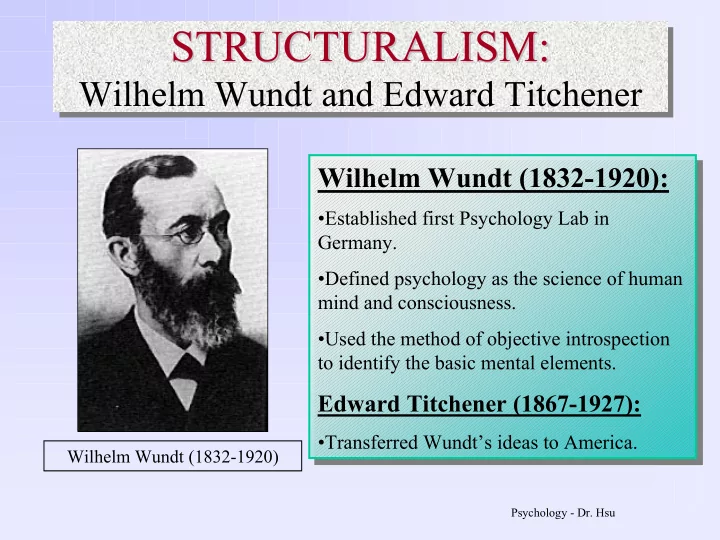
Wilhelm Wundt (1832-1920):

  • Established first Psychology Lab in

Germany.

  • Defined psychology as the science of human

mind and consciousness.

  • Used the method of objective introspection

to identify the basic mental elements.

Edward Titchener (1867-1927):

  • Transferred Wundt’s ideas to America.

Wilhelm Wundt (1832-1920):

  • Established first Psychology Lab in

Germany.

  • Defined psychology as the science of human

mind and consciousness.

  • Used the method of objective introspection

to identify the basic mental elements.

Edward Titchener (1867-1927):

  • Transferred Wundt’s ideas to America.

Wilhelm Wundt (1832-1920)

slide-2
SLIDE 2

Psychology - Dr. Hsu

FUNCTIONALISM

William James

FUNCTIONALISM FUNCTIONALISM

William James

William James (1842-1910):

  • Published “Principles of Psychology” in
  • 1890. The book covers a wide range of

topics, opening up the field of psychology.

  • Opposed Wundt’s elemental approach,

believed that “consciousness is a constant flow”.

  • Believed that psychology should focus on

the usefulness (or functions) of mental (learning and perceptual) abilities -- functionalism.

William James (1842-1910):

  • Published “Principles of Psychology” in
  • 1890. The book covers a wide range of

topics, opening up the field of psychology.

  • Opposed Wundt’s elemental approach,

believed that “consciousness is a constant flow”.

  • Believed that psychology should focus on

the usefulness (or functions) of mental (learning and perceptual) abilities -- functionalism.

William James (1842-1910)

slide-3
SLIDE 3

Psychology - Dr. Hsu

BEHAVIORISM:

John B. Watson

BEHAVIORISM: BEHAVIORISM:

John B. Watson

John B. Watson (1878-1958):

  • Argued strongly against structuralism and

contended that psychology should focus only on measurable and observable behavior -- behaviorism.

  • Defined psychology as the science of behavior.
  • The task of psychologists is to establish the

laws of behavior: S (stimulus) ------ R (response).

  • Believed in the dominant influence of learning

and environment as opposed and heredity.

John B. Watson (1878-1958):

  • Argued strongly against structuralism and

contended that psychology should focus only on measurable and observable behavior -- behaviorism.

  • Defined psychology as the science of behavior.
  • The task of psychologists is to establish the

laws of behavior: S (stimulus) ------ R (response).

  • Believed in the dominant influence of learning

and environment as opposed and heredity.

John B. Watson (1878-1958)

slide-4
SLIDE 4

Psychology - Dr. Hsu

BEHAVIORISM:

  • B. F. Skinner

BEHAVIORISM: BEHAVIORISM:

  • B. F. Skinner
  • B. F. Skinner (1904-1990):
  • A strong believer of behaviorism.
  • Contributed enormously in the area of
  • perant conditioning - learning by the

consequences of behavior.

  • Emphasized the roles of reinforcement and

punishment in shaping and modifying behavior.

  • B. F. Skinner (1904-1990):
  • A strong believer of behaviorism.
  • Contributed enormously in the area of
  • perant conditioning - learning by the

consequences of behavior.

  • Emphasized the roles of reinforcement and

punishment in shaping and modifying behavior.

  • B. F. Skinner (1904-1990)
slide-5
SLIDE 5

Psychology - Dr. Hsu

PSYCHOANALYSIS:

Sigmund Freud

PSYCHOANALYSIS: PSYCHOANALYSIS:

Sigmund Freud

Sigmund Freud (1856-1939)

  • Founder of Psychoanalysis - a personality

theory and an approach to psychotherapy.

  • Stressed the importance of unconscious

motives.

  • Emphasized the roles of early childhood

experience (psychosexual stages).

Sigmund Freud (1856-1939)

  • Founder of Psychoanalysis - a personality

theory and an approach to psychotherapy.

  • Stressed the importance of unconscious

motives.

  • Emphasized the roles of early childhood

experience (psychosexual stages).

Sigmund Freud (1856-1939)

slide-6
SLIDE 6

Psychology - Dr. Hsu

GESTALT PSYCHOLOGY:

Max Wertheimer

Max Wertheimer (1880-1943)

  • Focused on perception and how perception

influences thinking and problem solving.

  • “Gestalt” means whole, configuration, pattern,

and Gestalt psychologists illustrated how we tend to perceive separate pieces of information as integrated wholes.

  • Opposed Wundt’s approach in searching for

basic mental elements, because “the whole is more than the sum of its parts”.

Max Wertheimer (1880-1943)

  • Focused on perception and how perception

influences thinking and problem solving.

  • “Gestalt” means whole, configuration, pattern,

and Gestalt psychologists illustrated how we tend to perceive separate pieces of information as integrated wholes.

  • Opposed Wundt’s approach in searching for

basic mental elements, because “the whole is more than the sum of its parts”.

Max Wertheimer (1880-1943)

GESTALT PSYCHOLOGY: GESTALT PSYCHOLOGY:

Max Wertheimer

slide-7
SLIDE 7

Psychology - Dr. Hsu

HUMANISTIC PSYCHOLOGY:

Carl Rogers

HUMANISTIC PSYCHOLOGY: HUMANISTIC PSYCHOLOGY:

Carl Rogers

Carl Rogers (1902-1987):

  • Founder of client-centered or person-centered

therapy.

  • Believed that human nature is innately good.
  • Emphasized the uniqueness of human, growth

potential, and human’s capacity for choice and health.

  • Emphasized the importance of each person’s

subjective experience and perception of the world.

Carl Rogers (1902-1987):

  • Founder of client-centered or person-centered

therapy.

  • Believed that human nature is innately good.
  • Emphasized the uniqueness of human, growth

potential, and human’s capacity for choice and health.

  • Emphasized the importance of each person’s

subjective experience and perception of the world.

Carl Rogers (1902-1987)

slide-8
SLIDE 8

Psychology - Dr. Hsu

HUMANISTIC PSYCHOLOGY:

Abraham Maslow

HUMANISTIC PSYCHOLOGY: HUMANISTIC PSYCHOLOGY:

Abraham Maslow

  • A. Maslow (1908-1970):
  • Proposed a hierarchy of human needs, from the

lowest level of physiological needs to the highest level of self-actualization need.

  • Studied individuals who exemplified self-

actualization - who used their talents and abilities to their fullest.

  • Believed each person’s potential in self-

actualization.

  • A. Maslow (1908-1970):
  • Proposed a hierarchy of human needs, from the

lowest level of physiological needs to the highest level of self-actualization need.

  • Studied individuals who exemplified self-

actualization - who used their talents and abilities to their fullest.

  • Believed each person’s potential in self-

actualization.

Abraham Maslow (1908-1970)

slide-9
SLIDE 9

Psychology - Dr. Hsu

COGNITIVE PSYCHOLOGY:

Computer Revolution

Cognitive Psychology:

  • “Computer Revolution” advanced psychology

in the study of thinking, mental processes, and problem solving.

  • Cognitive psychologists apply information-

processing approach to the study of human cognition.

  • Cognitive psychologists believe that computer

can serve as a useful model for understanding how human processes information.

Cognitive Psychology:

  • “Computer Revolution” advanced psychology

in the study of thinking, mental processes, and problem solving.

  • Cognitive psychologists apply information-

processing approach to the study of human cognition.

  • Cognitive psychologists believe that computer

can serve as a useful model for understanding how human processes information.

Computer Revolution

COGNITIVE PSYCHOLOGY: COGNITIVE PSYCHOLOGY:

Computer Revolution Computer Revolution

slide-10
SLIDE 10

Psychology - Dr. Hsu

Time Span Pioneer / Main Event School of Thought Wilhelm Wundt Structuralism 1879 - 1910 William James Functionalism Edward Titchener Structuralism John B. Watson Behaviorism Max Wertheimer Gestalt Psychology 1910 -1930 Sigmund Freud Psychoanalysis

  • B. F. Skinner

Behaviorism 1930 - 1970 Carl Rogers & A. Maslow Humanistic Psychology Computer Revolution Cognitive Psychology 1970 - Present Brain Research and Imaging Physiological Psychology

History of Psychology