SLIDE 1 The Francis Crick Institute: Opportunities to Engage
Professor Maggie Dallman
- Vice President (International), Associate Provost (Academic
Partnerships) at Imperial Professor Malcolm Irving
- Associate Research Director at the Crick
Professor Edward Tate’s satellite group
- Dr Monica Faronato and Dr Christelle Soudy
Dr Morgan Beeby
- Lecturer in Structural Biology, Satellite and PhD co-supervisor
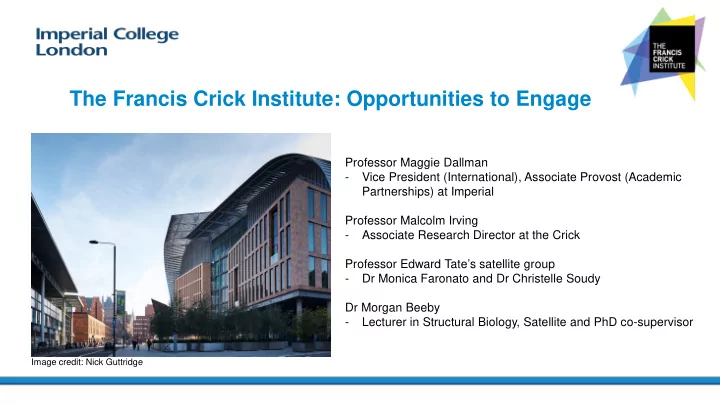
Image credit: Nick Guttridge
SLIDE 2
Professor Maggie Dallman Vice President (International), Associate Provost (Academic Partnerships)
SLIDE 3
The Crick Partnership
The Crick is a unique partnership between the MRC, Cancer Research UK, the Wellcome Trust, UCL, Imperial College London and King's College London. Imperial is a founding partner and has helped to shape the Crick’s scientific vision.
SLIDE 4 Strategy
The Francis Crick Institute’s scientific vision is 'to discover the biology underlying human health, improving the treatment, diagnosis and prevention of human disease and generating economic opportunities for the UK’. This can only be achieved in partnership, and Imperial sees the collaborations between our scientists as of fundamental importance to realising Discovery Without Boundaries.
Image credit: Paul Grundy
SLIDE 5 Opportunities to Engage
We have created programmes to enable Imperial researchers to work with collaborators at the Crick. We want you to engage! Key date: 6 April – deadline for applications for attachments
Image credit: Fiona Hanson
SLIDE 6
Professor Malcolm Irving Associate Research Director at the Crick
SLIDE 7 The Partner Universities and the Crick-Disciplinary Stretch
STEM Bio-discovery Translation Clinical
Universities BRCs AHSCs NHS
Technology, Modelling, Informatics Bench to bedside
Crick
Bedside to bench
SLIDE 8 Studentship Opportunities
Image credit: Paul Grundy
- Crick's PhD programme - a four-year biomedical
research PhD based at the Crick and registered with a university partner.
- Crick-Cancer Research UK doctoral fellowships for
clinicians - clinicians to perform research into cancer for three years (following the Crick's clinical PhD programme).
- Crick doctoral fellowships for clinicians - clinicians to
perform research for three years (following the Crick's clinical PhD programme). Applications open later in 2018.
SLIDE 9 Staff Opportunities
- Attachments - allow staff to do collaborative research with staff at the Crick and make use of the
cutting-edge facilities. Applications open now – deadline 6 April.
- Doctoral supervision - either core-funded studentships with HEI secondary supervisor or jointly
funded studentships with co-supervision. Applications open in April 2018.
- Networking fund - supports networking activities between staff from across the Crick Partnership of
typically between £2-5k. Applications open - rolling deadline.
- Group leader recruitment - early career researchers set up an independent research programme at
the Crick for 6 years until transferring to the College department. Applications open later in 2018.
- Interest Groups - college staff can join Crick Internal Interest Groups as Associate
- Members. Applications open later in 2018.
SLIDE 10 Types of Attachments
Image credit: Paul Grundy
- Secondments allow a PI to transfer all or part of their
research group to the Crick for an agreed period (typically between 3 and 6 years). Usually the PIs in question are early in their careers.
- Satellites comprise small groups of university researchers
(usually 1 to 3) embedded in a Crick research group for an agreed period (typically between 1 and 3 years).
- Sabbaticals will enable a PI to spend up to a year working in
a Crick research group, for example to learn new techniques
- r to undertake a hands-on collaboration.
SLIDE 11 How Attachments work
- Selected through a competitive process, based on:
- Excellence of the research proposal
- Added value to secondee group, the Crick and the University
- Interdisciplinarity
- Career development
- Transferring staff remain employees of home institution
- The work of these researchers is supported by external grants held by the university
- Attachments may be in both directions, but so far almost exclusively university to Crick
- Annual call, the next round of university attachments will take place in 2018
– Deadline 6 April 2018
SLIDE 12 Current Attachments
- In the first three rounds, we identified 37 attachments
in a wide spread of disciplines including physical and biophysical, computational and mathematical, and clinical disciplines.
- 8 secondments
- 21 satellite groups
- 7 sabbaticals
- 23 have commenced, the rest expected to transfer in
2018/19
- 2018 final decisions in July 2018
Image credit: Paul Grundy
SLIDE 13
Department of Chemistry Professor Ed Tate Department of Life Sciences Dr Morgan Beeby Dr Cristina Lo Celso Department of Mathematics Dr Gunnar Pruessner Department of Physics Professor Paul French Department of Materials Professor Molly Stevens Department of Medicine Professor Xiaodong Zhang Professor Wendy Barclay National Heart and Lung Institute Professor Clare Lloyd
Imperial attachments
SLIDE 14 Benefits
Image credit: Fiona Hanson
- Collaborations between leading biomedical scientists
and researchers in related fields from across the partners
- World-class equipment and facilities
- Scientific interest groups
- Seminars and symposia
- Translating basic science into clinical discoveries
- Crick as a national resource, encouraging collaboration
across the UK and beyond
SLIDE 15
Professor Edward Tate’s Satellite group Experiences from Dr Monica Faronato and Dr Christelle Soudy
SLIDE 16
Dr Morgan Beeby Experiences on attachment (satellite) and as a PhD co-supervisor
SLIDE 17
Contact the Imperial Crick team at crick@imperial.ac.uk For further information and application details please visit www.imperial.ac.uk/a-z-research/crick/