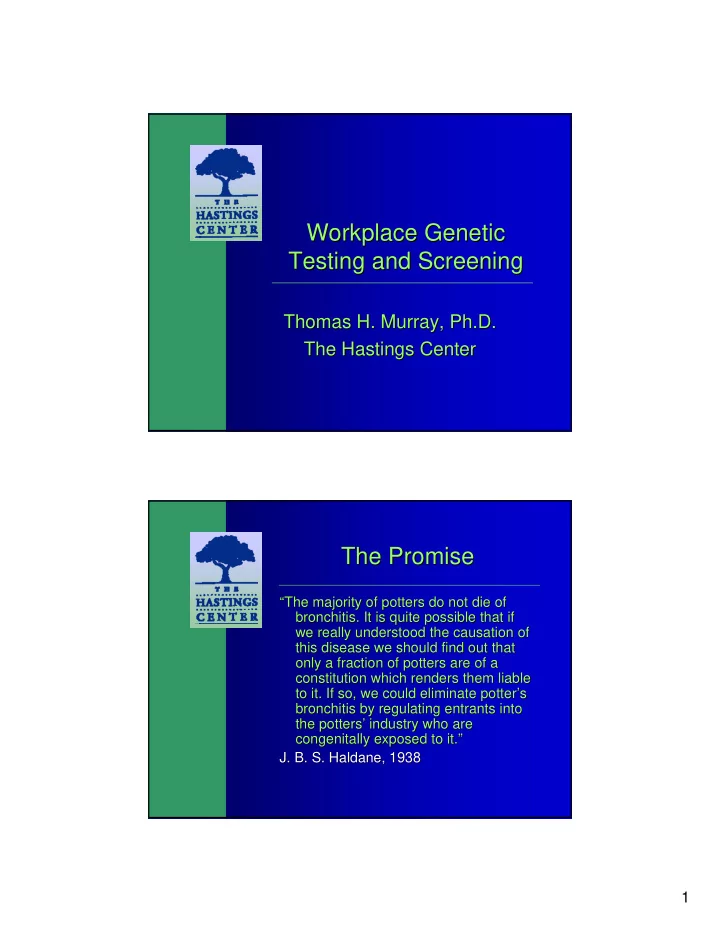
Workplace Genetic Workplace Genetic Testing and Screening Testing - - PDF document

workplace genetic workplace genetic testing and screening
SMART_READER_LITE
LIVE PREVIEW

Workplace Genetic Workplace Genetic Testing and Screening Testing - - PDF document

Workplace Genetic Workplace Genetic Testing and Screening Testing and Screening Thomas H. Murray, Ph.D. Thomas H. Murray, Ph.D. The Hastings Center The Hastings Center The Promise The Promise The majority of potters do not die of The


slide-1
SLIDE 1

1

Workplace Genetic Workplace Genetic Testing and Screening Testing and Screening

Thomas H. Murray, Ph.D. Thomas H. Murray, Ph.D. The Hastings Center The Hastings Center

The Promise The Promise

“ “The majority of potters do not die of The majority of potters do not die of

  • bronchitis. It is quite possible that if
  • bronchitis. It is quite possible that if

we really understood the causation of we really understood the causation of this disease we should find out that this disease we should find out that

  • nly a fraction of potters are of a
  • nly a fraction of potters are of a

constitution which renders them liable constitution which renders them liable to it. If so, we could eliminate potter to it. If so, we could eliminate potter’ ’s s bronchitis by regulating entrants into bronchitis by regulating entrants into the potters the potters’ ’ industry who are industry who are congenitally exposed to it. congenitally exposed to it.” ”

  • J. B. S.
  • J. B. S. Haldane

Haldane, 1938 , 1938

slide-2
SLIDE 2

2

Gene Gene-

  • environment

environment interactions interactions

  • Primaquine

Primaquine and and hemolysis hemolysis in in American soldiers in Korea American soldiers in Korea

  • G6PD and

G6PD and “ “favism favism” ”

  • Why not workplace

Why not workplace exposures? exposures?

Early candidates for Early candidates for “ “hypersusceptibility hypersusceptibility” ”

  • G6PD

G6PD

  • Sickle cell trait

Sickle cell trait

  • Alpha

Alpha-

  • 1

1-

  • antitrypsin deficiency

antitrypsin deficiency

  • Reactions to carbon disulfide

Reactions to carbon disulfide

  • Reactions to organic

Reactions to organic isocynates isocynates

Stokinger Stokinger and and Scheel Scheel, , “ “Hypersusceptibility Hypersusceptibility and and Genetic Problems in Occupational Medicine Genetic Problems in Occupational Medicine— —A A Consensus Report, Consensus Report,” ” J Occupational Medicine 15:7 J Occupational Medicine 15:7 (July 1973) 564 (July 1973) 564-

  • 573.

573.

slide-3
SLIDE 3

3

Early Warning Early Warning

“ “Genetic screening is going on Genetic screening is going on already and it will continue to be already and it will continue to be done, whether or not the experts done, whether or not the experts believe it is scientifically valid believe it is scientifically valid… …It It is time to begin considering is time to begin considering questions that we may well face questions that we may well face squarely before the end of this squarely before the end of this decade. decade.” ”

Author to be identified later, 1983. Author to be identified later, 1983.

4 Purposes for Genetic 4 Purposes for Genetic Screening or Testing Screening or Testing

  • Diagnosis

Diagnosis

  • Research on workplace

Research on workplace illnesses illnesses

  • Informing workers of their

Informing workers of their risks risks

  • Excluding workers

Excluding workers involuntarily involuntarily

slide-4
SLIDE 4

4

Toward an Ethical Toward an Ethical Analysis Analysis

  • How many people have the

How many people have the anomaly? anomaly?

  • What are their relative and

What are their relative and absolute risks? absolute risks?

  • How many people will be

How many people will be misidentified as false negatives, misidentified as false negatives, false positives? false positives?

  • How many jobs are involved?

How many jobs are involved?

Toward an Ethical Toward an Ethical Analysis (continued) Analysis (continued)

  • Are the illnesses serious, irreversible

Are the illnesses serious, irreversible if not detected early if not detected early

  • How solid is the evidence linking

How solid is the evidence linking disease to genes and exposures likely disease to genes and exposures likely in the workplace? in the workplace?

  • Would screening focus on groups with

Would screening focus on groups with a history of discrimination? a history of discrimination?

  • How cost

How cost-

  • effective is genetic

effective is genetic screening relative to other strategies screening relative to other strategies to reduce workplace diseases? to reduce workplace diseases?

slide-5
SLIDE 5

5

Conclusions Conclusions

  • Using genetic tests as part of

Using genetic tests as part of legitimate medical diagnosis for an legitimate medical diagnosis for an individual worker is acceptable. individual worker is acceptable.

  • Research on the relation between

Research on the relation between genes, workplace exposures, and genes, workplace exposures, and illness can be useful. illness can be useful.

  • Informing workers about genetic risks

Informing workers about genetic risks can be justifiable when the science can be justifiable when the science links alleles, exposures, and disease links alleles, exposures, and disease

A defensible exclusion A defensible exclusion policy MUST: policy MUST:

  • Have sound scientific linking genes to

Have sound scientific linking genes to exposures to disease exposures to disease

  • Have very large relative and absolute

Have very large relative and absolute risks risks

  • Have few, reversible,

Have few, reversible, misclassifications misclassifications

  • Exclude very few people

Exclude very few people

  • Involve very few jobs

Involve very few jobs

  • Target severe, irreversible, disease

Target severe, irreversible, disease

  • Not

Not single out beleaguered groups single out beleaguered groups

slide-6
SLIDE 6

6

Those who fail to learn Those who fail to learn from history from history… …

  • EEOC

EEOC vs vs Burlington Northern Burlington Northern Santa Fe Railroad Santa Fe Railroad

  • First EEOC lawsuit on genetic

First EEOC lawsuit on genetic testing testing

  • 20

20-

  • 30 BNSF employees

30 BNSF employees unknowingly subjected to test for unknowingly subjected to test for HNPP, Chromosome 17 deletion HNPP, Chromosome 17 deletion claimed to be associated with claimed to be associated with risk of carpal tunnel syndrome risk of carpal tunnel syndrome

HNPP and CTS HNPP and CTS

“HNPP is probably HNPP is probably underdiagnosed underdiagnosed because it typically has episodic and because it typically has episodic and transient clinical manifestations. transient clinical manifestations. Stockton et al. (2001) Stockton et al. (2001) evaluated 50 evaluated 50 patients diagnosed with idiopathic patients diagnosed with idiopathic CTS and found no instance of the CTS and found no instance of the chromosome 17 chromosome 17 microdeletion microdeletion that that causes HNPP. causes HNPP.” ”

  • OMIM

OMIM http:// http://www.ncbi.nlm.nih.gov/entrez/query.fcgi? www.ncbi.nlm.nih.gov/entrez/query.fcgi? cmd cmd= =Retrieve&db Retrieve&db= =OMIM&dopt OMIM&dopt= =Detailed&tm Detailed&tm pl pl= =dispomimTemplate&list_uids dispomimTemplate&list_uids=115430 =115430

slide-7
SLIDE 7

7

Disposition of EEOC Disposition of EEOC vs vs BNSF BNSF

  • BNSF agreed not to:

BNSF agreed not to:

– Directly or indirectly require its employees to submit blood for genetic tests – Analyze any blood previously obtained – Evaluate, analyze or consider any gene test analysis previously performed on any

  • f its employees

– Retaliate or threaten…any person who

  • pposed the genetic test or participated in

the EEOC proceedings. – EEOC Statement, 18 April 2001

Complexities Complexities

  • BNSF did genetic

BNSF did genetic testing testing not genetic not genetic screening screening

  • Lead outside counsel for BSNF argues that

Lead outside counsel for BSNF argues that this is an instance of this is an instance of genetic genetic exceptionalism exceptionalism

  • Employees should have been informed in any

Employees should have been informed in any case case

  • Company docs and divided loyalties

Company docs and divided loyalties

  • Not based on good science, an absolute

Not based on good science, an absolute requirement for any use of genetics in the requirement for any use of genetics in the workplace* workplace*

  • * T. H. Murray,

* T. H. Murray, “ “Warning: Screening Workers for Genetic Warning: Screening Workers for Genetic Risk, Risk,” ” Hastings Center Report, Feb. 1983: 5 Hastings Center Report, Feb. 1983: 5-

  • 8

8

slide-8
SLIDE 8

8

Thomas H. Murray, Ph.D. Thomas H. Murray, Ph.D. President President The Hastings Center The Hastings Center

  • 21 Malcolm Gordon Road

21 Malcolm Gordon Road

  • Garrison, NY 10524

Garrison, NY 10524-

  • 5555

5555

  • 845

845-

  • 424

424-

  • 4040

4040

  • murrayt@thehastingscenter.org

murrayt@thehastingscenter.org