Winter Weather National Weather Service Buffalo, NY Average - - PowerPoint PPT Presentation

winter weather
SMART_READER_LITE
LIVE PREVIEW

Winter Weather National Weather Service Buffalo, NY Average - - PowerPoint PPT Presentation

Winter Weather National Weather Service Buffalo, NY Average Seasonal Snowfall SNOWFALL = BIG IMPACTS School / government / business closures Airport shutdowns/delays Traffic accidents with injuries/fatalities Money


slide-1
SLIDE 1

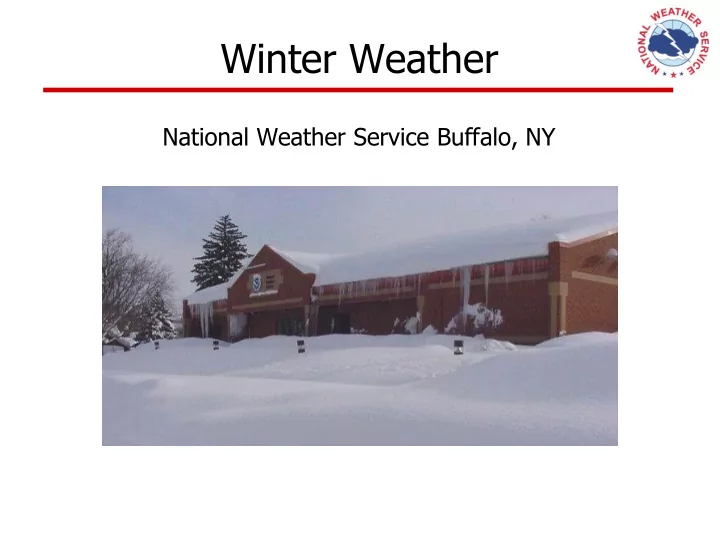
Winter Weather

National Weather Service Buffalo, NY
slide-2
SLIDE 2
slide-3
SLIDE 3

Average Seasonal Snowfall

slide-4
SLIDE 4

SNOWFALL = BIG IMPACTS

4

  • School / government / business closures
  • Airport shutdowns/delays
  • Traffic accidents with injuries/fatalities
  • Money plowing/treating roads
  • Lost resources in traffic congestion
  • Power outages/damage in strong storms
slide-5
SLIDE 5

Communicating Risk Potential

The National Weather Service uses a “Ready, Set, Go” approach Substituting the words “Outlook, Watch, and Warning”

This approach is based on the lead-time of the event and forecaster confidence.

slide-6
SLIDE 6

Hazardous Weather Outlook

  • Issued each day between 5am and 6am
  • Updated as necessary throughout the day
  • Outlines potential weather hazards expected
  • ver the next seven days
  • The potential for major storms beyond two days

will be discussed in the HWO

slide-7
SLIDE 7

WATCH vs. WARNING

Watch

Conditions are favorable for severe weather in or near the watch area. Watches are issued for winter storms, ice storms and blizzards.

Warning

The severe weather event is imminent

  • r occurring in the warned area.

Warnings are issued for winter storms, ice storms and blizzards.

slide-8
SLIDE 8

WINTER WEATHER WATCHES

  • Issued when forecaster confidence in the event
  • ccurring is at 50% or greater
  • Updated at least once every 12 hours or when

there is a change in timing, areal extent, or expected conditions.

  • Generally issued 24 to 48 hours in advance
  • Types:

– Winter Storm (Snow, Blowing Snow, Blizzard, Lake Effect) – Wind Chill

slide-9
SLIDE 9

WINTER WEATHER WARNINGS

  • Issued when hazardous winter weather is
  • ccurring or is imminent.
  • Forecaster confidence is at 80% or greater
  • Warnings can be issued based on significant

public impact events

  • Generally issued 12 to 36 hours in advance
slide-10
SLIDE 10

Warnings

  • Issued when forecaster confidence reaches 80%
  • Types
  • Blizzard Warning
  • Ice Storm Warning
  • Lake Effect Snow Warning
  • Winter Storm Warning
  • Wind Chill Warning
slide-11
SLIDE 11

Blizzard Warning

  • Wind speeds of 35 mph or greater

AND

  • Visibility of ¼ mile or less in blowing snow

AND

  • Conditions must persist for at least 3 hours
  • Blizzards may or may not be accompanied by falling

snow

– When not accompanied by falling snow, it is referred to as a Ground Blizzard

  • “Severe” blizzard

– All of the above except temperatures below 20° F – Wind chills well below zero

slide-12
SLIDE 12

Ice Storm Warning

  • Issued when 1/2 inch or more of ice

accumulation is expected

  • An Ice Storm Warning means that freezing rain

is expected to be the dominant precipitation type

slide-13
SLIDE 13

Winter Storm Warning

  • Issued when a combination of snow, sleet,

and/or freezing rain are expected to reach warning criteria

  • Issued for a general heavy snowfall of:

– 7 inches in 12 hours – 9 inches in 24 hours

slide-14
SLIDE 14

Lake Effect Snow Warning

  • Issued for a general heavy

snowfall of:

– 7 inches in 12 hours – 9 inches in 24 hours

  • Lake effect snow warning implies the localized

nature of the heavy snow

– In most cases not everyone in a county will receive warning criteria snowfall

slide-15
SLIDE 15

Wind Chill Warning

  • Issued for dangerously cold wind chills

– Wind speeds generally 5 mph or greater

  • Issued when wind chills are forecast to fall

below -25° F

slide-16
SLIDE 16

WINTER WEATHER ADVISORIES

  • Issued when winter weather is expected

to cause significant inconveniences.

  • If caution is not exercised, could lead to

life-threatening situations

  • Advisories:

– Winter Weather (Snow, Lake Effect Snow, Blowing Snow, Ice or Sleet) – Wind Chill

slide-17
SLIDE 17

17

slide-18
SLIDE 18

ALSO NEW THIS WINTER...

18

  • Short-fused SNOW SQUALL WARNINGS

– Visibilities of ¼ mile or less – Sub-freezing ambient road temperatures or plunging surface temperatures along and behind arctic front sufficient to produce flash freezes – Gusty winds and blowing snow

  • Beginning

December 1st

slide-19
SLIDE 19

OUR GOAL

  • To provide more information to

– Facilitate improved decision making – Elicit the proper public response during the most life-threatening weather events

19

slide-20
SLIDE 20

Weather Forecasts are Inherently Uncertain

  • Chaotic Nature of the Atmosphere
  • Deficiencies In Observations
  • Uncertainties in Computer Simulations of Atmosphere

Yet the demand for snowfall forecasts has escalated!

20

slide-21
SLIDE 21

Accurate Forecasts Desired Days in Advance But, as Lead Time increases, Certainty decreases

  • We need to better communicate the range of

possibilities

– Find a balance between Lead Time and Certainty

  • NWS constantly striving to provide:

– The most accurate weather forecast – Relay our degree of uncertainty

21

slide-22
SLIDE 22
slide-23
SLIDE 23

Our Websites

  • www.weather.gov/buf
  • http://digital.weather.gov
  • http://preview.weather.gov/edd

23

slide-24
SLIDE 24

24

Enter a Zip Code Or City, State Click Location

  • n the Map

www.weather.gov/buf

slide-25
SLIDE 25

“Point and Click” Forecast

slide-26
SLIDE 26

Hourly Forecast Graphs

slide-27
SLIDE 27

27

For a text forecast for a County Select Text Bulletins then Zone Forecast

www.weather.gov/buf

slide-28
SLIDE 28

http://digital.weather.gov

28

Graphical Forecasts from NWS digital database Zoom-able to Street Level Forecasts of:

  • Temperature
  • Wind
  • Probability of

Precipitation

  • Hazards
  • Precipitation

Amounts – 6-hr and total

  • Snow amounts –

6-hr and total

slide-29
SLIDE 29

http://preview.weather.gov/edd

29

http://go.usa.gov/hegF

  • Current Observations:

– Radar, Satellite, Hazards, Surface Observations

  • Forecasts:

– Forecast Graphics – Hydrology

slide-30
SLIDE 30

Storm Total Forecast

30

slide-31
SLIDE 31

Winter Weather Snowfall Rate Threat Buffalo Forecast Office

http://www.weather.gov/buf/Snowfall_Rate_Threat_Loop

31

slide-32
SLIDE 32

32 9/22/2017

Winter Weather Snowfall Rate Threat Buffalo Forecast Office

http://www.weather.gov/buf/SnowfallRateThreatTiles

slide-33
SLIDE 33

33

Winter Weather Snowfall Rate Threat Buffalo Forecast Office

http://www.weather.gov/buf/Snowfall_Rate_Threat_Loop

2AM Tuesday 11/18/2014 6AM Tuesday 11/18/2014

slide-34
SLIDE 34

www.weather.gov/buf

slide-35
SLIDE 35

NWS Weather Information On Your Mobile Phone

35

Take the weather with you on your mobile phone! Wherever you are, you can get the local weather forecast from the National Weather Service with

  • ne click on your home screen.

Bookmark mobile.weather.gov to make sure that you have the latest weather news and information on the go.

9/22/2017

slide-36
SLIDE 36

Weather Ready Nation Ambassadors

  • Partners commit to working with NOAA and other

Ambassadors to strengthen national resilience against extreme weather.

  • Unifies efforts across government,

non-profits, academia, and private industry toward making the nation more ready, responsive, and resilient against extreme environmental hazards.

  • Ambassadors serve a pivotal role in affecting societal change

— helping to build a nation that is ready, responsive, and resilient to the impacts of extreme weather and water events.

slide-37
SLIDE 37

5 Fun Facts about Snow

1. All snowflakes have six sides 2. Snow crystals are translucent, not white. All visible colors are reflected, which together, look white. 3. Most snowflakes fall at a speed of 2 to 5 feet per second, roughly the same speed as a person casually walking through a park 4. Official snowfall and snow depth measurements include snow, sleet and ice pellets – in the summer, hail will also be recorded as a trace of snow if it is on the ground when the observation is taken. 5. A cubic foot of snow may contain between 1 and 2 million individual snowflakes.

slide-38
SLIDE 38

38

Fall begins Friday (9/22) at 4:02 PM

slide-39
SLIDE 39

Any Other Questions?