
SLIDE 1
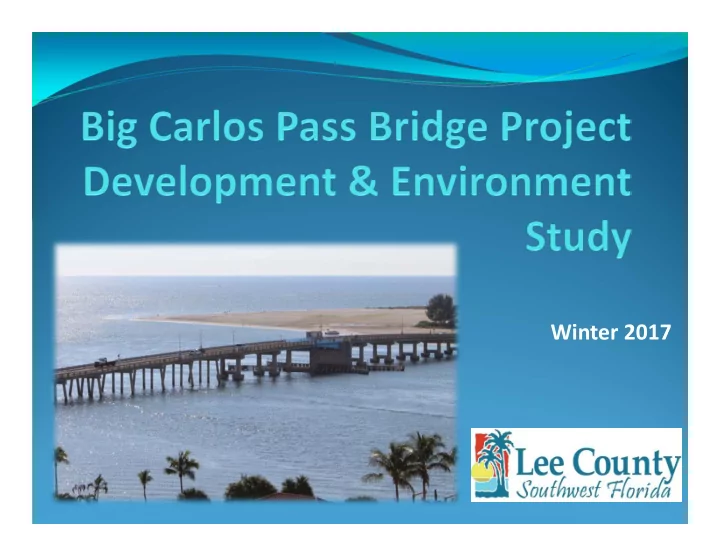
Winter 2017 Why Are We Here? Bridge was built in 1965 and is now - - PowerPoint PPT Presentation
Winter 2017 Why Are We Here? Bridge was built in 1965 and is now over 50 years old Big Carlos Bridge replacement programmed in FY20 21 First step is a Project Development & Environment Study (PD&E) Next steps include
Bridge was built in 1965 and is now over 50 years old Big Carlos Bridge replacement programmed in FY20‐21 First step is a Project Development & Environment Study
Next steps include design then construction
Data collection Alternatives Analysis (including the no‐build/rehabilitation
Public and agency involvement Selection of preferred alternative
Involves gathering information needed to develop/evaluate various alternatives. Some of the data gathered includes:
Traffic counts Crash records Existing roadway conditions Identification of wetlands Threatened/Endangered species habitat Existing land use and property information Existing drainage systems and drainage patterns Contamination sites Archeological/Historical sites
Engineering alternatives developed Input obtained from public, local
No‐build alternative remains viable
Alternatives evaluation for
Preferred build alternative and no build alternative will be
Final documentation will be submitted to the Florida
Then project can advance to the design, right‐of‐way
Typical Section
Existing typical two 13’ lanes + two 3’ sidewalks New typical section will be evaluated
Vertical Alignment
Bascule (Drawbridge)
Low‐Level Mid‐Level
Fixed‐Span
High‐level
Horizontal Alignment
South North
65’ HIGH 65’ HIGH LEVEL LEVEL FIXED FIXED 45’ MID LEV 45’ MID LEVEL BASCUL BASCULE (DRA (DRAWBRIDGE) WBRIDGE) 21 21’ L LOW L LEVEL B BASCULE (DRA (DRAWBRIDGE) WBRIDGE) Location of Location of Channel Channel MV MVC
Newsletters Project Website Public Information Meetings
Alternatives Public Meeting Public Hearing
Individual/Small Group Meetings
Meetings with HOAs Meetings with private marinas
Community Events
Lovers Key Outdoor Adventure Day & Exploration Walk Taste of the Beach, Christmas Boat Parade, Art Bazaar
Notification
Newsletters and invitation letters Advertisements in local papers and in community
newsletters
Online notices – County and Fort Myers Beach websites and
HOAs
Toll‐Free Hotline
Town of Fort Myers Beach City of Bonita Springs Utility Agency Owners Environmental Agencies Lovers Key State Park Islands End Condominiums Lovers Key Beach Club Island Beach Club Lovers Key Resort Waterside Condominiums Pelican Landing Community Association Chamber of Commerce Boating Organizations & Marinas
Public involvement Study duration approximately 18 months Outcomes of PD&E Study
Preferred Alternative identified Estimate of cost NEPA clearance to continue design
After PD&E phase‐design and construction