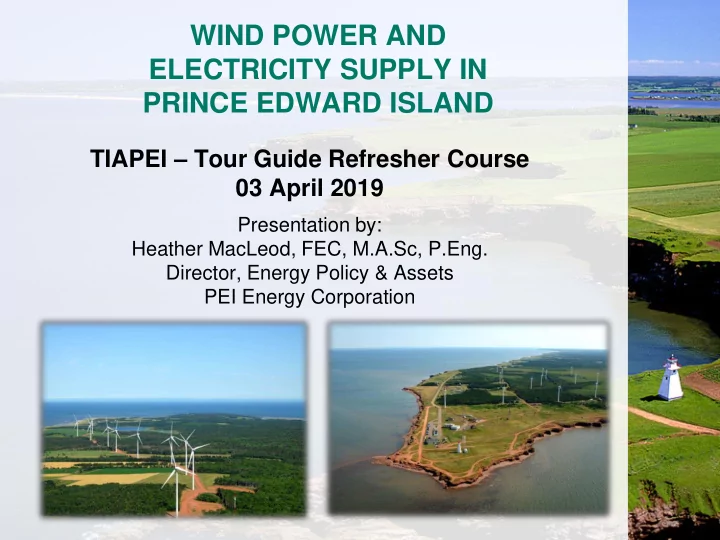
SLIDE 1
WIND POWER AND ELECTRICITY SUPPLY IN PRINCE EDWARD ISLAND
TIAPEI – Tour Guide Refresher Course 03 April 2019
Presentation by: Heather MacLeod, FEC, M.A.Sc, P.Eng. Director, Energy Policy & Assets PEI Energy Corporation
SLIDE 2 ~ Presentation Outline ~
- PEI Energy Situation
- PEI Energy Strategy
- Our Wind Resource
- Evolution of Wind Energy in PEI
- Commercial Wind Energy
- Models for Wind Development
- Small Wind Installations
- Renewable Energy Storage
- PEI-NB Cable Project
- Questions and Discussion
SLIDE 3 ~ PEI Energy Situation ~
Current Energy Mix
- PEI is very reliant on imported energy supplies,
particularly oil. Presently, 76% of our total annual energy consumption is in the form of liquid petroleum products.
- 14% of our total energy requirement is in the form of
electricity.
- 10% of our total energy consumption is derived from local
biomass products.
- More than $500 million leaves the province annually as
energy is imported to meet the Island’s heating, power and transportation requirements.
Energy sources include: gasoline, heating fuel, diesel, propane, biomass AND electricity. Electricity includes: electricity!
SLIDE 4 ~ PEI Energy Situation ~
PEI’s Current Energy Mix
- Transportation represents 42% (2017: 48%) of the
Province’s energy requirement and is almost entirely reliant
- n the importation of liquid petroleum fuels.
- Oil remains the major heating source for home heating and
requires 27% of PEI’s energy supply.
- Biomass, in the form of cordwood and
woodchips, is utilized for residential heating, government facilities, and district heating.
- On-Island wind power assets
supply 4% of total energy.
10% 10% 4% 27% 42% 7% Imported & oil- fired electricity Biomass Electricity from
Home Heating
Transportation Other
SLIDE 5 ~ PEI Energy Situation ~
Electrical Energy Mix by Fuel Type
Presently …
- 61% of the electricity is sourced from NB Power system
energy (a mix of electricity generated from oil, natural gas, coal, hydro, nuclear, wind and biomass).
- 24% of electricity is being generated
from wind turbines located in PEI.
- 14% of electricity comes from the
Point Lepreau nuclear plant through NB Power.
- Approximately 1% is generated
- n-Island with oil.
SLIDE 6 Energy Strategy Guiding Principles
- 1. LOWERING GREENHOUSE GAS EMISSIONS
Knowing the goals of our country and our province, it was important to generate a Strategy that would align us with this direction.
- 2. ACTIONS AND DECISIONS SHOULD BE COST-
EFFECTIVE This Strategy has been developed taking into account costs of various options, and favours those that lead to lower overall costs in the long term.
- 3. LOCAL ECONOMIC OPPORTUNITIES
Part of lowering GHGs and pursuing cost-effective options is focusing on local capacity and development
~ PEI Energy Strategy ~
Details: https://www.princeedwardisland.ca/en/publication/pei-energy-strategy
SLIDE 7 ~ Our Wind Resource ~
- Due to a lack of indigenous
sources of energy fuels, wind development was an
electricity generation.
class wind resource.
- Wind meets the strategic
- bjectives of our energy
policy as it:
energy security, price certainty & supply diversity;
non-emitting;
- Enables economic
- pportunities in rural PEI.
Wind Speed (m/s) at 50 meters agl Wind Speed (m/s) at 80 meters agl
SLIDE 8
- PEI was 100% dependant on fossil fuels for electric power
generation;
- Wind power was a fringe technology;
- Total installed wind capacity in PEI was less than 500 kW;
- A 65-kW wind turbine was a “large” turbine;
- Concepts of climate change and global
warming were still considered by many as science fiction;
- Wind power was generally dismissed as
too expensive for commercial scale viability. When we started with wind back in the early 1980’s …
~ Evolution of Wind Energy in PEI ~
SLIDE 9
- The concept of climate change is globally accepted;
- Wind power is mainstream technology and is the fastest
growing source of new electrical generation in the world;
- A 3 or 4-MW wind turbine is a common sized unit;
- Total installed wind capacity in PEI is 204 MWs (our peak load
is about 280 MW);
- Wind supplies 24% of the province’s electricity
requirements; Where we are now …
~ Evolution of Wind Energy in PEI ~
Details: https://www.princeedwardisland.ca/en/feature/pei-wind-energy/
SLIDE 10 ~ Wind Energy Developments to Date ~
There are now eight utility-grade wind farms operating within PEI, including the following provincially-owned facilities:
- The first commercial wind farm in Atlantic Canada was
developed by the PEI Energy Corporation at North Cape in 2001. This facility initially included eight 660-kW turbines and was expanded to 16 turbines in 2003. It has a total output of 10.5 MW.
- In January 2007, the PEI Energy Corporation commissioned
its second wind farm in Eastern Kings. This 30-MW facility consists of ten 3-MW turbines.
- In May 2013, the PEI Energy Corporation purchased a 3-MW
turbine near North Cape. It had been originally developed by Vestas-Canadian Wind Technologies in 2004 as a prototype.
- In January 2014, the PEI Energy Commission commissioned
its newest wind farm at Hermanville/Clearspring. It is also a 30-MW facility with ten 3-MW turbines.
SLIDE 11
~ Wind Energy Developments to Date ~
North Cape Wind Farm
SLIDE 12
~ Wind Energy Developments to Date ~
Eastern Kings Wind Farm
SLIDE 13 ~ Wind Energy Developments to Date ~
Hermanville/Clearspring
- The latest wind development was completed by the PEI Energy
Corporation in January 2014 at Hermanville/Clearspring, PEI.
SLIDE 14 ~ Wind Energy Developments to Date ~
Hermanville/Clearspring As one example of turbine size, the Acciona turbines at Hermanville/Clearspring were the largest in North America when the wind farm was built in 2013/2014. Acciona AW 116/3000
- Rotor diameter: 116 meters
- Blade: 56.7 meters / 14 tonnes
- Tower: height 92 meters / weight 262 tonnes
SLIDE 15
~ Wind Energy Developments to Date ~
Hermanville/Clearspring
SLIDE 16 ~ Models for Wind Development ~
- The provincial government, through the PEI Energy
Corporation, has been at the forefront of wind development in the province.
- Public ownership is not the only model of corporate structure
for wind development. The largest wind farm in PEI, at West Cape (99 MW), is owned and operated by Engie which also
- wns and operates another 9-MW facility near North Cape.
- The Wind Energy Institute of Canada is a non-profit research
and development facility that operates a 10-MW wind farm in North Cape. Its assets include five 2-MW wind turbines and a 2-MW battery storage system.
- The City of Summerside operates their own municipal electric
- utility. Generating assets for the City include four 3-MW
- turbines. The City also has an innovative “Heat for Less”
program to encourage its residents to utilize this renewable energy resource for home heating.
SLIDE 17
~ Net Metering Installations in PEI ~
Details: http://www.irac.pe.ca/electric/
SLIDE 18 ~ Small Wind Challenges ~
- While utility grade turbines have proven to be reliable
and cost effective, experience to date with small wind turbines has not been as positive.
- Small wind turbines are several times more costly to
purchase on a per kilowatt basis than the utility grade models.
- There is a tendency to rely on anecdotal evidence that
a location is “really windy” as opposed to the hard data.
- Maintenance and repair costs can be high relative to
the amount of energy that the turbine can generate.
- Setbacks from neighbors are important from a noise
and safety perspective.
SLIDE 19 ~ Renewable Energy Storage ~
Looking to the future, energy storage may provide
- pportunities for more wind energy development.
- WEICan – Wind Energy R&D Park
- Utility Scale Battery Storage – 1 MW / 2 MWh
- City of Summerside – Smart Utility Grid Project
- Furnaces, Space Heaters and Hot Water Heaters
- Smart Meters / Utility Internet Service
- Solar + Storage Project
- Maritime Electric – PowerShift Atlantic
- Residential – Hot Water Heaters
- Commercial – Refrigeration Units
- Load Control Device / Third-Party Internet Service
- PEI Wind-Hydrogen Solutions Initiative
SLIDE 20 ~ Wind-Hydrogen Solutions Initiative ~
Power Supply Water Treatment Electrolyzer Gas Holder Compressors Coolers Gas Control Panel Genset Storage Control Room
PEI Wind-Hydrogen Village Project
SLIDE 21
~ Wind Energy in Prince Edward Island ~
PEI Wind-Hydrogen Village Project
SLIDE 22
Hydrogen for transportation – vehicles and fueling
~ Wind-Hydrogen Solutions Initiative ~
SLIDE 23 Keeping the Lights On …
- Since the existing cable interconnection was installed in
1977, the Island’s peak load has increased by approximately 185 MW.
- The Island’s peak load is now 280 MW and is expected
to grow at a rate of up to 8 MW per year going forward.
- The volume of electricity consumed by Islanders is also
increasing at a rate of around 3% annually.
- With a capacity of 200 MW, the existing interconnection
was increasingly inadequate for the Island’s electricity demand.
- Electricity from on-Island oil fired generation costs 3 to 4
times as much as imported and wind generated electricity.
Details: http://energy.reinvented.net/
SLIDE 24 Planning the New Interconnection
- A variety of routes and configurations were
considered, including putting the new interconnection in or on the Confederation Bridge.
- Installation of two 180-MW submarine cables was
selected as the preferred option after considering security and reliability, maintenance and repair, risk management, service life and cost certainty (construction and operation).
- The preferred location for the new cable
interconnection was east of the Confederation Bridge, between Borden, PEI and Cape Tormentine, NB.
SLIDE 25
PEI-NB Interconnection Upgrade
SLIDE 26
PEI-NB Interconnection Upgrade
SLIDE 27 ~ Conclusions and Wrap Up ~
- Advancements in wind turbine technology in recent years
have significantly changed the energy supply situation in PEI.
- With a world-class wind resource the potential for more
wind energy development is excellent, but technologies like solar photovoltaic will serve to diversify our supply.
- There are big differences between commercial (utility)
scale and small scale wind installations … and the wind regimes they operate within.
- Economic energy storage technologies could take
renewable energy development to the next level.
- In the meantime, PEI has a new secure and reliable
interconnection with mainland Canada.
- Thank you for your attention!
SLIDE 28
~ Questions and Discussion ~