Wind Development in Yukon Unique technical matters in wind - - PowerPoint PPT Presentation

wind development in yukon
SMART_READER_LITE
LIVE PREVIEW

Wind Development in Yukon Unique technical matters in wind - - PowerPoint PPT Presentation

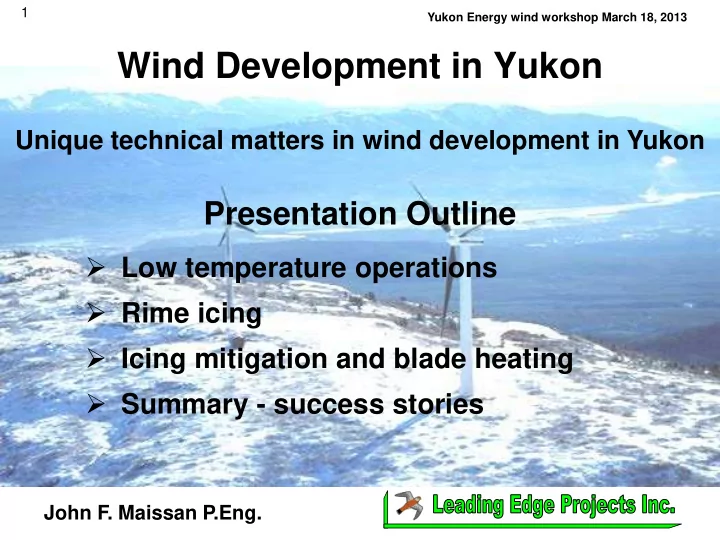
1 Yukon Energy wind workshop March 18, 2013 Wind Development in Yukon Unique technical matters in wind development in Yukon Presentation Outline Low temperature operations Rime icing Icing mitigation and blade heating Summary -


slide-1
SLIDE 1

Yukon Energy wind workshop March 18, 2013

John F. Maissan P.Eng.

1

Wind Development in Yukon

Unique technical matters in wind development in Yukon

Presentation Outline

  • Low temperature operations
  • Rime icing
  • Icing mitigation and blade heating
  • Summary - success stories
slide-2
SLIDE 2

Yukon Energy wind workshop March 18, 2013

Low temperature operations

John F. Maissan P.Eng.

2

  • 1. Standard Arctic turbine packages to -30°C
  • 2. Operation below -30°C requires special

steels

  • 3. Yukon mountain ridges where good winds

are found are less cold due to inversions – Haeckel Hill seldom below -30°C

  • 4. Also air densities lower, Haeckel Hill at

1.225 kg/m3 at about -30°C

  • 5. Enercon E70 2.3 MW at Diavik only large

turbines that can operate to -40°C

slide-3
SLIDE 3

Yukon Energy wind workshop March 18, 2013

Recommended for Yukon

John F. Maissan P.Eng.

3

Standard features & extras for low temperature

 Low temperature lubrication  Heaters in electrical cabinets  Heaters in hydraulic & gear oils, bearings  Add heaters in generator or nacelle to prevent condensation (sometimes included)  Add heated wind instruments (sometimes included)

slide-4
SLIDE 4

Yukon Energy wind workshop March 18, 2013

Rime icing

John F. Maissan P.Eng.

4

Cause of rime icing

 Humid sub-zero air pushed over ridges by wind  Pressure drops, air becomes super saturated and condensing moisture forms water or ice & water droplets in the air = cloud  Droplets adhere and freeze onto sub-zero things (trees, fences, power lines wind turbine blades)

Other characteristics

 Density ranges from about packed snow to ice  Can occur throughout temperature range  Usually porous with very rough surface – lots of air drag  Results in loss of lift on blades and significant reduction in

power production

slide-5
SLIDE 5

Yukon Energy wind workshop March 18, 2013

John F. Maissan P.Eng.

5

Rime icing on Gray Mountain

slide-6
SLIDE 6

Yukon Energy wind workshop March 18, 2013

Light rime ice mitigation

John F. Maissan P.Eng.

6

For light rime icing, <10% annual energy losses:

 Heated wind instruments a must  Black hydro- or ice-phobic blade coating to absorb solar heat when available to speed de-icing  Also suggest programming review to ensure turbine is allowed to under produce Manufacturers’ concern of blade overheating in summer found unfounded on Yukon Energy’s Vestas wind turbine Black coated blades standard part of Northern Power Systems 100kW turbine designed to operate to -40°C (Alaska target market)

slide-7
SLIDE 7

Yukon Energy wind workshop March 18, 2013

John F. Maissan P.Eng.

7

Black blades help deicing after shutdown

slide-8
SLIDE 8

Yukon Energy wind workshop March 18, 2013

Heavy rime ice mitigation

John F. Maissan P.Eng.

8

For heavy rime icing, >10% annual energy losses, how can it be described? Haeckel Hill estimate at 20% to 30% Several years of ice detector data indicated rime ice accumulation in >800 hourly periods / year Rime icing will be severe at all similar altitude sites throughout Yukon Icing severity increases with increasing altitude and with increasing height above ground level

slide-9
SLIDE 9

Yukon Energy wind workshop March 18, 2013

John F. Maissan P.Eng.

9

Icing while turbine shut down

slide-10
SLIDE 10

Yukon Energy wind workshop March 18, 2013

John F. Maissan P.Eng.

10

Rime ice on ¼ inch guy wire

slide-11
SLIDE 11

Yukon Energy wind workshop March 18, 2013

John F. Maissan P.Eng.

11

Icing on leading edge without heating

slide-12
SLIDE 12

Yukon Energy wind workshop March 18, 2013

John F. Maissan P.Eng.

12

Icing on leading edge without heating

slide-13
SLIDE 13

Yukon Energy wind workshop March 18, 2013

Heavy rime ice mitigation

John F. Maissan P.Eng.

13

Mitigation required for heavy rime icing (musts)

 Heated wind instruments  Black hydro- or ice-phobic blade coating to absorb solar heat when available to speed de-icing  Programming review to ensure turbines are allowed to under produce when safe to do so – no significant vibration or blade imbalance  Blade heating systems are also required  Ice detection systems should be an essential part of blade heating control systems  Long blades that flex help too

More on ice detection and blade heating

slide-14
SLIDE 14

Yukon Energy wind workshop March 18, 2013

John F. Maissan P.Eng.

14

Heater keeping leading edge clear

slide-15
SLIDE 15

Yukon Energy wind workshop March 18, 2013

Ice Detectors

John F. Maissan P.Eng.

15

Background

 Original ice detector with Bonus turbine did not function properly  Goodrich (Rosemount) 0872B12 ice detector purchase in 1996 worked reliably on Haeckel Hill until destroyed when shed blew over in wind storm  For many years detectors on the North America market not reliable in severe icing  Now better ice detectors are becoming available again

slide-16
SLIDE 16

Yukon Energy wind workshop March 18, 2013

Goodrich 0872B12 ice detector

John F. Maissan P.Eng.

16

slide-17
SLIDE 17

Yukon Energy wind workshop March 18, 2013

Current ice detectors

John F. Maissan P.Eng.

17

  • 1. Labkotec from Finland

 Have made ice detectors for about 20 years  Used for blade heating control on wind turbines in Scandinavia almost all that time  $10,900 CDN from ATS Technology (Toronto)

slide-18
SLIDE 18

Yukon Energy wind workshop March 18, 2013

Current ice detectors

John F. Maissan P.Eng.

18

  • 2. Goodrich – Campbell Scientific

 Have made ice detectors for decades  Have medium duty 0872F1 ice detector, $14,900  New severe climate detector 0872N1 to replace 0872B12 coming soon, $18,000 0872N1 0872F1

slide-19
SLIDE 19

Yukon Energy wind workshop March 18, 2013

Blade heating background

John F. Maissan P.Eng.

19

 Bonus supplied Yukon Energy’s first turbine with blade heating in 1993  Finland also installed first blade heating on commercial turbines in 1993  Late 1990s 15 turbines up to 1 MW with off –shelf Kemijoiki / VTT blade heating systems  Yukon Energy Vestas own designed system 2000  Then almost 10 year lull as turbine sales increased & manufacturers could not keep up, dropped icing  Enercon developed blade heating starting 2004  2010 Finnish WinWinD put blade heating on 3MW turbine (with VTT?)  Nordex (with VTT) followed in 2010-2011

slide-20
SLIDE 20

Yukon Energy wind workshop March 18, 2013

Blade Heating systems descriptions

John F. Maissan P.Eng.

20

1. VTT / Kemijoiki / WinWinD / Nordex

 External surface electro-thermal blade heating  Full blade surface  Ice detector controlled (Labkotec)  Low power anti-icing; high power de-icing  Turbine runs while heaters operate

2. Enercon

 Internal hot air heating  Heated air flows along leading edge from root to tip then returns  Some heat benefit in entire blade  No ice detector, temp. & rel. humidity control  Turbines used to stop to de-ice, no longer?

slide-21
SLIDE 21

Yukon Energy wind workshop March 18, 2013

Cost & energy of blade heating

John F. Maissan P.Eng.

21

 Capital costs in the order of 5% of turbine cost  Energy requirement in the order of 0.5% to 4% of annual turbine energy  Author’s analysis indicates blade heating is economic if annual losses are about 10% or higher (50% recovery of “lost” energy and 3% of annual energy consumed in heating system) – Enercon says higher recovery  All Yukon sites likely have >10% losses

slide-22
SLIDE 22

Yukon Energy wind workshop March 18, 2013

Current turbines with blade heating

John F. Maissan P.Eng.

22

  • 1. WinWinD 3MW – not yet in North America
  • 2. Enercon various models 2 to 3 MW, 2 MW

E82 available in Canada

  • 3. Nordex 2.5 MW turbines available in

North America

  • 4. RE Power says that it has passive and

active systems available

  • 5. Vestas hints it has, 2012 information says

systems will be in production in 2013

slide-23
SLIDE 23

Yukon Energy wind workshop March 18, 2013

Third Party blade heating suppliers

John F. Maissan P.Eng.

23

  • 1. Kelly Aerospace USA

 Electro-thermal blade heating system – on

  • utside of blade

 Leading edge up to 15% of blade width  No ice detector, use temp & relative humidity  For 80 or 90 m rotor new turbine approx $125 to $135k or 3% to 6% of turbine cost  System on Vestas V90 3MW in Caribou Hills project in New Brunswick; also in Sweden

slide-24
SLIDE 24

Yukon Energy wind workshop March 18, 2013

Third Party blade heating suppliers

John F. Maissan P.Eng.

24

  • 2. GreenWIND Global Canada (EcoTEMP°) in

Europe

 Electro-thermal blade heating system on

  • utside of blade, claims lower energy use

 Appears to be mainly leading edge  Method of control e.g. ice detector unknown  No information yet on capital costs  EcoTEMP° working with Vestas, Siemens, & developer O2

slide-25
SLIDE 25

Yukon Energy wind workshop March 18, 2013

Summary

John F. Maissan P.Eng.

25

  • 1. Low temperature operation possible
  • 2. Rime icing is serious concern at all

elevated altitude locations in Yukon

  • 3. Reasonable ice detectors on the market
  • 4. Turbines with anti- and de-icing systems

available from manufacturers

  • 5. Opinion – room for improvement in

controls onset of icing & reducing energy

  • 6. Opinion – active anti- and de-icing

systems cost effective if annual losses >10% = all elevated sites in Yukon

slide-26
SLIDE 26

Yukon Energy wind workshop March 18, 2013

Success stories

John F. Maissan P.Eng.

26

Cold climate operations

1. Diavik Diamond mine NWT, 9.2 MW 2012, Enercon E70 operate to -40°C, $30 million load approx 10 MW 2. Eva Creek, central Alaska, 25 MW 2012, RE Power turbines, Golden Valley Electric, $93 million, $1.5 million O&M, 76 GWh/year, cost about $0.095 / kWh, ~7.5% of GVEA’s energy supply 3. Pillar Mountain Alaska coast, 4.5 MW 2009 + 4.5 MW 2012, GE 1.5 MW turbines, Kodiak Electric, lower cost than diesel; 15% to 20% of annual energy, 80% hydro, balance diesel. Xtreme Power 3 MW battery & frequency / voltage stabilization

slide-27
SLIDE 27

Yukon Energy wind workshop March 18, 2013

Success stories

John F. Maissan P.Eng.

27

Cold climate operations

4. Fire Island near Anchorage, Alaska, 17.6 MW 2012, GE 1.6 MW turbines, selling to Chugach Electric $0.097 / kWh, ~4% of Chugach energy needs 5. Delta Junction wind project includes a 900 kW EWT wind turbine and a 100 kW North Wind 100 turbine

slide-28
SLIDE 28

Yukon Energy wind workshop March 18, 2013

Success Stories

John F. Maissan P.Eng.

28

Wind farms with blade heating in icing

1. Olostunturi Finland, 3 MW, 5 600 kW Bonus turbines, 1998-1999 2. Pori Finland, 4 MW, 4 Bonus 1 MW turbines, 1999 3. Moschkogel Austria, 10 MW, 5 Enercon E70 2 MW, 2006 4. Uljabuouda Finland, 30 MW, 10 WinWinD 3 MW turbines, 2009-2010 5. Jokkmokksliden Finland, 7.5 MW, 5 Nordex 2.5 MW turbines, 2010-2011

slide-29
SLIDE 29

Yukon Energy wind workshop March 18, 2013

Success Stories

John F. Maissan P.Eng.

29

Wind farms with blade heating in icing

6. Storliden Sewden, 25 MW, 10 Nordex 2.5 MW turbines, 2011 7. Blaiken Sweden, 150 MW, 60 Nordex 2.5 MW turbines, 2012 (30 turbines installed) - 2013 8. Gabrielsberget North Sweden, 46 MW, 20 Enercon E82 2.3 MW turbines, 2012 9. Glotesvalen Sweden, (IKEA) 90 MW, 30 Vestas V90 3 MW turbines ordered in 2012 (2014 installation) unconfirmed information that these will have deicing systems

slide-30
SLIDE 30

Yukon Energy wind workshop March 18, 2013

John F. Maissan P.Eng.

30

Thank you for this

  • pportunity

to talk to you!

John F. Maissan, P.Eng.