Will previously-accepted areas of expert testimony be admissible - - PDF document

will previously accepted areas of expert testimony be
SMART_READER_LITE
LIVE PREVIEW

Will previously-accepted areas of expert testimony be admissible - - PDF document

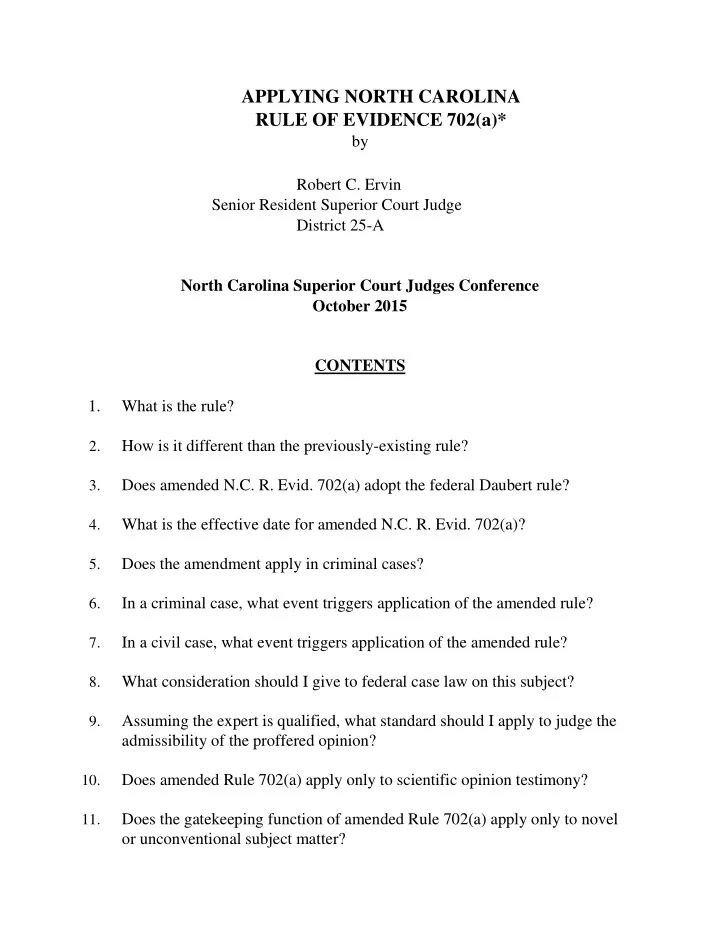
APPLYING NORTH CAROLINA RULE OF EVIDENCE 702(a)* by Robert C. Ervin Senior Resident Superior Court Judge District 25-A North Carolina Superior Court Judges Conference October 2015 CONTENTS 1. What is the rule? How is it different than the


slide-1
SLIDE 1

APPLYING NORTH CAROLINA RULE OF EVIDENCE 702(a)*

by Robert C. Ervin Senior Resident Superior Court Judge District 25-A North Carolina Superior Court Judges Conference October 2015 CONTENTS 1. What is the rule?

2.

How is it different than the previously-existing rule?

3.

Does amended N.C. R. Evid. 702(a) adopt the federal Daubert rule?

4.

What is the effective date for amended N.C. R. Evid. 702(a)?

5.

Does the amendment apply in criminal cases?

6.

In a criminal case, what event triggers application of the amended rule?

7.

In a civil case, what event triggers application of the amended rule?

8.

What consideration should I give to federal case law on this subject?

9.

Assuming the expert is qualified, what standard should I apply to judge the admissibility of the proffered opinion?

10.

Does amended Rule 702(a) apply only to scientific opinion testimony?

11.

Does the gatekeeping function of amended Rule 702(a) apply only to novel

  • r unconventional subject matter?
slide-2
SLIDE 2

12.

Will previously-accepted areas of expert testimony be admissible under the amended rule?

13.

Is there a checklist that I can use?

14.

What factors should I consider when a dispute arises concerning the ability

  • f an expert witness to testify?

15.

What considerations do I use when analyzing technical evidence and not scientific evidence? 16. Do I have to accept the expert’s testimony merely because the expert himself claims the method is accurate?

17.

Do I have to accept a party’s contention about the state of the science in a particular area? 18. How closely do I scrutinize the factual basis of the proffered expert testimony?

19.

What about challenges to expert testimony at the summary judgment stage?

20.

How right do I have to be when I rule on the admissibility of expert testimony?

21.

Are there other pitfalls about which I should be aware?

slide-3
SLIDE 3

1

  • 1. What is the rule?

N.C. R. Evid. 702 provides that: (a) If scientific, technical or other specialized knowledge will assist the trier of fact to understand the evidence or to determine a fact in issue, a witness qualified as an expert by knowledge, skill, experience, training, or education, may testify thereto in the form of an opinion, or otherwise, if all of the following apply: (1) The testimony is based upon sufficient facts or data. (2) The testimony is the product of reliable principles and methods. (3) The witness has applied the principles and methods reliably to the facts of the case.

  • 2. How is it different than the previously-existing rule?

Before the 2011 legislation, N.C. R. Evid. 702(a) did not have the three subparagraphs containing additional conditions for admissibility. The previous rule simply said: (a) If scientific, technical or other specialized knowledge will assist the trier of fact to understand the evidence or to determine a fact in issue, a witness qualified as an expert by knowledge, skill, experience, training, or education, may testify thereto in the form of an opinion. Pre-amendment, the North Carolina Supreme Court observed that “application of the [pre-amendment] North Carolina approach is decidedly less mechanistic and rigorous than the "exacting standards of reliability" demanded by the federal approach.” Howerton v. Arai Helmet, 358 N.C. 440, 464 (2004). The Court further noted that once: the trial court makes a preliminary determination that the scientific or technical area underlying a qualified expert's opinion is sufficiently reliable (and, of course, relevant), any lingering questions or controversy concerning the quality of the expert's conclusions go to the weight of the testimony rather than its admissibility.

  • Id. at 461. (emphasis added).
  • 3. Does amended N.C. R. Evid. 702(a) adopt the federal Daubert rule?

YES, at least, according to the Court of Appeals. The amended language of Rule 702 implements the standards set forth in Daubert. State v. McGrady, ___ N. C. App. __,

slide-4
SLIDE 4

2

753 S. E. 2d 361 (2014); Wise v. Alcoa, ___ N. C. App. __, 752 S. E. 2d 172 (2013). Our Rule 702 “was amended to mirror the Federal Rule 702, which itself was amended to conform to the standard outlined in Daubert”. Pope v. Bridge Broom, Inc., ___ N. C. App. ___, 770 S. E. 2d 702, 707 (2015). In McGrady, the Court of Appeals opined that “it is clear that amended Rule 702 should be applied pursuant to the federal standard as articulated in Daubert.” 752 S. E. 2d at 367; See also Pope, 770 S. E. 2d at 707-708.

  • 4. What is the effective date for amended N.C. R. Evid. 702(a)?

During its 2011 session, the General Assembly amended N.C. R. Evid. 702(a). 2011

  • N. C. Sess. Law ch. 283, Sec.1.3. The amended rule applies in actions arising on or after

October 1, 2011. 2011 N. C. Sess. Law ch. 317, Sec. 1.1.

  • 5. Does the amendment apply in criminal cases?
  • YES. The Rules of Evidence apply in both civil and criminal cases. See N.C. R.
  • Evid. 1101(a). The North Carolina Court of Appeals has confirmed that amended N.C.
  • R. Evid. 702(a) applies in criminal cases. See State v. Meadows, 2013 N.C. App. LEXIS

989 (N.C. Ct. App. October 1, 2013) (holding that trial court should evaluate admissibility in light of amended Rule 702(a)).

  • 6. In a criminal case, what event triggers application of the amended rule?

“A criminal action arises when the defendant is indicted.” See State v. Gamez, 745 S.E.2d 876, 878 (N.C. Ct. App. July 16, 2013); see also State v. Meadows, 2013 N.C.

  • App. LEXIS 989 (October 1, 2013) (repeating standard enunciated in Gamez). A second

bill of indictment filed after the effective date for the amended statute, but which is joined with the first indictment, does not trigger application of the amended rule: “the criminal proceeding arose on the date of the filing of the first indictment.” Gamez, 745 S.E.2d at

  • 879. In contrast, when the State obtains a superseding indictment, because a

“superseding indictment annuls or voids the original indictment,” “the ‘trigger date’ is the date the superseding indictment was filed.” State v. Walston, 747 S.E.2d 720 (N.C. Ct.

  • App. August 20, 2013) reversed on other grounds, 367 N. C. 290, 753 S. E. 2d 667

(2014).

  • 7. In a civil case, what event triggers application of the amended rule?

Amended Rule 702(a) became effective October 1, 2011 and applies to actions arising

  • n or after that date. A civil action “arises” when a party has a right to apply to a proper

tribunal for relief. See Swartzberg v. Reserve Life Ins. Co, 252 N.C. 150, 113 S. E. 2d

slide-5
SLIDE 5

3

270 (1960) (“In general, a cause or right of action accrues, so as to start the running of the statute of limitations, as soon as the right to institute and maintain a suit arises.") There is some confusion here. In Webb v. Wake Forest University Baptist Medical Center, ___ N. C. App. ___, 756 S. E. 2d 741 (2014), the Court of Appeals observed in a footnote that “our General Assembly amended N.C. G. S. Section 8C-1 Rule 702 in 2011. The amendments apply ‘to actions commenced on or after 1 October 2011.’” Similarly in Pope v. Bridge Broom, Inc., ___ N. C. App. ___, 770 S. E. 2d 702 (2015), the Court of Appeals noted in another footnote that “the amended Rule 702 applies here because the complaint was filed about a month after the effective date of the amendment.” These footnotes in Webb and Pope appear to be erroneous as indicated in State v. Gamez, ___ N. C. App. ___, 745 S. E. 2d 876 (2013). In Gamez, the Court of Appeals

  • bserved that the amendment to Rule 702 was enacted in Session Law 2011-283. Session

Law 2011-283 provided that “the remainder of this act becomes effective October 1, 2011, and applies to actions commenced on or after that date.” However, on the same day that Session Law 2011-283 was enacted, the General Assembly enacted Session Law 2011-317. Session Law 2011-317 rewrote the effective date provision of Session Law 2011-283. The revision provided that “the remainder of this act becomes effective October 1, 2011, and applies to actions arising on or after that date.” Session Law 2011- 317, Sec. 1.1. The opinions in both Webb and Pope overlook the effect of Session Law 2011-317. In Webb, the plaintiff’s claim arose in March 2008 and the Court of Appeals properly applied the Howerton rule. In Pope, the Court of Appeals mistakenly applied amended Rule 702 since the accident that lead to the plaintiff’s claim occurred on September 10, 2011. Since the challenged testimony in Pope was deemed to be admissible under the amended Rule 702, the outcome of the case likely would not have changed if the Howerton rule was applied.

  • 8. What consideration should I give to federal case law on this subject?

Federal law is not binding, but it certainly is an excellent start. The Court of Appeals in cases applying the amended version of Rule 702 has cited federal cases in addition to United States Supreme Court cases. See Pope v. Bridge Broom, Inc., ___ N. C. App. ___, 770 S. E. 2d 702 (2015); State v. McGrady, ___ N. C.

  • App. ___, 753 S. E. 2d 361 (2014).

Also, the Commentary to Rule 102 of the North Carolina Rules of Evidence observes that “federal precedents are not binding on the courts of this State in construing these

  • rules. Nonetheless, these rules were not adopted in a vacuum. A substantial body of law

construing these rules exists and should be looked to by the courts for enlightenment and

slide-6
SLIDE 6

4

guidance in ascertaining the intent of the General Assembly in adopting these rules. Uniformity of evidence rulings in the courts of this State and federal courts is one motivating factor in adopting these rules and should be a goal of our courts in construing those rules that are identical.”

  • 9. Assuming the expert is qualified, what standard should I apply to judge the

admissibility of the proffered opinion? The United States Supreme Court summarized the inquiry for scientific evidence: “Faced with a proffer of expert scientific testimony, the trial judge must determine at the outset,” . . . whether the expert is proposing to testify to: (1) scientific knowledge that (2) will assist the trier of fact to understand or determine a fact in issue. This entails a preliminary assessment of whether the reasoning or methodology underlying the testimony is scientifically valid and of whether that reasoning or methodology properly can be applied to the facts in issue.” Daubert v. Merrell Dow, 509 U.S. 579, 592 (1993) (emphasis added). North Carolina’s amended Rule 702(a) essentially embraces this test with the specification of the required conditions of admissibility: (1) a basis of sufficient data or facts; (2) the product of reliable principles and methods; and (3) the product of reliable application of those principles and methods. Under North Carolina’s amended Rule 702, trial courts must conduct a three-part inquiry concerning the admissibility of expert testimony: Parsing the language of the Rule, it is evident that a proposed expert’s opinion is admissible, at the discretion of the trial court, if the opinion satisfies three

  • requirements. First, the witness must be qualified by knowledge, skill, experience,

training or education. Second, the testimony must be relevant, meaning that it ‘will assist trier of fact to understand the evidence or to determine a fact in issue. Third, the testimony must be reliable. Pope v. Bridge Broom, ___ N. C. App. ___, 770 S. E. at 708 citing In re Scrap Metal Antitrust Litigation, 527 F. 3d 517, 528-9 (6th Cir. 2008).

  • 10. Does amended Rule 702(a) apply only to scientific opinion testimony?
slide-7
SLIDE 7

5

  • NO. First, the rule’s language is not limited to only scientific evidence. Second,

federal courts have applied the rule beyond scientific opinion testimony. Specifically, in Kumho Tire, the Supreme Court observed that “the . . . basic gatekeeping obligation applies . . . to all expert testimony.” Kumho Tire Co. v. Carmichael, 526 U.S. 137, 147 (1999).

  • 11. Does the gatekeeping function of amended Rule 702(a) apply only to novel
  • r unconventional subject matter?
  • NO. First, the rule’s language is not limited to only novel or unconventional subject

matter, but speaks to “scientific, technical or other specialized knowledge.” Second, the United States Supreme Court has observed that the requirements of Rule 702 do not apply exclusively to unconventional evidence. Daubert, 509 U.S. at 593 n.11 (noting that the rule does not apply exclusively to unconventional evidence, but “well-established propositions are less likely to be challenged than those that are novel”).

  • 12. Will previously-accepted areas of expert testimony be admissible under the

amended rule? IT DEPENDS. In a pre-amendment and pre-Howerton case, the North Carolina Court of Appeals stated that “nothing in Daubert or Goode requires that the trial court re-determine in every case the reliability of a particular field of specialized knowledge consistently accepted as reliable by our courts, absent some new evidence calling that reliability into question.” State v. Berry, 143 N.C. App. 187, 546 S.E.2d 145 (2001). Similarly, although the North Carolina Supreme Court rejected the Daubert admissibility test in Howerton, it did recognize that “initially, the trial court should look to precedent for guidance in determining whether the theoretical or technical methodology underlying an expert’s opinion is reliable . . . when specific precedent justifies recognition of an established scientific theory or technique advanced by an expert, the trial court should favor its admissibility, provided the other requirements of admissibility are likewise satisfied.” Howerton, 358 N.C. at 459. Remember, though, that there are different prongs to N.C. R. Evid. 702(a). A determination of admissibility requires not only examination of whether the science or specialized knowledge is valid or reliable, but whether the “testimony is based upon sufficient facts or data” and the “witness has applied the principles and methods reliably

slide-8
SLIDE 8

6

to the facts of the case,” even in those fields previously determined to be generally

  • reliable. N.C. R. Evid. 702(a)(3).

To illustrate, in Joiner, the United States Supreme Court observed that the issue before the trial court was not “whether animal studies can be a proper foundation for an expert’s opinion,” but “whether these experts’ opinions were sufficiently supported by the animal studies on which they purported to rely.” General Electric Co. v. Joiner, 522 U.S. 136, 144 (1997). The Court concluded that the “studies were so dissimilar to the facts presented in this litigation that it was not an abuse of discretion for the [trial court] to have rejected the experts’ reliance on them.” Id. at 145.

  • 13. Is there a recognized checklist that I can rely on?
  • NO. As the Court of Appeals observed in Pope, “Daubert provides a non-

exclusive checklist for trial courts to consult in evaluating the reliability of expert testimony…The test of reliability is flexible and the Daubert factors do not constitute a definitive checklist or test, but may be tailored to the facts of a particular case.” Pope, 770 S. E. 2d at 708. See also State v. Turbyfill, ___ N. C. App. ___, ___ S. E. 2d ___ (N.

  • C. App. Sept. 1, 2105).
  • 14. What factors should I consider when a dispute arises concerning the ability of

an expert witness to testify? The United States Supreme Court has identified some factors that may bear on the determination, particularly when scientific testimony is at issue:

  • whether the theory or technique can be (or has been) tested;
  • whether the theory or technique has been subjected to peer review and

publication;

  • whether a particular technique has a known or potential error rate,
  • whether there are standards controlling the technique’s operation; and
  • whether the theory or technique is generally accepted.

Kumho Tire, 526 U.S. at 149 (quoting Daubert, 509 U.S. at 592-94). The Court of Appeals in Pope referenced these factors. 770 S. E. 2d at 708. In addition, the Court of Appeals noted that federal courts have utilized other factors relevant to the determination including:

slide-9
SLIDE 9

7

  • whether the expert proposes to testify about matters growing naturally and

directly out of research the expert has conducted independent of the litigation;

  • whether the expert has developed opinions expressly for the purpose of

testifying;

  • whether the expert has unjustifiably extrapolated from an accepted premise

to an unfounded conclusion;

  • whether the expert as adequately accounted for obvious alternative

explanations;

  • whether the expert is as careful in his testimony as he would be outside the

context of his paid litigation consulting; and

  • whether the field of expertise claimed by the expert is known to reach

reliable results for the type of opinion 770 S. E. 2d at 708-709.

  • 15. What considerations do I use when analyzing technical evidence and not

scientific evidence? Each case will have its own particularized considerations. As an illustration, in Kumho Tire, the Supreme Court considered an engineer’s analysis of tire failure. The Daubert factors were largely inapplicable. In the Supreme Court’s analysis, the following considerations were addressed.

  • The engineer’s actual inspection of the tire.
  • The expert’s qualifications in terms of degrees and experience.
  • The expert’s inability to determine with any precision the number of miles

the tire had been driven.

  • The expert originally formed his opinion based on photographs and only

inspected the tire on the day his deposition was taken.

  • The data that the expert relied upon to underpin his opinion contained

errors.

  • The subjective nature of the expert’s analysis.
  • The expert’s reliance on a theory of tire failure without any indication that

any other expert used this theory or that any articles or papers had ever relied on the theory.

  • 526. U.S. at 152-57.
slide-10
SLIDE 10

8

The Supreme Court observed that the expert should employ “in the courtroom the same level of intellectual rigor that characterizes the practice of an expert in the relevant field.” Id. at 152.

  • 16. Do I have to accept the expert’s testimony merely because the expert himself

claims the method is accurate?

  • NO. “Nothing requires a trial court to admit opinion evidence that is connected to

existing data only by the ipse dixit of the expert.” State v. McGrady, ___ N. C. App. ___, 753 S. E. 2d 361, 369, quoting General Electric Co. v. Joiner, 522 U. S. 136, 146, 139 L. Ed 2d 508, 519. Ipse dixit is Latin for “he himself said it” and is defined as “something asserted but not proved.” McGrady, 753 S. E. 2d at 36,9 citing Black’s Law Dictionary. “A court may conclude that there is simply too great an analytical gap between the data and the opinion proffered.” Id.

  • 17. Do I have to accept a party’s contention about the state of the science in a particular

area?

  • NO. In State v. Perry, ___ N. C. App. ___, 750 S. E. 2d 521 (2013), the defendant

challenged the admissibility of the State’s medical experts and contended that “certain

  • pinions presented by the State’s experts were ‘unreliable given the current state of the

medical research.’” The defendant contended on appeal that the opinions of the State’s experts “rested on previously accepted medical science that is now in doubt and that because current medical science has cast significant doubt on previously accepted theories regarding the possible causes of brain injuries in children, there is currently no medical certainty around these topics.” The record developed at trial contained no information concerning the state of current medical science or the degree to which significant doubt had arisen with respect to the manner in which brain injuries in young children occur. The Court of Appeals concluded in Perry that “we cannot evaluate the validity of this claim in the absence of record evidence establishing what the current state

  • f medical research into the subject of childhood head injuries actually is.” 750 S. E. 2d

at 531. In Perry, the Court of Appeals observed that the “trial court was simply not presented with any such evidence in this case and did not, for that reason, have any

  • pportunity to determine whether accepted medical thinking on the issues relevant to this

case had changed.” Id. In short, just because a lawyer or party says it is so is not

  • enough. The party has to prove it with evidence.
  • 18. How closely do I scrutinize the factual basis of the proffered expert testimony?

“As a general rule, questions relating to the bases and sources of an expert’s opinion

  • nly affect the weight to be assigned that opinion rather than its admissibility.” Pope,
slide-11
SLIDE 11

9

770 S. E. 2d at 710. Trial courts do “not examine whether the facts obtained by the witness are themselves reliable—whether the facts used are qualitatively reliable is a question of the weight to be given the opinion by the factfinder, not the admissibility of the opinion.” Id. at 710. Any dispute concerning the underlying facts “goes to the quality and therefore the credibility of the measurement and not its admissibility.” Id. “Experts may rely on data and other information supplied by third parties…even if the data were prepared for litigation by an interested party. Unless the expert opinion’s is too speculative, it should not be rejected as unreliable merely because the expert relied on the reports of others.” Pope, 770 S. E. 2d at 710.

  • 19. What about challenges to expert testimony at the summary judgment stage?

Expect to see full attacks on expert admissibility at the summary judgment stage. See generally Joiner, 522 U.S. 136 (1997). The test for admissibility is the same at summary judgment as it is at trial. “In a motion for summary judgment, the evidence presented to the trial court must be admissible at trial, N.C.G.S. § 1A-1, Rule 56(e) (2003), and must be viewed in a light most favorable to the non-moving party.” Howerton, 358 N.C. at 467. Practical point: If a party asserts that certain expert testimony is inadmissible at summary judgment, the court should make clear if (and how) it ruled on that challenge. Remember that a determination on admissibility likely binds the trial judge should the matter proceed to trial.

  • 20. How right do I have to be when I rule on the admissibility of expert testimony?

Your ruling on the admissibility or inadmissibility of expert testimony is reviewed for abuse of discretion. Pope v. Bridge Broom, Inc., ___ N. C. App. ___, 770 S. E. 2d 702, 707 (2015); State v. McGrady, ___ N. C. App. ___, 753 S. E. 2d 361 (2014). Abuse of discretion results where the court’s ruling is manifestly unsupported by reason or is so arbitrary that it could not have been the result of a reasoned decision. Pope, 770 S. E. 2d at 707; McGrady, 753 S. E. 2d at 365. The Court of Appeals further noted that “the federal courts have traditionally granted a great deal of discretion to the trial court when determining whether expert testimony is admissible under Daubert.” Id. at 369. In McGrady, the defendant contended that the trial court abused its discretion in coming to certain conclusions. However, the Court of Appeals noted that the defendant did not “show how the court’s decision was arbitrarily or manifestly unreasonable.” 753 S. E. 2d at 369. Instead, the defendant argued “for the reasonableness of a different conclusion

slide-12
SLIDE 12

10

based on the same evidence.” Id. That contention, according to the Court of Appeals, demonstrated a misunderstanding of the abuse of discretion standard. In State v. Turbyfill, the Court of Appeals observed that “the trial court is afforded wide latitude when making a determination about the admissibility of expert testimony.” ___

  • N. C. App. ___, ___ S. E. 2d ___ (N. C. App. Sept. 1, 2015).
  • 21. Are there other pitfalls about which I should be aware?
  • YES. In a criminal case, if presented with a challenge to the admissibility of the

defendant’s expert witness, you should be mindful of State v. Cooper, 747 S.E.2d 398 (N.C. Ct. App. Sept. 3, 2013). In Cooper, the North Carolina Court of Appeals did not review the exclusion of the defendant’s proposed expert witness for an abuse of discretion. Rather, the court noted that "[c]onstitutional rights are not to be granted or withheld in the court's discretion." Id. (quoted case omitted). The court reasoned that “the denial of a defendant's right to present a witness through a misapplication of a rule of evidence” can amount to a constitutional violation. The court therefore reviewed for error. Finding error, it then concluded that the State failed to show that the error was “harmless beyond a reasonable doubt,” and ordered a new trial. *This manuscript constitutes a revision of an earlier manuscript prepared by this author and the distinguished Shannon R. Joseph, Esq. for the October 2013 Superior Court Judge’s Conference. The revisions likely diminish the overall quality of the earlier work.