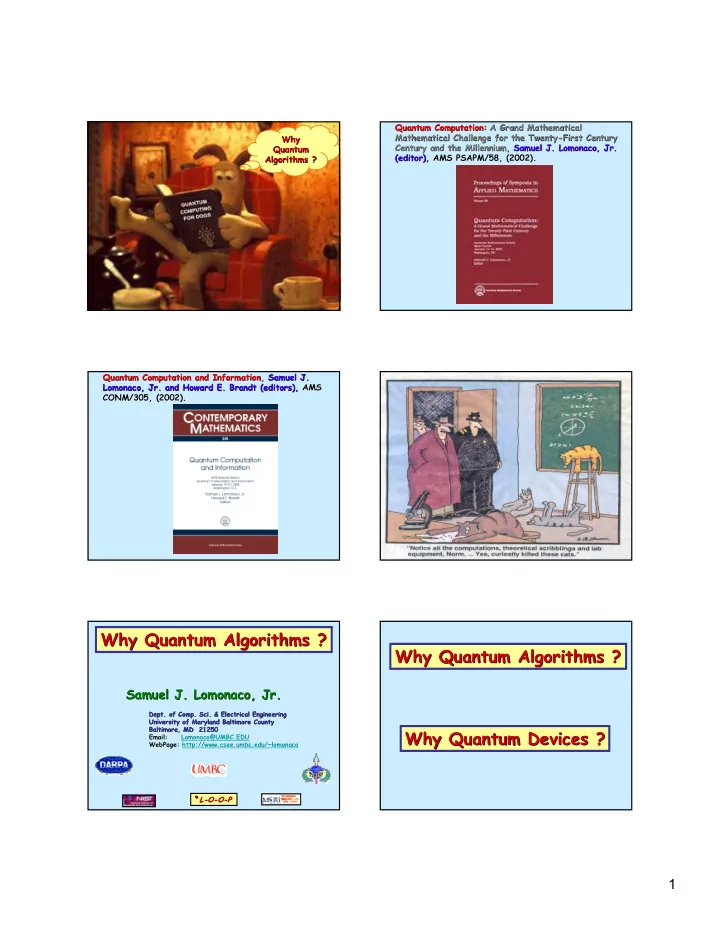
Why Quantum Algorithms ? Why Quantum Algorithms ? Why Quantum - - PDF document

why quantum algorithms why quantum algorithms why quantum
SMART_READER_LITE
LIVE PREVIEW

Why Quantum Algorithms ? Why Quantum Algorithms ? Why Quantum - - PDF document

Quantum Computation: Quantum Computation: A Grand Mathematical A Grand Mathematical Mathematical Mathematical Challenge for the Twenty Challenge for the Twenty- -First Century First Century Why Why Century and the Millennium, Century and


slide-1
SLIDE 1

1

Why Why Quantum Quantum Algorithms ? Algorithms ? Quantum Computation: Quantum Computation: A Grand Mathematical A Grand Mathematical Mathematical Mathematical Challenge for the Twenty Challenge for the Twenty-

  • First Century

First Century Century Century and the Millennium, and the Millennium, Samuel J. Lomonaco, Jr. Samuel J. Lomonaco, Jr. (editor), (editor), AMS PSAPM/58, (2002). AMS PSAPM/58, (2002). Quantum Computation and Information Quantum Computation and Information, , Samuel J. Samuel J. Lomonaco, Jr. and Howard E. Brandt Lomonaco, Jr. and Howard E. Brandt (editors), (editors), AMS AMS CONM/305, (2002). CONM/305, (2002).

Why Quantum Algorithms ? Why Quantum Algorithms ?

Samuel J. Lomonaco, Jr. Samuel J. Lomonaco, Jr.

  • Dept. of Comp.
  • Dept. of Comp. Sci
  • Sci. & Electrical Engineering

. & Electrical Engineering University of Maryland Baltimore County University of Maryland Baltimore County Baltimore, MD 21250 Baltimore, MD 21250 Email: Lomonaco@UMBC.EDU WebPage: http://www.csee.umbc.edu/~lomonaco

  • L

L-

  • O

O-

  • O

O-

  • P

P

Why Quantum Algorithms ? Why Quantum Algorithms ? Why Quantum Devices ? Why Quantum Devices ?

slide-2
SLIDE 2

2

New Quantum Algorithms New Quantum Algorithms

  • Continuous Variable

Continuous Variable Shor Shor Algorithms Algorithms

  • Functional integral Quantum Algorithms

Functional integral Quantum Algorithms (highly speculative) (highly speculative)

  • Dual

Dual Shor Shor Algorithm Algorithm

  • Quantum Circle Algorithms

Quantum Circle Algorithms

  • Lifted (Purified)

Lifted (Purified) Shor Shor

  • Wandering

Wandering Shor Shor Algorithms Algorithms

I double dare I double dare Yanhua Yanhua to to implement this in optics implement this in optics

A Continuous A Continuous Variarble Variarble Shor Shor Algorithm Algorithm

This algorithm finds the hidden period of an This algorithm finds the hidden period of an admissible map admissible map

: f →

  • Lomonaco, Jr., Samuel J., and Louis H.

Lomonaco, Jr., Samuel J., and Louis H. Kauffman, Kauffman, A Continuous Variable A Continuous Variable Shor Shor Algorithm Algorithm, arXiv:quant , arXiv:quant-

  • ph/0210141

ph/0210141

Distributed Distributed Quantum Quantum Algorithms ? Algorithms ?

A Distributed Quantum Algorithms A Distributed Quantum Algorithms

Anocha Anocha Yimsiriwattana Yimsiriwattana

Yimsiriwattana Yimsiriwattana, , Anocha Anocha, and Samuel J. , and Samuel J. Lomonaco, Jr., Lomonaco, Jr., Generalized GHZ States Generalized GHZ States and Distributed Quantum Computing and Distributed Quantum Computing, , arXiv:quant arXiv:quant-

  • ph/0402148

ph/0402148 Yimsiriwattana Yimsiriwattana, , Anocha Anocha, and Samuel J. , and Samuel J. Lomonaco, Jr., Lomonaco, Jr., Distributed quantum Distributed quantum computing: A distributed computing: A distributed Shor Shor, , algorithm, arXiv:quant algorithm, arXiv:quant-

  • ph/0403146

ph/0403146

Distributed Quantum Computing Distributed Quantum Computing

Why ?? Why ??

  • Provides a mechanism for isolating the

Provides a mechanism for isolating the problem of problem of decoherence decoherence

  • Distributed computing is one path to

Distributed computing is one path to scalable quantum computing scalable quantum computing

slide-3
SLIDE 3

3

Overview Overview The computational cost of transforming a quantum The computational cost of transforming a quantum algorithm into a distributed quantum algorithm algorithm into a distributed quantum algorithm

  • Space Complexity Overhead:

Space Complexity Overhead: The additional space The additional space

  • verhead is insignificant, i.e., the number of
  • verhead is insignificant, i.e., the number of

required additional required additional qubits qubits is 5 and independent of is 5 and independent of the number of the number of qubits qubits of the non

  • f the non-
  • distributed

distributed algorithm algorithm

  • Time Complexity Overhead:

Time Complexity Overhead: There is a resulting There is a resulting a linear slowdown of the non a linear slowdown of the non-

  • distributed algorithm

distributed algorithm

  • But

But … … the rate of slowdown is bounded above by a the rate of slowdown is bounded above by a constant ( constant ( = 9 = 9 ) ) which is which is independent of the number independent of the number

  • f
  • f qubits

qubits in the non in the non-

  • distributed.

distributed.

Conclusion Conclusion

It really pays to distribute a quantum It really pays to distribute a quantum algorithm. algorithm.

  • The problem of

The problem of decoherence decoherence is isolated is isolated to the individual small computing nodes in to the individual small computing nodes in the network, where the network, where decoherence decoherence is most is most easily handled. easily handled.

  • As a result, the need for costly quantum

As a result, the need for costly quantum error correction is reduced by at least one error correction is reduced by at least one

  • rder of magnitude.
  • rder of magnitude.

We Will Show How to Use Quantum We Will Show How to Use Quantum Entanglement for Distributed Entanglement for Distributed Control of Quantum Control of Quantum Algorithms Algorithms

Distributed Distributed Quantum Quantum Computing Computing Architecture Architecture

Distributed Quantum Computing Distributed Quantum Computing

  • By a distributed quantum computer, we

By a distributed quantum computer, we mean mean a network of quantum computers a network of quantum computers interconnected by quantum and classical interconnected by quantum and classical channels channels

  • The

The distributed computing paradigm distributed computing paradigm provides an effective way to utilize a provides an effective way to utilize a number of small quantum computers number of small quantum computers

classical channels classical channels quantum channels quantum channels

Architecture Architecture

quantum register quantum register channel channel qubits qubits classical classical computer computer

Each column represents Each column represents a separate computer a separate computer

slide-4
SLIDE 4

4

Distributed Distributed Quantum Quantum Computing Computing Primitives Primitives

Section 3 Section 3

The Application of The Application of Generalized GHZ States Generalized GHZ States and and Cat Cat-

  • Like States

Like States to to Distributed Quantum Computing Distributed Quantum Computing

A A Generalized Generalized GHZ GHZ state state is a quantum state is a quantum state

  • f the form
  • f the form

00 11 1 2 +

  • n

n 0 0’ ’s s n n 1 1’ ’s s A A Cat Cat-

  • Like

Like state state is a quantum state of the is a quantum state of the form form

00 11 1 α β +

  • Terminology

Terminology

A A generalized GHZ generalized GHZ state can be state can be used to create a used to create a “ “cat cat-

  • like

like” ” state, state, Key Idea Key Idea

which which can in turn be used

can in turn be used to to distribute distribute control control. . Use Entanglement to Distribute Control Use Entanglement to Distribute Control

H

=

00 11 2 +

2 2 Qubit Qubit Entangling Gate Entangling Gate

=

000 111 2 +

3 3 Qubit Qubit Entangling Gate Entangling Gate

H

slide-5
SLIDE 5

5

n n Qubit Qubit Entangling Gate Entangling Gate

=

H

Important Fact Important Fact

Generalized GHZ states are constructed Generalized GHZ states are constructed from EPR pairs by applying only local from EPR pairs by applying only local

  • perations.
  • perations.
  • Method 1:

Method 1: Via Via nonlocal nonlocal CNOTS CNOTS

  • Method 2:

Method 2: Via entanglement swapping Via entanglement swapping So all network quantum So all network quantum channels are EPR channels ! channels are EPR channels !

Observations Observations

  • If we can implement a non

If we can implement a non-

  • local CNOT,

local CNOT, then a then a distributed version distributed version of any unitary

  • f any unitary

transformation can be implemented transformation can be implemented

  • The

The CNOT gate CNOT gate and and the the set of all set of all

  • ne
  • ne-
  • qubit

qubit gates gates are universal are universal

Non Non-

  • local CNOT Gate

local CNOT Gate

M X Z M H J.

  • J. Eisert

Eisert, K. Jacobs, P. , K. Jacobs, P. Papadopoulus Papadopoulus, and M.B. , and M.B. Plenio Plenio, ,

“ “Optimal local implementation of non Optimal local implementation of non-

  • local quantum gates

local quantum gates” ”. .

  • Phys. Rev. A, 62, 052317 (2000)
  • Phys. Rev. A, 62, 052317 (2000)

| 0 |1 〉 + 〉 α β | 〉 | 0〉 | t〉

Distributing a Control Line via Distributing a Control Line via Cat Cat-

  • like State

like State

Cat Cat-

  • Like

Like | 000 |111 α β 〉 + 〉 | t〉

| 000 | 0 | 111 | 1 X α β 〉 〉 + 〉 〉

State to be State to be Controlled Controlled Z M M M H H H

Generalized Non Generalized Non-

  • local CNOT

local CNOT

X X X M +

| 0 | 1 α β 〉 + 〉 | 0〉 | 0〉 | 0〉 | 0〉 | t〉

| 0000 |1111 α β 〉 + 〉 Cat Cat-

  • Creator

Creator Disentangler Disentangler Control Control

Cat Cat-

  • like

like

C C H H A A N N N N E E L L

slide-6
SLIDE 6

6

Creating a Cat Creating a Cat-

  • like State from a GHZ State

like State from a GHZ State

X X X M

| 0 | 1 α β 〉 + 〉 | 0〉 | 0〉 | 0〉 | 0〉

( )

1 | 0000 | |1111 2 〉 + 〉 | 0000 | 1111 α β 〉 + 〉 Cat Cat-

  • Creator

Creator First Primitive for DQC First Primitive for DQC

Disentangling the Quantum Channel Disentangling the Quantum Channel

| 0000 | 1111 α β 〉 + 〉

| 0 | | 1 α β 〉 + 〉

| r〉

Z M M M H H H +

Disentangler Disentangler Quantum Quantum Channel Channel Control Line Control Line Second Primitive for DQC Second Primitive for DQC

Standard Quantum Teleportation Circuit Standard Quantum Teleportation Circuit

X M Z M H

| 0 | 1 α β 〉 + 〉 | 0〉 | 0〉 | 0 | 1 α β 〉 + 〉

Quantum Teleportation Circuit Quantum Teleportation Circuit

X M Z M H

| 0 | 1 α β 〉 + 〉

| 0 0 |1 1 r r α β 〉 + 〉 | 0〉 | 0〉 | 0 | 1 α β 〉 + 〉

Cat Cat-

  • Creator

Creator Disentangler Disentangler Alice Alice Bob Bob

Applying Applying DQC DQC Primitives Primitives

Section 4 Section 4

A A local local Control Control-

  • U gate

U gate

U1 U2 U3 U4

| 0 |1 α β 〉 + 〉

slide-7
SLIDE 7

7

A A Non Non-

  • local

local Control Control-

  • U gate

U gate

U1 U2 U3 U4

| 0 | 1 α β 〉 + 〉 | 0〉 | 0〉

M X Z M H

A A Local Local Control Control-

  • U gate

U gate

with No Shared with No Shared Qubits Qubits

U3 U2 U1

| 0 |1 α β 〉 + 〉

A Multiply Non A Multiply Non-

  • local Control

local Control-

  • U gate

U gate

| 0 | 1 α β 〉 + 〉

U3 U2 U1 X M X M H M H Z + | 0 |1 α β 〉 + 〉 U1 U2 U3 U4

1 2 3 4 5 6 8 7

A Local Control A Local Control-

  • U gate

U gate

with Shared with Shared Qubits Qubits If gates share If gates share qubit qubit 4, we can 4, we can … …

| 0 |1 α β 〉 + 〉

U1 U2 U4 U3

1 2 3 4 4' 5 6 7 8

teleportation teleportation Teleport back Teleport back

Multiple Control Via Multiple Control Via Teleportation of Teleportation of Qubits Qubits

Reset: Refreshing Entanglement Reset: Refreshing Entanglement

H H H H NL

| 0〉 | 0〉 | 0〉 | 0〉 | 0〉 | 0〉 | 0〉 | 0〉

R E S E T NL

slide-8
SLIDE 8

8

Non Non-

  • local CNOT Gate

local CNOT Gate

X

| 0 | 1 α β 〉 + 〉 | 0〉 | 0〉 | t〉

X X

| 0〉 | 0〉

Z M H M

Reset Quantum Channel Reset Quantum Channel

X X

Quantum Teleportation Circuit Quantum Teleportation Circuit

X M Z M H

| 0 | 1 α β 〉 + 〉 | 0〉 | 0〉 | 0 | 1 α β 〉 + 〉 | 0〉 | 0〉

X X

Quantum Teleportation Circuit Quantum Teleportation Circuit

X M Z M H

| 0 | 1 α β 〉 + 〉 | 0〉 | 0〉 | 0〉 | 0〉 | 0 | 1 α β 〉 + 〉 | 0〉 | 0〉

Swap Swap-

  • Reset

Reset

Distributing Quantum Computing Distributing Quantum Computing Primitive Operations Primitive Operations

  • Cat

Cat-

  • Creator

Creator

  • Reset

Reset

  • Swap

Swap-

  • Reset

Reset

  • Disentangler

Disentangler

H

| 000 |111 α β 〉 + 〉

H M X H M Z M X H M Z

Creating Creating n n qubit qubit GHZ state from GHZ state from n n-

  • 1

1 ebits ebits with only LOCC with only LOCC

Undistributed Undistributed Distributed Distributed

H

To setup n qubit GHZ by the diagram takes

  • O(log n) steps, and
  • O(log n) channel qubits

Creating Creating n n qubit qubit GHZ state from GHZ state from n n-

  • 1

1 ebits ebits with only LOCC with only LOCC

slide-9
SLIDE 9

9

A Distributed A Distributed Quantum Fourier Quantum Fourier Transform Transform

Section 5 Section 5

Quantum Fourier Transform Quantum Fourier Transform

R

2

H

R

3

R

2

H

R

3

R

4

R

2

H H H

Rk

= =

1 2 3 4

1 1 1 1 1 2     −  

2 2

1

k

i

e

π

       

Distributed Quantum Fourier Distributed Quantum Fourier

R

2

H H

R

3

M M H Z M

R

4

M H Z

R

2

M M H Z

1 2 3 4

v

Distributed Distributed Quantum Quantum FourierTransformation FourierTransformation

H

R

2

R

3

R

4 R 5

R

6

H

R

2

R

3

R

4

R

5

H

R

2

R

3

R

4

H

R

2

R

3

H

R

2

Distributed Distributed Shor Shor Factoring Algorithm Factoring Algorithm

Section 6 Section 6

Shor Shor’ ’s s Quantum Factoring Algorithm Quantum Factoring Algorithm reduces to the task of finding the reduces to the task of finding the

  • rder of the map:
  • rder of the map:

mod

N n

n a N →

slide-10
SLIDE 10

10

  • Given N and find the order of a.

Let r be the order of a.

  • Define as follow: let

N

a ∈ Z

a

M

:| | mod

a

M x ax N 〉 → 〉

N

x ∈Z

Order Finding Algorithm Order Finding Algorithm

| 0〉 |1〉

M

|1〉

n

H ⊗

† n

QFT

a

M

j

The result of measurement will be some j such that is a good approximation to .

2n j k r

This can be computed using

  • nly polynomially

many gates This can be computed using

  • nly polynomially

many gates

Order Finding Algorithm Order Finding Algorithm

Phase Estimation Phase Estimation

  • Repeat

Repeat to find different to find different j

j

Order Finding Order Finding Quantum Quantum Factoring Factoring

reduces to reduces to

Order Finding & Order Finding & Shor Shor’ ’s s Factoring Factoring Alg Alg. .

  • Use

Use continued fraction continued fraction algorithm to algorithm to find the period find the period r

r

Quantum Factoring Algorithm Quantum Factoring Algorithm

Quantum Factoring Order Finding Phase Estimation Phase Estimation

  • Input :

Input : (1) an n-qubit unitary transformation U with eigenvectors and eigenvalues where and for each k (2) an eigenvector

  • Output :

Output : an estimation value of

Phase Estimation Algorithm Phase Estimation Algorithm

Problem Definition Problem Definition

1 2

, , ,

N

ψ ψ ψ …

1 2

, , ,

N

λ λ λ … 2n N =

2

k

i k

e π θ λ =

: {1, , }

t

t N ψ ∈ …

t

θ

Phase Estimation Algorithm Phase Estimation Algorithm

U

m qubits n qubits

( ) :

k m

c U k k U ψ ψ →

slide-11
SLIDE 11

11

Phase Estimation Algorithm Phase Estimation Algorithm

U

( ) :

k m

c U k k U ψ ψ → k k

t

ψ

k t

U ψ

Phase Estimation Algorithm Phase Estimation Algorithm

U

( ) :

k m

c U k k U ψ ψ → k k

t

ψ

2

t

ik t

e π θ ψ

U

( ) :

k m

c U k k U ψ ψ → k

2

t

ik

e k

π θ t

ψ

t

ψ

Phase Estimation Algorithm Phase Estimation Algorithm

U

( ) :

k m

c U k k U ψ ψ →

2 1

1 2

m

m k

k

− =

2 1 2 2

1 2

m m

j ik m k

e k

π − =

t

ψ

t

ψ

Assume

2m

t

j θ =

for some

{1, ,2 }

m

j ∈ …

Phase Estimation Algorithm Phase Estimation Algorithm

Quantum Fourier Transformation Quantum Fourier Transformation

A m-qubit Quantum Fourier Transformation (QFT) is defined as follow:

2 2 1 2

1 : 2

m m

ikj m k

QFT j e k

π − =

Therefore, inverse QFT is:

2 2 1 1 2

1 : 2

m m

ikj m k

QFT e k j

π − − =

Phase Estimation Algorithm Phase Estimation Algorithm

( ):

k m

c U k k U ψ ψ →

2 1

1 2

m

m k

k

− =

t

ψ

t

ψ

Assume

2m

t

j θ =

for some

{1, ,2 }

m

j ∈ …

1

QFT − j U

Phase Estimation Algorithm Phase Estimation Algorithm

slide-12
SLIDE 12

12

( ):

k m

c U k k U ψ ψ →

t

ψ

t

ψ

2m

t

j θ ≈

1

QFT − j U

m

H ⊗

for some

{1, ,2 }

m

j ∈ …

Phase Estimation Algorithm Phase Estimation Algorithm Quantum Factoring Algorithm Quantum Factoring Algorithm

Order Finding Phase Estimation Quantum Factoring

Order Finding Algorithm Order Finding Algorithm

  • Input

Input : Integers N and

  • Output

Output : The order of a, r, such that Problem Definition Problem Definition

N

a∈

1mod

r

a N ≡

Define a unitary transformation

:

a

M x ax →

Order Finding Algorithm Order Finding Algorithm

Consider

1

1

r st s t s

a r ψ ω

− − =

=

( )

1

1 1

r

a a r ψ

= + + +

  • (

)

1 ( 1) 1 1

1 1

r r

a a r ψ ω ω

− − − −

= + + +

  • where

2 i r

e

π

ω =

Then

t a t t

M ψ ω ψ = ( ):

k m a t a t

c M k k M ψ ψ →

t

ψ

t

ψ

2m j t r ≈

1

QFT − j

a

M

m

H ⊗

for some

{1, ,2 }

m

j ∈ …

Order Finding Algorithm Order Finding Algorithm Order Finding Algorithm Order Finding Algorithm

Two obstacles: Two obstacles:

  • How to construct ?

How to construct ?

  • How to implement ?

How to implement ?

t

ψ

( )

m a

c M

slide-13
SLIDE 13

13

Observer that

1

1 1

r t t

r ψ

− =

=

and

1 2 1

1 1 0 1 2

m

r H I t m t k

k r ψ

− − ⊗ =

∑ ∑

1 2 1 ( )

1 1 2

m m a

r c M kt t m t k

k r ω ψ

− − =

∑ ∑

1

1

1

r QFT t t t

j r ψ

− =

∑ Order Finding Algorithm Order Finding Algorithm

1

2

t m

j t r ≈

1

QFT − j

a

M

m

H ⊗

for some

{1, ,2 }

m t

j ∈ …

1

Order Finding Algorithm Order Finding Algorithm

Two obstacles: Two obstacles:

  • How to construct ?

How to construct ?

  • How to implement ?

How to implement ? Modular Exponentiation Modular Exponentiation

t

ψ

( )

m a

c M

Order Finding Algorithm Order Finding Algorithm Erasing Garbage Erasing Garbage

Let f be functions. We define unitary transformation F as follow:

: 0 0 ( ) ( ) F x x f x g x →

where g is “garbage” function. The garbage can be erased as follow:

0 0 0 ( ) ( ) 0

F I

x x f x g x

⇒ ( ) ( ) ( )

COPY

x f x g x f x ⇒ 0 0 ( )

R

F I

x f x

1

XF F COPY F

= ⋅ ⋅

The Overwriting Invertible Function The Overwriting Invertible Function

Let f be invertible functions. : ( ) F x x f x → Overwriting Invertible operation is

( )

F

x x f x ⇒ ( )

SWAP

f x x ⇒ ( ) 0

R

FI

f x ⇒

R

OF FI SWAP F = ⋅ ⋅

1

: ( ) FI x x f x

Modular Exponentiation Modular Exponentiation

Let be the binary representation of k,

1 1 m

k k k

  • 1

2

s s

m k k a a s

M M

− =

=∏

k

1

k

2

k

3

k

k k

a

M

2 a

M

2

2 a

M

3

2 a

M 1

slide-14
SLIDE 14

14 The Multiplier The Multiplier

a

M

x ax

:

a

M x ax →

k k a a a

M x M M x a x = =

  • Observe that

k

k a a

M M =

Let be the binary representation of x,

1 1 n

x x x −

  • 1

2

n s s s

ax ax

− =

= ∑

x

1

x

2

x

3

x

x x

a

A

2 a

A

2

2 a

A

3

2 a

A ax

a

MF

x ax x

The Multiplier The Multiplier

Overwrite Multiplier Overwrite Multiplier

:

a

MF x x ax →

1

:

a

MFI x x a x

1

a a

MFI MF − =

Define

R a a a

M MFI SWAP MF = ⋅ ⋅

a

MF x

ax x

R a

MFI ax

a

M x ax

The Adder The Adder

a

A b mod b a N +

:

a

A b b a → +

Assume we have Full Adder (FA) and Half Adder (HA):

a

FA

b c b ( )mod2n b a c + + ' c

a

HA

b b ( )mod2n b a +

Case 1: Case 2:

b a N + <

( )mod ( )mod 2n b a N b a + = +

b a N + ≥

( )mod ( 2 )mod 2

n n

b a N b a N + = + + −

2n a N

FA

+ −

b b s c s ( )mod b a N +

(2 )

n N

HA

− −

: 0 0 0

a

AF b b s c b a → +

c

X

The Adder The Adder

: 0 0 0

a

AF b b s c b a → +

R a a a

XAF AF COPY AF = ⋅ ⋅ : 0 0 0 0 0

a

XAF b b b a → +

a

AF

b b s c b a + R a

AF

b b a +

The Adder The Adder

slide-15
SLIDE 15

15

Overwrite Adder Overwrite Adder

a a

XAFI XAF− =

R a a a

A XAFI SWAP XAF = ⋅ ⋅

a

A b mod b a N +

a

XAF

b b b a +

R a

XAF

b a +

Binary Adder Binary Adder

a

BFA

a b c ⊕ ⊕ b ' c c b a b a a b ⊕ a b ∧ a b c a b ' c a b c ⊕ ⊕ b c b ' c a b c ⊕ ⊕ a

A Binary Full Adder:

a

BHA

a b c ⊕ ⊕ b c b b c b a b c ⊕ ⊕ a

A Binary Half Adder:

The Construction of a Full Adder The Construction of a Full Adder

a

FA

b c b ( )mod2n b a c + + ' c 0 1 1 n

b b b b − ≡

  • 1

1 n

a a a a − ≡

  • a

BFA

s b

1

c b

1

a

BFA

1

s

1

b

2

c

1

b

1 n

a

BFA

− 1 n

s −

1 n

b −

n

c

1 n

b − a

HA

b b ( )mod2n b a + 0 1 1 n

b b b b − ≡

  • 1

1 n

a a a a − ≡

  • a

BFA

s b

1

c b

1

a

BFA

1

s

1

b

2

c

1

b

1 n

a

BHA

− 1 n

s −

1 n

b −

1 n

b −

The Construction of a Half Adder The Construction of a Half Adder

Complexity Analysis Complexity Analysis

k 1

a

M

2

a

M

2 2

a

M k 1

a

A

2 a

A

2

2 a

A

Complexity Analysis Complexity Analysis

slide-16
SLIDE 16

16

k 1

a

XAF

b b b a +

R a

XAF

b a +

Complexity Analysis Complexity Analysis

k 1

a

AF

b b s c b a +

R a

AF

b b a +

Complexity Analysis Complexity Analysis Distributed Shor Distributed Shor

k x

FAa HAa

b b c s s b ' c k 1

a

BFA

s b

1

c b

1

a

BFA

1

s

1

b

2

c

1

b

1 n

a

BHA

− 1 n

s −

1 n

b −

1 n

b −

c

Complexity Analysis Complexity Analysis

k 1

b c b ' c a b c ⊕ ⊕ a c

5( )

X ∧

Complexity Analysis Complexity Analysis

Complexity Analysis Complexity Analysis

The number of gates The number of gates

Let G(F) be the number of gates in circuit F.

( ) ( ) ( ( )) ( )

n R m a

G SHOR G H G c M G QFT

= + + ( ( )) ( ( ) 1)

m a a

G c M m G M = + ( ) ( ) ( ) ( )

R a a a

G M G MF G SWAP G MF = + + ( ) ( ( ) 1)

a a

G MF n G A = + ( ) ( ) ( ) ( )

R a a a

G A G XAF G SWAP G XAF = + + ( ) ( ) ( ) ( )

R a a a

G XAF G AF G COPY G AF = + + ( ) ( ) ( ) 2

a a a

G AF G FA G HA = + + ( ) ( ) 4

a a

G FA nG BFA n = = ( ) ( 1) ( ) ( ) 4 2

a a a

G HA n G BFA G BHA n = − + = − 8n = 17n = 35n =

2

35n n = +

2

70 3 n n = +

2

70 3 mn mn m = + +

2

( ) O mn =

slide-17
SLIDE 17

17

The number of qubits The number of qubits

Let Q(F) be the number of qubits in circuit F.

( ) max{ ( ), ( ( )), ( )}

n R m a

Q SHOR Q H Q c M Q QFT

= ( ( )) ( )

m a a

Q c M Q M m = + ( ) max{ ( ), ( ), ( )}

R a a a

Q M Q MF Q SWAP Q MF = ( ) ( )

a a

Q MF Q A n = + ( ) max{ ( ), ( ), ( )}

R a a a

Q A Q XAF Q SWAP Q XAF = ( ) 4 1

a

G XAF n = + 4 1 n = + 5 1 n = + 5 1 n = + 5 1 n m = + + 5 1 n m = + +

Complexity Analysis Complexity Analysis Distributed Quantum Factoring Distributed Quantum Factoring

Assumption Assumption

Let n=log(N), and m=2n. Assume that (n+c)-qubit quantum computers are available.

n

H ⊗

R

QFT

a

M

1

M t

j

m qubits n qubits

Distributed Shor Distributed Shor

k 1

a

M

2

a

M

2 2

a

M

3 2

a

M k x

a

A

2 a

A

Distributed Shor Distributed Shor

k

a

AF

b b s c b a +

R a

AF

b b a +

x

Distributed Shor Distributed Shor

slide-18
SLIDE 18

18

k x

FAa HAa

b b c s s b ' c

Distributed Shor Distributed Shor

k x FA FA FA FA HA

FA

Teleport Qubit Teleport Qubit

Distributed Shor Distributed Shor Assumptions Assumptions

Let n=log(N), and m=2n. Assume that (n+c)-qubit quantum computers are available.

What is What is c

c ?

? The number c is dependent on

  • How many channel qubits are needed ?
  • How many extra carry qubits are needed ?
  • The assumptions made for the elementary

gates?

Distributed Shor Distributed Shor

k x FA FA FA FA HA

FA

What is What is c

c ?

?

5(

) X ∧

3 for

5(

) X ∧

Carry bits

2 for carry

Communication Cost Communication Cost

  • Communication Cost:

Communication Cost: – – Distributed Control Distributed Control – – Teleportation Teleportation

  • Over estimate: Every gate is non

Over estimate: Every gate is non-

  • local control gate. Then it is

local control gate. Then it is

  • Communication cost is lower:

Communication cost is lower: – – not all controlled gate are non not all controlled gate are non-

  • local,

local, – – the control qubit can be shared. the control qubit can be shared.

2

( ) O mn

Communication Costs Communication Costs

k x FA FA FA FA HA

FA

Teleport Qubit Teleport Qubit

slide-19
SLIDE 19

19

The Number of Full Adder Circuit The Number of Full Adder Circuit

Let A#(F) be the number of full adder in circuit F.

#( ( )) #( )

m a a

A c M mA M = #( ) #( ) #( ) #( )

R a a a

A M A MF A SWAP A MF = + + #( ) #( )

a a

A MF nA A = #( ) #( ) #( ) #( )

R a a a

A A A XAF A SWAP A XAF = + + #( ) #( ) #( ) #( )

R a a a

A XAF A AF A COPY A AF = + + #( ) #( ) #( )

a a a

A AF A FA A HA = + 2 = 4 = 8 = 8n = 16n = 16mn =

Communication Costs Communication Costs

( ) 4 #( ( )) ( )

R m a

D SHOR A c M D QFT = + ( ) ( )

R

O mn D QFT = +

Let D(F) be the number of distributed control in circuit F. If m=2n, Let T(F) be the number of teleportation in circuit F. If m=2n,

2

( ) O n =

2

( ) 3 #( ( )) ( )

m a

T SHOR A c M O n = =

Communication Costs Communication Costs Parallel Adder Parallel Adder

k x FA FA FA k x FA 1 A 1 A FA FA

k 1

a

BFA

s b 1 c b 1 a

BFA

1 s 1 b 2 c 1 b 1 n a

BHA

− 1 n s − 1 n b− 1 n b−

c

1 , ! 1 0, . stop cont → →

Parallel Adder Parallel Adder

The End The End

Weird ! Weird !