
SLIDE 1
1" Tel"Aviv,"5."Jan."2014"
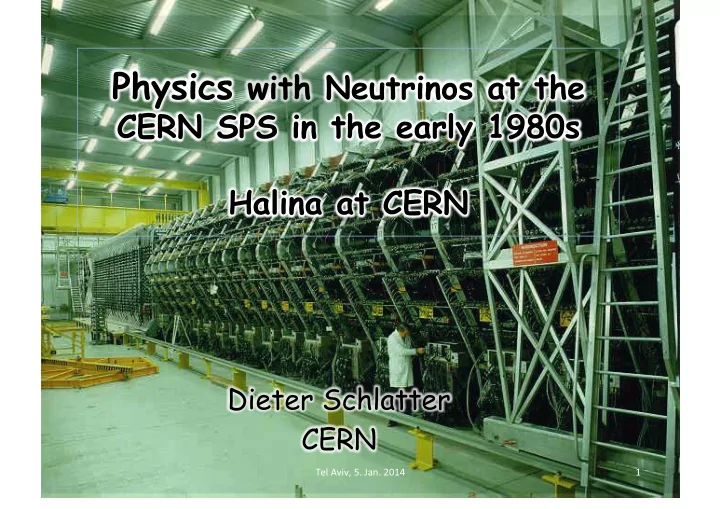
Tel"Aviv,"5."Jan."2014" 1" Physics - - PowerPoint PPT Presentation
Tel"Aviv,"5."Jan."2014" 1" Physics landscape at the end 1970s Parton model for proton -> partons are fractionally charged quarks (gluons postulated) Z 1 0.5 x [ u ( x ) + u ( x ) + d ( x ) + d (
1" Tel"Aviv,"5."Jan."2014"
2" Tel"Aviv,"5."Jan."2014"
3" Tel"Aviv,"5."Jan."2014"
4" Tel"Aviv,"5."Jan."2014"
5" Tel"Aviv,"5."Jan."2014"
John"Rander"
6" Tel"Aviv,"5."Jan."2014"
7" Tel"Aviv,"5."Jan."2014"
F."Eisele"
8" Tel"Aviv,"5."Jan."2014"
9" Tel"Aviv,"5."Jan."2014"
10" Tel"Aviv,"5."Jan."2014"
Volume 105B, number 4 PHYSICS LETTERS 8 October 1981 where Q2 is the squared four-momentum transfer from the muon, E is the beam energy, M the proton mass, y = viE, where v is the energy transferred from the muon to the hadronic final state and x the Bjorken variable Q2[
relationship between F 1 and F 2 is conventionally ex- pressed in terms of R, the ratio of o L to or, as 2x~1/l~ 2 = (1 + 4M2x2/02)/(1 + R). For this paper F 2 has been extracted using the above relationship with R = 0.0 and R = 0.2. The experiment was performed in the muon beam
eter shown in fig. 1, further details of which are al- ready published [7]. Each #+, incident on the 6 m long hydrogen target, was measured in momentum to +0.3% by a focussing spectrometer in the beam line and in position and direction by the scintillator hodo- scopes BHA and BHB. Muons scattered from the tar- get were detected and measured in the drift chambers Wl-W5 and the proportional chambers P0-P3. Tracks detected in the drift chambers W6, W7, which had penetrated the lead-iron-scintillator calorimeter, H2, and the 2 m thick wall of magnetised iron, were identi- fied as muons. Five scintillation counter hodoscopes, H1V, H1H, H3V, H3H and H4 were used to form a trigger on a scattered muon. Signals from pairs of hodoscopes were fed into matrices of coincidence logic to select events in which a muon was observed (i) scattered through at least 0.5 ° , (ii) pointing back to the target in both views, and (iii) not excessively deflected in the vertical plane by the magnetised iron absorber. Condition (i) suppressed the high rate from low-Q 2 events, condi- tion (ii) rejected most of the beam halo, while condi- tions (ii) and (iii) together imposed a cut-off at about 15 GeV in momentum, suppressing the contribution
2
rendered negligible by the use of the hodoscope arrays V1, V2 and V3 in anticoincidence. Muon tracks were reconstructed by initially finding a track segment behind the absorber, and associating it with a track in W4, W5. Then by stepping back through W3, P3, P2, P1 and the chambers in front of the magnet the whole track was found. A quintic spline fit was used to determine the muon momentum, and the incident and scattered muon were fitted to a common interaction vertex. The muon tracks found were tested to ensure that the trigger was satisfied by the muon itself, and not, for example, by a combina- tion of a muon and a produced hadron. The beam flux used during the experiment was de- termined by counting the number of beam tracks re-
B E A M
VI
V3 7, / / / / / "T
r
BHA // BHB Fe wall V2 if Plan view
I I I I II 2 3 4 5 (m) SPECTROMETER MAGNET W7
[
H3V W6 Pe wall EMC FORWARD SPECTROMETER
316
“Measurement"of"the"nucleon"structure"funcKon"F2"in"muon"4"iron"" interacKons"at"1204GeV,"2504GeV"and"2804GeV”:""EMC"Coll.,""PLB,"Aug,"1981"
“A"measurement"of"the"nucleon"structure"funcKon"from"muon4carbon" ""deep"inelasKc"scaeering"at"high"Q2"“:"BCDMS4Coll.,"PLB,"Sep."1981"
Volume 104B, number 5 PHYSICS LETTERS 10 September 1981 structure function in the kinematic region Q2 > 25 GeV 2 where higher twist effects [3], complicating the interpretation of the data are expected to be small. The high statistical accuracy of the data was provided by the high-intensity muon beam available at the CERN SPS. The apparatus used for these measurements is shown in fig. 1. It is a magnetized iron torus with a 40 m long carbon target located in the central hole. The azimuthally symmetric magnetic field deflects scattered muons back towards the beam axis with a sagitta in the iron proportional to Q2/Ebeam. Twenty planes of scintillation counters, each with seven an- nular subdivisions detect those muons with a sagitta and hence Q2 greater than a specified threshold. Tra- jectories of the scattered muons are measured in multi- wire proportional chamber planes located after every 44 cm of iron. Alternate planes measure orthogonal track projections. Interactions are recorded if the scattered muon is: (a) in coincidence with a beam muon; (b) unaccom- panied by a halo track, and (c) transverses four con- secutive scintillator planes at a radius Of at least 44 cm from the spectrometer axis. The latter requirement introduces a Q2 cut-off of ~20 GeV 2 at a beam energy
posed downstream of the interaction point. The efficiency of the scintillators, triggering elec- tronics, and proportional chambers is continuously monitored in the data by exploiting the redundancy
~>97%. The calibration of the spectrometer energy mea- surement has been verified by using muon beams with energies of 120 and 200 GeV directly incident on the
than 1% and the resolution is measured as -+7% at these energies. From Monte Carlo calculations the reso- lution is found to be almost independent of energy above 20 GeV. Because of the focusing properties of the spectrometer the measurement errors on the ener- gy tend to compensate the errors on the scattering a~n~le. The resulting Q2 resolution changes slightly with Q varying from 6% at the highest Q 2 to 8% at the lowest Q2. Since the data analysis requires a knowledge
dependence, these were measured in auxiliary studies. The results were in good agreement with existing cal- culations [4], which were then used in the determina- tion of the incident and scattered energies. The muon beam has already been described in de- tail elsewhere [5]. To summarize, it has an energy spread of -+4%, a profile at the target of o x ~ Oy ~ 2 cm and a characteristic divergence of +0.4 mrad. The energy of individual beam particles is measured to an accuracy of -+0.5% using a set of four scintillator hodo- scopes together with one of the bending elements of the beam [6]. The muon beam is defined through the target by four hodoscope counters. The timing of all hodoscope cells is recorded with each event. The OR
1 (radius = 42 mm) is used to define the beam signal in the trigger. For the data reported below the beam intensity was ~ 107 tz/s. The absolute beam flux was determined by
Halo-Veto ~Segmented trigger Target MWPC's Hodoscop7 /ounters ( ~ Hodoscopes-'--------....._~/~~iO planes, SM I SM2 SM3 SM4 SM5 SM6 SM7 SM8 SM9 SMIO
proportional chambers are arranged in ten supermodules (SM 1-10). The last two supermodules do not contain target units. A wall of scintillation counters vetoes the halo muons.
404
11" Tel"Aviv,"5."Jan."2014"
H."Abramowicz"et"al.,"Z.Phys.C"(1983)"
q(x) − ¯ q(x)
q(x) + ¯ q(x) νN
Q2"slopes" F(x)"
12" Tel"Aviv,"5."Jan."2014"
13" Tel"Aviv,"5."Jan."2014"
H."Abramowicz"et"al."Z."Phys.C"(1982)"
14" Tel"Aviv,"5."Jan."2014"
H."Abramowicz"et"al.,"Z."Phys."C"(1982)"
15" Tel"Aviv,"5."Jan."2014"
+0.013(mc -1.5GeV/c2)
H."Abramowicz"et"al."Phys.Rev.Lee.(1986)""
16" Tel"Aviv,"5."Jan."2014"
CDHSW,"PLB,"Jan."1984"
H."Murayama" Two"detectors" Iron4scint."Calo."
excluded"
17" Tel"Aviv,"5."Jan."2014"
18" Tel"Aviv,"5."Jan."2014"
19" Tel"Aviv,"5."Jan."2014"
20" Tel"Aviv,"5."Jan."2014"
21" Tel"Aviv,"5."Jan."2014"