Why mammograms are more important than instagrams: I have nothing to - - PDF document

why mammograms are more important than instagrams
SMART_READER_LITE
LIVE PREVIEW

Why mammograms are more important than instagrams: I have nothing to - - PDF document

9/21/2016 Disclosure Why mammograms are more important than instagrams: I have nothing to disclose regarding this presentation. An update on metastatic breast cancer. Bridgette Kanz Schroader, PharmD, MPA Clinical Staff Pharmacist Markey Cancer


slide-1
SLIDE 1

9/21/2016 1

Why mammograms are more important than instagrams:

An update on metastatic breast cancer.

Bridgette Kanz Schroader, PharmD, MPA Clinical Staff Pharmacist Markey Cancer Center

Disclosure

I have nothing to disclose regarding this presentation.

Objectives

1. Review the pathophysiology of metastatic breast cancer. 2. Identify recent changes in the treatment of metastatic breast cancer. 3. Explore the emerging role of the androgen receptor. 4. Discuss future directions for research in metastatic breast cancer.

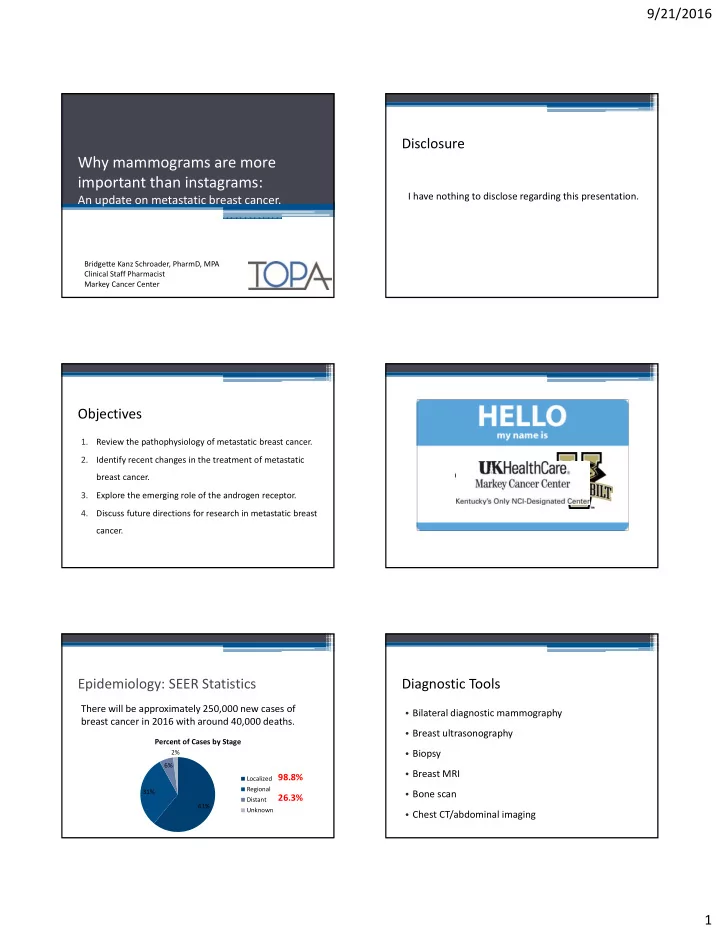
Epidemiology: SEER Statistics

There will be approximately 250,000 new cases of breast cancer in 2016 with around 40,000 deaths.

61% 31% 6% 2%

Percent of Cases by Stage

Localized Regional Distant Unknown

98.8% 26.3%

Diagnostic Tools

  • Bilateral diagnostic mammography
  • Breast ultrasonography
  • Biopsy
  • Breast MRI
  • Bone scan
  • Chest CT/abdominal imaging
slide-2
SLIDE 2

9/21/2016 2 Staging

  • Staging is determined using the American Joint

Committee on Cancer TNM Staging System for Breast Cancer (Tumor, Node, Metastases)

  • This includes traditional TNM as well as pathologic lymph

node staging based on lymph node dissection

  • Staging also includes assigning a histologic grade and

histopathologic subtype

Pathogenesis

Pandya and Moore. Clin Obstet Gynecol, 2011. Wong and Rebelo. McMaster Pathophysiology Review, 2016.

Pathogenesis

Pandya and Moore. Clin Obstet Gynecol, 2011. Wong and Rebelo. McMaster Pathophysiology Review, 2016. National Cancer Institute, 2016.

Alphabet Soup

  • Histological subtype
  • Molecular subtype:

▫ HER2+ or HER2‐ ▫ Hormone receptor (HR) + or HR‐ ▫ Triple negative breast cancer (TNBC)

  • Menopausal status

Histological Subtype Ductal Lobular Preinvasive Cancer 25% Cells limited to basement membrane Ductal carcinoma in situ May spread through ducts and distort duct architecture 1% progress to invasive cancer per year Usually unilateral Lobular carcinoma in situ Does not distort duct architecture 1% progress per year Can be bilateral Invasive Cancer 75% Extension beyond the basement membrane Invasive ductal carcinoma Usually from DCIS precursor Cause fibrous response, producing a palpable mass

  • n examination

Metastasis through lymphatics and blood Invasive lobular carcinoma Usually from LCIS precursor Minimal fibrous response, presents less often with palpable mass Mets through abdominal viscera Almost always ER+ Wong and Rebelo. McMaster Pathophysiology Review, 2016.

slide-3
SLIDE 3

9/21/2016 3

Malhotra et al. Caner Biol Ther, 2010.

Molecular Subtype: HER2/neu

  • Human Epidermal Growth Factor Receptor 2
  • HER2/neu is a proto‐oncogene that encodes transmembrane receptors for

growth factors including EGFR, HER2, 3 and 4.

  • HER2 has intracellular tyrosine kinase activity that affects physiology,

growth and differentiation of cells while extracellular domains interact with HER family members and facilitate transduction.

  • There is no known ligand for HER2.
  • Amplification of the HER2/neu oncogene results in up to 100x physiologic

levels of HER2 facilitating tumorigenesis.

  • Burstein. N Engl J Med, 2005.

Marker, 2016. Image: The Lancet.

Molecular Subtype: Hormone Receptor Status

  • Refers to expression of estrogen and progesterone

receptors on tumor cells

  • The effects of estrogen are mediated through ER‐α

and ER‐β. ER‐α is the dominant isoform and correlates with the most prognostic factors in breast cancers.

  • The progesterone receptor is not as well studied but

is an ER‐regulated gene. Two isoforms, PR‐A and B, are linked to cancer progression.

Pietras, RJ. Oncologist, 2006. Yager and Davidson. NEJM, 2006.

Molecular Subtype: TNBC

  • ER, PR, HER2 negative
  • Represents 15‐20% of breast cancer carcinoma
  • Generally a large, aggressive primary tumor
  • More likely to occur in younger patients (< age 50),

African American or Hispanic women or those with BRCA1 mutation

Foulkes et al. N Engl J Med, 2010.

slide-4
SLIDE 4

9/21/2016 4 Menopause

Defined as the permanent cessation of menses. Criteria include:

  • Age 60 years or older
  • Age less than 60 years and amenorrheic for 12 or more

months in the absence of chemo, tamoxifen, toremifene

  • r ovarian suppression, and FSH and estradiol in the

postemenopausal range

  • If taking tamoxifen or toremifene and age younger than

60, then FSH and plasma estradiol in postmenopausal ranges

NCCN, 2016.

Menopausal status: why does it matter?

  • Production of estrogen varies. Since the inhibition of

estrogen is related to therapy, it’s important to target the appropriate production center.

  • Premenopausal women produce the majority of 17β‐

estradiol in their ovaries while postmenopausal women produce the majority in extragonadal sites.

  • Simpson. J Steroid Biochem Mol Biol, 2003.

Current Treatment

  • HR+, HER2‐
  • HR+, HER2+
  • TNBC

General Treatment: HR+, HER2‐ or +

  • Prior endocrine therapy within 1 year

▫ Ovarian ablation or suppression (OA/S) (if premenopausal) + endocrine therapy

  • No prior endocrine therapy within 1 year

▫ Premenopausal: OA/S + endocrine therapy or SERM ▫ Postmenopausal: AI or SERM or selective ER down‐ regulator

  • Continue sequential endocrine therapy until no benefit

after 3 regimens or visceral crisis

  • Visceral crisis

▫ Chemotherapy

General Treatment: HR+, HER2‐ or +

  • Non‐steroidal aromatase inhibitors (anastrozole,

letrozole)

  • Steroidal aromatase inactivator (exemestane)
  • Exemestane + everolimus
  • Palbociclib + letrozole
  • Palbociclib + fulvestrant (category 1)
  • Fulvestrant
  • Tamoxifen or toremifene
  • Megestrol acetate
  • Fluoxymesterone
  • Ethinyl estradiol

General Treatment: HR‐, HER2+

  • Preferred first line agents

▫ Pertuzumab + trastuzumab + docetaxel (category 1) ▫ Pertuzumab + trastuzumab + paclitaxel

  • Other options

▫ Ado‐trastuzumab emtansine (T‐DM1) ▫ Trastuzumab + paclitaxel +/‐ carboplatin, + docetaxel, + vinorelbine, + capecitabine

  • Agents for trastuzumab exposed disease

▫ Lapatinib + capecitabine ▫ Trastuzumab + capecitabine, + lapatinib or others

slide-5
SLIDE 5

9/21/2016 5 General Treatment: TNBC

  • Preferred single agents

▫ Anthracyclines: doxorubicin, liposomal doxorubicin ▫ Taxanes: paclitaxel ▫ Anti‐metabolites: capecitabine, gemcitabine ▫ Microtubule inhibitors: vinorelbine, eribulin

  • Combinations: CAF/FAC, FEC, AC, EC, CMF,

docetaxel/capecitabine, GT, gem/carbo, paclitaxel/bevacizumab

  • There is no compelling evidence that combination

regimens are superior to sequential single agents

General Treatment: Summary

Wong and Rebelo. McMaster Pathophysiology Review, 2016.

Recent Advances

  • HR+
  • TNBC

Hormone Receptor Positive Disease

  • CDK4/6 pathway inhibition
  • Endocrine therapy combinations

Estrogen Receptor Resistance

  • Over time estrogen receptor resistance develops to

endocrine therapy

  • Ligand dependent resistance mechanisms

▫ Receptor amplification, increased circulating hormone

  • r endogenous hormone

▫ Receptor hypersensitivity, changing ratio of coregulators

  • Ligand independent resistance mechanisms

▫ Receptor mutation, crosstalk, bypass receptors ▫ Loss of receptors

Rau et al. Endocr Relat Cancer, 2005.

Impact in Metastatic Disease: The action‐reaction hypothesis

slide-6
SLIDE 6

9/21/2016 6 Estrogen Receptor Resistance

  • ER‐α mutations promote ligand independent

receptor activation and resistance to various therapies

  • Chandarlapaty et al analyzed 541 patients from the

BOLERO‐2 trial (prior AI exposure) looking at D538G and Y537S mutations

  • Mutation prevalence of 28.8% overall.

▫ WT OS 32.1mo (CI 28‐36mo) ▫ D538G OS 25.99 mo (CI 19‐32mo) ▫ Y537S OS 19.98 mo (CI 13‐29mo)

Chandarlapaty et al. JAMA Oncol, 2016.

CDK4/6 Pathway

  • Cyclin‐dependent kinases 4 and 6 phosphorylate proteins

such as retinoblastoma tumor suppressor protein and

  • thers to promote synthesis of genes important for DNA

replication and movement through the cell cycle

  • Tumors increase CDK dependent activity through a

variety of mechanisms including p16 inactivation, CDK4 amplification or mutation, cyclin D1 overexpression or translocation or amplification of an encoding gene

  • Inhibition of CDK4/6 results in cell cycle arrest from G1 to

the S phase of the cell cycle

Murphy and Dickler et al. Oncol, 2015.

CDK4/6 Pathway

Murphy and Dickler et al. Oncol, 2015.

Palbociclib + Letrozole (P+L)

Phase III

Randomized

Controlled Double‐ blind Key Eligibility:

  • ER+, HER2‐ advanced

breast cancer

  • Treatment naive

R 2:1

N = 666

P 125mg/d po 3 wks on/1 off + L (2.5mg/d) Placebo + L p (y / ) *Patients were stratified by disease site, disease free interval from (neo)adjuvant tx, prior HT (yes/no) PALOMA‐ 2 Finn et al. JAMA Oncol, 2016.

PALOMA‐2 Results

  • Median PFS 24.8 months for combo vs 14.5mo (HR 0.58

[0.46‐0.72], p <0.01)

  • ORR improved with the combination from 34.7% to

42.1% (p = 0.031)

  • Clinical benefit rate was defined as CR + PR + SD≥ 24

weeks and was 84.9% with combo vs 70.3% (p<0.01)

  • ADE

▫ Most common severity seen was G3 neutropenia (56.1%) ▫ Discontinuation was higher in combo with 9.7% vs 5.9%

  • Caveat: overall survival data is pending

Palbociclib + Fulvestrant (P+F)

Phase III

Randomized

Controlled Multicenter Double blind Key Eligibility:

  • HR+, HER2‐
  • Progressed on previous

endocrine therapy

  • ECOG PS 0‐1
  • Measurable disease or

bone disease only

  • Relapse or progression

during tx or <12 mo R 2:1

N = 521

P (125mg/d 3wk

  • n/1 off) + F

(500mg IM D1, 15 C1 then D1 q28d) Placebo + F p *Patients were stratified by sensitivity to previous tx, menopausal status, and presence of visceral mets PALOMA‐3 Cristofanilli et al. JAMA Oncol, 2016.

slide-7
SLIDE 7

9/21/2016 7 PALOMA‐3: Progression Free Survival

Cristofanilli et al. JAMA Oncol, 2016.

PALOMA‐3: Progression Free Survival

Cristofanilli et al. JAMA Oncol, 2016.

PALOMA‐3 Results

  • Grade 3 or 4 adverse events occurred in 73% of the

combo group versus 38% in the placebo group

  • The most common grade 3 or 4 adverse events

included neutropenia (65%), anemia (3%) and leukopenia (28%) but without increase in incidence

  • f neutropenic fever

Murphy and Dickler et al. Oncol, 2015.

What about other endocrine combos?

  • A phase III trial recently evaluated the addition of

bevacizumab to letrozole in postmenopausal patients with HR+ MBC

  • Historically, bevacizumab was granted accelerated

approval for the treatment of HER2‐ MBC in combination with first‐line chemotherapy.

  • It was revoked in 2011 and the majority of data since

that time has been negative

Dickler et al. J Clin Oncol, 2016.

Bevacizumab + Letrozole

Phase III

Randomized

Open label Key Eligibility:

  • ER+ metastatic breast

cancer

  • Treatment naive

R 1:1

N = 343

B (15mg/kg IV q3 wks) + L (2.5mg/d po) Letrozole *Patients were stratified by measurable disease and disease‐free interval CALGB 40503 (Alliance) Dickler et al. J Clin Oncol, 2016.

Alliance 40503 Results

  • After a median follow‐up of 39 months, the addition
  • f bev resulted in a HR=0.75 (CI 0.59‐0.96, p=0.016)
  • The PFS in the combination was 20.2mo compared

to 15.6mo in the placebo arm.

  • No difference in overall survival (HR 0.87, p=0.188)

with median OS in the combo of 43.9mo vs 47.2.

  • Grade 3 or 4 ADE in the combo group included

hypertension (24%) and proteinuria (11%)

Dickler et al. J Clin Oncol, 2016.

slide-8
SLIDE 8

9/21/2016 8 Is there hope for bevacizumab?

  • Results from this trial were similar to the

Letrozole/Fulvestrant and Avastin Study (LEA)

  • In both trials, significant adverse events were noted

and in LEA, 8 patients died during treatment or within 30 days and neither showed OS benefit

  • The authors concluded that the increase in PFS must

be weighed carefully against the risks, expense and inconvenience of IV therapy associated with bevacizumab and that PFS may not be an appropriate surrogate for OS

Dickler et al. J Clin Oncol, 2016.

Triple Negative Breast Cancer

  • Immunotherapy

Checkpoint Inhibition in TNBC

  • The Cancer Genome Atlas showed that PD‐L1 mRNA is

expressed more in TNBC versus non (p<0.01)

  • Further studies showed PD‐L1 expression in 20‐30% of

TNBC associated with higher rates of tumor infiltrating lymphocytes and higher histologic grade tumors.

  • PTEN/PI3K mutations are also associated with HR‐ breast

cancers and contribute to upregulation of PD‐L1 as well as T‐cell suppression

Nanda et al. J Clin Oncol, 2016.

Checkpoint Inhibition

  • Guha. Pharm Journal, 2014.

Pembrolizumab

Phase Ib

Non‐ Randomized Multicenter

Open label Key Eligibility:

  • Advanced PD‐L1+ TNBC

N = 32

Pembrolizumab 10mg/kg IV q2 wks PD‐L1 + disease was defined as expression in stroma or ≥1% of tumor cells by IHC KEYNOTE‐012 Nanda et al. J Clin Oncol, 2016.

KEYNOTE‐012 Results

  • Patients received a median of 5 doses
  • Common toxicities included arthralgia, myalgia,

fatigue and nausea and were generally mild

  • Five patients (15.6%) experienced Grade 3 or higher

toxicity and one patient died from DIC related to tx

  • Of 27 patients available for analysis, 18.5%

responded to therapy

  • The median time to response was 17.9 weeks,

ranging from 7.3 to 32.4 weeks

  • Duration of response is NR (15 to ≥ 47.3 weeks)

Nanda et al. J Clin Oncol, 2016.

slide-9
SLIDE 9

9/21/2016 9 Future Checkpoint Inhibitors in MBC

Phase Drug Status NCI Identifier 1/2 Lirilumab (anti‐KIR)+ nivolumab Recruiting NCT01714739 1 Lirilumab + ipilimumab Completed NCT01750580 1 BMS 936558 (anti‐PD‐L1) Completed NCT00729664 Atezolizumab Recruiting Durvalumab +/‐ tremelimumab Recruiting 1/2 Ipilimumab +/‐ nivolumab Recruiting NCT01928394 Clinicaltrials.gov, 2016.

Other Immunotherapy Strategies

  • DNA and viral vaccines
  • Peptide and protein vaccines
  • Cellular vaccines

Nanda et al. J Clin Oncol, 2016.

Future Research

  • CDK4/6 inhibitors
  • Vaccine
  • Androgen receptor

Future research: CDK4/6 Inhibitors

  • LEE011 (ribociclib)

▫ Orally bioavailable small molecule inhibitor ▫ Currently being investigated in phase I and II trials in combination with other therapies

  • LY2835219 (abemaciclib)

▫ Currently being investigated in ongoing studies ▫ Previously, showed activity (8 PR, 3 unconfirmed PR) in metastatic breast cancer as monotherapy in a heavily pretreated population

MONARCH‐1

  • Single‐arm, phase II trial in heavily pretreated HR+,

HER2‐ ABC of abemaciclib (n=132)

  • Overall response rate 17.4% with a median PFS of 5.7

months and median OS 17.7mo with upper boundary NR

  • Abemaciclib was granted breakthrough therapy

approval in October 2015 for patients with refractory HR+ ABC or MBC and is being evaluated in combination with fulvestrant in MONARCH‐2

Dickler et al. J Clin Oncol, 2016.

Future research: OPT‐822/OPT‐821

  • Vaccine that induces IgG and IgM by targeting Globo H, a

cancer associated carbohydrate antigen expressed by 60‐ 80% of breast cancers

  • Analyzed in a phase II/III double‐blind, randomized,

international study of 349 patients with MBC with response or SD following 2 or less lines of therapy

  • Patients received the vaccine plus low‐dose

cyclophosphamide with or without hormone therapy

Huang et al. J Clin Oncol, 2016.

slide-10
SLIDE 10

9/21/2016 10 OPT‐822/OPT‐821: Results

  • No difference was observed in median PFS (HR 0.96,

p =0.77) or interim OS (HR 0.79, p=0.29)

  • Subgroup of patients who developed IgG response

(titer ≥ 1:160 at any time point) had significantly better results

▫ PFS 48.5 vs 23.9 weeks, HR 0.51, p <0.01 ▫ Is response due to the vaccine or IgG levels?

Huang et al. J Clin Oncol, 2016.

Future Research: Androgen Receptor

  • The androgen receptor is expressed in 60% of metastatic

breast tumors, with varying expression across subtypes

  • Historically, testosterone has been used alone and in

combination with tamoxifen with varying results

  • Recently, interest has been renewed in using the AR as a

drug target in breast cancer treatment

Chia et al. Curr Oncol Rep, 2015.

AR/ER+ Tumors

  • The AR is expressed on 84‐95% of ER+ tumors
  • Treatment naïve

▫ AR may antagonize the growth effect of ER signaling ▫ High AR expressers respond better to ER therapy

  • Treatment resistant

▫ An AR/ER ratio ≥2 increases the risk of tamoxifen failure ▫ The role of AR in AI resistant tumors is less clear

Chia et al. Curr Oncol Rep, 2015.

AR+/ER‐/HER2+ Tumors

  • The AR is expressed on 50‐63% of HER2+ tumors
  • In the absence of ER, AR may assume a similar oncogenic role due

to crosstalk

  • AR upregulates HER2 through transcription stimulation resulting in

activation of AR transcription through downstream mediators involving ERK‐CREB1

  • Further, Wnt7B is induced by AR and activates β‐catenin leading to

nuclear translocation and activation of HER3, which dimerizes with HER2 leading to c‐myc mediated amplification of AR signaling

Chia et al. Curr Oncol Rep, 2015.

Bicalutamide

Phase II

Single arm Multicenter

Open label Key Eligibility:

  • AR+, ER/PR‐ MBC
  • ECOG PS <2
  • Adequate renal, hepatic

and hematologic function

  • No chemo within 2 weeks

and investigational tx within 3 weeks N = 28 Bicalutamide 150mg po daily AR+ was defined as >10% nuclear staining

  • n IHC

Translational Breast Cancer Consortium Gucalp et al. Clin Cancer Res, 2013. CBR = 19% CBR = 19%

AR+/ER‐/HER2‐ Tumors

  • The AR is expressed on 10‐53% of TNBC tumors
  • Work with cell lines has indicated that AR plays a

functional role in maintaining cell proliferation in TNBC and can act as a biomarker for sensitivity to PI3K and ERK inhibition due to upregulation of membrane receptor kinase pathways

Chia et al. Curr Oncol Rep, 2015.
slide-11
SLIDE 11

9/21/2016 11 What can we do? Target the AR! How?

AR Directed Therapy Agent AR antagonists Enzalutamide Enzalutamide + Trastuzumab Selective androgen receptor modulators GTx024 (Enobosarm) CYP17 Inhibitors Orteronel Abiraterone Androgens DHEA (dehydroepiandrosterone) CR1447 (4‐OH‐testosterone) Antisense oligonucleotides targeting AR AZD5312 Chia et al. Curr Oncol Rep, 2015.

Social Issues

  • Access to tissue
  • Cost of care

The Metastatic Breast Cancer Project www.MBCproject.org

  • Due to the prevalence of breast cancer patients

treated in the community, many patients do not have tumor samples available for research

  • Patients are sent a saliva kit to mail back for germline

DNA analysis and share medical records and tissue

  • Results reported at ASCO include 1227 MBC enrolled

in the first 3 months

  • Researchers are able to identify patients with rare

phenotypes, extraordinary response to therapy and generate new hypotheses.

Wagle et al. J Clin Oncol, 2016.

Cost of Care

5000 10000 15000 20000 25000 Trastuzumab No trastuzumab Out of Pocket Variation Giordano et al. J Clin Oncol, 2016.

Cost of Care

50000 100000 150000 200000 Trastuzumab No trastuzumab Insurer Pay Out of Pocket Variation Giordano et al. J Clin Oncol, 2016.

slide-12
SLIDE 12

9/21/2016 12 Cost of Care

  • Limitations include focus on a younger patient

population with private health insurance

  • Patients without private insurance may face much higher

costs of care

  • Researchers were unable to include the costs of newer

therapies in the current study and relied on insurance claims for information

Giordano et al. J Clin Oncol, 2016.

Take Home Message

  • Cancer treatment remains a financial burden
  • Providers need to weigh multiple options and discuss

these issues with the patient

  • The ultimate goal is to provide high VALUE care

instead of high COST care

Why mammograms are more important than instagrams:

An update on metastatic breast cancer.

Bridgette Kanz Schroader, PharmD, MPA Clinical Staff Pharmacist Markey Cancer Center

Questions?