Breast and Cervical Cancer Question Question Answer / Key Points - - PowerPoint PPT Presentation

breast and cervical cancer
SMART_READER_LITE
LIVE PREVIEW

Breast and Cervical Cancer Question Question Answer / Key Points - - PowerPoint PPT Presentation

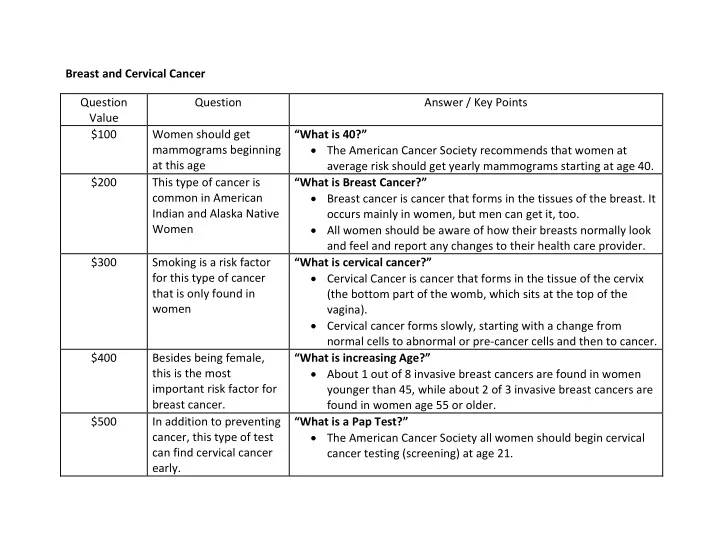
Breast and Cervical Cancer Question Question Answer / Key Points Value $100 Women should get What is 40? The American Cancer Society recommends that women at mammograms beginning at this age average risk should get yearly mammograms


slide-1
SLIDE 1

Breast and Cervical Cancer Question Value Question Answer / Key Points $100 Women should get mammograms beginning at this age “What is 40?”  The American Cancer Society recommends that women at average risk should get yearly mammograms starting at age 40. $200 This type of cancer is common in American Indian and Alaska Native Women “What is Breast Cancer?”  Breast cancer is cancer that forms in the tissues of the breast. It

  • ccurs mainly in women, but men can get it, too.

 All women should be aware of how their breasts normally look and feel and report any changes to their health care provider. $300 Smoking is a risk factor for this type of cancer that is only found in women “What is cervical cancer?”  Cervical Cancer is cancer that forms in the tissue of the cervix (the bottom part of the womb, which sits at the top of the vagina).  Cervical cancer forms slowly, starting with a change from normal cells to abnormal or pre‐cancer cells and then to cancer. $400 Besides being female, this is the most important risk factor for breast cancer. “What is increasing Age?”  About 1 out of 8 invasive breast cancers are found in women younger than 45, while about 2 of 3 invasive breast cancers are found in women age 55 or older. $500 In addition to preventing cancer, this type of test can find cervical cancer early. “What is a Pap Test?”  The American Cancer Society all women should begin cervical cancer testing (screening) at age 21.

slide-2
SLIDE 2

Colorectal Cancer Question Value Question Answer/Key Points $100 An unhealthy diet is a risk factor for this type of cancer, found both in men and women. “What is Colorectal Cancer?”  Colorectal cancer is cancer that starts in the colon or the rectum.  These cancers can also be referred to separately as colon cancer or rectal cancer, depending on where they start. $200 The colon and rectum are a part of this system “What is the digestive system?”  The colon and rectum are parts of the digestive system, which is also called the gastrointestinal (GI) system. $300 91% of colorectal cancer cases are diagnosed in people this age and

  • lder.

“What is age 50?”  Younger adults can develop colorectal cancer, but the chances increase markedly after age 50: About 9 out of 10 people diagnosed with colorectal cancer are at least 50 years old. $400 In addition to preventing cancer, this type of screening exam can detect colorectal cancer early. “What is Colonoscopy?”  In a colonoscopy the doctor looks at the entire length of the colon and rectum with a colonoscope $500 These type of tests for colorectal cancer can be done either in a doctor’s

  • ffice or at home.

“What is Fecal Occult Blood Test (FOBT) or Fecal Immunochemical Test (FIT)?”  The fecal occult blood test (FOBT) is used to find occult blood (blood that can't be seen with the naked eye) in feces.

slide-3
SLIDE 3

Lung Cancer Question Values Question Answer/Key Points $100 In addition to smoking cigarettes, this type of smoke can lead to lung cancer “What is lung cancer?”  Second‐hand smoke – breathing the smoke from other people’s tobacco – leads to higher risk for lung cancer. $200 This is the single most preventable cause of cancer in the U.S. “What is cigarette smoking?”  About 8 out of 10 lung cancer deaths in women and 9 out of 10 lung cancer deaths in men are caused by smoking. $300 This type of cancer is the leading cause of cancer deaths in both men and women in the United States. “What is lung cancer?”

  • Lung cancer is cancer that forms in the tissue of the lungs.
  • Lung cancer is the leading cause of cancer death in the United

States. $400 This type of screening exam has been proven to detect lung cancer early “What is Low Dose Computed Tomography?”  Adults between the ages of 55‐74, who meet the eligibility criteria of the National Lung Screening Trial (NLST) and are concerned about their risk of lung cancer may consider screening for early lung cancer detection by talking with their healthcare provider. $500 Most lung cancer starts in the lining of this tissue. “What is bronchi?”

  • Most lung cancers start in the large breathing tubes (bronchi),

but they can also begin in other areas such as the windpipe (trachea), smaller breathing tubes (bronchioles), or air sacs (alveoli.)

slide-4
SLIDE 4

Cancer Support Question Value Question Answer/Key Points $100 You can find more information on cancer types that are more common in American Indian communities on this website “What is www.cancer.org/col?”

  • The Circle Of Life website has information about cancer types

that are more common in American Indian and Alaska Native communities. $200 You can find additional information about cancer prevention, early detection, treatment and survivorship by calling this number “What is 1‐800‐237‐2345 or 1‐800‐ACS‐2345?” $300 You can find additional information about cancer prevention, early detection, treatment and survivorship on this site “What is www.cancer.org or the American Cancer Society?” $400 Gallbladder, Mouth, Stomach and Kidney Cancers are sometimes found more in these communities when compared to other populations “What is American Indian and Alaska Native?”

  • There are other cancers that may be more common among AI/

AN than among other groups.

  • These cancers include: gallbladder, mouth / throat, kidney,

stomach, multiple myeloma, ovarian, uterine, testicular, and even some childhood cancers.

slide-5
SLIDE 5

Cancer Support (cont.) Question Value Question Answer/Key Points $500 One way to help detect cancer is by getting this annual exam from a healthcare provider “What is a Physical?”

  • It is important to see a healthcare provider annually to get an

exam.

slide-6
SLIDE 6

Prostate Cancer Question Value Question Answer/Key Points $100 Almost 2 out of 3 prostate cancers are found in men over this age “What is age 65?”  Some prostate cancers can grow and spread quickly, but most

  • f them grow slowly

 Autopsy studies show, 70% to 90% of the men had cancer in their prostate by age 80, but in many cases neither they nor their health care providers even knew they had it. $200 This term is used to describe a disease that is a long‐lasting condition that can be controlled but not cured like diabetes and now cancer. “What is Chronic Disease?”  It is not possible to “catch” cancer, like you “catch” a cold, from someone who has it.  Cancer can be a chronic disease. Cancer can often be cured, but many types that cannot be cured can be treated to prolong life. $300 This blood test is often used to screen for prostate cancer is not recommended for screening by the American Cancer Society “What is Prostate Specific Antigen (PSA) Test?”  The American Cancer Society does not recommend routine prostate cancer screening for all men at this time.  Beginning at age 50, men should talk with their health care providers to discuss the options for testing and decide what is right for them. $400 This test can be done by health care provider to screen for prostate abnormalities “What is Digital Rectal Exam (DRE)?”

  • Men should talk to their health care providers about prostate

screening.

slide-7
SLIDE 7

Prostate Cancer (cont.) Question Value Question Answer/Key Points $500 Since most prostate cancers are found early, nearly this percentage of men will survive at least 10 years after cancer treatment “What is 99%?”

  • According to the most recent data, when including all stages of

prostate cancer:

  • The relative 5‐year survival rate is almost 100%
  • The relative 10‐year survival rate is 99%
  • The 15‐year relative survival rate is 94%
slide-8
SLIDE 8

Skin Cancer Question Value Question Answer/Key Points $100 People with darker skin can be diagnosed with this type of cancer if exposed too much UV light. “What is skin cancer?”

  • Skin cancer is by far the most common type of cancer. It

accounts for nearly half of all cancers in the United States.

  • People with darker skin tan more easily, but tanning is still a

form of skin damage. $200 This type of cancer is the more serious form of skin cancer “What is melanoma?”

  • There are two main types of skin cancer: melanoma (the more

serious type) and all the other types (non‐melanoma). $300 This type of exposure can raise skin cancer risk even without sunburn “What is UV exposure?”

  • Unprotected and/or excessive exposure to ultraviolet

(UV) radiation includes sunlight or tanning booths and lamps $400 The "ABCD Rule“ is useful in identifying skin changes and is an acronym for: “What is A for ASYMMETRY, B for BORDER, C for COLOR, D for DIAMETER?”

  • ASYMMETRY: One half of a mole or birthmark does not match

the other.

  • BORDER: The edges are irregular, ragged, notched, or blurred.
  • COLOR: The color is not the same all over and may include

shades of brown or black, or sometimes with patches of pink, red, white, or blue.

  • DIAMETER: The spot is larger than the size of a pencil eraser,

although melanomas can sometimes be smaller than this

slide-9
SLIDE 9

Skin Cancer (cont.) Question Value Question Answer/Key Points $500 A sign of possible melanoma is a change in the ____of a mole or the appearance of a new spot. “What is size, shape, or color?”

  • Another very important sign of possible melanoma is a change

in the size, shape, or color of a mole or the appearance of a new spot.

  • Some melanomas do not fit the ABCD rule, so it is very

important to tell a health care provider about any changes in skin markings or new spots on the skin. Final Jeopardy Question Value Question Answer/Key Points This disease was recently found to be the number

  • ne cause of death in

American Indian and Alaska Native Communities “What is Cancer?”

  • Cancer has been identified as the leading cause of death in

American Indian and Alaska Native communities.

  • This differs for other racial / ethnic groups as cancer is typically

the second leading cause of death behind cardiovascular disease for all ages combined.