
SLIDE 1
http://www.somethingofthatilk.com/index.php?id=135
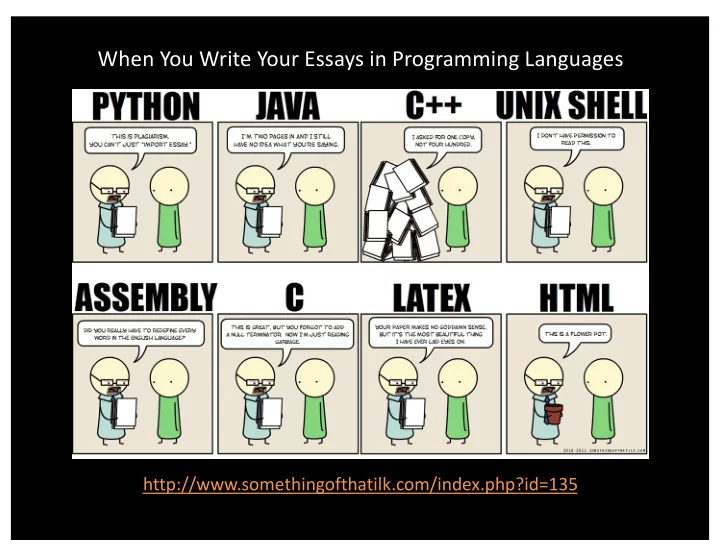
When You Write Your Essays in Programming Languages
When You Write Your Essays in Programming Languages - - PowerPoint PPT Presentation
When You Write Your Essays in Programming Languages http://www.somethingofthatilk.com/index.php?id=135 CS 252: Advanced Programming Language Principles Operational Semantics Prof. Tom Austin San Jos State University Lab Review (in-class)
http://www.somethingofthatilk.com/index.php?id=135
When You Write Your Essays in Programming Languages
CS 252: Advanced Programming Language Principles
San José State University
Lab Review
(in-class)
Everyone knows what an if statement does, right? if true then x = 1 else x = 0
At the end of this code snippet, the value of x will be 1
Everyone knows what an if statement does, right? if false then x = 1 else x = 0
At the end of this code snippet, the value of x will be 0
Everyone knows what an if statement does, right? if 0 then x = 1 else x = 0
Will x be set to 0, like in C/C++? Will x be set to 1, like in Ruby? Or will it be an error, like in Java?
Everyone knows what an if statement does, right? x = if true then 1 else 0
Is assignment valid or an error?
Formal semantics define how a language works concisely and with minimal ambiguity.
A Review of Compilers
Lexer/ Tokenizer Parser
source code tokens
Abstract Syntax Tree (AST) Compiler
Machine code
Interpreter
Commands
We don't care about lexing or parsing. We don't care if we have a compiler or interpreter
A Review of Compilers
Lexer/ Tokenizer Parser
source code tokens
Compiler
Machine code
Interpreter
Commands
We don't care about lexing or parsing. We don't care if we have a compiler or interpreter
Abstract Syntax Tree (AST)
ASTs are the key to understandin g a language
Bool* Language
e ::= true | false | if e then e else e expressions: constant true constant false conditional
Despite appearances, these are really ASTs
Values in Bool*
v ::= true | false values: constant true constant false
Formal Semantic Styles
–Big-step (or "natural") –Small-step (or "structural")
Formal Semantic Styles
–Big-step (or "natural") –Small-step (or "structural")
Big-Step Evaluation Relation
An expression e … … evaluates to … … a value v.
Big-Step Evaluation Relation
Preconditions
limits when the rule applies
Big-step semantics for Bool*
e1 ⇓ true e2 ⇓ v if e1 then e2 else e3 ⇓ v
B-IfTrue
e1 ⇓ false e3 ⇓ v if e1 then e2 else e3 ⇓ v
B-IfFalse
v ⇓ v
B-Value
Bool* big-step example
if (if true then false else true) then true else false
if true then false else true ⇓ false
true ⇓ true false ⇓ false
false ⇓ false
⇓ false
Converting our rules into code
(in-class)
Language extension: numbers Users demand a new feature – numbers! We will add 3 new features:
the next highest number.
the next lowest number.
BoolNum* Language
e ::= true | false | if e then e else e | n | succ e | pred e
Let's extend our semantics to handle these new language constructs
(in-class)
Literate Haskell
foo x = 1 + (foo (x – 1)) Literate Haskell src file (.lhs) > foo x = 1 > + (foo (x – 1))
Lab 2: Write a Bool* Interpreter
http://www.cs.sjsu.edu/~austin/cs25 2-spring18/labs/lab02/interp.lhs
and pred
Example: Information Flow Analysis
–E.g. protect credit card info –Attacker might control some code
–Mark sensitive data –Keep track of which data is secret
SecretKeeper Language
e ::= true | false | n | if e then e else e | succ e | pred e | secret e
Semantics assignment 1
for SecretKeeper
either secret or public. Your evaluation relation might be