When Things Go Wrong: How to Get Help Ethics and Scientific - - PowerPoint PPT Presentation

when things go wrong how to get help
SMART_READER_LITE
LIVE PREVIEW

When Things Go Wrong: How to Get Help Ethics and Scientific - - PowerPoint PPT Presentation

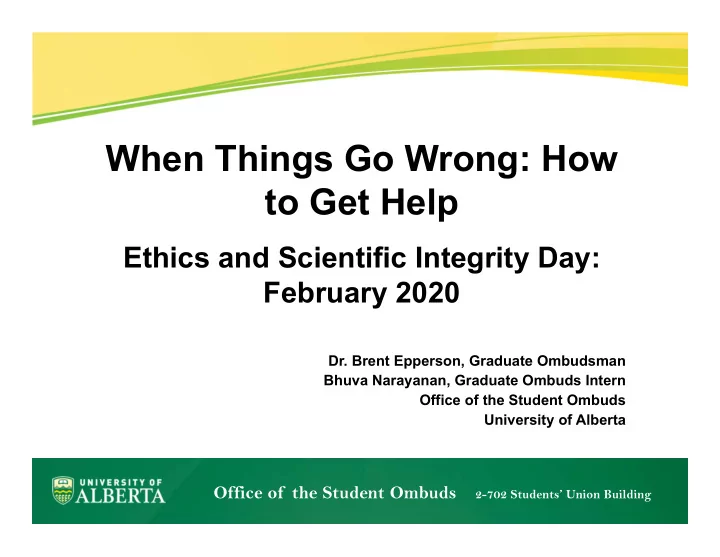
When Things Go Wrong: How to Get Help Ethics and Scientific Integrity Day: February 2020 Dr. Brent Epperson, Graduate Ombudsman Bhuva Narayanan, Graduate Ombuds Intern Office of the Student Ombuds University of Alberta Office of the Student


slide-1
SLIDE 1

When Things Go Wrong: How to Get Help

Ethics and Scientific Integrity Day: February 2020

  • Dr. Brent Epperson, Graduate Ombudsman

Bhuva Narayanan, Graduate Ombuds Intern Office of the Student Ombuds University of Alberta

Office of the Student Ombuds

2-702 Students’ Union Building

slide-2
SLIDE 2

What is the Office of the Student Ombuds?

  • We offer advice and support on academic and disciplinary issues.
  • We are advocates for fairness and equity, working to strengthen the collegial

relationship between students and the university.

  • We act as an impartial third party to any conflict or dispute involving students and the

University.

  • We are a source of information on University regulations and policies.
  • Our service is confidential and free.
  • We are independent from the faculties and from the student associations (GSA and SU).
  • We are accessible to all students (undergraduate, graduate, and post-doctoral) and

located in an accessible area.

Office of the Student Ombuds

2-702 Students’ Union Building

slide-3
SLIDE 3

Understanding expectations to avoid conflict: Things you should discuss with your supervisor early in your program.

1. How frequently do you expect to meet with your graduate students? 2. How many hours of work per week do you expect from a graduate student? 3. What is your preferred mode of communication? (i.e. in person or via e-mail)

Office of the Student Ombuds

2-702 Students’ Union Building

slide-4
SLIDE 4

Things you should discuss with your supervisor (continued)

4. What are your timeline expectations for completion of the various stages of my program? 5. How available will you be to meet, discuss, answer emails? 6. What are your expectations in terms of publications and conference presentations?

Office of the Student Ombuds

2-702 Students’ Union Building

slide-5
SLIDE 5

Tips to diffuse conflict

  • Deal with problems early – do not let them persist or worsen.
  • Deal with problems appropriately – do not start by calling the president
  • f the university.
  • Talk to your supervisor openly and directly.
  • Do not assume your supervisor knows that you feel there is a problem.
  • Act professionally (even when the other person does not).
  • Preserve the supervisory relationship whenever possible.

Office of the Student Ombuds

2-702 Students’ Union Building

slide-6
SLIDE 6

Where to go for help when things go wrong? First empower yourself with information

The Calendar, the Graduate Program Manual, the Code of Student Behaviour, and the GSA AEGS Collective Agreement:

  • Outline the steps, procedures and policies for graduate programs
  • Spell out the roles, rights and responsibilities for supervisors, students (including as

teaching and research assistants), and departments and faculties

  • The Calendar is found online at:

http://www.registrarsoffice.ualberta.ca/Calendar.aspx

  • The Graduate Program Manual is found on the FGSR webpage at:

http://www.gradstudies.ualberta.ca/gpm.aspx

  • The Code of Student Behaviour is found at:

http://www.governance.ualberta.ca/CodesofConductandResidenceCommunityStandard s/~/media/Governance/Documents/Codes%20of%20Conduct%20and%20Residence% 20Community%20Standards/Code%20of%20Student%20Behaviour/COSB-Updated- February-3-2014.pdf

  • Your GSA 2014-2016 AEGS Collective Agreement (for TAs and RAs) is found at:

http://www.gsa.ualberta.ca/en/~/media/gsa/CollectiveAgreement/AEGS2014- 2016_2015-2016PayScale.pdf

Office of the Student Ombuds

2-702 Students’ Union Building
slide-7
SLIDE 7

Getting Help

Seek assistance from a third party if you can’t resolve the conflict:

  • Graduate Coordinator
  • Department Chair (when Graduate Coordinator is unavailable)
  • Graduate Ombudsperson
  • FGSR Associate Deans

Other Resources

  • The Graduate Students’ Association (GSA) (labour issues and advocacy)
  • The Office of Safe Disclosure and Human Rights
  • International Student Services (visa and study permit issues)
  • The Student Success Centre and the Centre for Writers (writing and other

academic guidance)

  • Counselling and Clinical Services (Mental health assistance)
  • Student Legal Services of Edmonton (legal advice in non-criminal matters)

Office of the Student Ombuds

2-702 Students’ Union Building

slide-8
SLIDE 8

My Contact Information

  • Dr. Brent Epperson

Graduate Ombudsman Office of the Student Ombuds University of Alberta gradomb@ualberta.ca www.ombudservice.ualberta.ca/

Office of the Student Ombuds

2-702 Students’ Union Building