
SLIDE 1
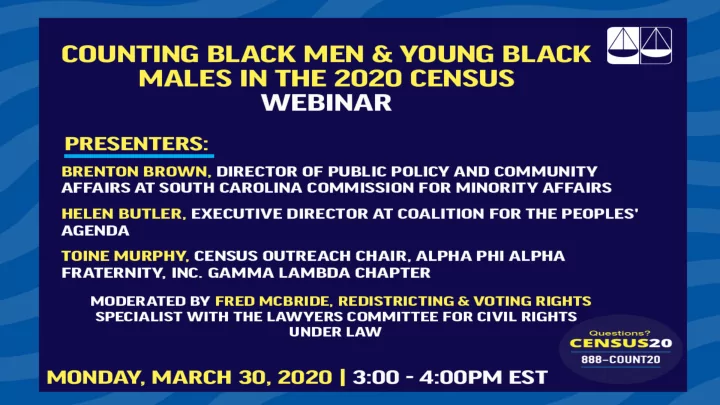
What We Wil ill Strategies Special Initiatives by Organizations - - PowerPoint PPT Presentation
Identify & Measure the Problem Importance of the Census, Funding and Engagement What We Wil ill Strategies Special Initiatives by Organizations to Cover Increase the Count of Black Males Messaging, Resources &
❖ Identify & Measure the Problem ❖ Importance of the Census, Funding and Engagement Strategies ❖ Special Initiatives by Organizations to Increase the Count of Black Males ❖ Messaging, Resources & Other Programs ❖ Census Updates ❖ Q&A
African-American households are at risk of being undercounted. The African-American population has been historically undercounted in the decennial census, disadvantaging their families, communities, and neighborhoods. In fact:
American population by more than 800,000
American children were overlooked by the 2010 Census, roughly twice the rate for young non-Hispanic White children.
undercounted in greater numbers than men of
Americans live in historically undercounted census tracts.
4
Of this rate, African-American men have been historically undercounted in greater numbers than men of other racial or ethnic groups
Note: Net undercounts are shown as a negative numbers
5
O’Hare – Count All Kids
Census coverage for males and females by race in the 2010 census
6
Source U.S. Census Bureau, Demographic Analysis tables released May 2012
Males Females Total −0.8 1.1 Black Alone −4.6 −0.1 Non-Black Alone −0.3 1.1
Source U.S. Census Bureau, Demographic Analysis tables released May 2012
Brenton Brown Director of Public Policy and Community Affairs South Carolina Commission for Minority Affairs
Census Overview
counting) of all residents in the United States.
Article I, §2, clause 3 of the U.S. Constitution: “The actual Enumeration shall be made within three Years after the first Meeting of the Congress of the United States, and within every subsequent Term of ten Years, in such Manner as they shall by Law direct.”
can respond online
What the Census determines
reapportionment of seats in Congress and drawing of new legislative districts
formulas
hospitals
laws, the Voting Rights Act, and other legislation
deciding where to expand
population estimates and projections, weights for sample surveys – any group or institution
that uses data for planning, often starts with Census
Census Questions
living or staying in this dwelling on April 1, 2020?
people staying here on April 1, 2020 that you did not include in Question 1?
number?
➢ Emphasize that census participation is apolitical and nonpartisan ➢Educate as to how lack of census participation reinforces the cycle of low wages being instituted in Black communities ➢ Explain that the census assists the government in determining where resources should be directed to assist communities ➢Combine census participation with voter engagement activities ➢ Relate census engagement with community development initiatives (i.e. money for schools, healthcare facilities, roads, etc.) ➢ Educate as to how census participation influences business development
Outr treach Meth thod: Tru rusted Voic ices
for reaching Black men and young Black males are through “trusted voices.”
in high esteem and respected for their character and integrity.
athletes, coaches, entertainers, older male role models, etc.
Outreach Meth thod: Tru rusted Lo Locatio ions
In addition to trusted voices, it is important to reach Black men at trusted locations. To reach Black men you must go where they are and communicate in the circles they communicate in, such as: barb barbershops, s, spo sporting events, radio, , te tele levis ision, , and soc socia ial l med edia. a.
Vary ry Meth thods
men and young Black males are not a monolith.
strategies to engage the various sub- demographic groups within various Black male communities.
I’ve Got My Brother’s Back – Count Us Black!
Presented by Helen Butler – The Peoples’ Agenda
Georgia State Capitol
GEORGIA
In FY2016, Georgia received $23,835,175,686 through 55 federal spending programs guided by data derived from the 2010 Census. Ranks fifth among states for the highest possible undercount in percentage terms, with blacks, Hispanics and children under 5 years
the Urban Institute Some 136,600 blacks, 39,700 Hispanics and 46,400 children under five could be missed in Georgia under a worst- case scenario 2010 Census Georgia gained two Congressional seats (12 to 14)
U.S. Census: What’s in it?
Medicaid - Medicare Part B Supplemental Nutrition Assistance Program (SNAP) - $[xx] billion Supplemental Nutrition Assistance Program (SNAP) Highway Planning and Construction Section 8 Housing Choice Vouchers National School Lunch Program Special Education Grants (IDEA)
APPORTIONMENT COUNTS DELIVERED
By law, Census Bureau delivers population counts to President for apportionment.
Complete Count Committee
Mayor Keisha LanceBottoms Committed $1 Million to ensure accurate count No other city, county or the State of Georgia has committed such funds
FOR EACH UNDERCOUNTED PERSON WE LOSE: $2,400/YEAR x 10 YEARS* $24,000 PER UNDERCOUNTED PERSON** ** SOME ESTIMATES LOWER AND HIGHER
Result lts of
an Undercount
So So Why is is It It Hard to to Co Count Bla Black Men?
government
System
Tar arget Cou
ies I’ve Got My Brother’s Back – Cou
t us s Blac lack
2010 % Black % Hispanic Counties % Return Rate Population Population Bulloch 51.7 43.0 5.0 Clayton 52.7 49.0 46.0 Cobb 53.4 69.0 9.0 Dekalb 59.3 95.0 3.0 Evans 59.5 47.0 13.0 Fulton 57.7 91.0 7.0 Gwinnett 54.5 40.0 44.0 Randolph 58.7 46.0 6.0 Tattnall 59.8 37.0 22.0 Telfair 55.6 43.0 0.0 Wheeler 51.9 46.0 2.0 Wilcox 53.4 34.0 1.0
Before Coronavirus our plans to count Black Men:
mobilization activities)
across state) in the census & importance of drawing fair maps (redistricting)
areas of the state to allow Georgians to complete census
response rate for Black men and children under age 5
Post Coronavirus our plans to count Black Men:
April 1st
engagement)
vote distributed in target counties
You Can Help lp!
Quick Michigan Stats
In 2016, Michigan received nearly $30 billion in federal funding, including:
The Michigan Math
$1,800 in federal funding for each person who goes uncounted in 2020. Michigan's undercounted:
Census due to lack of internet access, inaccessible housing, distrust of government or other issues. This projection is before the virus crisis.
in urban cities and counties!!!!
The Goal Of Reaching Our Black and Brown Brothers and Sisters
community regarding the Census 2020 and how if personally will affect us!
we serve.
respond, to complete the questionnaire during the NRFU (Non Response Follow Up) period.
Our Core Message – The Three C’s of the Census
Count Me In and Help Shape Your Future!
mail, phone or online.
will not be shared with anyone.
future success of Michigan and the communities in which you live and play.
Place, Displaced Families, Homeless, Etc.
Using COVID-19/Coronavirus as modern day example of Why Funding is Important
As an influencer or community-based organization or community leader, We can help ensure the people our networks are fully counted, especially the most vulnerable our black and brown communities. With our partnerships, and engagement activities, we have a chance to produce a complete and accurate count, which will directly affect the quality of life for everyone!
the case for the public, Census workers and GOTC organizations, staff, and volunteers conducting outreach.
every single person in our household, including children and babies. The Black community’s future depends on it.
representative visit your home, in person.
English and 12 non English languages or by calling phone questionnaire assistance: https://2020census.gov/en/ways-to-respond/responding-by-phone.html).
invitation or paper questionnaire. Our priority is clear: Making sure that as many people as possible complete the census
2020 Hard-to-Count Mapping Application http://www.censushardtocountmaps2020.us/ Mapping Application Tutorial https://mailchi.mp/da4ad37868ba/census2020-htc- map-updates-feb-2020
Example #1 – Finding areas with very high risk of undercount of young children in a state In this example, someone is trying to find the areas in the state of Georgia with the highest undercount risk for young children. Using the CUNY map, one can produce a map of Georgia with the very high risk of Undercount tracts in large counties highlighted. There are two different ways one can do this with the CUNY mapping application. First, using the “+” and “-“ buttons on the CUNY mapping application, focus in on the geography area you are interested in and center the arrow over the county you are interested in. The tracts in the county will show which census tracts are at very high risk of undercount, which are at high risk of undercount, and which are a low risk of undercount. Also on the CUNY mapping application (https://www.censushardtocountmaps2020.us/) in the upper left-hand corner there is a box for “ST./CO”. Click on that box, hover the arrow over the state of Georgia and click the “Zoom in” button in the upper lefthand corner of the screen. Using the “Share Map” button” in the upper lefthand corner of the page, one can then download the URL that will take people to this map of Georgia.
https://bit.ly/2WUTeAy
❑ Start date for Nonresponse Follow-up delayed until late May; deadline for self- response rates extended to August 14 (from July 31) ❑ Group Quarters & Service-based Enumeration delayed until May 1 ❑ Hiring and training, in- person delivery of paper questionnaire & in- person counting delayed until at least April 15
RSVP here.
Special thanks to
CENTER FOR URBAN RESEARCH