What we know about Latinos and DD ADHD, Autism, Deafness, - - PDF document

what we know about latinos and dd
SMART_READER_LITE
LIVE PREVIEW

What we know about Latinos and DD ADHD, Autism, Deafness, - - PDF document

Providing Culturally Responsive and Empowering Services for Latino Families with Developmental Disabilities Celia Jaes Falicov, Ph.D . University of California, San Diego cfalicov@ucsd.edu No conflict of Interest UCSF Developmental


slide-1
SLIDE 1

Providing Culturally Responsive and Empowering Services for Latino Families with Developmental Disabilities

Celia Jaes Falicov, Ph.D.

University of California, San Diego

cfalicov@ucsd.edu No conflict of Interest

UCSF Developmental Disabilities Conference, March 2016

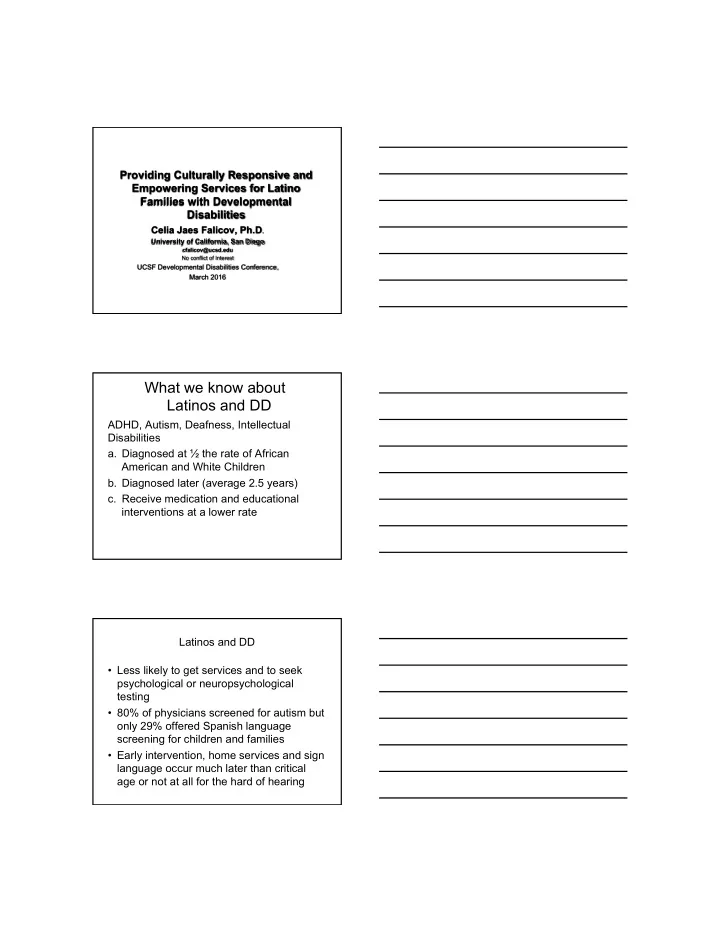
What we know about Latinos and DD

ADHD, Autism, Deafness, Intellectual Disabilities

  • a. Diagnosed at ½ the rate of African

American and White Children

  • b. Diagnosed later (average 2.5 years)
  • c. Receive medication and educational

interventions at a lower rate Latinos and DD

  • Less likely to get services and to seek

psychological or neuropsychological testing

  • 80% of physicians screened for autism but
  • nly 29% offered Spanish language

screening for children and families

  • Early intervention, home services and sign

language occur much later than critical age or not at all for the hard of hearing

slide-2
SLIDE 2

Understanding Challenges and Strengths

  • f Immigrants

Barriers to Detection and Seeking Services: 1.Transportation, child care, limited time, lack of insurance and money to seek services, immigration status.

  • 2. Low parent education: unfamiliarity with

health care system, fear of stigma and discrimination

  • 3. Lack of language and culturally related

assessment and treatment

Practitioner Culture

CLIENT CULTURE

Theory/ Training Personal

The Practice Encounter is not Culturally Neutral

Encompasses two different but related aspects CULTURAL DIVERSITY Values, beliefs and meaning differences (ethnicity, religion, nationality) RESPONSIVENESS SOCIAL JUSTICE Contextual Stressors tied to power differences (race, class, immigrant) EMPOWERMENT

MULTICULTURALISM

slide-3
SLIDE 3

Culture-Specific Competence with Latinos

Equated with ethnic values such as:

  • Familismo (family-centered lives)
  • Machismo (men’s predominance)
  • Personalismo (social manners)
  • Respect for parents and elders
  • Religiosity

The Problem with Ethnic Values only

  • They may perpetuate stereotypes because

values:

  • Are not static, they evolve
  • Are Contextual (class, education, nationality,

urban-rural)

  • Latinos come from many different cultures &

generations

  • They may have bicultural or multicultural

identities

M

MULTIDIMENSIONAL

E

ECOLOGICAL

C

COMPARATIVE

Same 4 domains

A

APPROACH

slide-4
SLIDE 4

4

FAMILY Cultural Maps Theory/ Training Personal Practitioner Cultural Maps

ECOLOGICAL CONTEXT FAMILY LIFE CYCLE MIGRATION/ ACCULTURATION FAMILY ORGANIZATION

Cultural Competence or “Cultural

Humility”? Practitioner’s self- reflection about her or his own personal and professional culture (race, class, beliefs and values) Clients as Experts

  • n their culture and context

Practitioners become aware of power dynamics and give more voice to clients (Tervalon and Murray-Garcia, 1998)

FAMILY LIFE CYCLE ECOLOGICAL CONTEXT MIGRATION/ ACCULTURATION

  • Community
  • Work
  • School
  • Religion
  • Ideals
  • Meanings
  • Timings
  • Transitions
  • Separations &

Reunifications

  • Trauma/

Undocumented

  • Losses and

Gains

  • Cultural

Identities

FAMILY ORGANIZATION

  • Nuclear/

Extended Family

  • Connectedness
  • Hierarchies
  • Communication

Styles Practitioner Maps

FAMILY MAPS

Theory Training Personal

POWER DIFFERENCES (discrimination, racism) CULTURAL VALUE DIFFERENCES

Falicov, 1995

slide-5
SLIDE 5

Cultural Diversity

Meaning and Belief differences tied to

  • Ethnicity
  • Religion
  • Nationality
  • Profession

Clinical Approaches

  • Curiosity & Respect
  • Culture-Attuned

Therapies (traditional healing)

  • Transformations of

Theory (attachment, individuation)

Social Justice

Contextual Stressors tied to

  • Gender
  • Race
  • Social Class
  • Minority Status

Clinical Approaches

  • Empowerment
  • Social Action
  • Legitimize Local

Knowledge

Migration (Impact on Families)

slide-6
SLIDE 6

MIGRATION STRESSORS

  • LANGUAGE BARRIERS
  • UNDOCUMENTED OR TEMPORARY

VISA STATUS

  • LACK OF KNOWLEDGE OF

INSTITUTIONS AND SERVICES

Deafness example: Trilingual challenge

  • Decisions about what type of

communication (sign language, English, Spanish

  • Sign language is based on English
  • Very difficult for parents who do not speak

English, most opt for what they are advised to do about English and ASL but hope for a trilingual future for their child

New forms of SEPARATIONS and REUNIFICATIONS

  • Grandparents and Extended Family
  • Father
  • Father and Mother
  • Mother (Feminization of Migration)

Ratio of Latina women to men has increased

considerably

slide-7
SLIDE 7

A confusing picture

The interaction between migration family stress, trauma and ADHD Diagnosis of Attention Deficit and Hyperactivity Oscar (10) was diagnosed by the school

counselor and the teacher as having ADHD and referred for medication, without consideration of the child as new immigrant, the tensions of family separation and reunification and cultural attitudes towards medication.

Attitudes towards medication

  • Belief in risk of addiction
  • Related to drug use in the neighborhood
  • Preference for natural and home

remedies---fear toxic and addictive effects

  • f medication

A candid parent said: “It could be the beginning of a life in the streets”

slide-8
SLIDE 8

Trauma

Pre-migration trauma may be involved as precipitating events for migration Post-migration trauma, at reunification there may be increased risk of child maltreatment Symptoms of trauma can look like ADHD

Recommendation

  • Explore migration stresses, separations,

trauma

  • Avoid suggesting medication initially or

explore parents’ attitude towards it

  • Use translators and cultural consultants

when needed, use “promotoras” with information about Family Resource Centers in Spanish

Ecological Context

(Isolation, low interaction with Institutions-schools, medical system)

slide-9
SLIDE 9

Re-Building Community

Increases social capital:

  • protects against depression in

women,

  • alcohol abuse in men
  • gang involvement in youth

(Vega et al, 1991; Vigil, 2002, Smorowski et al, 2009)

Doubly Challenged: Many Latinos with DD

  • Poverty
  • Unsafe neighborhood
  • Lack of Transportation
  • Lack of Child Care
  • Overwork

Lack of entitlement to question types of services, timing of appointments, or voicing their opinions unless encouraged towards shared decision making

Community Empowerment Group: UCSD Medical Student-Run Free Clinic

  • Weekly Participants: underserved, uninsured,

isolated patients and medical students, physicians, psychologists, social workers

  • Facilitator or “promotora”: experienced

community member/ STRENGTH BASED

  • Discussion of current issues in ALL of our lives

and communities.

  • Patients are the experts. Topics for discussion:

forgiveness, gratitude, self-care…

slide-10
SLIDE 10

CULTURAL BELIEFS ABOUT HEALTH & CURE

Complementary Traditional Latino Healing Conventional

Medical Religious Witchcraft Traditional Illnesses Problems ▪ Universal illnesses ▪Life tragedies ▪Illnesses ▪Sin & Guilt Bewitchment ▪Jealousy/ envy ▪Mal de Ojo (evil eye) ▪Susto (fright) Helpers ▪Physicians ▪Psycho- therapists ▪Priests ▪Pastors ▪White & Black witches ▪Espiritistas ▪Santeros ▪Curanderos ▪Yerberos ▪Sobadores

SPIRITUAL BELIEFS ABOUT CHILD WITH DD

  • A gift or a blessing from God to be

accepted with dignity and devotion. Parents report an increase in faith after diagnosis

  • A smaller number believe disability may be

a punishment from God.

  • Mothers viewed child as bringing positive

transformations in their lives. (Skinner, Bailey,

Correa and Rodriguez, 1999)

Ask families about beliefs

  • 1. What thoughts do you have about may

have caused the condition?

  • 2. Who else have you consulted with?

(relatives, priests)? What do they advise you to do?

  • 3. What do you think will happen over

time?

slide-11
SLIDE 11

RELIGION TRADITIONAL HEALING MEDICAL/ PSYCHOLOGICAL EDUCATIONAL PATIENT/FAMILY & CULTURE CENTERED

COMMUNITY HEALTH CARE COLLABORATIONS For Immigrants

Recommendation: the power of networks

  • Explore ecological context

(social network, work, schools, church, traditional healing)

  • Explore neighborhood health and

education services

Recommendation: the power of the local

  • Provide services in the school

(Latino parents expect intervention and support from school)

  • Primary health care clinic in the

community is the second preferred place

  • Provide parent support groups in Spanish

*in the clinic, the church or the school)

  • Be open minded about local healing

Lynch and Stein (1987)

slide-12
SLIDE 12

Family Organization

(models of nuclear and extended family life)

The Family as the Unit of Treatment Who is Family?

Grandparents, siblings,uncles, aunts, nephews, cousins, godfathers and godmothers (padrinos, madrinas---they have considerable authority and responsibility towards the child) compadres, comadres (close friends of father and mother—their help and opinion matters)

Highly interconnected network—functions long distance via Skype, WhatsApp, phone and text

Family Size & Practitioner’s Ideals

SMALL FAMILIES

(LARGE FAMILIES)

PARENTHOOD Intensive Extensive INDIVIDUAL ATTENTION High Limited CONTROL Democratic Authoritarian KIN NETWORK Exclusion Inclusion SIBLINGS Small Independent Large Involved PROBLEMS Magnified Minimized

slide-13
SLIDE 13

Grandmothers

u They are often “Other-Mothers” u Are integral to the lives of minority youth

u Inquire and include Latino extended family relationships in our inquiries

Extended Family “Wait and See”

  • Noisier, higher levels of activity, closer

physical and emotional space.

  • Larger number of caretakers may accept

wider range of behaviors than small nuclear families, make less use of medical labels and have a broader definition of normal.

  • Relying on family interventions to make a

difference with ADHD and Autism. RECOMMENDATION: Family Centered interviewing

  • Regard family members as the experts on the

child’s care, strengths and viable treatments

  • Inquire about how each parent is doing in

general and with the child

  • Inquire about the opinion of other family

members about the child and treatment

  • Invite significant extended family members:

grandparents, siblings, friends or neighbors to meetings even if it means repeating information

slide-14
SLIDE 14

Latino siblings of DD child A population at risk

Compared to Whites they have more emotional difficulties (anxiety, lower school performance, poorer relationships with parents and with peers) Why? Cultural Differences in communication, information and emotional expression

(Kao et al, 2013; Lobato et al; 2005)

Latino SIBLINGS of DD child, cont.

  • More involved in daily care of child with

mental retardation or deafness than fathers.

  • They see mother as worried, frustrated

and sad.

  • They feel overburdened with caretaking

but reluctant to express feelings to parents

  • ut of respect and sense of family loyalty.

(Magaña, 1999; Canary, 2008)

Siblings (continued)

  • Parents protect siblings by not talking to

them about the child’s disability, normalizing the situation and minimizing its impact on the family, therefore Latino siblings have less accurate information in spite of their desire to know and talk more. Refer to SIBLINK---a support group for siblings of child with DD or other chronic illness.

slide-15
SLIDE 15

Family Life Cycle

(timing and meanings of normative stages and transitions)

Life Cycle: Childhood and Adolescence

CHILD REARING GOALS

  • Good Manners and Consideration of Others

(Relational focus, aggression control and shaming);

“bien educado” (well educated, obedient)

  • vs. Autonomy and Self-Maximization

(Individual focus, assertiveness)

(Harwood et al., 1995; Domenech-Rodriguez, 2006, 2009)

When do parents seek or respond to treatment for DD?

  • When they see the problem as bothering others
  • utside family (misbehavior, peer aggression,

academic complaint by authority) OR

  • When behavior is disruptive within the family:

disrespectful of adults, isolated, very reclusive rather than polite and interactive, but quiet is fine

  • Recommendation:

Important to ask what is a problem for parents rather than focus on a list of specific symptoms

slide-16
SLIDE 16

Strengths: Cultural and Personal

  • Resilience in coping with loss, trauma,

poverty and discrimination

  • Deeply caring for the next generation
  • A spirit of acceptance of disability yet

struggle to adapt to it

  • Endurance and hard work
  • Valuing family bonds
  • Pride in cultural traditions

Summary of MECA topics to explore for assessment and treatment planning for special needs Latinos

  • Migration Stressors
  • Ecological context
  • Family Organization
  • Family Life Cycle

Language and lack of knowledge, separations,trauma------------------- Community supports, work, transportation, use of traditional healing and spiritual acceptance----------- Single parent, extended, grandparents, siblings, values of large families------------------ Child rearing goals, protective, relational focus, obedience, aggression control, manners------------

Providing family/community centered services for Latinos and DD using MECA Migration Ecological context Family Organization Family Life Cycle

Use translators and cultural

  • consultants. Explore separations,

trauma for complex treatment

  • Encourage community life.

Provide local services-school and primary care clinic. Collaborate with cultural local healing----------- Provide family culturally oriented services by including siblings, grandparents----------------------- Acknowledge different parenting styles and child rearing goals---------------------

slide-17
SLIDE 17

REFERENCES FOR LATINOS FAMILIES AND DEVELOPMENTAL DISABILITIES Presenter: Celia J. Falicov Kao B, Romero‐Bosch L, Plante W, Lobato D (2012) The experiences of Latino siblings of children with developmental disabilities. Child Care Health Dev. 38(4):545‐52. Domenech Rodríguez, M. M., Donovick, M. R., & Crowley, S. L. (2009). Parenting styles in a cultural context: Observations of “protective parenting” in first‐generation Latinos. Family Process, 48(2), 195–210. Feldman, H. M.(2014) Redesigning Health Care for Children with Disabilities. Strengthening Inclusion, Contribution and Health. Baltimore: Paul Brookes Falicov, C.J. (2014) Latino Families in Therapy, New York, Guilford Press. Harwood, R. L., Miller, J. G., & Irizarry, N. L. (1995). Culture and attachment: Perceptions of the child in context. New York: Guilford Press. Hughes, Marie Tejero; Valle‐Riestra, Diana Martinez; Arguelles, Maria Elena (2008) The Voices of Latino Families Raising Children with Special Needs Journal of Latinos and Education, vol7, n3, 241‐257 Lobato, D., Kao, B., & Plante, W. (2012). Latino siblings of children with disabilities: Relationship between familistic values and psychological functioning. Journal of Child Psychology and Psychiatry, 52(6), 696–703. Long, K.A. et. al (2013)Perceptions of Emotion Expression and Sibling–Parent Emotion Communication in Latino and Non‐Latino White Siblings of Children With Intellectual Disabilities Journal of Pediatric Psychology, 38,5,551‐562. Magana S. Puerto Rican families caring for an adult with mental retardation: Role of

  • familism. American Journal on Mental Retardation 1999;104:466‐482.

Schneider, Brian W., "ADHD Problem Recognition for Latino Parents: The Role of Cultural Factors and Parental Cognitions" (2012).Dissertations (2009 ‐). Paper 216. http://epublications.marquette.edu/dissertations_mu/216 Tervalon, M., Murray‐Garcia, J. (1998). Cultural humility versus cultural competence: A critical distinction in defining physician training outcomes in multicultural education. Journal of Health Care for the Poor and Underserved, 9(2), 117‐125. Skinner, D ; Bailey,D ; CorreaV ; Rodriguez,P. (1999) Narrating self and disability: Latino mothers' construction of identities vis‐à‐vis their child with special needs. Journal of Exceptional Children, vol 65, No4, 481‐495

slide-18
SLIDE 18