What to do when Diabetes affect your Moon Guest Speaker: Patria - - PDF document

what to do when diabetes affect your moon
SMART_READER_LITE
LIVE PREVIEW

What to do when Diabetes affect your Moon Guest Speaker: Patria - - PDF document

5/15/2017 What to do when Diabetes affect your Moon Guest Speaker: Patria Aguilar, MHP Case Presentation: 1. Mayra Mendoza, Program Coordinator del Proyecto Vida 2. Elida Perez, CHW of MHP Drafted by Ileana Maria Ponce-Gonzalez, MD,


slide-1
SLIDE 1

5/15/2017 1

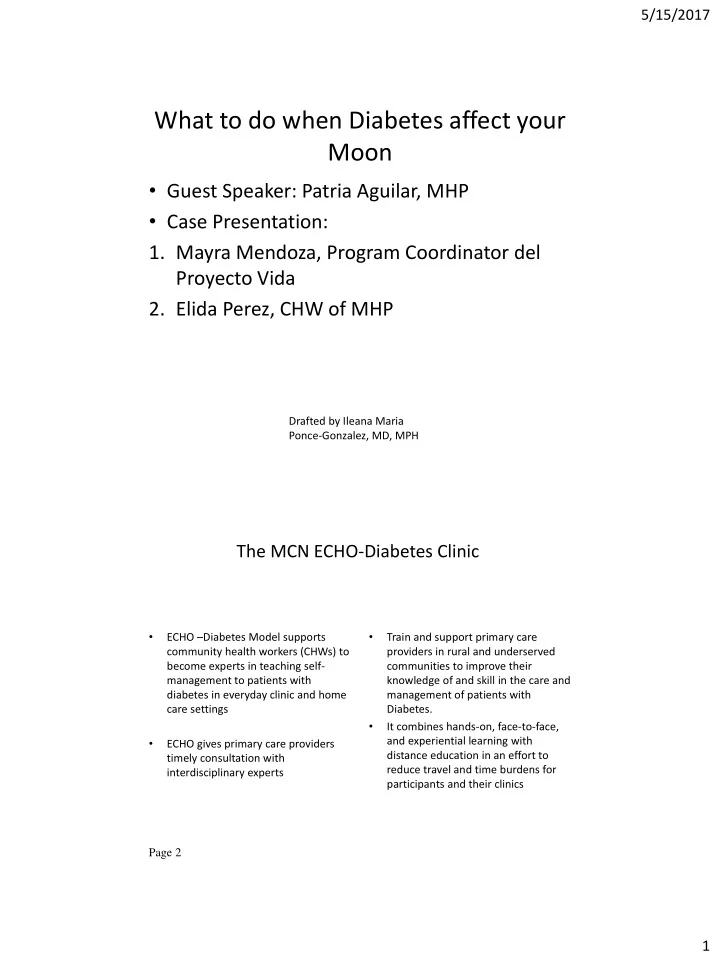
What to do when Diabetes affect your Moon

  • Guest Speaker: Patria Aguilar, MHP
  • Case Presentation:
  • 1. Mayra Mendoza, Program Coordinator del

Proyecto Vida

  • 2. Elida Perez, CHW of MHP

Drafted by Ileana Maria Ponce-Gonzalez, MD, MPH

The MCN ECHO-Diabetes Clinic

  • ECHO –Diabetes Model supports

community health workers (CHWs) to become experts in teaching self- management to patients with diabetes in everyday clinic and home care settings

  • ECHO gives primary care providers

timely consultation with interdisciplinary experts

  • Train and support primary care

providers in rural and underserved communities to improve their knowledge of and skill in the care and management of patients with Diabetes.

  • It combines hands-on, face-to-face,

and experiential learning with distance education in an effort to reduce travel and time burdens for participants and their clinics Page 2

slide-2
SLIDE 2

5/15/2017 2

The MCN ECHO-Diabetes Clinic

  • The participants will remain in their

communities working with their patients during the majority of training.

  • Participants will learn from one

another in a supportive and culturally appropriate environment

  • The training recognizes the skills,

expertise, and knowledge that CHWs and clinician already have

  • Clinics will benefit from the added

competencies that the CHW or CHR will bring to the healthcare team

  • The participants will have the
  • pportunity to network, share

information and resources’

  • The participant will learn new skills to

grow professionally asp public speakers by presenting a real case during the ECHO-Diabetes Clinic Page 3

Learning Objectives

1. Understanding how diabetes can affect your moon. 1. Understand at least one barrier in the control of diabetes and depression.

slide-3
SLIDE 3

5/15/2017 3

How Diabetes can affect your moon?

Effects of mental illness include sustained abnormal alterations in thinking, mood,

  • r behavior

associated with distress and impaired functioning.

slide-4
SLIDE 4

5/15/2017 4

The effects of mental illnesses can include disruptions

  • f daily function;

incapacitating personal, social, and

  • ccupational

impairment; and premature death.

The most common mental illnesses in adults are anxiety and mood disorders.

slide-5
SLIDE 5

5/15/2017 5

Mental Illness by the Numbers2, 3

Over 8.9 million persons in the U.S. have both a mental health and substance use

  • disorder. (SAMHSA)

Mental health disorders were one of the five most costly conditions in the United States in

  • 2006. (AHRQ) (PDF, 615KB)

Mental illness is associated with increased occurrence

  • f chronic diseases

such as cardiovascular disease, diabetes,

  • besity, asthma,

epilepsy and cancer. (CDC) 2,4

slide-6
SLIDE 6

5/15/2017 6 Mental illness is associated with lower use of medical care, reduced adherence to treatment therapies for chronic diseases and higher risks

  • f adverse health outcomes. (CDC) 2,4

Abnormalities in the interactions between neurotransmitters and hormones in the brain (HPA); elevated cortisol 1

slide-7
SLIDE 7

5/15/2017 7

Nearly 50% of U.S. Adults will develop at least one mental illness at sometime or another

More than the blues but persisting malaise

  • r other signs; beyond

temporary mood change.

slide-8
SLIDE 8

5/15/2017 8

Estimated that one fourth of the adult population experiences depression

1/4

Depression is more prevalent in women than in men

slide-9
SLIDE 9

5/15/2017 9

Unresolved stress is a risk for depression 1

slide-10
SLIDE 10

5/15/2017 10

Alcohol or drug abuse Thyroid problems Side effects from some medications Social Isolation Family history

  • f either

condition Obesity Hypertension Inactivity Coronary artery disease

Risk factors of Depression 5

Diabetes Risk Factors 14

Family history of diabetes Obesity increases the risk of type 2 diabetes Race: it's unclear why, but blacks, Hispanics, American Indians and Asian-Americans — are at higher risk. High cholesterol Smoking and high blood pressure Sedentary lifestyle

http://www.idf.org/node/26455?language=es

slide-11
SLIDE 11

5/15/2017 11

Depression Diabetes

?

Studies show that people with diabetes have a greater risk of depression than people without diabetes

slide-12
SLIDE 12

5/15/2017 12

Depression can make diabetic symptom worse…

Low blood sugar levels can also lead to hunger and eating too much Low blood sugar at night can disturb your sleep

Diabetes can make symptoms of depression worse…

Trouble controlling blood sugar levels can make people feel like they are losing control of their life Denial of depression block good diabetes self-care Poor control of diabetes can cause symptoms that look like depression

slide-13
SLIDE 13

5/15/2017 13

Other Challenges

Low energy Regular blood sugar testing can feel like too much Increased anxiety It can be difficult to keep up with a good diet

Untreated depression can make it more difficult to successfully manage diabetes.

slide-14
SLIDE 14

5/15/2017 14

Barriers facing treatment for depression and chronic conditions

 Time  Stereotyping  Culture & beliefs  Cost\  Poor chronic condition management

slide-15
SLIDE 15

5/15/2017 15

Seek support from family and friends

slide-16
SLIDE 16

5/15/2017 16

Ideas for Alternative Therapies12

Acupuncture Tai chi Yoga Meditation Guided imagery Massage therapy Music or art therapy Spirituality Aerobic exercise

How can a CHW can help a person with depression?

1) Listen to them 2) Do not judge (sometimes we judge people with mental

  • illnesses. 'Esta loco(a)' or''esta

chflada(o)'. 3) Act as a source of support and education. 4) Link people with depression to local resources (support groups at the local church, etc)

slide-17
SLIDE 17

5/15/2017 17

Referral of Patients to Appropriate Programs

  • Local Health Center
  • National Suicide Prevention Lifeline: 1-800-273-

8255

  • Your Recovery is Our Recovery: 1 866-547-6451
  • American Diabetes Association

http://www.diabetes.org

ECHO Diabetes-Case Presentation

Page 34

slide-18
SLIDE 18

5/15/2017 18

Stories from the field

Questions?

This project is supported by the Health Resources and Services Administration (HRSA) of the U.S. Department of Health and Human Services (HHS) under cooperative agreement number U30CS09742, Technical Assistance to Community and Migrant Health Centers and Homeless for $1,094,709.00 with 0% of the total NCA project financed with non-federal sources. This information or content and conclusions are those of the author and should not be construed as the official position or policy

  • f, nor should any endorsements be inferred by HRSA, HHS or the U.S. Government.

Patria Alguila [Need Contact Info and a Photo]

slide-19
SLIDE 19

5/15/2017 19

  • 1. https://www.cdc.gov/mentalhealthsurveillance/fact_sheet.html
  • 2. http://www.apa.org/helpcenter/data-behavioral-health.aspx
  • 3. https://en.wikipedia.org/wiki/Comorbidity
  • 4. https://www.cdc.gov/mentalhealthsurveillance/fact_sheet.html
  • 5. http://www.diabetes.org/living-with-diabetes/complications/mental-

health/depression.html

  • 6. https://www.qualitymeasures.ahrq.gov/hhs/content.aspx?id=3527#.WJ4xsm8rKUk
  • 7. http://www.integration.samhsa.gov/clinical-practice/screening-tools#depression
  • 8. http://www.mentalhealthamerica.net/mental-health-screening-tools
  • 9. https://psychcentral.com/lib/diabetes-and-depression/
  • 10. http://www.diabetes.org/living-with-diabetes/complications/mental-

health/stress.html

  • 11. http://www.diabetes.org/living-with-diabetes/complications/mental-health/
  • 12. https://www.adaa.org/finding-help/treatment/complementary-alternative-

treatment

  • 13. https://www.psychologytoday.com/blog/when-your-adult-child-breaks-your-

heart/201401/addressing-mental-health-treatment-barriers

  • 14. http://www.mayoclinic.org/diseases-conditions/diabetes/basics/risk-factors/con-

20033091

References