The Moon 2 1 Earths Moon is the largest in size in relation to - - PDF document

the moon
SMART_READER_LITE
LIVE PREVIEW

The Moon 2 1 Earths Moon is the largest in size in relation to - - PDF document

1 The Moon 2 1 Earths Moon is the largest in size in relation to its object, except for Pluto/Charon The Moon is radius of Earth 1/80 the mass of Earth 3 4 2 5 Light from Moon takes 1.3 seconds to reach Earth 6 3


slide-1
SLIDE 1

1

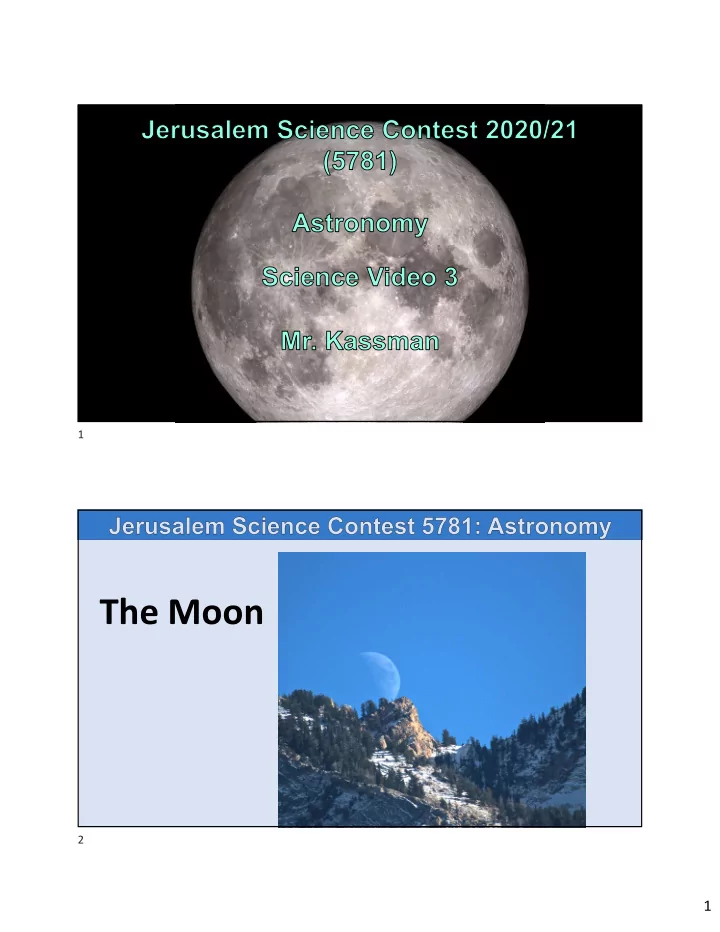
The Moon

1 2
slide-2
SLIDE 2

2

Earth’s Moon is the largest in size in relation to its object, except for Pluto/Charon

  • The Moon is ¼ radius of

Earth

  • 1/80 the mass of Earth

3 4

slide-3
SLIDE 3

3

Light from Moon takes 1.3 seconds to reach Earth

5 6

slide-4
SLIDE 4

4

Sizes and distances to scale:

7 8

slide-5
SLIDE 5

5

9 10

slide-6
SLIDE 6

6

11 12

slide-7
SLIDE 7

7

Features of the Moon

Near Side

13 14

slide-8
SLIDE 8

8

Far Side

NASA’s 3-D Model

https://solarsystem.nasa.gov/resources/2366/earths-moon-3d-model/

15 16

slide-9
SLIDE 9

9

Formation of the Moon

Formation of the Moon

Scientists want to explain certain facts:

  • Orbit of the Moon
  • Composition of the Moon similar to Earth’s mantle (not crust or

core)

  • Features of the Moon like Aitken basin, craters and maria (of

basalt – cooled lava) Note: this is ongoing research as we explore and observe and collect data about the Moon.

17 18

slide-10
SLIDE 10

10

Formation of the Moon

Main Theories:

  • Capture Theory – Moon formed elsewhere and was “captured” into orbit

by Earth

  • Fission Theory – Moon “split off” from Earth
  • Condensation Theory – Earth and Moon “condensed” out of the same

matter

  • Giant-Impact Theory – large body collided with Earth, ejecting the moon

19 20

slide-11
SLIDE 11

11

Capture Theory Fission Theory

21 22

slide-12
SLIDE 12

12

Condensation Theory Giant-Impact Theory

23 24

slide-13
SLIDE 13

13

Giant-Impact Theory

25 26

slide-14
SLIDE 14

14

Moon Evolution

27 28

slide-15
SLIDE 15

15

29 30