WHATS YOUR Thomas Gordons 12 Roadblocks CHALLENGE? 1. Ordering, - - PDF document

what s your
SMART_READER_LITE
LIVE PREVIEW

WHATS YOUR Thomas Gordons 12 Roadblocks CHALLENGE? 1. Ordering, - - PDF document

MOTIVATIONAL SELF-DETERMINATION THEORY INTERVIEWING (SECTION 1: SPIRIT AND Human behaviors are volitional PROCESS) Innately tend toward Trevor J. Manthey, MSW, Ph.D. growth MINT Member Social context can support or thwart


slide-1
SLIDE 1

1

Trevor J. Manthey, MSW, Ph.D. MINT Member

MOTIVATIONAL INTERVIEWING

(SECTION 1: SPIRIT AND PROCESS)

SELF-DETERMINATION THEORY

  • Human behaviors are

volitional

  • Innately tend toward

growth

  • Social context can

support or thwart growth

 A Beginning Definition:

…is a collaborative conversation style for strengthening a person’s own motivation and commitment to change.

 A Pragmatic Definition

…is a person-centered counseling style for addressing the common problem of ambivalence about change.

WHAT IS MOTIVATIONAL INTERVIEWING? 3 DEFINITIONS OF MI

 A Technical Definition

…is a collaborative, goal-oriented style of communication with particular attention to the language of change. It is designed to strengthen personal motivation for and commitment to a specific goal by eliciting and exploring the person’s own reasons for change within an atmosphere of acceptance and compassion.

 Arranging conversations so people talk themselves into change.

3 DEFINITIONS OF MI

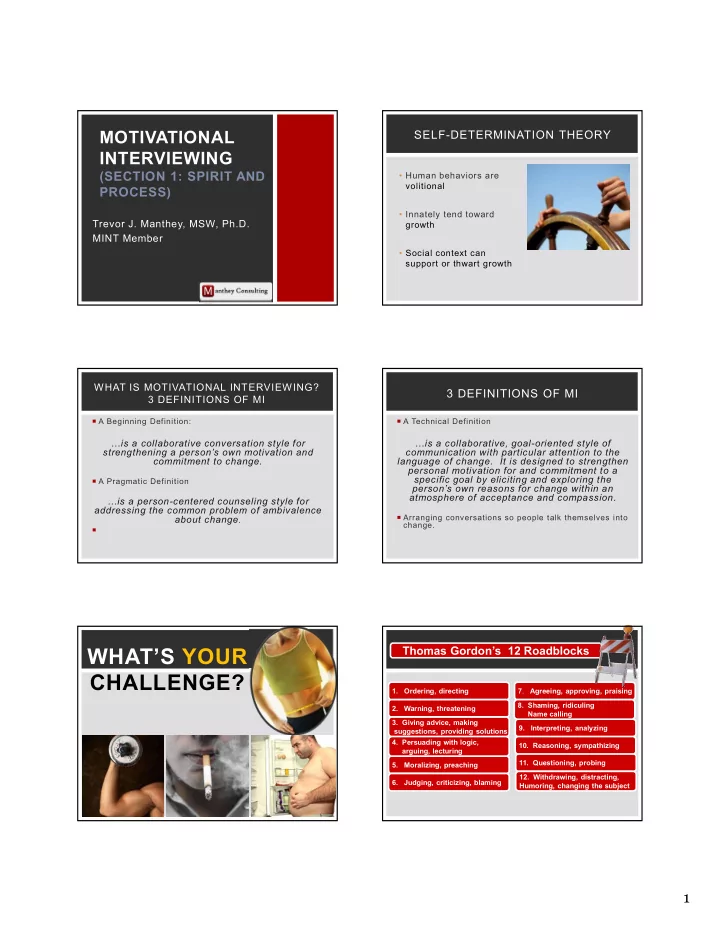
WHAT’S YOUR CHALLENGE?

Thomas Gordon’s 12 Roadblocks

  • 1. Ordering, directing
  • 2. Warning, threatening
  • 3. Giving advice, making

suggestions, providing solutions

  • 5. Moralizing, preaching
  • 4. Persuading with logic,

arguing, lecturing

  • 6. Judging, criticizing, blaming
  • 7. Agreeing, approving, praising
  • 9. Interpreting, analyzing
  • 11. Questioning, probing
  • 10. Reasoning, sympathizing
  • 12. Withdrawing, distracting,

Humoring, changing the subject

  • 8. Shaming, ridiculing

Name calling

slide-2
SLIDE 2

2

We must resist the “righting influence”

  • Why don’t you want to make a change?
  • How can you tell me you don’t have a problem?
  • What makes you think you are not at risk?
  • Why don’t you just...
  • Why can’t you...

Why doesn’t this approach work?

  • It causes the two people to actually act out the

“sustain” side of their ambivalence!

THE RIGHTING REFLEX

artnership cceptance

  • absolute worth
  • accurate empathy
  • autonomy support
  • affirmation
  • mpassion

vocation

THE SPIRIT OF MI

 MI is not done “to” or “on” someone at all. MI is done “for” and “with” a person.

  • Miller and Rollinick, MI3

MI ASSUMPTIONS

Ambivalence about change is normal.

Ambivalence can be resolved by working with intrinsic motivations and values.

R oll With Resistance

(Dancing with Discord)

E xpress Empathy D evelop Discrepancy

(Amplify Ambivalence)

S upport Self-Efficacy

GENERAL PRINCIPLES

Reasons not to change Reasons for change

AMPLIFIED AMBIVALENCE

slide-3
SLIDE 3

3

Process I:

ENGAGE

Process II:

FOCUS

Process III:

EVOKE

Process IV:

PLAN

THE FOUR PROCESSES OF MI THE FOUR PROCESSES OF MI III: EVOKE IV: PLAN I: ENGAGE II: FOCUS FOUR TYPES OF LANGUAGE

Discord

(Resistance)

Sustain Talk Change Talk Emotionally Based Relationally Oriented The No-Change Side Of Ambivalence The Change Side

  • f Ambivalence

Response Response Response (Re)Engage with Empathic Reflections! Rescue Change Talk! Elicit More Change Talk! Commitment Talk Resolve and Readiness Response Begin Planning Process! Engage Evoke Evoke Plan (Re)Focus

O.A.R.S. Open-ended questions Affirmations Reflections Summary Statements

The foundational “Micro Skills” of MI These skills are used differently in each MI process

  • Do not invite brief answers
  • Encourage or “elicit” more productive talk
  • Client should do more than half of the talking.
  • Do not ask more than 3 questions in a row.
  • MI “competency”: 3 open Q’s to 1 closed.

OPEN-ENDED QUESTIONS…

slide-4
SLIDE 4

4

In ordinary counseling sessions: questions often outnumber reflections by a ratio of 10Q:1R Counselors “competent” in Motivational Interviewing:1Q:2R

 Moving past what has already been said without moving too far ahead will keep reflective listening from going in circles  Reflection is not a passive process  Counselor chooses what to respond to and what to ignore

REFLECTIVE LISTENING

“Even though nothing has happened, I’ve been feeling more depressed lately. I just don’t want to get out of bed or make phone calls.”

Simple Reflection

Repeating an element of what the speaker has said “You’ve been more depressed lately.” Staying close to what the speaker has said with some synonyms “So your sadness is getting worse and you don’t know why.”

Complex Reflection

Inferring/guessing at the speaker’s meaning and reflecting it back “You are having a hard time and want to understand why you keep sliding back into depression.” Emphasizing the emotional dimension through feeling/metaphors “Its like a heavy cloud that sucks your energy.”

Collecting

  • Gathering together what the client has

said Linking

  • Making connections

Transitional

  • Preparing to shift focus

SUMMARIZING Desire for Status Quo Inability to Change Reason for Status Quo Need for Status Quo Commitment to Status Quo NO BEHAVIOR CHANGE SUSTAIN TALK

slide-5
SLIDE 5

5

“ACCEPTANCE FACILITATES CHANGE, WHILE PERCEIVED EXPECTATION OF CHANGE GENERATES RESISTANCE”

PEOPLE ARE OFTEN MORE PERSUADED BY WHAT THEY HEAR THEMSELVES SAY THAN BY WHAT OTHER PEOPLE TELL THEM.

PARADOX

Confidence

Specific Behavior Global Efficacy

Commitment

 Intention

Importance

Recognition of Problem / Need Cost / Benefit Expectancies

  • Goals
  • Values

WHEN ARE PEOPLE MOTIVATED TO TAKE STEPS TOWARD CHANGE?

Desire for Change Ability to Change Reason to Change Need for Change Commitment to Change BEHAVIOR CHANGE CHANGE TALK

Activation

Taking small steps

DESIRE for Change: “I want to…” ABILITY for Change: “I could…” REASONS for Change: “I should…” NEED for Change: “I have to…”

CHANGE TALK

Work with these to strengthen COMMITMENT to Change: “I will…”

E: Elaboration

Ask for elaboration, more detail, in what ways, specific examples

A: Affirm

Express appreciation or admiration

R: Reflection

Simple, Complex

S: Summarize

Collect and focus the change talk

RESPONDING TO CHANGE TALK

“Early in the MI session the skill is

  • ften to discern a ray
  • f change talk, like

spotting a lighthouse in a storm or detecting a signal within noise. It is not necessary to eliminate the storm or the noise, just follow the signal.”

Miller and Rollnick 2012

slide-6
SLIDE 6

6

Importance/Confidence Ruler Querying Extremes Looking Back / Looking Forward Evocative Questions Decisional Balance Goals and Values

ELICITING CHANGE TALK:

MI BECOMES DIRECTIVE  “One reason it is possible to keep on learning and improving one’s skills in Motivational Interviewing is that immediate expert feedback is continuously

  • available. It is available from those you serve.”

Motivational Interviewing – p. 180

LEARNING NEW COUNSELING SKILLS