What s Gonna Happen Today Intro to Optimization Systems and their - - PowerPoint PPT Presentation

what s gonna happen today
SMART_READER_LITE
LIVE PREVIEW

What s Gonna Happen Today Intro to Optimization Systems and their - - PowerPoint PPT Presentation

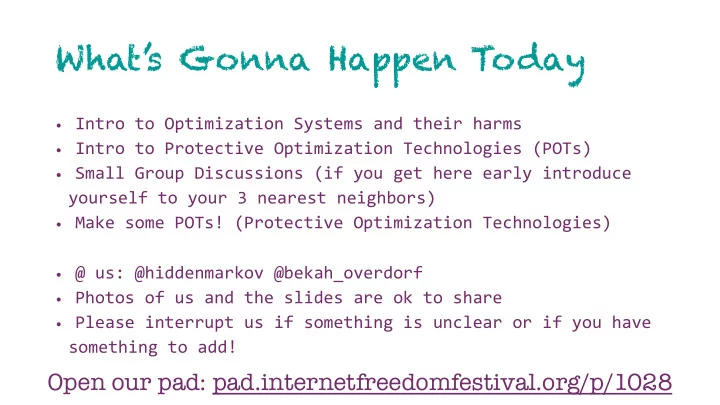
What s Gonna Happen Today Intro to Optimization Systems and their harms Intro to Protective Optimization Technologies (POTs) Small Group Discussions (if you get here early introduce yourself to your 3 nearest neighbors) Make


slide-1
SLIDE 1

What’ s Gonna Happen Today

  • Intro to Optimization Systems and their harms
  • Intro to Protective Optimization Technologies (POTs)
  • Small Group Discussions (if you get here early introduce

yourself to your 3 nearest neighbors)

  • Make some POTs! (Protective Optimization Technologies)
  • @ us: @hiddenmarkov @bekah_overdorf
  • Photos of us and the slides are ok to share
  • Please interrupt us if something is unclear or if you have

something to add!

Open our pad: pad.internetfreedomfestival.org/p/1028

slide-2
SLIDE 2

a guide to revolutionary counter optimization

BEKAH OVERDORF

SHE/HER @BEKAH_OVERDORF

BOGDAN KULYNYCH

HE/HIM @HIDDENMARKOV

slide-3
SLIDE 3

What to Expect

  • Explore optimization systems and their

harms

  • Explore methods to counter these harms
slide-4
SLIDE 4

Information Systems

Information and communication systems Store Process Collect Transport

slide-5
SLIDE 5

Information Systems

  • Issues
  • Surveillance
  • Censorship
  • Manipulation

Information and communication systems Store Process Collect Transport

slide-6
SLIDE 6

From Information Systems to Optimization Systems

Information and communication systems Store Process Collect Transport Optimization systems Store Process Collect Transport

Feedback!

slide-7
SLIDE 7

From Information Systems to Optimization Systems

slide-8
SLIDE 8

Optimization Systems

Use optimization algorithms to extract maximum value (U) from the manipulation of people's activities and their environment.

max

!∈ℝ $(&)

slide-9
SLIDE 9

Optimization Systems

Prices

Police Resources Recitivism (prison resources) Recommendations

Routes

slide-10
SLIDE 10

Waze

Optimizes ROUTES for its users around traffic

What is optimized? Who benefits? Fastest Routes Users

slide-11
SLIDE 11

Harms

  • Antisocial and negative environmental outcomes
  • Adverse side effects
  • Only benefit a few
  • Externalize exploration costs
  • Externalize cost of errors
  • Produce errors due to distributional shift
  • Fulfill objective but not its intended goals
  • Distribute errors unfairly
slide-12
SLIDE 12

Externalities of Optimization Systems

Externalities are the negative effects, intended or accidental, that are caused by these systems. Who loses? Non-Users/residents whose neighborhoods are flooded with users.

slide-13
SLIDE 13

Break Out! (10 minutes)

Turn to the people near you Come up with some examples of optimization systems.

  • What are these systems optimizing for?
  • Who benefits?
  • Who loses?
  • What externalities may these systems have?

Example Optimization System: Waze Who benefits: Users Optimizing for: Quickest routes for users Who loses: Non-users Externality: Surface roads are congested

pad.internetfreedomfestival.org/p/1028

slide-14
SLIDE 14

Break Out! (5 minutes)

Now that you’ve come up with systems and their externalities… What do we do about these externalities?

pad.internetfreedomfestival.org/p/1028

slide-15
SLIDE 15

Tell us about your problems and solutions

slide-16
SLIDE 16

Solutions from within the system Solutions from

  • utside the system
  • Waze developers can create a

reporting system and stop sending users down streets with complaints

  • Towns can mimic traffic on

the streets where they don’ t want Waze traffic

slide-17
SLIDE 17

“We’re creating algorithms that cause harms, so we need to fix the algorithms”

Protective Optimization Technologies

Solutions from within the system Solutions from

  • utside the system
slide-18
SLIDE 18

POTs: Solutions from the Outside

slide-19
SLIDE 19

Protective Optimization Technologies

POTs are solutions to the harms of

  • ptimization systems that come

from outside the system GOAL: design tools to deal with Optimization on behalf of the users

slide-20
SLIDE 20

Design Steps for Protective Optimization Technologies

1.

Name the externality

2.

Identify who or which environments are harmed

3.

Dissect the roots of its cause: what is the technical problem?

4.

Identify the Goal of the POT and the benefactors of the POTs

5.

Create the Solution

6.

Evaluate impact on benefactors and other actors

slide-21
SLIDE 21

Design Steps for Protective Optimization Technologies

1.

Name the externality

2.

Identify who or which environments are harmed

3.

Dissect the roots of its cause: what is the technical problem?

4.

Identify the Goal of the POT and the benefactors of the POTs

5.

Create the Solution

6.

Evaluate impact on benefactors and other actors

1.

Surface roads are congested

2.

Non-users

3.

That the routing algorithm sends users through the town

4.

Reroute traffic off of surface roads

5.

Find the minimum number

  • f roads to block s.t. the

town is not congested

6.

See if there’ s still traffic!

slide-22
SLIDE 22

Break Out! (15 minutes)

Make some POTs! Are there any solutions that you can come up with that don’t rely on the service provider? Some help: Think about how the inputs to the system –

  • n what data does the system make a decision? How can

we edit that data? Can we? Is your POT “acceptable” “ethical” “feasible”? Does it have it’s own Externalities?

slide-23
SLIDE 23

Tell us about your POTs!

slide-24
SLIDE 24

The Rest of the POTs Team

Carmela Troncoso Ero Balsa Seda Gürses

slide-25
SLIDE 25

Thank you

Blog Post:https://bit.ly/2VhUgDq Code:github.com/spring-epfl/pots Tell us your problems! rebekah.overdorf@epfl.ch bogdan.kulynych@epfl.ch seda.gurses@kuleuven.be Papers: arxiv.org/abs/1806.02711 arxiv.org/abs/1811.11293

POTs