What makes a Virtual Human Alive ? 1. Avatar & Autonomous - - PowerPoint PPT Presentation

what makes a virtual human alive
SMART_READER_LITE
LIVE PREVIEW

What makes a Virtual Human Alive ? 1. Avatar & Autonomous - - PowerPoint PPT Presentation

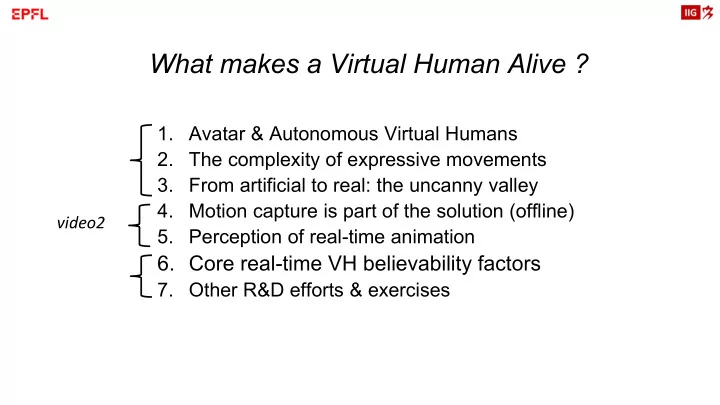
What makes a Virtual Human Alive ? 1. Avatar & Autonomous Virtual Humans 2. The complexity of expressive movements 3. From artificial to real: the uncanny valley 4. Motion capture is part of the solution (offline) video2 5. Perception of


slide-1
SLIDE 1

What makes a Virtual Human Alive ?

  • 1. Avatar & Autonomous Virtual Humans
  • 2. The complexity of expressive movements
  • 3. From artificial to real: the uncanny valley
  • 4. Motion capture is part of the solution (offline)
  • 5. Perception of real-time animation
  • 6. Core real-time VH believability factors
  • 7. Other R&D efforts & exercises

video2

slide-2
SLIDE 2
  • 4. Motion capture is part of the solution for offline productions

High human-likeness can be recovered through motion capture provided that :

Professional actors are hired for performance The actors learn text and performs as if they were filmed The actors are native speakers of the language Capturing eye motions is essential for the coherence of the synthesized behavior (http://www.mocaplab.com/services/eye-mocap/eye-tracker/)

Capturing micro-expressions is a must for the expression of emotions [as formalized by Psychologist Paul Ekman] The mocap session is also video recorded - from many viewpoints - to recover subtleties that cannot be measured through marker-based motion capture Check the TV series “lie to me” & the ref on micro-expressions

[film «Renaissance»2006]

slide-3
SLIDE 3

Very high mesh resolution is necessary for the micro expression deformation:

2010: Avatar(J. Cameron)

Micro-expressions: 02-03, 07-08, 11-12

slide-4
SLIDE 4
  • Alternate motion capture technology based on Computer Vision :
  • Interview presenting Image Metrics technology (2008) [youtube / Emily / Advertizement]
  • 4. Motion capture is part of the solution for offline productions (2)

http://www.youtube.com/watch?v=JF_NFmtw89g&feature=fvwrel

  • Numerous studies to assess the influence of rendering [McDonnell[2012]:

Building a DB of facial expressions under controlled lighting

  • ffline pipeline synthetizing

new facial animation sequences No simple mapping between the degree of realism and appeal/familiarity/friendliness

slide-5
SLIDE 5

[Cinefex on-line edition 2010]

  • 4. Motion capture is part of the solution for offline productions (3)

However, a very high resolution of facial meshes is not compatible with real-time display in VR, such as the “swing cam” concept introduced by James Cameron at the shooting stage to design camera trajectories.

slide-6
SLIDE 6
  • 5. Perception of real-time animation

The purpose of perception studies is to determine two tradeoffs regarding CPU/GPU use.

Context: a few ms to update the state of Virtual Humans

  • Uncanny valley: matching animation quality with mesh resolution
  • Rationale: use only a VH degree of realism that can be supported by the available animation

resources.

  • Don’t add mobile accessories if they cannot be animated, such as long hairs, ear rings, floating

pieces of cloth, etc…

  • Compute what you see:
  • Rationale: do NOT compute what is NOT perceived.
  • Levels of Details: decrease the resolution of human graphical models as distance increases to

reduce display cost and simplify the movement to reduce animation cost.

slide-7
SLIDE 7
  • 5. Perception of real-time animation (2)

In 1998; Hodgins et al showed that the geometric model type used to represent the human affected people’s ability to perceive the difference between two human motions. Subjects were more able to tell the difference between 2 motions when they were displayed on the polygonal character.

slide-8
SLIDE 8
  • 5. Perception of real-time animation (3)

Hodgins, O’Sullivan, Newell, McDowell found that:

  • The graphical model may alter the

perception of walking style (e.g. neutral).

  • Gender-specific style should not be used for

the other gender.

  • People are most sensitive to differences in

human motions for high-resolution geometry (2022 pol) and impostor (i.e., image based rendering) representations, less sensitive for low resolution geometry (800 pol) and stick figures, and least sensitive for point-light representations [M 2005].

Impostor = 17x8 precomputed texture from high resolution geometry

slide-9
SLIDE 9
  • 5. Perception of real-time animation (4)

Task: indicate whether a running motion is biological or artificial Setup: 4 sessions (7 minutes) x 7 characters x 6 motions (1 s) Results:

  • Bias: subjects are more inclided to

perceive a biological motion for simplified characters.

  • Motion rendered with anthropomorphic

characters are perceived as less natural.

  • Emotion is not involved (fMRI)

In [C2007], Chaminade et al. investigated how the appearance of computer animated characters influenced the perception of a running movement.

stripes bar = mocap movement plain bar = keyframed movement

slide-10
SLIDE 10

[References]

[C2007] T Chaminade, J Hodgins, M Kawato -Anthropomorphism influences perception of computer-animated characters’ actions, Social cognitive and affective neuroscience, 2007 [H 1998] Hodgins et al.: Perception of Human Motion With Different Geometric Models, IEEE Transactions on Visualization and Computer Graphics, 4(4), 307-316 [ M 2005] R. Mc Donnell, S. Dobbyn, C O'Sullivan Optimising and Evaluating the Realism of Virtual Crowds: Perceptual Experiments and Metrics, in EG07 tutorial on crowd animation. [M 2012] McDonnell, R., Breidt, M., Bülthoff, H. 2012. Render me Real? Investigating the Effect ofRender Style on the Perception of Animated Virtual Humans. ACM Trans. Graph. 31 4, DOI = 10.1145/2185520.2185587 [P 1995] K. Perlin, “Real Time Responsive Animation with Personality,” IEEE Trans. Visualization and Computer Graphics, vol. 1, no. 1, pp. 5-15,Mar. 1995 [TRV 2006] Traité de Réalité Virtuelle, Ed. P. Fuch, vol 2, chap 17, Eds A. Berthoz & J.L. Vercher [W 2009] van Welbergen, H., van Basten, B.J.H., Egges, A., Ruttkay, Z., Overmars, M.H.: Real Time Animation of Virtual Humans: A Trade-off Between Naturalness and Control. In: Eurographics - State of the Art Reports, Eurographics Association, pp. 45–72 (2009)

slide-11
SLIDE 11

[Web References]

http://en.wikipedia.org/wiki/Lie_to_Me : with Prof. Paul Ekman as consultant. Doc on microexpressions : http://www.youtube.com/watch?v=k2rb7pAP7hk Image Metrics: http://www.youtube.com/watch?v=JF_NFmtw89g&feature=fvwrel Web site of Prof. Ken Perlin: http://www.mrl.nyu.edu/~perlin/ [PerlinNoise] : http://freespace.virgin.net/hugo.elias/models/m_perlin.htm