What is value when it comes to maternity care? I have no actual or - - PowerPoint PPT Presentation

what is value when it comes to maternity care
SMART_READER_LITE
LIVE PREVIEW

What is value when it comes to maternity care? I have no actual or - - PowerPoint PPT Presentation

10/16/2019 Disclosures What is value when it comes to maternity care? I have no actual or potential conflict of interest in relation to this program/presentation. Chitra Akileswaran, MD, MBA UCSF Obstetrics and Gynecology Update: What


slide-1
SLIDE 1

10/16/2019 1

What is “value” when it comes to maternity care?

Chitra Akileswaran, MD, MBA

UCSF Obstetrics and Gynecology Update: What Does the Evidence Tell Us? October 16, 2019

Disclosures I have no actual or potential conflict of interest in relation to this program/presentation. Objectives

  • 1. Review the challenge around cost and quality in US

healthcare and specifically maternity care

  • 1. Understand what value-based care means and how it

applies to maternity care

  • 1. Learn about the principles that underlie value-based

maternity care through examples

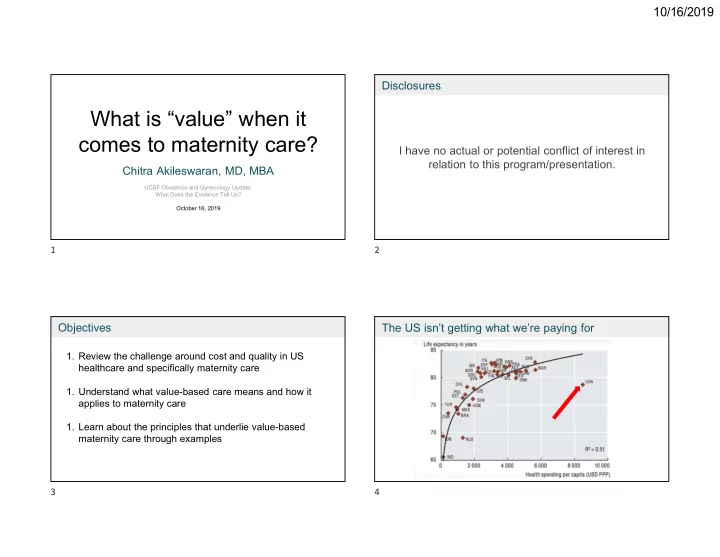
The US isn’t getting what we’re paying for

1 2 3 4

slide-2
SLIDE 2

10/16/2019 2

Roots of US healthcare crisis

Access Payment Population Equity

Low emphasis

  • n prevention,

more on acute treatment Fee-for-service encourages doing as much as possible We are caring for an aging, more chronically ill demographic Who is included and excluded as part of our healthcare system?

US maternity care rivals the costs of a royal birth Affordability is a major issue for families

“Ms. Martin called her local hospital inquiring about the price of maternity care; the finance

  • ffice at first said it did not know, and then gave

her a range of $4,000 to $45,000. “It was unreal,” Ms. Martin said. “I was like, How could you not know this? You’re a hospital.”’

Quiz #1: Spot the real headline:

  • A. American women rate giving birth in the

US “five stars”

  • B. Our maternal mortality rate is a national

embarrassment

  • C. US lags when it comes to minimizing

childbirth complications

  • D. Despite OB shortage, US women love

their obstetricians

A m e r i c a n w

  • m

e n r a t e . . . O u r m a t e r n a l m

  • r

t a l i t . . . U S l a g s w h e n i t c

  • m

e . . . D e s p i t e O B s h

  • r

t a g e , . . .

0% 3% 23% 75%

5 6 7 8

slide-3
SLIDE 3

10/16/2019 3

Despite high costs of childbirth, US women are dying Our maternity outcomes are getting worse The mother-blaming narrative Phrases you might have heard

“Moving from volume to value” “Risk-based payment” “Value-based care”

10 11 12 13

slide-4
SLIDE 4

10/16/2019 4

Value is where US healthcare is headed Quiz #2: What is value-based healthcare?

A.

Value-based care means we are paid according to whether patients are satisfied

B.

Value-based care is care provided according to a patient’s values

  • C. Value-based care is a payment model that

rewards the best possible outcomes for the least costs incurred

  • D. Value-based care doesn’t have a clear

definition

V a l u e

  • b

a s e d c a r e m e a . . V a l u e

  • b

a s e d c a r e i s c a . . V a l u e

  • b

a s e d c a r e i s a . . . V a l u e

  • b

a s e d c a r e d

  • e

. . .

1% 28% 70% 1%

What is value-based healthcare?

Outcomes Cost

Health outcomes + patient experience Direct + indirect costs of care

The highest value care achieves the best outcomes for the lowest cost What is value-based healthcare?

Getting paid to do the right thing, not just to do more

Rather than bill for each encounter/procedure, we will be paid per patient or

  • episode. It will be up to us to manage the costs of care.

Reframe care in terms of how well we solve our patients’ problems at a population level

  • Ex. Patient comes to you with fibroid uterus and debilitating AUB. The outcome

she wants is not a hysterectomy - but to have her bleeding controlled.

14 15 17 18

slide-5
SLIDE 5

10/16/2019 5

How do you use the concept of value today?

Brand of detergent Price per ounce Arm & Hammer $0.08 Cheer $0.16 Tide $0.13 Tide Free & Clear $0.23 Walmart Great Value $0.08 Trader Joe’s $0.07 Method $0.75

The goal of marketing to make you believe that the value equation (what you get versus what you pay for) is positive - more positive than the alternatives

Price Scent Packaging aesthetic Environmental impact Convenience of purchase

How fee-for-service differs from paying for value

Fee-for-service Value-based payment

You are paid to do more for patients (visits, procedures, etc.) You are paid to produce the best

  • utcomes for patients

Focuses on sick care Focuses on preventive care Results in fragmented care, duplication, and overutilization Rewards care coordination, limiting redundancy - our “INVISIBLE” work No reason to innovate, use technology to reduce in-person care Incentivizes innovative ways to see patients to limit costs, i.e. virtual care Costs increase even if quality stagnates Costs should decrease as quality climbs

Value-based care: Care coordination example

Pregnant patient with a history of a severe postpartum hemorrhage with her prior pregnancy transfers her care to you at 24 weeks gestation due to relocation. During your visit with her, you learn that she has seen a hematologist in the past and received blood work. She doesn’t know if she still needs to see a hematologist

  • r what the results of her blood work were.

Furthermore, she has a history of chronic hypertension for which she no longer takes medications, but doesn’t know what medication she used to be on. She lives far away from your office and has a hard time getting to her visits due to childcare.

Value-based care: Care coordination example

Pregnant patient with a history of a severe postpartum hemorrhage with her prior pregnancy transfers her care to you at 24 weeks gestation due to relocation. During your visit with her, you learn that she has seen a hematologist in the past and received blood work. She doesn’t know if she still needs to see a hematologist

  • r what the results of her blood work were.

Furthermore, she has a history of chronic hypertension for which she no longer takes medications, but doesn’t know what medication she used to be on. She lives far away from your office and has a hard time getting to her visits due to childcare.

19 20 21 22

slide-6
SLIDE 6

10/16/2019 6

Value-based care: Care coordination example

  • A. The patient is responsible for collecting records from her prior

OB, hematologist, and primary care doctor and coordinate her

  • visits. It may mean she misses some visits with you and that you

don’t have complete records.

  • B. You coordinate records collection, medication reconciliation, and

call her to ensure she can make her upcoming visits before or after a long day of clinic. Sometimes you forget or don’t have time.

  • C. You are incentivized to hire someone to help you coordinate

care, because you will be reimbursed at a higher rate based on how well your patients achieve certain outcomes for your practice, such as visit attendance.

T h e p a t i e n t i s r e s p

  • n

s . . . Y

  • u

c

  • r

d i n a t e r e c

  • r

d . . . Y

  • u

a r e i n c e n t i v i z e d t . . .

3% 82% 16%

Which is likely to produce the best clinical outcome for this patient?

ACOG Committee Opinion

Types of payment for high-value care Rewards for improving processes: % completion of postpartum visit, use of shared decision aids Penalties for unwanted outcomes: preventing readmission Payments for shared accountability: bundled payments for maternity care with providers keeping the savings or paying a penalty Consumer-directed models: preferred providers/hospitals, tiered formularies

Value-based maternity care Value-based maternity care

Maternity outcomes + patient experience with pregnancy/birth/postpartum Costs of maternity episode

What outcomes do we want to see in maternity care?

Health Outcomes Low NTSV c-section rate Limit <39wk births Few term NICU admits High VBAC rate Good BP control Appropriate weight gain Less perinatal mood/anxiety Meet breastfeeding goals Patient Experience Less birth-related trauma Improved satisfaction Better preparation for birth and postpartum Increased access to providers Emotional/psychological support Normal recovery and return to life functions

23 25 26 27

slide-7
SLIDE 7

10/16/2019 7

What costs do we want to limit in maternity care?

Costs Fewer unnecessary prenatal visits Fewer unnecessary ED visits Fewer unnecessary ultrasounds Limit redundant labs and preventive screening Multiple visits for one problem (e.g. nutrition visit separate from OB visit for GDM) Fewer unnecessary cesareans Fewer postpartum readmissions

Value-based care: Maternity care example

May 2019: Launched bundled payment program in NJ and TX for prenatal, antepartum hospitalizations, L&D, and postpartum care up to 60 days. Providers keep the difference if care costs less than the payment.

Goals

  • Can we reduce unnecessary

procedures including c-sections?

  • Can we identify risks early and avoid

hospitalizations?

  • Can we promote quality standards (c-

section rate, avoiding early deliveries)? Risks

  • If one clinician bears the risk, how will

team-based care work?

  • How is a “low risk” patient to be

defined? Will payment be risk- adjusted?

  • How will providers track quality in real-

time to ensure payment?

Some principles of value-based maternity care

Ownership Personalization Integration

Value-based maternity care: Ownership

Forthcoming study of 11,000 California births via commercial payor Matched practices with highest quality metrics with lowest costs of care Visited high-value practices to understand common qualities

OB office is medical “home”

Labs, basic ultrasound can be done in-office Nurse triage and same-day visits available to avoid urgent care/ED Specialist consultations are one-off, patient returns to OB for care

28 29 30 31

slide-8
SLIDE 8

10/16/2019 8

Value-based maternity care: Personalization

Flexible, individualized care using technology that meets patients Each patient engages with self-monitoring tools, smartphone app for messaging, online communities Reduced in-person visit schedule OB Nest model at Mayo Clinic

Home BP, weight, and fetal monitoring Smartphone app to message with nurse Online community with

  • ther OB Nest

patients

Value-based maternity care: Personalization

8-10 weeks 11-12 weeks 16 weeks 18-20 weeks – ultrasound 24 weeks 26-28 weeks 32 weeks 34 weeks 36 weeks 37 weeks 38 weeks 39-41 weeks 1 week postpartum 6-8 weeks postpartum RN Clinic MD Clinic RN Virtual RN Virtual RN Virtual RN Clinic MD Clinic RN Virtual MD Clinic RN Virtual RN Virtual MD Clinic, weekly RN Virtual MD Clinic Sample Visit Schedule

Results

  • Reduced in-person

clinic visits

  • Increased patient

confidence and satisfaction

  • Potential to better

manage population health, cost savings

de Mooij MJM, Hodny RL, O'Neil DA, Gardner MR, Beaver M, et al. OB Nest: Reimagining Low-Risk Prenatal

  • Care. Mayo Clin Proc. 2018 Apr;93(4):458-466. doi:

10.1016/j.mayocp.2018.01.022. Epub 2018 Mar 12.

Value-based maternity care: Integration

Pilot program as part of larger initiative to reduce maternal mortality and address racial disparities Identified two counties with largest Medicaid pop + maternal/infant mortality Doulas bill as Medicaid practitioners NY State Medicaid Doula Pilot

4 prenatal visits Labor and birth support 4 postpartum visits Why?

  • Increasing value for day-to-day, community-based non-

clinical support as part of healthcare (e.g. coaches)

  • Doulas associated with lower rates of intervention,

increased birth satisfaction

  • Doulas can bridge trust gap and support informed care for

populations traditionally marginalized by healthcare system

Points to remember

  • The US healthcare system is in a crisis where costs are skyrocketing and

producing worse outcomes, especially around pregnancy and childbirth

  • Value-based care is a payment model that rewards better outcomes for

lower costs

  • Some examples of value-based maternity care include bundled payments

for pregnancy/birth/postpartum; rewards and penalties for certain quality metrics; and tiered providers and formularies

  • Principles of value-based maternity care will include ownership,

personalization, and integration

32 33 34 35
slide-9
SLIDE 9

10/16/2019 9

Questions?

Thank you

36