What is the role of the international community? By Finn Tarp - - PowerPoint PPT Presentation

what is the role of the international community
SMART_READER_LITE
LIVE PREVIEW

What is the role of the international community? By Finn Tarp - - PowerPoint PPT Presentation

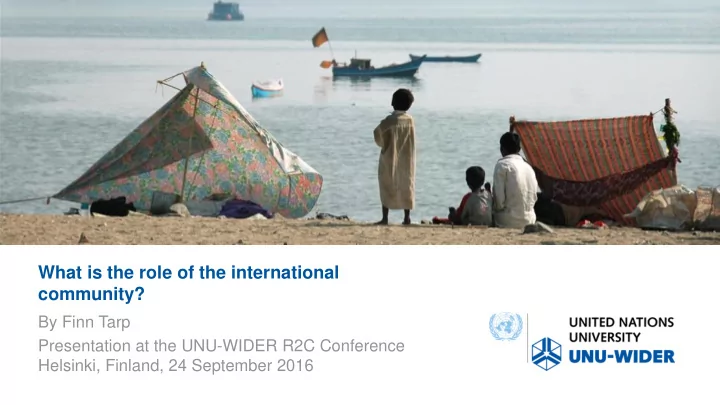
What is the role of the international community? By Finn Tarp Presentation at the UNU-WIDER R2C Conference Helsinki, Finland, 24 September 2016 ReCom: Research and Communication on Foreign Aid ReCom: http://recom.wider.unu.edu/ 300

slide-1
SLIDE 1

What is the role of the international community?

By Finn Tarp Presentation at the UNU-WIDER R2C Conference Helsinki, Finland, 24 September 2016

slide-2
SLIDE 2

ReCom: Research and Communication

  • n Foreign Aid
slide-3
SLIDE 3

ReCom: http://recom.wider.unu.edu/

  • 300 researchers from 60 countries
  • Analysed aid under 5 themes: Social Sectors, Growth & Employment,

Governance & Fragility, Gender Equality, Environment & Climate Change

  • 240 working papers
  • 5 position papers
  • Lots of academic publications, policy briefs etc.
  • All available from our web-site!
slide-4
SLIDE 4

Key messages

  • Aid is effective, and has had a very respectable rate of return;

including in places with weak institutional environments.

  • For example: aid to the education and health sectors has helped

reduce maternal mortality and the female/male gap in youth literacy.

  • And aid has helped save lives in many rough places

A complete summary:

  • 15 lessons: https://www.wider.unu.edu/publication/what-do-we-

know-about-aid-we-approach-2015

slide-5
SLIDE 5

Case 1: Vietnam

slide-6
SLIDE 6

Aid in Vietnam

  • Infrastructure
  • Quality control
  • Private sector development
  • Growth and poverty reduction
slide-7
SLIDE 7

Case 2: Mozambique

slide-8
SLIDE 8

Aid in Mozambique

  • Humanitarian
  • Education and health (human capital)
  • Growth and poverty reduction
slide-9
SLIDE 9

Case 3: AERC

slide-10
SLIDE 10

Aid and AERC

  • Macroeconomic management
  • Education and training
  • Networking
slide-11
SLIDE 11

Aid data in historical perspective

slide-12
SLIDE 12

Net bilateral flows from DAC donors, foreign direct investment and personal remittances received in constant billions 2010 US$, 1990-2014.

500 1000 1500 2000 2500 3000 1990 1991 1992 1993 1994 1995 1996 1997 1998 1999 2000 2001 2002 2003 2004 2005 2006 2007 2008 2009 2010 2011 2012 2013 2014 Personal remittances, received (constant bill. 2010 US$) Net bilateral aid flows from DAC donors, Total (constant bill. 2010 US$) Foreign direct investment, net inflows (BoP, constant bill. 2010 US$)

slide-13
SLIDE 13

Net official development assistance and official aid received (constant bill. 2013 US$), 1990-2014.

20 40 60 80 100 120 140 160 1990 1991 1992 1993 1994 1995 1996 1997 1998 1999 2000 2001 2002 2003 2004 2005 2006 2007 2008 2009 2010 2011 2012 2013 2014

slide-14
SLIDE 14

Net bilateral flows from DAC donors (bill. current US$) and net bilateral flows from DAC donors as a share of donor GDP, 1990-2015.

0.05 0.1 0.15 0.2 0.25 20 40 60 80 100 120 140 1990 1991 1992 1993 1994 1995 1996 1997 1998 1999 2000 2001 2002 2003 2004 2005 2006 2007 2008 2009 2010 2011 2012 2013 2014 Net bilateral aid flows from DAC donors, Total (constant bill. 2010 US$) Net bilateral aid flows from DAC donors as share of the donor GDP

slide-15
SLIDE 15

Net official development assistance (ODA) received (% of recipient country GNI), 1990-2014.

0.05 0.1 0.15 0.2 0.25 0.3 1990 1991 1992 1993 1994 1995 1996 1997 1998 1999 2000 2001 2002 2003 2004 2005 2006 2007 2008 2009 2010 2011 2012 2013 2014

slide-16
SLIDE 16

Net official development assistance (ODA) per capita in aid receiving countries (current US$), 1990-2014.

5 10 15 20 25 1990 1991 1992 1993 1994 1995 1996 1997 1998 1999 2000 2001 2002 2003 2004 2005 2006 2007 2008 2009 2010 2011 2012 2013 2014

slide-17
SLIDE 17

Final remarks

slide-18
SLIDE 18

Final remarks

  • Aid contributes in spite of its clunkiness – uninformed rhetoric and cynical

criticism is not helpful

  • But aid is only one element of the international response to crises – and in

many cases a minor element

  • Involvement of other policy areas, such as foreign policy, security policy,

trade policy and economic policy may in many cases be primarily called for (Syria, Iraq, South Sudan or the African Great Lakes region).

  • Only if these policy areas get productively involved can the factors driving

human suffering and the war economies be overcome.

slide-19
SLIDE 19

www.wider.unu.edu

Helsinki, Finland