What is science? Definitions from Feinmans What Is Science? (1966): - - PowerPoint PPT Presentation

what is science
SMART_READER_LITE
LIVE PREVIEW

What is science? Definitions from Feinmans What Is Science? (1966): - - PowerPoint PPT Presentation

What is science? Definitions from Feinmans What Is Science? (1966): long The result of a discovery that it is worthwhile rechecking by new direct experiments, 02830 Project in Digital Media Engineering and not necessarily trusting


slide-1
SLIDE 1

02830 Project in Digital Media Engineering

Writing scientific papers

Jeppe Revall Frisvad October 2017

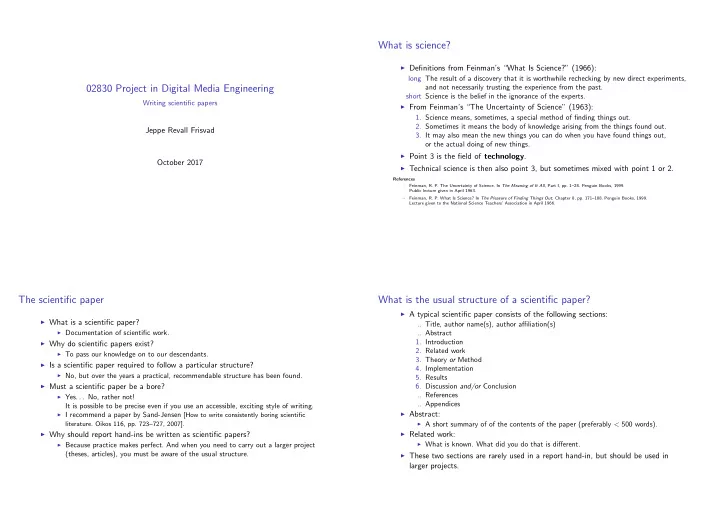
What is science?

◮ Definitions from Feinman’s “What Is Science?” (1966):

long The result of a discovery that it is worthwhile rechecking by new direct experiments, and not necessarily trusting the experience from the past. short Science is the belief in the ignorance of the experts.

◮ From Feinman’s “The Uncertainty of Science” (1963):

  • 1. Science means, sometimes, a special method of finding things out.
  • 2. Sometimes it means the body of knowledge arising from the things found out.
  • 3. It may also mean the new things you can do when you have found things out,
  • r the actual doing of new things.

◮ Point 3 is the field of technology. ◮ Technical science is then also point 3, but sometimes mixed with point 1 or 2.

References

  • Feinman, R. P. The Uncertainty of Science. In The Meaning of It All, Part I, pp. 1–28. Penguin Books, 1999.

Public lecture given in April 1963.

  • Feinman, R. P. What Is Science? In The Pleasure of Finding Things Out, Chapter 8, pp. 171–188. Penguin Books, 1999.

Lecture given to the National Science Teachers’ Association in April 1966.

The scientific paper

◮ What is a scientific paper?

◮ Documentation of scientific work.

◮ Why do scientific papers exist?

◮ To pass our knowledge on to our descendants.

◮ Is a scientific paper required to follow a particular structure?

◮ No, but over the years a practical, recommendable structure has been found.

◮ Must a scientific paper be a bore?

◮ Yes. . . No, rather not!

It is possible to be precise even if you use an accessible, exciting style of writing.

◮ I recommend a paper by Sand-Jensen [How to write consistently boring scientific

  • literature. Oikos 116, pp. 723–727, 2007].

◮ Why should report hand-ins be written as scientific papers?

◮ Because practice makes perfect. And when you need to carry out a larger project

(theses, articles), you must be aware of the usual structure.

What is the usual structure of a scientific paper?

◮ A typical scientific paper consists of the following sections:

.. Title, author name(s), author affiliation(s) .. Abstract

  • 1. Introduction
  • 2. Related work
  • 3. Theory or Method
  • 4. Implementation
  • 5. Results
  • 6. Discussion and/or Conclusion

.. References .. Appendices

◮ Abstract:

◮ A short summary of of the contents of the paper (preferably < 500 words).

◮ Related work:

◮ What is known. What did you do that is different.

◮ These two sections are rarely used in a report hand-in, but should be used in

larger projects.

slide-2
SLIDE 2

The structure of a scientific paper

◮ Introduction:

◮ Define and motivate the problem.

Answer: What is the problem? Why is it interesting?

◮ Describe the objectives of the paper (put forward an hypothesis, if relevant).

Answer: How do you intend to handle the problem?

◮ Theory or Method

◮ Describe possible solutions and decide on the best one.

◮ Implementation:

◮ Used if the reader needs extra info to implement the theory in practice. Or if a

particular algorithm or hardware gives an advantage (speed-up, for example).

◮ Results:

◮ Describe the outcome of your efforts (e.g. measured or simulated data, model,

formula, algorithm, new comprehension.)

◮ Substantiate the chosen solution, test it, and present the results.

The structure of a scientific paper

◮ Discussion and/or Conclusion

◮ Discussion: reflect on theory, implementation and results. ◮ Conclusion: recapitulate how the problem, which was defined in the introduction,

was solved in the paper.

◮ Self-criticism is good practice. Assess the quality of your solution. ◮ Describe future work: new applications, improvements.

◮ References:

◮ List of all the books, articles, papers, web pages, etc. which were used for writing the

paper.

◮ There should be a number or other identifier for each reference such that they can

easily be referred to in the main text.

◮ Some examples follow on the next slide.

◮ Appendices:

◮ Extra details for the reader with a special interest (code, longer derivations,

simulated data, enlarged figures, etc.)

Referencing styles

Numerical Alphabetical

The Cornell box [2] is a benchmark scene for calculation

  • f diffusely reflected indirect illumination.

This special arrangement of the fibrils ensures that they are almost transparent [Ben71].

Author-date

Casein micelles only scatter light and the refractive in- dex is ηcasein = 1.503 in the visible range [Attaie and Richtert 2000]. Data provided by Babin et al. [2003a] have been trans- lated into the volume fractions given here.

Scientific honesty

◮ What is scientific misconduct? [Hansen, V. L. What is scientific misconduct? BioZoom, Vol. 9,

  • Nr. 4, s. 9-14, 2006]

◮ FFP-definition (US National Academy of Sciences):

◮ Fabrication: making up results and recording or reporting them. ◮ Falsification: manipulating research, materials, equipment, or processes, or changing

  • r omitting data or results such that the research is not accurately represented in the

research record.

◮ Plagiarism: the appropriation of another person’s ideas, processes, results, or words

without giving appropriate credit.

◮ Provide references if something you write comes from elsewhere. Also if you

rephrase it.

◮ Any non-obvious “statement” must be substantiated by a reference or an

  • explanation. If you “heard it from somewhere”, then find the reference.
slide-3
SLIDE 3

DTU Code of Honour

“As a student at DTU I am subject to DTU’s code of honour for examinations and other academic activity. I accept and support that I am governed by the high standards for accountability and academic and scientific integrity that apply to lecturers, researchers, and students at the university. I therefore show independence in my work and my exam submissions always reflect my own work, without having received unjust oral or written assistance, including by digital means. I know that I must never copy (plagiarize) other people’s ideas, thoughts, reports or articles, but I am permitted to quote and refer to them using quotation marks and source

  • references. I also know that I am not allowed to communicate with others

during a written exam.”

◮ Q&A on “fine or problematic?”:

https://www.inside.dtu.dk/en/undervisning/regler/aereskodeks/snydscenarier

Figures – good advise from the Scientific Computing section

◮ Use the scales that best illustrate the relation you are plotting (or graphing) in

your paper. Poor examples:

◮ A figure (including caption) must be self-explanatory. ◮ A simple estimate of the part of the figure area that holds information should be a

value close to 1.

Thesis assessment

◮ Level of difficulty ◮ Reproducibility ◮ Quality of results ◮ Quality of presentation (written and oral) ◮ Quality of references

Review of scientific papers often includes assessment of

◮ Appropriateness / suitability for publication venue ◮ Novelty / originality / justification ◮ Significance / importance / magnitude of contribution ◮ Reproducibility ◮ Technical soundness ◮ Quality, depth, and completeness of content ◮ Clarity / quality of presentation

Reference Sand-Jensen, Kaj. How to write consistently boring scientific literature. Oikos 116(5), pp. 723–727, May 2007.