What Is Risk? Lets start with your view Javier Go Estrada What - - PDF document

what is risk
SMART_READER_LITE
LIVE PREVIEW

What Is Risk? Lets start with your view Javier Go Estrada What - - PDF document

Long Term Trends (II): Risk Javier Estrada ADFIN Winter/2014 1. What Is Risk? Your view In the short term In the long term Evidence 2. Risk and the Holding Period Evidence Time diversification What Is Risk?


slide-1
SLIDE 1

1

  • 1. What Is Risk?
  • Your view
  • In the short term
  • In the long term
  • Evidence
  • 2. Risk and the Holding Period
  • Evidence
  • Time diversification

Long‐Term Trends (II):

Risk

Javier Estrada ADFIN – Winter/2014

Javier Estrada IESE Business School Barcelona Spain ADFIN Winter/2014

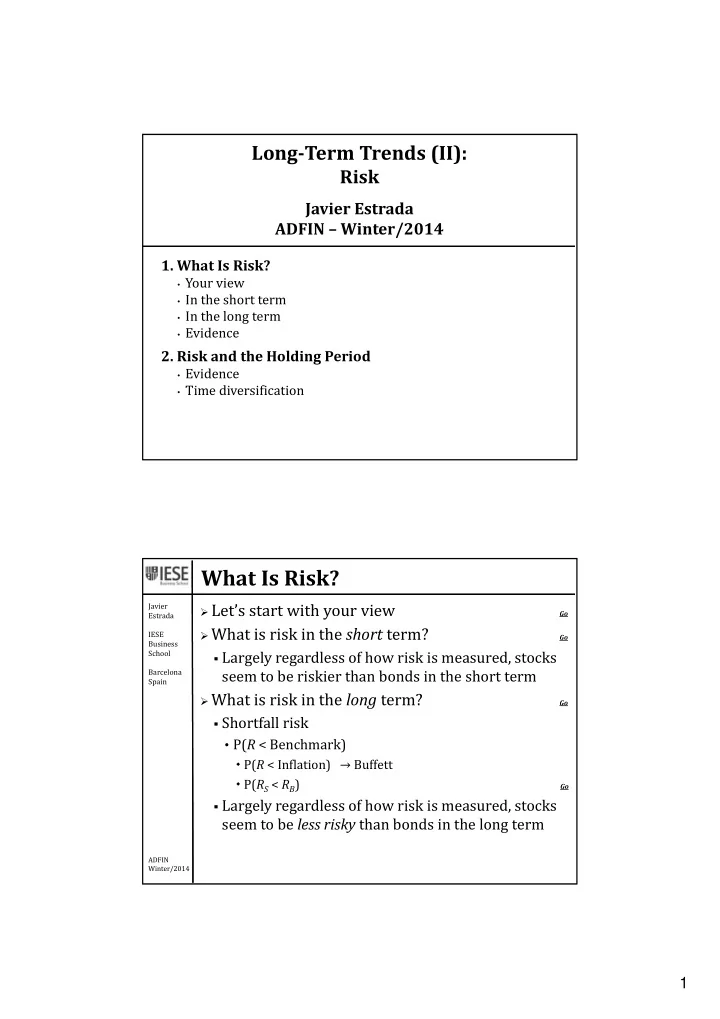
What Is Risk?

  • Let’s start with your view

Go

  • What is risk in the short term?

Go

  • Largely regardless of how risk is measured, stocks

seem to be riskier than bonds in the short term

  • What is risk in the long term?

Go

  • Shortfall risk
  • P(R < Benchmark)

 P(R < Inflation) → Buffett  P(RS < RB)

Go

  • Largely regardless of how risk is measured, stocks

seem to be less risky than bonds in the long term

slide-2
SLIDE 2

2

Javier Estrada IESE Business School Barcelona Spain ADFIN Winter/2014

Risk and the Holding Period

  • These two variables are critically intertwined

Go

  • Time diversification
  • The longer is the holding period, the more likely is a

riskier (more volatile) asset to outperform a less risky (less volatile) asset

 The longer is the holding period, the more likely is a higher exposure to risk to yield a higher return

  • Time diversification is a concept with critical and

widely‐used implications

  • Financial advisors
  • Asset allocation informal rules
  • xB ≈ Age / xS = 100–Age

Go

  • xB ≈ Age–20 / xS = 120–Age (More aggressive)

 Largely consistent with the glidepath of TDFs

Javier Estrada IESE Business School Barcelona Spain ADFIN Winter/2014

So …

  • The bottom line (I)
  • What is risk?
  • Short‐term measures like …

 volatility?  spreads?  loses in worst‐case scenarios?

  • Long‐term measures like …

 the probability of losing purchasing power?  the probability of underperforming a less volatile asset?

  • Is risk in the eyes of the beholder?
slide-3
SLIDE 3

3

Javier Estrada IESE Business School Barcelona Spain ADFIN Winter/2014

So …

  • The bottom line (II)
  • Relative to bonds, stocks have …
  • in the short term, higher volatility
  • in the long term, a very low shortfall probability (2)
  • Then, why do stocks outperform bonds?
  • Is it a compensation for bearing short‐term volatility?

 Are long‐term investors getting a free lunch at the expense of short‐term investors?

  • Is it myopic loss aversion?

 Loss aversion plus a short evaluation period

  • The evidence in terms of both data and the actions of

practitioners is clear

Javier Estrada IESE Business School Barcelona Spain ADFIN Winter/2014

So …

  • The bottom line (III)
  • Think and draw conclusions for your own investment

decisions

  • How do (will) you evaluate the risk of your portfolio?
  • Should you be largely invested in stocks with little

exposure to bonds? The other way around? A more balanced approach?

  • What trade‐offs are you willing to take?

Go

slide-4
SLIDE 4

4

Javier Estrada IESE Business School Barcelona Spain ADFIN Winter/2014

Appendix

Javier Estrada IESE Business School Barcelona Spain ADFIN Winter/2014

What Is Risk?

  • You give me $100 to play a game
  • Option 1
  • I give you back $105
  • Option 2: I spin a roulette …
  • If 0, you get $0
  • If 1‐6, you get $107
  • If 7‐12, you get $110
  • If 13‐18, you get $113
  • If 19‐24, you get $116
  • If 25‐30, you get $119
  • If 31‐36, you get $122
  • Which option is riskier?
slide-5
SLIDE 5

5

Javier Estrada IESE Business School Barcelona Spain ADFIN Winter/2014

What Is Risk?

  • In terms of returns
  • Option 1
  • R = 5% (Certain)
  • Option 2
  • If 0

→ R = ‒100% (P = 1/37)

  • If 1‐6

→ R = 7% (P = 6/37)

  • If 7‐12

→ R = 10% (P = 6/37)

  • If 13‐18 → R = 13%

(P = 6/37)

  • If 19‐24 → R = 16%

(P = 6/37)

  • If 25‐30 → R = 19%

(P = 6/37)

  • If 31‐36 → R = 22%

(P = 6/37)

  • Expected returns
  • O1: 5% / O2: 11.4%
  • Exactly as B & S in USA (1900‐2009)

Javier Estrada IESE Business School Barcelona Spain ADFIN Winter/2014

What Is Risk?

  • Which option do you consider riskier?
  • G1 gives you $300 for sure
  • G2 gives $100 per spot after rolling two dice
slide-6
SLIDE 6

6

Javier Estrada IESE Business School Barcelona Spain ADFIN Winter/2014

What Is Risk?

  • Note that …
  • Option 1 has no uncertainty
  • Option 2, in turn, …
  • has a very low shortfall probability

 P = 1/37 = 2.7%

  • has much more uncertainty

 But it is mostly upside risk  Uncertainty about how much more, not how much less, you will have

  • So, what is risk?
  • Uncertainty?
  • Downside potential?

Javier Estrada IESE Business School Barcelona Spain ADFIN Winter/2014

What Is Risk?

Back

slide-7
SLIDE 7

7

Javier Estrada IESE Business School Barcelona Spain ADFIN Winter/2014

Risk in the Short Term

Back Javier Estrada IESE Business School Barcelona Spain ADFIN Winter/2014

Warren Buffett – Fortune (2012)

“Money-market funds, bonds, mortgages, bank deposits … are among the most dangerous of

  • assets. Their beta may be zero,

but their risk is huge. Over the past century these instruments have destroyed the purchasing power of investors in many countries.”

slide-8
SLIDE 8

8

Javier Estrada IESE Business School Barcelona Spain ADFIN Winter/2014

Warren Buffett – Fortune (2012)

“The riskiness of an investment is not measured by beta … but rather by the probability … of that investment causing its owner a loss purchasing power over his contemplated holding

  • period. Assets can fluctuate greatly in

price and not be risky as long as they are reasonably certain to deliver increased purchasing power over the holding period.”

Back Javier Estrada IESE Business School Barcelona Spain ADFIN Winter/2014

Risk in the Long Term

Back

slide-9
SLIDE 9

9

Javier Estrada IESE Business School Barcelona Spain ADFIN Winter/2014

Risk and the Holding Period

RP<0 = 39/110 = 35%

(*) 1900‐2009, S&P and 10Y Treasuries

Javier Estrada IESE Business School Barcelona Spain ADFIN Winter/2014

Risk and the Holding Period

RP<0 = 15/101 = 15%

(*) 1900‐2009, S&P and 10Y Treasuries

slide-10
SLIDE 10

10

Javier Estrada IESE Business School Barcelona Spain ADFIN Winter/2014

Risk and the Holding Period

RP<0 = 3/91 = 3%

(*) 1900‐2009, S&P and 10Y Treasuries

Javier Estrada IESE Business School Barcelona Spain ADFIN Winter/2014

Risk and the Holding Period

RP<0 = 0/81 = 0%

(*) 1900‐2009, S&P and 10Y Treasuries

slide-11
SLIDE 11

11

Javier Estrada IESE Business School Barcelona Spain ADFIN Winter/2014

Risk and the Holding Period

Back Javier Estrada IESE Business School Barcelona Spain ADFIN Winter/2014

Risk and the Holding Period

Back

slide-12
SLIDE 12

12

Javier Estrada IESE Business School Barcelona Spain ADFIN Winter/2014

Trade‐Offs

Back