What is OPIC? The Legislature created the Office of Public - - PDF document

what is opic
SMART_READER_LITE
LIVE PREVIEW

What is OPIC? The Legislature created the Office of Public - - PDF document

Texas Office of Public Insurance Counsel TEXAS OFFICE OF PUBLIC INSURANCE COUNSEL (OPIC) What is OPIC? The Legislature created the Office of Public Insurance Counsel (OPIC) in 1991 as an independent agency to advocate for consumers in rate,


slide-1
SLIDE 1

Texas Office of Public Insurance Counsel 1

TEXAS OFFICE OF PUBLIC INSURANCE COUNSEL (OPIC)

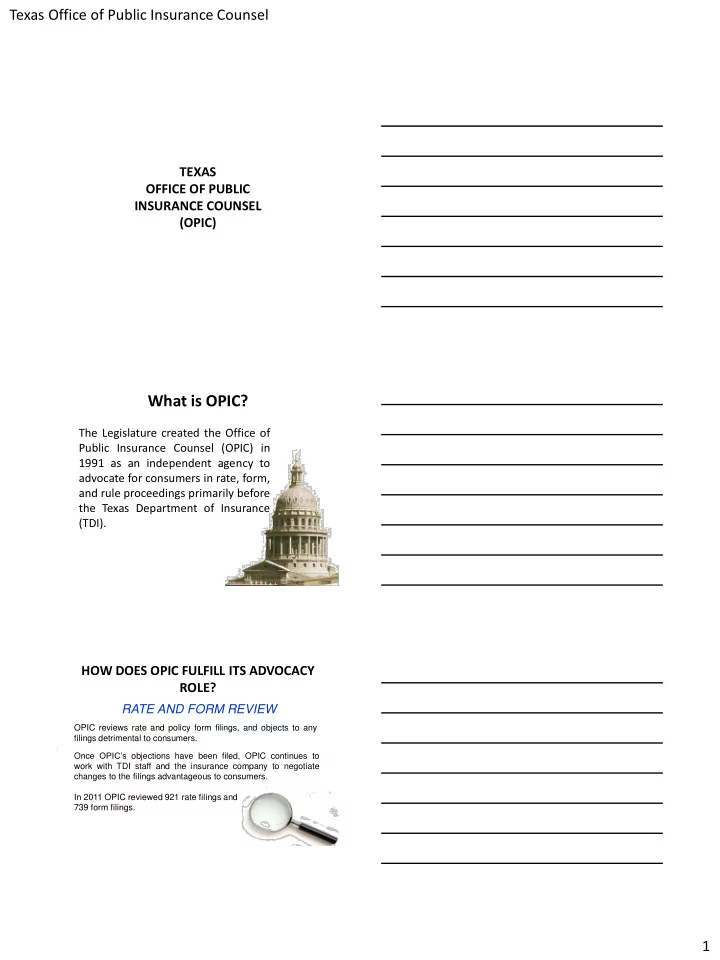
The Legislature created the Office of Public Insurance Counsel (OPIC) in 1991 as an independent agency to advocate for consumers in rate, form, and rule proceedings primarily before the Texas Department of Insurance (TDI).

What is OPIC?

HOW DOES OPIC FULFILL ITS ADVOCACY ROLE?

RATE AND FORM REVIEW

OPIC reviews rate and policy form filings, and objects to any filings detrimental to consumers. Once OPIC’s objections have been filed, OPIC continues to work with TDI staff and the insurance company to negotiate changes to the filings advantageous to consumers. In 2011 OPIC reviewed 921 rate filings and 739 form filings.

slide-2
SLIDE 2

Texas Office of Public Insurance Counsel 2

CONSUMER EDUCATION OPIC’s Rate and Market Concerns

Texas Homeowners Insurance

  • Trend toward lower coverage
  • Excessive ceding of risk
  • Excessive rates
  • Trust gap

Trend Toward Lower Coverage

Fewer All-Risk Policies Written

  • Texas has, by far, the highest percentage of

named-peril residential policies in the country.

  • 43.6% of residential property policies in Texas

are named-peril as opposed to all-risk per 2009 NAIC data.

  • The next highest is Oklahoma at 13.2%.
  • In 2001, the figure for Texas was under 13%.
slide-3
SLIDE 3

Texas Office of Public Insurance Counsel 3

Trend Toward Lower Coverage

Increasing Deductibles (Especially for Wind/Hail)

Tier 2

% of Total HO Policies

Wind Ded 2005 2006 2007 2008 2009 % Chg 05- 09 < 1% 16.2% 14.0% 7.0% 5.7% 4.6%

  • 71.9%

1% 62.5% 64.8% 65.7% 60.3% 52.3%

  • 16.3%

2% 18.6% 18.2% 22.2% 27.5% 35.5% 91.1% > 2% 1.3% 1.4% 3.1% 4.5% 5.5% 314.3% 2% or Greater 19.9% 19.6% 25.3% 31.9% 41.0% 106.0%

Tier 2 consists of the layer of counties geographically behind the Tier 1 coastal area. This includes Harris County (Houston).

Excessive Ceding of Risk

  • Massive ceding of Tier 1 risk to TWIA ($59.3

billion of wind exposure as of March 2012).

  • Reinsurance loads in rate filings at 10-15% of

statewide prospective earned premium.

  • Reinsuring of non-hurricane catastrophe risk.
  • Reinsurance agreements with recovery rates

below 20%.

Excessive Rates

Inflated Catastrophe Loads

  • Use of near-term hurricane models.
  • Use of questionably validated severe storm

models.

– Early hurricane models sometimes vastly deviated from historical risk parameters.

  • Non-hurricane cat loads that ignore sharp

deductible shift.

  • Extra profit loads built in for retained risk.
slide-4
SLIDE 4

Texas Office of Public Insurance Counsel 4

Excessive Rates

Unreasonable Target Rates of Return

  • Target rates of return in recent filings range

from 12-18% greatly exceeding market rates.

  • Limited, if any, accounting for ceding of cat

risk in establishing ROR.

  • Allocated premium-equity ratios are

historically high in the 1-1 range.

Trust Gap

  • Industry concerns:

– Lack of regulatory consistency (unclear standards) – “File and haggle” system (rate review feels like PA)

  • Regulator and OPIC concerns

– Too much gaming with rate filings, inflated indications – Inadequate filing disclosure – Questionable rating plans

Profitability Picture Since File and Use

Texas Financial Statement Data

Earned Premium Incurred Losses Loss Ratio 2004 4,361,635,314 1,213,088,301 27.8% 2005 4,610,859,573 2,609,419,843 56.6% 2006 4,604,385,162 1,566,429,126 34.0% 2007 5,000,782,866 1,820,164,762 36.4% 2008 5,224,968,126 6,742,744,446 129.0% 2009 5,435,727,942 3,652,905,485 67.2% 2010 5,718,375,100 2,793,093,954 48.8% 2011 5,877,532,348 4,202,037,831 71.5% Total / Avg. 40,834,266,431 24,599,883,748 60.2%

Source: Financial Statement State Page Data (Texas) Reported to NAIC