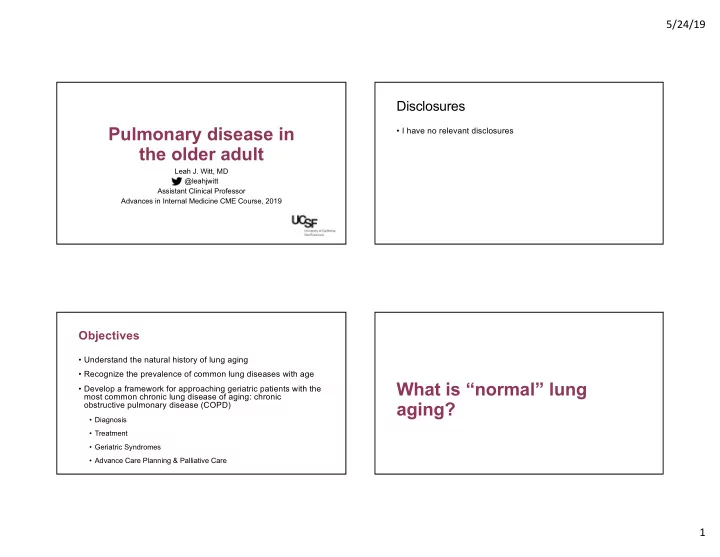
What is normal lung Develop a framework for approaching geriatric - - PowerPoint PPT Presentation

what is normal lung
SMART_READER_LITE
LIVE PREVIEW

What is normal lung Develop a framework for approaching geriatric - - PowerPoint PPT Presentation

5/24/19 Disclosures Pulmonary disease in I have no relevant disclosures the older adult Leah J. Witt, MD @leahjwitt Assistant Clinical Professor Advances in Internal Medicine CME Course, 2019 Objectives Understand the natural


slide-1
SLIDE 1

5/24/19 1

Pulmonary disease in the older adult

Leah J. Witt, MD @leahjwitt Assistant Clinical Professor Advances in Internal Medicine CME Course, 2019

Disclosures

  • I have no relevant disclosures

Objectives

  • Understand the natural history of lung aging
  • Recognize the prevalence of common lung diseases with age
  • Develop a framework for approaching geriatric patients with the

most common chronic lung disease of aging: chronic

  • bstructive pulmonary disease (COPD)
  • Diagnosis
  • Treatment
  • Geriatric Syndromes
  • Advance Care Planning & Palliative Care

What is “normal” lung aging?

slide-2
SLIDE 2

5/24/19 2

Lung aging (decline in maximal lung function) begins:

  • A. in the 2nd decade of life
  • B. in the 3rd decade of life
  • C. in the 4th decade of life
  • D. when you sign up for Medicare

Lung aging (decline in maximal lung function) begins:

  • A. in the 2nd decade of life
  • B. in the 3rd decade of life
  • C. in the 4th decade of life
  • D. when you sign up for Medicare

Bush 2016, Burri 2006, Lange 2015

Prenatal Childhood/

Adolescence

(<20) Young Adult (20-35) Mid- life (35-50) Mature Adulthood (50-80) Late Adulthood (>80)

Maximal lung function begins to decline in the 3rd decade of life

COPD IPF Lung cancer Onset of lung aging Asthma Respiratory Infections Pollution Parental smoking Bush 2016, Burri 2006, Lange 2015

Parenchymal Destruction & Reduced Elastic Recoil over Lifespan

Janssens 1999

slide-3
SLIDE 3

5/24/19 3

Chest wall stiffening (extrinsic restriction): kyphosis and rib cage/cartilage calcification

Leech 1990

Respiratory Muscles Weaken (Sarcopenia)

Janssens 1999

With age, vital capacity ↓ and “air trapping” (residual volume) ↑

Janssens 1999

Aging & Pulmonary Disease Chronic Obstructive Pulmonary Disease (COPD) Idiopathic Pulmonary Fibrosis (IPF) Combined Pulmonary Fibrosis & Emphysema (CPFE) Asthma-COPD overlap syndrome (ACOS) Dyspnea Lung cancer Asthma Bronchiectasis Aspiration

slide-4
SLIDE 4

5/24/19 4 Aging & Pulmonary Disease Chronic Obstructive Pulmonary Disease (COPD) Idiopathic Pulmonary Fibrosis (IPF) Combined Pulmonary Fibrosis & Emphysema (CPFE) Asthma-COPD overlap syndrome (ACOS) Dyspnea Lung cancer Asthma Bronchiectasis Aspiration

Chronic Obstructive Pulmonary Disease (COPD)

  • Mr. F: 85 y/o m with

Very severe COPD (FEV1 30% predicted)

COPD diagnosis

  • Symptoms:
  • Dyspnea
  • Chronic cough/sputum
  • Frequent respiratory tract

infections

  • Environment:
  • Smoke/pollution exposure
  • Typically >40 years old
  • Patient factors
  • Abnormal lung development
  • Accelerated lung aging

Lange NEJM 2015 Postma NEJM 2015

Spirometry is confirmatory of COPD (not diagnostic by itself)

Key: FEV1 = forced expiratory volume in 1 second FVC = forced vital capacity TLC = total lung capacity RV = residual volume Obstruction = FEV1/FVC <70% (actual) FEV1 <80% (predicted)

slide-5
SLIDE 5

5/24/19 5

Grade COPD Severity

Based on FEV1 (if FEV/FVC <70%)

  • GOLD 1: mild

FEV1 ≥ 80% predicted

  • GOLD 2: moderate

50% ≤ FEV1 < 80%

  • GOLD 3: severe

30% ≤ FEV1 < 50%

  • GOLD 4: very severe

FEV1 < 30% Based on symptoms/exacerbations

  • mMRC breathlessness scale

(Grades 0-4) or COPD assessment test (Score 0-40)

GOLD 2019

A B C D

mMRC 0-1 CAT <10 mMRC ≥ 2 CAT ≥ 10 0 or 1 (no hospitalization) ≥ 2 or ≥ 1 hospitalization Exacerbations Symptoms

MMRC 3: Stop for breath after walking 100 meters or after a few minutes on level ground

Treatments

Which of the following are true regarding oxygen use in COPD?

  • A. Supplemental oxygen provides a mortality benefit if patients

are hypoxic with ambulation

  • B. Supplemental oxygen must be used >15 hours in order to

provide a mortality benefit

  • C. Supplemental oxygen use isn’t useful for palliation in people

who are not hypoxic

  • D. Supplemental oxygen does not improve breathlessness during

exercise for mildly hypoxic and non-hypoxic people with COPD, not otherwise on oxygen

Which of the following is true regarding oxygen use in COPD?

  • A. Supplemental oxygen provides a mortality benefit if patients

are hypoxic with ambulation

  • B. Supplemental oxygen must be used >15 hours in order to

provide a mortality benefit

  • C. Supplemental oxygen use isn’t useful for palliation in people

who are not hypoxic

  • D. Supplemental oxygen does not improve breathlessness during

exercise for mildly hypoxic and non-hypoxic people with COPD, not otherwise on oxygen

Ekstrom Cochrane 2016 Cranston Cochran 2005 LOTT NEJM 2016 Uronis Thorax 2015

slide-6
SLIDE 6

5/24/19 6

Treatments

  • Impacts on mortality
  • Smoking cessation
  • Oxygen use (if hypoxic at rest)
  • Immunizations (flu, pneumonia)
  • Symptomatic Improvement/Exacerbation Prevention
  • Maintenance Inhalers (LAMA > LABA)
  • Severe disease: ICS/LAMA/LABA triple therapy
  • Avoid long-term oral steroids
  • Pulmonary rehabilitation

GOLD 2019

Geriatrics & Inhaler challenges

Side effects

Anti-muscarinic agents Dry mouth, urinary retention Beta agonists Tachycardia, arrhythmia, tremor Inhaled corticosteroids Thrush, hoarseness, pneumonia,

  • steoporosis

Incorrect Use

  • Error rate >40% for metered

dose inhalers, dry powder inhalers slightly better

  • Common errors: coordination,

no post-inhalation breath hold

Cost

  • Cost- related non-adherence is

high (31%), cost >$20 month increases risk

  • Medicare Part D: high out-of-

pocket costs ($900 yearly)

Castaldi 2010, Tseng 2017, Sanchis 2016, GOLD 2019

Poll: I received training to counsel patients about correct inhaler use.

  • A. Yes
  • B. No
  • C. That’s not my job

COPD Foundation app

slide-7
SLIDE 7

5/24/19 7 Polypharmacy in Community-Dwelling Adults with COPD

>4 meds 80.6% 58.4% Witt et al unpublished http://www.livebetter.org/

COPD = Geriatric Primary Care

COPD Geriatric Primary Care

  • Target comorbidities

Morbid obesity, GERD, pulmonary hypertension, OSA, diastolic dysfunction and renal failure

  • Think about function

Consider mobility aids, durable medical equipment, DMV placards and

  • caregiving. Help people prepare for travel.
  • Osteoporosis

Overlooked and undertreated: smoking & steroid use increase risk

  • Prognosticate and discuss advance care planning
  • Consider lung cancer screening

Bon et al Ann Am Thorac Soc 2018

slide-8
SLIDE 8

5/24/19 8

Prognosticating: BODE index BMI, Obstruction, Dyspnea & Exercise

4 year survival: 0-2 points - 80% 3-4 points - 67% 5-6 points - 57% 7-10 points - 18%

Celli NEJM 2004

Mortality = 82%

Prognosticating: ADO index Age, Dyspnea, Ostruction

Score 9: 3 year mortality 64%

Puhan 2009

End of Life Care

  • 2006 VA study of patients with

COPD or lung cancer in the last 6 months of life

  • Patients with COPD:
  • twice the odds of ICU

admission

  • Costs were $4000 higher
  • Much less use of palliative

medicine

Au et al Archives of Internal Medicine 2006

Symptom Management & End of Life Care

  • Consider opiates for breathlessness
  • Low dose opioids: not associated with increased admissions or

deaths in patients.

  • A fan directed at the face can be helpful
  • Think outside of the box about making life easy
  • DMV disability placard
  • Shower chair or other durable medical equipment (DME)
  • Advance Care Planning (e.g. prepareforyourcare.org)
  • Symptom Management/Palliative Care referrals

Ekstrom et al 2014 BMJ

slide-9
SLIDE 9

5/24/19 9

Lung Cancer Screening with low dose CT scan has demonstrated

  • A. a 96.4% false positive rate
  • B. fewer deaths related to cancer compared to CXR screening

(247per 100,000 person years compared to 309 per 100,000 person years in CXR)

  • C. All-cause mortality is reduced by 6.7% as compared to chest

radiography

  • D. often inappropriate screening of groups not recommended to

be screened

  • E. All of the above

Lung Cancer Screening with low dose CT scan has demonstrated

  • A. a 96.4% false positive rate
  • B. fewer deaths related to cancer compared to CXR screening

(247per 100,000 person years compared to 309 per 100,000 person years in CXR)

  • C. All-cause mortality is reduced by 6.7% as compared to chest

radiography

  • D. often inappropriate screening of groups not recommended to

be screened

  • E. All of the above

Ma 2013 Huo 2017 National Lung Screening Trial Research Team 2011

USPSTF Grade B recommendation

  • Annual screening by Low

Dose CT in adults aged 55-80

  • 30 pack year smoking history

and currently smoking

  • r quit within 15 years
  • **Stop when life expectancy

is limited by comorbidities

  • r patient would not want

curative lung surgery or radiation**

  • LDCT Shared Decision-

Making: recommended but rarely done

  • Consider decision aid

https://www.uspreventiveservicestaskforce.org/Page/Document/UpdateSummaryFinal/lung-cancer-screening Redberg JAMA 2018 Brenner et al JAMA 2018 https://effectivehealthcare.ahrq.gov/decision-aids/lung-cancer-screening/static/lung-cancer-screening-decision-aid.pdf

slide-10
SLIDE 10

5/24/19 10

Mobility & Function

Numerical age ≠ physiologic age

  • People with chronic lung

disease:

  • Have more muscle weakness

(sarcopenia)

  • Are more frail (based on Fried

Frailty phenotype: grip strength, walk speed, weight loss, exhaustion, physical activity)

  • Have a slower gait speed
  • Are more functionally impaired
  • Frailty predicts mortality better

than FEV1

Fried 2001 Lahousse 2016 Fragoso 2012 Gosselink 1996

Community-Dwelling Older Adults with COPD have more Geriatric Co-morbidities

Witt et al unpublished

32 65 90.7 39.1 10.9 18.9 52.6 94.2 57.2 5.9

10 20 30 40 50 60 70 80 90 10

Depressive symptoms Loneliness Frequently social Sex in last year Poor self-rated mental health

%

Mental Health and Social Isolation in US Older Adults with COPD

COPD Non-COPD

Witt et al unpublished

slide-11
SLIDE 11

5/24/19 11 Key Points

  • Lung aging begins in the third decade, initiating a gradual decline

in maximal pulmonary function throughout the remainder of life

  • Respiratory organ aging = degradation of lung parenchyma,

weakening of respiratory muscles, and distortion of the thorax

  • Numerical age ≠ physiologic age. Individuals with chronic lung

diseases have a higher burden of ”geriatric syndromes”: frailty, functional impairment, falls, urinary incontinence, and social isolation

  • COPD is a geriatric condition. Consider maintenance inhalers

(LAMA, then LABA, then ICS) for symptomatic improvement, tobacco cessation/oxygen use for a mortality benefit, and pulm rehab for quality of life improvements. Recommend advance care planning, consider palliative care when very symptomatic.

References

  • Au DH, Udris EM, Fihn SD, McDonell MB, Curtis JR. Differences in health care utilization at the end of life among patients with chronic obstructive

pulmonary disease and patients with lung cancer. Archives of Internal Medicine. 2006 Feb 13;166(3):326-31. Bush A. Lung development and aging. Annals of the American Thoracic Society. 2016 Dec;13(Supplement 5):S438-46.

  • Bon J, Zhang Y

, Leader JK, Fuhrman C, Perera S, Chandra D, Bertolet M, Diergaarde B, Greenspan SL, Sciurba FC. Radiographic Emphysema, Circulating Bone Biomarkers, and Progressive Bone Mineral Density Loss in Smokers. Ann Am Thorac Soc 2018; 15: 615-621

  • Burri PH. Structural aspects of postnatal lung development–alveolar formation and growth. Neonatology. 2006;89(4):313-22.
  • Castaldi PJ, Rogers WH, Safran DG, Wilson IB. Inhaler costs and medication nonadherence among seniors with chronic pulmonary disease. Chest.

2010 Sep 1;138(3):614-20.

  • Celli, B. R., Cote, C. G., Marin, J. M., Casanova, C., Montes de Oca, M., Mendez, R. A., Pinto Plata, V. & Cabral, H. J. 2004. The body-mass index,

airflow obstruction, dyspnea, and exercise capacity index in chronic obstructive pulmonary disease. New England Journal of Medicine, 350, 1005- 1012.

  • Ekström MP

, Bornefalk-Hermansson A, Abernethy AP , Currow DC. Safety of benzodiazepines and opioids in very severe respiratory disease: national prospective study. Bmj. 2014 Jan 30;348:g445.

  • Ekström M, Ahmadi Z, Bornefalk-Hermansson A, Abernethy A, Currow D. Oxygen for breathlessness in patients with chronic obstructive pulmonary

disease who do not qualify for home oxygen therapy. Cochrane database of systematic reviews. 2016(11).

  • Fried LP

, T angen CM, Walston J, Newman AB, Hirsch C, Gottdiener J, Seeman T , Tracy R, Kop WJ, Burke G, McBurnie MA. Frailty in older adults evidence for a phenotype. The Journals of Gerontology Series A: Biological Sciences and Medical Sciences. 2001 Mar 1;56(3):M146-57.

  • Fletcher C, Peto R. The natural history of chronic airflow obstruction. Br Med J. 1977 Jun 25;1(6077):1645-8.
  • Fragoso CA, Enright PL, McAvay G, Van Ness PH, Gill TM. Frailty and respiratory impairment in older persons. The American journal of medicine.

2012 Jan 1;125(1):79-86.

  • GOSSELINK, R., TROOSTERS, T

. & DECRAMER, M. 1996. Peripheral muscle weakness contributes to exercise limitation in COPD. American journal of respiratory and critical care medicine, 153, 976-980.

  • Huo J, Shen C, Volk RJ, Shih YC. Use of CT and chest radiography for lung cancer screening before and after publication of screening guidelines:

intended and unintended uptake. JAMA internal medicine. 2017 Mar 1;177(3):439-41.

  • Ito K, Barnes PJ. COPD as a disease of accelerated lung aging. Chest. 2009 Jan 1;135(1):173-80.
  • Janssens JP

, Pache JC, Nicod LP . Physiological changes in respiratory function associated with ageing. European Respiratory Journal. 1999 Jan 1;13(1):197-205.

References

  • Lahousse L, Ziere G, Verlinden VJ, Zillikens MC, Uitterlinden AG, Rivadeneira F, Tiemeier H, Joos GF, Hofman A, Ikram MA, Franco OH. Risk of frailty

in elderly with COPD: a population-based study. Journals of Gerontology Series A: Biomedical Sciences and Medical Sciences. 2015 Sep 9;71(5):689

  • Lange P

, Celli B, Agustí A, Boje Jensen G, Divo M, Faner R, Guerra S, Marott JL, Martinez FD, Martinez-Camblor P , Meek P . Lung-function trajectories leading to chronic obstructive pulmonary disease. New England Journal of Medicine. 2015 Jul 9;373(2):111-22.

  • Long-Term Oxygen Treatment Trial Research Group. A randomized trial of long-term oxygen for COPD with moderate desaturation. New England

Journal of Medicine. 2016 Oct 27;375(17):1617-27.

  • LAHOUSSE, L., ZIERE, G., VERLINDEN, V. J., ZILLIKENS, M. C., UITTERLINDEN, A. G., RIVADENEIRA, F., TIEMEIER, H., JOOS, G. F., HOFMAN,
  • A. & IKRAM, M. A. 2016. Risk of frailty in elderly with COPD: a population-based study. The Journals of Gerontology Series A: Biological Sciences and

Medical Sciences, 71, 689-695.

  • Lange P

, Celli B, Agustí A, Boje Jensen G, Divo M, Faner R, Guerra S, Marott JL, Martinez FD, Martinez-Camblor P , Meek P . Lung-function trajectories leading to chronic obstructive pulmonary disease. New England Journal of Medicine. 2015 Jul 9;373(2):111-22.

  • MA, J., WARD, E. M., SMITH, R. & JEMAL, A. 2013. Annual number of lung cancer deaths potentially avertable by screening in the United States.

Cancer, 119, 1381-1385.

  • National Lung Screening Trial Research Team. Reduced lung-cancer mortality with low-dose computed tomographic screening. New England Journal
  • f Medicine. 2011 Aug 4;365(5):395-409.
  • Puhan MA, Garcia-Aymerich J, Frey M, ter Riet G, Antó JM, Agustí AG, Gómez FP

, Rodríguez-Roisín R, Moons KG, Kessels AG, Held U. Expansion

  • f the prognostic assessment of patients with chronic obstructive pulmonary disease: the updated BODE index and the ADO index. The Lancet. 2009

Aug 29;374(9691):704-11.

  • Sanchis J, Gich I, Pedersen S, Team AD. Systematic review of errors in inhaler use: has patient technique improved over time?. Chest. 2016 Aug

1;150(2):394-406.

  • Tseng CW, Yazdany J, Dudley RA, DeJong C, Kazi DS, Chen R, Lin GA. Medicare Part D plans’ coverage and cost-sharing for acute rescue and

preventive inhalers for chronic obstructive pulmonary disease. JAMA internal medicine. 2017 Apr 1;177(4):585-8.

  • Uronis HE, Ekström MP

, Currow DC, McCrory DC, Samsa GP , Abernethy AP . Oxygen for relief of dyspnoea in people with chronic obstructive pulmonary disease who would not qualify for home oxygen: a systematic review and meta-analysis. Thorax. 2015 May 1;70(5):492-4.