What Is Echolocation The analysis by an animal of the echoes of its - - PDF document

what is echolocation
SMART_READER_LITE
LIVE PREVIEW

What Is Echolocation The analysis by an animal of the echoes of its - - PDF document

Bat Echolocation Call Structure & Habitat Influence Delivered by: Neil Middleton 1 What Is Echolocation The analysis by an animal of the echoes of its own emitted sound waves John D Altringham, Bats Biology and Behaviour Micro-bats


slide-1
SLIDE 1

1

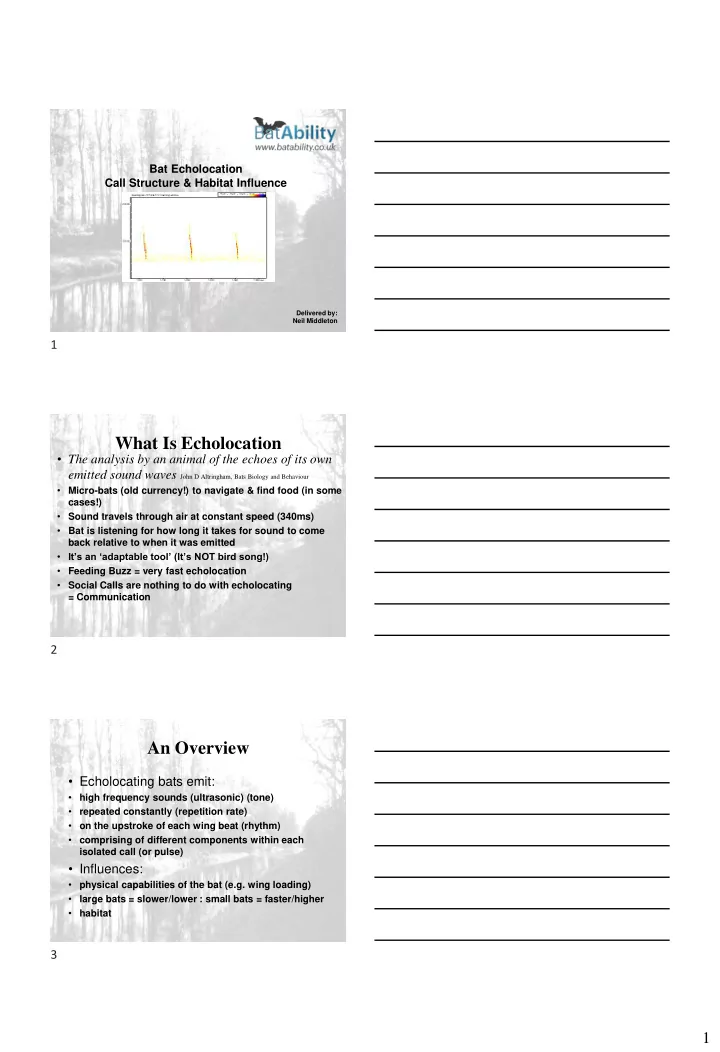
Bat Echolocation Call Structure & Habitat Influence

Delivered by: Neil Middleton

What Is Echolocation

  • The analysis by an animal of the echoes of its own

emitted sound waves John D Altringham, Bats Biology and Behaviour

  • Micro-bats (old currency!) to navigate & find food (in some

cases!)

  • Sound travels through air at constant speed (340ms)
  • Bat is listening for how long it takes for sound to come

back relative to when it was emitted

  • It’s an ‘adaptable tool’ (It’s NOT bird song!)
  • Feeding Buzz = very fast echolocation
  • Social Calls are nothing to do with echolocating

= Communication

An Overview

  • Echolocating bats emit:
  • high frequency sounds (ultrasonic) (tone)
  • repeated constantly (repetition rate)
  • on the upstroke of each wing beat (rhythm)
  • comprising of different components within each

isolated call (or pulse)

  • Influences:
  • physical capabilities of the bat (e.g. wing loading)
  • large bats = slower/lower : small bats = faster/higher
  • habitat

1 2 3

slide-2
SLIDE 2

2

Freq (kHz) Time (ms) Closed Edge Open

Faster Reps Slower Reps Higher Freq Lower Freq More FM Less FM

Pipistrellus spp.

45kHz Cpip 55kHz Spip

distance detail

40kHz Npip

Habitat Influences

  • Open Space
  • Use lower rep rates
  • Use long range echo’, loud, lower frequency & regular
  • Have a longer CF component
  • Change direction less often
  • Flies faster = less wing beats (e.g. Nyctalus)
  • Clutter
  • Use faster rep rate
  • Shorter & quieter calls
  • Use FM
  • Flies slower = more wing beats (e.g. Natterer’s)
  • Edge Habitat?

4 5 6

slide-3
SLIDE 3

3

Freq Time Closed Edge Open Fast Wingbeat Slow Slow Flight Speed Fast Detail Information Distance Myotis spp. Plecotus spp. Pipistrellus spp. Serotine Nyctalus spp.

Others

  • Horseshoe spp
  • Barbastelle

Call Structure

  • Can comprise of a FM component and a CF

component

  • Broadband = FM bats/components
  • Short sweep down through frequencies (iow the frequency alters

during the call)

  • Good for detail at close range & accuracy
  • Narrowband = CF bats (almost!)/components
  • Longer call covering narrower frequency range (iow the frequency

remains constant and the pulse lasts longer)

  • More effort concentrated in one area over longer time
  • Good for distance
  • Horseshoe bats & Doppler shift (i.e. the pitch of a sound rises or drops

as a sound source moves)

7 8 9

slide-4
SLIDE 4

4

Call Structure

Frequency/Amplitude

As Distance From Bat Increases Overall Effectiveness of Echolocation Reduces

Higher Frequencies Pick Out Detail & Smallest Objects (e.g. insects) Lower Frequencies Don’t attenuate as quickly over distance & better for relatively larger stuff & giving echoes back from more distant objects

Attenuation No Ways It’s A Giveaway

10 11 12

slide-5
SLIDE 5

5

Measuring Call Parameters Harmonics Search Phase Calls Better for ID

13 14 15

slide-6
SLIDE 6

6

Closed Edge Open Habitat Influence on Bat Call ID Nyctalus Noctule Leisler’s

As the bat moves to an Open setting the call structure becomes more distinguishable

Bat Echolocation – Species ID

Pipistrellus spp.

16 17 18

slide-7
SLIDE 7

7

Nyctalus spp. Myotis spp.

  • All fast rep rates
  • All FM bats (no CF tail) = dry clicks
  • Very difficult to ID to species level,

however…

  • Sometimes you can get there - almost!

Q&A

19 20 21

slide-8
SLIDE 8

8

Thanks For Attending Today

^☺^

Contact Info: Neil Middleton BatAbility Courses & Tuition Email: neil.middleton@batability.co.uk Mobile: 07877 570590

R

22