What is Condor? Specialized job and resource management system - - PDF document

what is condor
SMART_READER_LITE
LIVE PREVIEW

What is Condor? Specialized job and resource management system - - PDF document

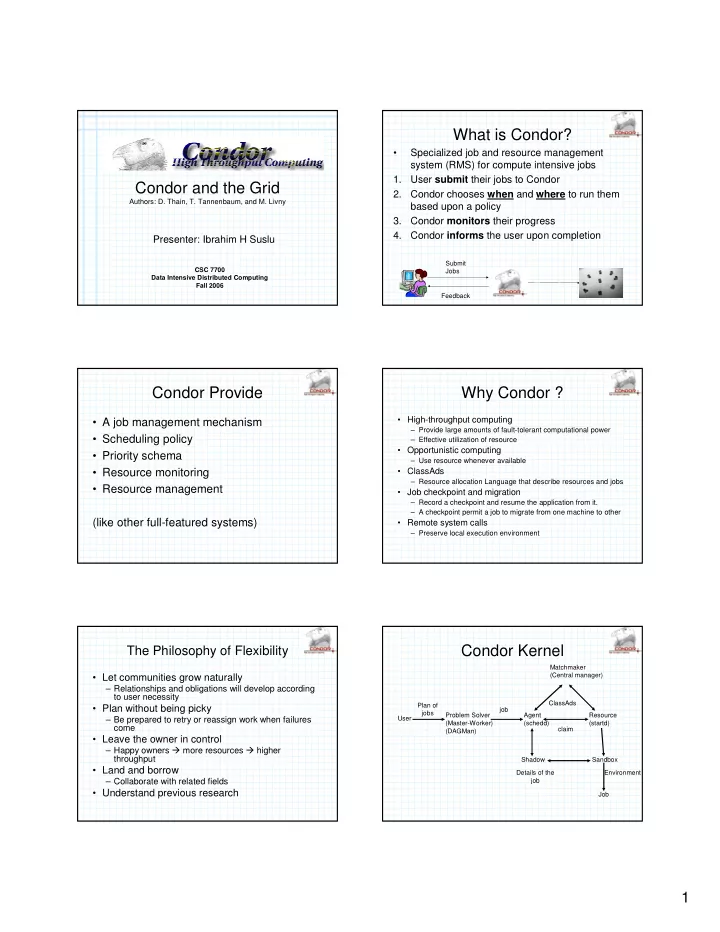
What is Condor? Specialized job and resource management system (RMS) for compute intensive jobs 1. User submit their jobs to Condor Condor and the Grid 2. Condor chooses when and where to run them Authors: D. Thain, T. Tannenbaum, and M.


slide-1
SLIDE 1

1

Condor and the Grid

Authors: D. Thain, T. Tannenbaum, and M. Livny

Presenter: Ibrahim H Suslu

CSC 7700 Data Intensive Distributed Computing Fall 2006

What is Condor?

  • Specialized job and resource management

system (RMS) for compute intensive jobs 1. User submit their jobs to Condor 2. Condor chooses when and where to run them based upon a policy 3. Condor monitors their progress 4. Condor informs the user upon completion

Submit Jobs Feedback

Condor Provide

  • A job management mechanism
  • Scheduling policy
  • Priority schema
  • Resource monitoring
  • Resource management

(like other full-featured systems)

Why Condor ?

  • High-throughput computing

– Provide large amounts of fault-tolerant computational power – Effective utilization of resource

  • Opportunistic computing

– Use resource whenever available

  • ClassAds

– Resource allocation Language that describe resources and jobs

  • Job checkpoint and migration

– Record a checkpoint and resume the application from it. – A checkpoint permit a job to migrate from one machine to other

  • Remote system calls

– Preserve local execution environment

The Philosophy of Flexibility

  • Let communities grow naturally

– Relationships and obligations will develop according to user necessity

  • Plan without being picky

– Be prepared to retry or reassign work when failures come

  • Leave the owner in control

– Happy owners more resources higher throughput

  • Land and borrow

– Collaborate with related fields

  • Understand previous research

Condor Kernel

User Problem Solver (Master-Worker) (DAGMan) Agent (schedd) Resource (startd) Matchmaker (Central manager) Shadow Sandbox Job Plan of jobs job ClassAds claim Details of the job Environment

slide-2
SLIDE 2

2

Typical Condor Pool

  • Flocking

Gateway Flocking Organizational level Transparent Direct Flocking One individual to another Organization

Links pools of resources

Planning and Scheduling

  • Planning

– Acquisition of resources by users – Concerned with ‘what’ and ‘where’

  • Scheduling

– Management of a resource by its owner – Concerned with ‘who’ and ‘when’

Matchmaker

  • Bridge between planning and scheduling
  • Agents and resources advertise

characteristics and requirements as ClassAds

  • Pairs satisfying each other’s constraints

are created

  • Both parties are informed
  • Claiming- independent authorization and

authentication

Condor Architecture overview I

  • !"

!"

  • #$
  • !"

!"

  • Condor Architecture overview II
slide-3
SLIDE 3

3

ClassAds

  • Resource allocation Language

– Attribute name-value pairs – No specific schema

  • Requirements

– Constraints, for a match these should evaluate to true

  • Rank

– Desirability of a match

Job ClassAd Machine ClassAd [ [ MyType = ‘‘Job’’ MyType=“Machine” TargetType = ‘‘Machine’’ TargetType=“Job” Requirements = Machine=“tnt.isi.edu” ((other.Arch==‘‘INTEL’’&& Requirements=

  • ther.OpSys==‘‘LINUX’’)

(Load<3000) && other.Disk > my.DiskUsage) Rank=dept==self.dept Rank = (Memory 10000) + KFlops Arch=“Intel” Cmd = ‘‘/home-exe’’ OpSys=“Linux” Department = ‘‘CompSci’’ Disk=600000 Owner = ‘‘tannenba’’ ] DiskUsage = 6000 ]

Problem Solvers

  • High level structure built on top of the Condor agent
  • Manage large number of jobs

– Concern with the application-specific details of ordering and task selection

  • Relies on a Condor agent in two ways

– Uses agent as service for reliably executing jobs – Making the problem solver itself reliable

  • Two are provided with Condor

– Master-worker (MW)

  • System for solving a problem of indeterminate size on a large and

unreliable workforce

– Directed acyclic graph manager (DAGMAN)

  • Service for executing multiple jobs with dependencies in a

declarative form

Split Execution

  • Facilitates successful remote execution of

jobs

  • Shadow represents the user to the system

– Has information that specifies the job at run time

  • Executables, arguments, input files.....
  • Sandbox is responsible for giving the job a

safe place to play

– Creates an environment for job execution

  • A Matched Sandbox and Shadow form the

universe

Condor Universes

  • Create a specific job environment
  • Defined by a matched sandbox and shadow
  • Different Universes provide different functionality

for your job:

– Standard Support for transparent process checkpoint and restart – Vanilla Run any Serial Job – Java Provide a complete Java environment – Globus Manage your Grid jobs

Standard Universe

  • Requires re-linking your program with special

library provided by condor

  • Allows checkpointing and remote System Calls

– Checkpointing

  • Condor’s Process Checkpointing mechanism saves all the

state of a process into a checkpoint file

  • Memory, CPU, I/O, job details, etc.
  • The process can then be restarted from right where it left off

– Remote System Calls

  • Provides an I/O service over secure RPC channel
  • Provides remote access to the user’s home storage device

– Multi-process jobs are not allowed – Interprocess communication is not allowed

Vanilla Universe

  • You can run any program

– C/C++/Perl/Python/Fortran/Java/Lisp… – No checkpointing: if your job is interrupted or the machine crashes, Condor has to restart it from the beginning. – No remote system calls

  • Input and output files
slide-4
SLIDE 4

4

Java Universe

  • Works better for Java programs
  • Checks for valid Java environment
  • Distinguishes Java environment

exceptions from program exceptions

  • No checkpointing
  • Remote I/O

Globus Universe

  • Advantages of using Condor-G to manage your

Grid jobs

– Full-featured queuing service – Credential Management – Fault-tolerance

  • Disadvantages

– No matchmaking or dynamic scheduling of jobs – No job checkpoint or migration – No remote system calls

Condor-G

  • Computation management agent for Grid

Computing

– Merges Globus and Condor technologies

Application, problem solver… Globus Toolkit Condor-G Condor Processing, storage….. Job submission Job execution Resource discovery, authentication….

“Gliding in”: allows to reach of Condor-G and the features of Condor

Which Universe?

  • Standard:

– Good for mixed Condor pools, flocked pools, and the Grid at large.

  • Vanilla:

– Good for a Condor pool of identical machines

  • Java:

– Good for Java application

  • Globus:

– Good for Globus jobs

Access to Data in Condor

  • Use shared filesystem if available
  • No shared filesystem?

– Condor can transfer files

  • Can automatically send back changed files
  • Atomic transfer of multiple files
  • Can be encrypted over the wire

– Remote I/O Socket – Standard Universe can use remote system calls

slide-5
SLIDE 5

5

Example: Nug30

  • nug30 (a Quadratic Assignment Problem

instance of size 30) had been the “holy grail” of computational QAP research for > 30 years

  • In 2000, Anstreicher, Brixius, Goux, & Linderoth

set out to solve this problem

  • Using a mathematically sophisticated and well-

engineered algorithm, they still estimated that we would require 11 CPU years to solve the problem.

Nug 30 Computational Grid

  • !"
  • #

$%&

  • '#

$%&

  • '

(

  • ))

(

  • #*

(

  • #*

+ $ # +

  • *

+ $ # +% $ '* +%

  • ##

Location Arch/OS Number

  • Used tricks to make it look

like one Condor pool

– Flocking – Glide-in

  • 2510 CPUs total

Nug30 solved

93% Parallel Efficiency 11 years CPU Time 653 Avg # Machines 6 days 22:04:31 hours Wall Clock Time

Questions