What is computable? Examples: check if a number n is prime - - PDF document

what is computable
SMART_READER_LITE
LIVE PREVIEW

What is computable? Examples: check if a number n is prime - - PDF document

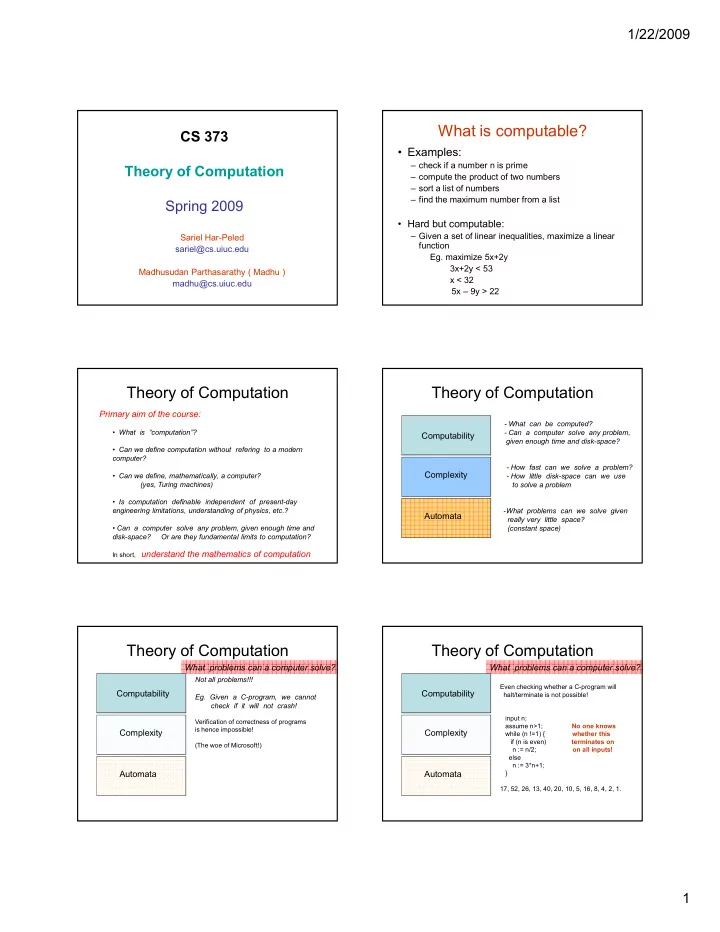
1/22/2009 What is computable? Examples: check if a number n is prime compute the product of two numbers sort a list of numbers find the


slide-1
SLIDE 1

1/22/2009 1

  • Spring 2009

Sariel HarPeled sariel@cs.uiuc.edu Madhusudan Parthasarathy ( Madhu ) madhu@cs.uiuc.edu

What is computable?

  • Examples:

– check if a number n is prime – compute the product of two numbers – sort a list of numbers – find the maximum number from a list

  • Hard but computable:

– Given a set of linear inequalities, maximize a linear function

  • Eg. maximize 5x+2y

3x+2y < 53 x < 32 5x – 9y > 22

Theory of Computation

  • !"

#

  • $!$

%"&

In short,

Theory of Computation

Computability Complexity Automata

" ! " $! $%" " '$! '%" $! !$$ $

  • Theory of Computation

Computability Complexity Automata !$

(!))) *#+$" %)

Verification of correctness of programs is hence impossible! (The woe of Microsoft!)

Theory of Computation

Computability Complexity Automata !$

Even checking whether a Cprogram will halt/terminate is not possible! input n; assume n>1; while (n !=1) { if (n is even) n := n/2; else n := 3*n+1; } 17, 52, 26, 13, 40, 20, 10, 5, 16, 8, 4, 2, 1.

slide-2
SLIDE 2

1/22/2009 2

Theory of Computation

Computability Complexity Automata

  • !"#
  • $%&'(

) *

  • $
  • +&
  • ,
  • '$-&

Theory of Computation

Computability Complexity Automata

.*!!

  • &/-
  • $-&

/&0

Theory of Computation

Computability Complexity Automata

What can we compute? Most general notions of computability Uncomputable functions What can we compute fast? Faster algorithms, polynomial time Problems that cannot be solved fast: * Cryptography What can we compute with very little space? Constant space (+stack) * String searching, language parsing, hardware verification, etc.

Theory of Computation

Turing machines Contextfree . languages Automata

Automata: Foundations of computing Mathematical methods of argument Simple setting 1

  • '

+ $

  • 1
  • 2
  • 3

.

  • 4

+ 5 1

  • 6

Theory of Computation

Turing machines Contextfree . languages Automata

Contextfree languages Grammars, parsing Machines with stack Still a simple setting; but infinite state 1

  • '

+ $

  • 1
  • 2
  • 3

.

  • 4

+ 5 1

  • 6

Theory of Computation

Turing machines Contextfree . languages Automata

Turing machines (1940s): The most general notion of computing The ChurchTuring thesis Limits to computing: Uncomputable functions Motivation from mathematics:

  • Can we solve any mathematical question

?

  • Godel’s theorem: NO!
  • “Even the most powerful machines

cannot solve some problems.” 1

  • '

+ $

  • 1
  • 2
  • 3

.

  • 4

+ 5 1

  • 6
slide-3
SLIDE 3

1/22/2009 3

Theory of Computation

Turing machines Contextfree . languages Automata

  • !"
  • 1
  • '

+ $

  • 1
  • 2
  • 3

.

  • 4

+ 5 1

  • 6

Kurt Gödel

  • Logician extraordinaire
  • Hilbert, Russel, etc. tried to

formalize mathematics

  • “Incompleteness theorem” (1931)

– Cannot prove consistency of arithmetic formally – Consequence: unprovable theorems Since proofs computation, noncomputability was established

72*89:;! 89<

Alonzo Church

First notions of computable functions First language for programs lambda calculus formal algebraic language for computable functions

$(* 89:! 899=

Alan Turing

  • “father of computer science”
  • Defined the first formal notion of

a computer (Turing machine) in 1936: “&!(! ,*!”

  • Proved uncomputable functions

exist

  • ChurchTuring thesis: all real world computable
  • functions are Turing m/c computable
  • Cryptanalysis work breaking Enigma in WWII

$-*898>! 89=?

Noam Chomsky

  • Linguist ; introduced the notion of formal

languages arguing generative grammars are at the base of natural languages

  • Hierarchy of formal languages that

coincides with computation

  • Eg. Contextfree grammars capture

most skeletons of prog. languages “Logical Structure of Linguistic Theory” (1957)

*89><!

Automata theory

  • ,
  • -,.!

" /!01232

  • $
  • ,1245
slide-4
SLIDE 4

1/22/2009 4

Theory of Computation

Turing machines Contextfree . languages Automata

1

  • '

+ $

  • 1
  • 2
  • 3

.

  • 4

+ 5 1

  • 6
  • *898

*89= ' !*89=9

Goals of the course

  • To understand the notion of “computability”
  • Inherent limits to computability
  • The tractability of weaker models of computation
  • The relation of computability to formal languages
  • Mathematics of computer science

– Rigor – Proofs

A result you would know at the end...

  • $!%

#

  • Formal proof!
  • No computer *ever* will solve this problem

(not even a quantum computer)

Textbook

Michael Sipser Introduction to Theory

  • f Computation

(2nded; 1st ed may be ok) I will announce chapter readings that you must read before class.

Course logistics

  • Section 1: Tu/Thu 11:0012:15 Sariel HarPeled

Section 2: Tu/Thu 12:3013:45 Madhusudan Parthasarathy. Lectures in SC 1105.

  • Discussion sections (all in SC 1111): by TAs

Tue 2:00 PM 2:50 PM Tue 3:00 PM 3:50 PM Tue 4:00 PM 4:50 PM Wed 4:00 PM 4:50 PM

  • Announcements (homework posting announcements,

discussions, corrections/clarifications): Newsgroup: class.cs373

Teaching assistants

  • Micah Hodosh mhodosh2@illinois.edu,
  • Aparna Sundar sundar2@illinois.edu,
  • Reza Zamani zamani@uiuc.edu
slide-5
SLIDE 5

1/22/2009 5

Problem Sets

  • Homeworks every week;

handed out on Thursday, due in class by 12:30pm on Thursday.

  • Write each problem on a separate sheet of paper.

(allows distributed grading)

  • Homework can be done in groups of at most three people.
  • However, each student must hand in their own homework

(no group submissions; must clearly write your group members)

  • There may be additional “quizzes” (15min tests) at discussion

sections as well.

Grading

  • Two midterms

20% each

  • Final exam

30%

  • Homework/Quizzes 25%

(least scored HW not counted)

  • Attendance to

discussion sections 5%

Curve

  • Raw numerical scores tend to run low in theory classes;

letter grades will primarily be decided based on relative ranking within the class.

  • 2

95 % A+ 85 % A 80 % A 70 % B+ 60 % B 50 % B 40 % C+ 30 % C 20 % C 15 % D+ 10 % D 5 % D < 5 % F

My lectures

  • I will use a tablet PC; all class lecture slides will

be posted online.

  • Additional resources (on course webpage)

– Sariel’s and Margaret’s lecture notes (Sp08) – Lecture notes (slides) from Fall’08 – Review notes on main results you should learn/know (by me) – Old homeworks/solutions online – Probably too many resources!....

Honors?

  • Honors students will do extra problems

and a project.

  • Please contact me after class if you intend

taking this course as an honors course.

How to do wellV

  • This is essentially a math course:

– you must learn the concepts well; if you don’t there’s almost no chance of success – if you do learn the concepts, there is very little else (facts, etc.) to learn; you can do really well! – You must do problems. There’s no replacement for this. – Attending lectures is highly adviced!

  • It will be very hard to learn the concepts by yourself or from textbook.

– Don’t postpone learning; you will not be able to “make up” later. Topics get quickly hard. – Come regularly to discussion sections; you will learn a lot by working out problems and learn from fellow students

slide-6
SLIDE 6

1/22/2009 6

How to do wellV

  • Come to office hours!!

– We are here to help you learn and do well.

  • A new plan:

– We will categorize homework problems, exam problems into various categories:

  • Machine construction, Proofs, Notation, Conceptual

understanding, etc.

  • We will tell you how well you do in each category

– We will also, at midterms, try to estimate how well you are doing and your projected grade. This will help you gauge your grade and overcome the panic of looking at low scores!