Computable Real Functions Parameterized Uniform Parameterized - - PowerPoint PPT Presentation

computable real functions parameterized uniform
SMART_READER_LITE
LIVE PREVIEW

Computable Real Functions Parameterized Uniform Parameterized - - PowerPoint PPT Presentation

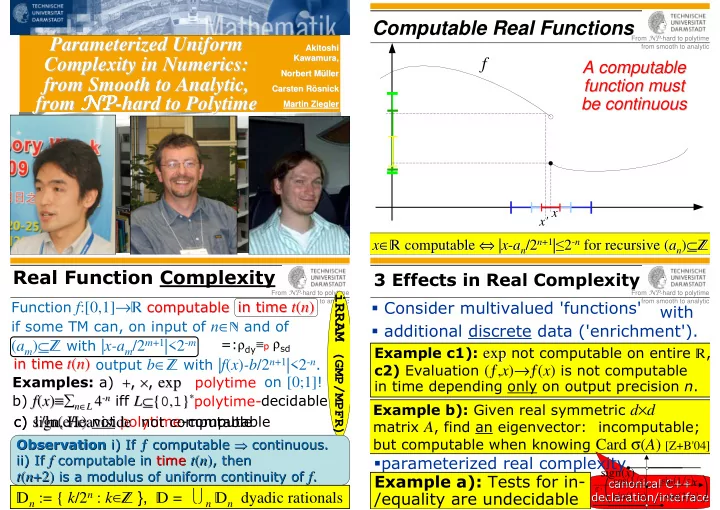
Computable Real Functions Parameterized Uniform Parameterized Uniform From NP -hard to polytime from smooth to analytic Akitoshi Akitoshi Complexity in Numerics: Complexity in Numerics: Kawamura, , Kawamura A computable A computable f


slide-1
SLIDE 1

Parameterized Uniform Parameterized Uniform Complexity in Numerics: Complexity in Numerics: from Smooth to Analytic, from Smooth to Analytic, from from NP NP NP NP NP NP NP NP-

  • hard to Polytime

hard to Polytime

Akitoshi Akitoshi Kawamura Kawamura, , Norbert Müller Norbert Müller Carsten Carsten Rösnick Rösnick Martin Ziegler Martin Ziegler

From NP-hard to polytime from smooth to analytic

x x∈ ∈ computable computable ⇔ ⇔ | |x x-

  • a

an

n/2

/2n

n+1 +1|

|≤ ≤2 2-

  • n

n for

for recursive recursive ( (a an

n)

)⊆ ⊆

  • f

Computable Real Functions

A A computable computable function function must must be be continuous continuous

x x'

From NP-hard to polytime from smooth to analytic

Real Function Complexity

Function f:[0,1]→ computable computable if some TM can, on input of n∈ and of

(am)⊆ with |x-am/2m+1|<2-m

  • utput b∈ with |f(x)-b/2n+1|<2-n.

in time in time t

t( (n n) ) iRRAM (GMP/MPFR)

Examples: a) + +, , × ×, , exp

exp

b) f

f( (x x) )≡ ≡∑

∑n

n∈ ∈L L 4

4-

  • n

n iff L

L⊆ ⊆{ {0 0, ,1 1} }*

*

decidable in time in time t

t( (n n) )

Observation Observation i) i) If If ƒ

ƒ computable

computable ⇒ ⇒ continuous continuous. . ii) ii) If If f

f computable

computable in in time time t

t( (n n) ),

, then then

t t( (n n+2) +2) is

is a a modulus modulus of uniform

  • f uniform continuity

continuity of

  • f f

f.

.

n := { k/2n : k∈ }, = n n dyadic rationals

=:ρdy-name

  • n [0;1]!

polytime polytime- c) 1/

1/ln(e ln(e/ /x x) ) not polytime-computable

c) sign

sign, , Heaviside Heaviside not computable

≡ ρsd

p p

From NP-hard to polytime from smooth to analytic

Example b): Given real symmetric d×d matrix A, find an eigenvector: but computable when knowing Card σ(A) [Z+B'04]

canonical canonical C++ C++ declaration declaration/ /interface interface

x

3 Effects in Real Complexity

Consider multivalued 'functions' additional discrete data ('enrichment').

sign(x)

Example a): Tests for in- /equality are undecidable

incomputable;

with

Example c1): exp

exp not computable on entire ,

c2) Evaluation (ƒ,x)→ƒ(x) is not computable in time depending only on output precision n.

parameterized real complexity

ε·

  • cos(1/ε)

sin(1/ε) sin(1/ε) − cos(1/ε)

  • not
slide-2
SLIDE 2

From NP-hard to polytime from smooth to analytic

Nonuniform Complexity of Operators

ƒ:[0;1]→[0;1] polytime computable (⇒ continuous)

  • Max:

Max: ƒ ƒ → → Max( Max(ƒ ƒ): ): x x → → max max{ { ƒ ƒ( (t t): ): t t≤ ≤x x} } Max( Max(ƒ ƒ) ) computable in exponential time;

polytime-computable iff P=NP

∫: : ƒ ƒ → → ∫ƒ ∫ƒ: : x x → → ∫ ∫0

x x ƒ

ƒ( (t t) ) dt dt ∫ƒ ∫ƒ computable in exponential time;

"#P-complete"

  • dsolve

dsolve: C[0;1] : C[0;1]× ×[ [-

  • 1;1]

1;1] ∋ ∋ ƒ ƒ → → z z: : ż ż( (t t)= )=ƒ ƒ( (t t, ,z z), ), z z(0)=0 (0)=0.

in general no computable solution z

z( (t t) )

for ƒ∈

ƒ∈C C1

1 "PSPACE-complete"

for ƒ∈

ƒ∈C Ck

k "CH-hard"

even when restricting to ƒ∈

ƒ∈C C∞

but but for for analytic analytic ƒ

ƒ ƒ ƒ ƒ ƒ ƒ ƒ

polytime polytime non non-

  • uniform

uniform [Friedman&Ko'80ies] [Friedman&Ko'80ies] non non-

  • uniform

uniform

Negativistic !! Negativistic !!

Phase transition Phase transition C Cω

ω ω ω ω ω ω ω→

→ → → → → → →C C∞

∞ ∞ ∞ ∞ ∞ ∞ ∞

Positivistic !! Positivistic !!

From NP-hard to polytime from smooth to analytic

d dn

n/

/dx dxn

n φ

φ( (C C· ·x x-

  • z

z)/ )/C C

NP NP ∋ ∋ L L = = {

{ x

x∈ ∈{0,1} {0,1}n

n |

| ∃ ∃y y∈ ∈{0,1} {0,1}p

p( (n n) ):

: 〈 〈x x, ,y y〉∈ 〉∈V V }

}

n n-

  • th

th large large interval interval: : size size 2 2-

  • n

n,

, containing containing 2 2n

n subintervals

subintervals: : one

  • ne for

for each each x x∈ ∈{0,1} {0,1}n

n,

, in turn in turn subdivided subdivided into into 2 2p

p( (n n) ) subsubintervals

subsubintervals for for y y's 's n n=1 =1 n n=2 =2

x x=0 =0 x x=1 =1 x x= = 00 00 01 01 10 10 11 11

y y=000,001, =000,001,… … y y=000,001, =000,001,… …

1 1 ½ ½ ¼ ¼ C∞ 'pulse' function

φ φ( (t t) = ) = exp( exp(-

  • t

t² ²/1 /1-

  • t

t² ²), | ), |t t|<1 |<1

too, uniformly in C,z

≤ ≤ ? ?

〈 〈x x, ,y y〉∈ 〉∈V V 〈 〈x x, ,y y〉∉ 〉∉V V

To To every every L

L∈ ∈NP NP there

there exists exists a a polytime polytime computable computable C

C∞

∞ function

function f

fL

L:[0,1]

:[0,1]→ → s.t.:

s.t.:

[0,1] [0,1]∋ ∋y y→ →max max f fL

L|

|[0,

[0,y y] ] polytime

polytime iff iff L

L∈ ∈P P

0.2 0.4 0.6 0.8 1

  • 1
  • 0.5

0.5 1

n n

polytime computable

'Max is NP

NP NP NP-hard'

From NP-hard to polytime from smooth to analytic

incomputable incomputable [ZhWe'01] [ZhWe'01]

vi vi) ) Max Max v) v) anti anti-

  • derivative

derivative, , binary binary unary unary

  • tail bound |∑j≥N cj zj| ≤ C·(|z|/r)N/(1-|z|/r)

Representing Power Series

∑j cj zj

  • radius of convergence R=1/limsupj |cj|1/j
  • to 0<r<R exist C∈: |cj|≤C/rj

Complexity uniform in |z|≤1: Convergence degrades es as r→1; quantitatively? Theorem 1: Represent series ∑j cj zj with R>1 as [a (ρdy)ω-name of] (cj) and K,C∈ as above. The following are uniformly computable in time

  • polyn. in n+K+log(C):

(i.e. R>1) iii) iii) product product, , ii) ii) sum sum, , iv iv) ) derivative derivative, ,

  • ∋ K :≥ 1/log(r) = Θ(1/(r-1))

i) i) eval eval, , 1 1 r r R R (Cauchy-Hadamard)

parametrized parametrized running running time time

From NP-hard to polytime from smooth to analytic

Must 'skip' over 2n entries to access access ƒ(2-n)

Parameterized Real Complexity

  • Classical complexity theory:

worst-case over all inputs of length n as parameter

  • parametrized complexity (FPT etc): 2 param.s (n,k)

∈ ∈[0;1] [0;1] compact

compact! !

  • Real operator/functional Λ: encode input ƒ∈Lip[0;1]
  • as values on dense sequence
  • and Lipschitz constant ℓ∈ as discrete data & advice
  • Complexity of a single real: n = output precision
  • of a real function ƒ: n = output precision

in worst-case over all arguments x

  • or parameterized – e.g. in k= |x| or k= log |x|

0,1,½,¼,¾,⅛,⅜,⅝,...=:

  • TTE: encode x as infinite binary sequence, length=∞
  • x=(xj) real sequence: access

access time polynom. in n+j

slide-3
SLIDE 3

From NP-hard to polytime from smooth to analytic

2nd Order Representations

Meta-Def: representation of G is a surject. γ:⊆2ω →G Must 'skip' over 2n entries to access access ƒ(2-n)

  • Real operator/functional Λ: encode input ƒ∈Lip[0;1]
  • as values on dense sequence
  • and Lipschitz constant ℓ∈ as discrete data & advice

0,1,½,¼,¾,⅛,⅜,⅝,...=:

  • TTE: encode x as infinite binary sequence, length=∞
  • x=(xj) real sequence: access

access time polynom. in n+j

Γ-name Z:{0,1}*→{0,1}*

  • communic. via oracle

access time= access time= input length input length

γ-name z:1*→{0,1}

  • communic. on tape

Kawamura&Cook'10 generalize to surject. Γ:⊆ωω →G,

dom(Γ) ⊆ LM := { Z:{0,1}*→{0,1}*, |Z(u)|≤|Z(v)| ∀|u|≤|v| }

⇒ extend from sequential to (realistic) random access

From NP-hard to polytime from smooth to analytic

Meta-Def: representation of G is a surject. γ:⊆2ω →G

K K:=| :=|Z Z|: |: → → , | , |u u| |→ →| |Z Z( (u u)| )| well

well-

  • defined

defined

  • Consider 2nd order representation of

C[0;1] s.t. steep functions have long names

  • Permit 2nd order polynomial running times P(n,K)

⇒ closed under (both kinds of) composition, generalizes (parameterized) 1st order polynom. time

'Long' names Z require much time to even read ‒ cmp. evaluation of 'steep' real functions…

term over ,+,×,n,K()

Γ-name Z:{0,1}*→{0,1}*

  • communic. via oracle

access time= access time= input length input length

γ-name z:1*→{0,1}

  • communic. on tape

Kawamura&Cook'10 generalize to surject. Γ:⊆ωω →G,

dom(Γ) ⊆ LM := { Z:{0,1}*→{0,1}*, |Z(u)|≤|Z(v)| ∀|u|≤|v| }

⇒ extend from sequential to (realistic) random access

2nd Order Polyn.s & Time

From NP-hard to polytime from smooth to analytic

2nd order 2nd order representation representation

unary

1/L 1/L

U

Real Analytic Functions on [0,1]

Definition: Cω[-1,1] := { f:[-1;1]→ restriction of complex differentiable g:U→, [0,1]⊆U⊆ open }

∑j cj,m·(z-xm)j, m=1…M

Equivalent: f∈C∞[-1;1] and ∃k∈ ∀j: ||f(j)|| ≤ 2k·kj·j! Equiv.: f finitely many local power series on [-1;1]

  • real sequence f()
  • L∈ unary: RL ⊆ U
  • G∈ binary ∀z∈RL: |g'(z)|≤G
  • real sequence f() and k∈ unary

Cm,Km∈: |cj,m|≤Cm/2j/Km

binary

RL := {x+iy: |y| ≤ 1/L, -1/L ≤ x ≤ 1+1/L }

Theorem 2: Theorem 2: These These are are mutually mutually 2 2nd

nd ord.

  • rd.

polytime polytime equivalent equivalent Theorem 3: Theorem 3: On On C

ω[0,1]

[0,1],

, i) i) eval eval ii) ii) sum sum … … vi vi) ) max max are are computable computable with within in parameterized parameterized polyn

  • polyn. time

. time

From NP-hard to polytime from smooth to analytic

Overview

Complexity of real functions Non-uniform complexity of real operators: NP-hard on C∞, polytime on analytic (=Cω) Enrichment rendering power series computable in parameterized polynomial time. 2nd order representation rendering computable real analytic functions in 2nd order polytime. Gevrey's function hierarchy between Cω and C∞ and 2nd order representations with complexity.

slide-4
SLIDE 4

From NP-hard to polytime from smooth to analytic

0.2 0.4 0.6 0.8 1
  • 1
  • 0.5
0.5 1 exp(-t 2/1-t 2)

Gevrey's Function Hierarchy

Definition (Maurice Gevrey 1918, studying PDEs):

g∈Gℓ

k[-1;1] :⇔ ∀j: ||g(j)|| ≤ 2k·kj·jj·ℓ

Example: The following g is not analytic but in G3[-1;1] G1=Cω Labhalla&Lombardi&Moutai 2001: ⇒ g∈G2ℓ-1[-1;1] Equivalent: f∈C∞[-1;1] and ∃k∈ ∀j: ||f(j)|| ≤ 2k·kj·j!

  • real sequence f() and unary mapping ∋n→k+nℓ
  • sequence pn∈[X] with deg(pn)<B·nℓ ||g-pn||≤2-n

⇒ ∃B ∀n ∃p∈[X]: deg(p)<B·nℓ ||g-p||≤2-n

  • real sequence f() and k∈ unary

2nd order repr.

From NP-hard to polytime from smooth to analytic

  • real sequence f() and unary mapping ∋n→k+nℓ

Uniform Complexity

  • n Gevrey's Hierarchy

Definition (Maurice Gevrey 1918, studying PDEs):

g∈Gℓ

k[-1;1] :⇔ ∀j: ||g(j)|| ≤ 2k·kj·jj·ℓ

  • sequence pn∈[X] with deg(pn)<B·nℓ ||g-pn||≤2-n

⇒ ∃B ∀n ∃p∈[X]: deg(p)<B·nℓ ||g-p||≤2-n

2nd order repr.

Theorem 4 (our main result): a) Both 2nd order representations of k,ℓ Gℓ

k

are 2nd order polynomial-time equivalent and b) render i) eval, ii) sum, … iv) d/dx, v) ∫, vi) max computable within time polynomial in (k+n)poly(ℓ) c) Given f(), max on Gℓ

1 requires time Ω(nℓ).

From NP-hard to polytime from smooth to analytic

Conclusion and Perspectives

  • Max and ∫ are nonuniformly NP-hard on C∞[-1;1]
  • but nonunif. polytime on Cω[-1;1], i.e. analytic f.

Today Today: : uniform uniform computability computability and and parameterized parameterized complexity complexity of

  • f operators
  • perators on
  • n Gevrey's

Gevrey's hierarchy hierarchy G

Gℓ

climbing climbing from from C

ω to

to C

C∞

∞ with

with optimal

  • ptimal runtime

runtime n

npoly(

poly(ℓ ℓ) )

Theorem 4 (our main result): a) Both 2nd order representations of k,ℓ Gℓ

k

are 2nd order polynomial-time equivalent and b) render i) eval, ii) sum, … iv) d/dx, v) ∫, vi) max computable within time polynomial in (k+n)poly(ℓ) c) Given f(), max on Gℓ

1 requires time Ω(nℓ).

1st

  • rder

From NP-hard to polytime from smooth to analytic

Conclusion and Perspectives

  • Max and ∫ are nonuniformly NP-hard on C∞[-1;1]
  • but nonunif. polytime on Cω[-1;1], i.e. analytic f.

Today Today: : uniform uniform computability computability and and parameterized parameterized complexity complexity of

  • f operators
  • perators on
  • n Gevrey's

Gevrey's hierarchy hierarchy G

Gℓ

climbing climbing from from C

ω to

to C

C∞

∞ with

with optimal

  • ptimal runtime

runtime n

npoly(

poly(ℓ ℓ) )

  • Actually implement and evaluate

these algorithms (iRRAM)

  • Quantitatively refine the

upper complexity bounds

  • Multivariate case?