What is AST? Abstract Syntax Tree pruned CST What is it? From - - PDF document

what is ast abstract syntax tree
SMART_READER_LITE
LIVE PREVIEW

What is AST? Abstract Syntax Tree pruned CST What is it? From - - PDF document

What is AST? Abstract Syntax Tree pruned CST What is it? From Wikipedia: Why use it instead of CST? A finite, labeled, directed tree, where the internal CST AST nodes are labeled by operators, and the leaf nodes represent the operands


slide-1
SLIDE 1

1

Abstract Syntax Tree

What is it? Why use it instead of CST? CST → AST

CS453 2

What is AST?

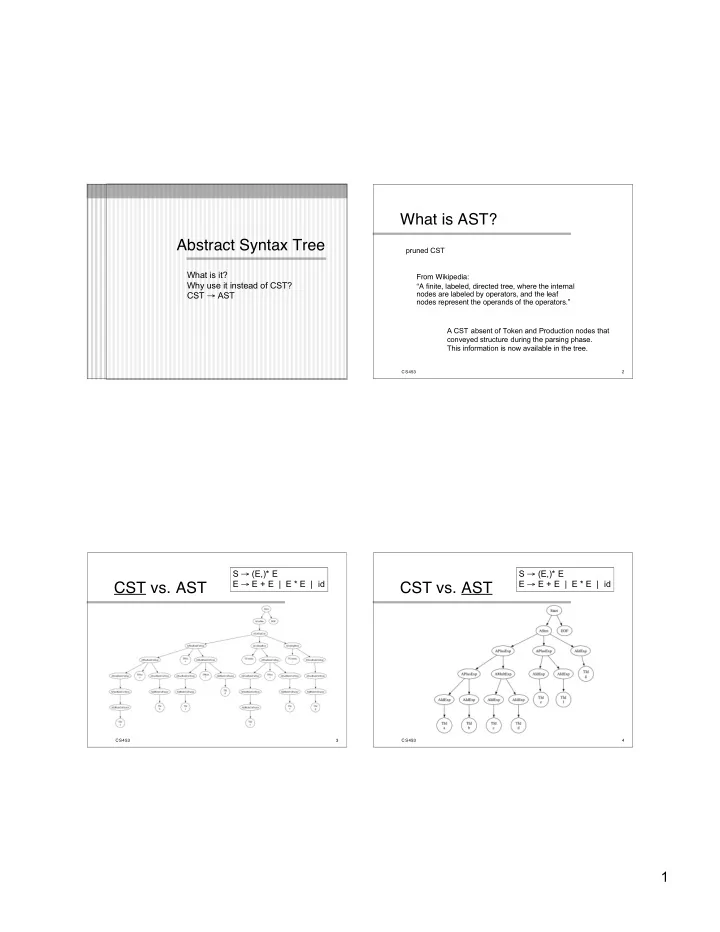
From Wikipedia: “A finite, labeled, directed tree, where the internal nodes are labeled by operators, and the leaf nodes represent the operands of the operators.” A CST absent of Token and Production nodes that conveyed structure during the parsing phase. This information is now available in the tree. pruned CST

CS453 3

CST vs. AST

S → (E,)* E E → E + E | E * E | id

CS453 4

CST vs. AST

S → (E,)* E E → E + E | E * E | id

slide-2
SLIDE 2

2

CS453 5

Why use it?

clean closer to BNF grammar I want more curly braces in my sableCC grammar file. more convenient than CST

CS453 6

CST → AST

Productions cst_full_name = [last]:name comma [first]:name; Productions cst_full_name {-> full_name} = [last]:name comma [first]:name {-> New full_name(first, last)}; Abstract Syntax Tree full_name = [first]:name [last]:name;

CST AST FN → LN , FN

CS453 7

CST

CS453 8

AST

slide-3
SLIDE 3

3

CS453 9

CST → AST

Productions cst_exp {-> exp} = {plus_rule} cst_exp plus cst_term {-> New exp.plus(cst_exp.exp, cst_term.exp)} | {term_rule} cst_term {-> cst_term.exp}; cst_term {-> exp} = id {-> New exp.id(id)}; Abstract Syntax Tree exp = {plus} [left]:exp [right]:exp | {id} id;

E → E + E | id

CS453 10

CST

CS453 11

AST

CS453 12

CST → AST

Productions cst_objects {-> objects} = cst_object* {-> New objects([cst_object.object])}; cst_object {-> object} = [name]:alpha_str colon [attribute]:alpha_str {-> New object(name, attribute)}; Abstract Syntax Tree

  • bjects = object*;
  • bject = [first]:alpha_str [last]:alpha_str;

OL → O* O → name : attribute

slide-4
SLIDE 4

4

CS453 13

CST

CS453 14

AST

CS453 15

CST → AST

NL → ((FN:)* FN)? FN → LN , FN

Productions (without transformations, your turn) cst_names = cst_name_list?; cst_name_list = cst_name_list_item* cst_name_last_item; cst_name_list_item = cst_full_name colon; cst_name_last_item = cst_full_name; cst_full_name = [last]:name comma [first]:name; Abstract Syntax Tree names = full_name*; full_name = [first]:name [last]:name;

CS453 16

CST

slide-5
SLIDE 5

5

CS453 17

AST

CS453 18

CST → AST

NL → ((FN:)* FN)? FN → LN , FN

Productions cst_names {-> names} = cst_name_list? {-> New names([cst_name_list.full_name])}; cst_name_list {-> full_name*} = cst_name_list_item* cst_name_last_item {-> [cst_name_list_item.full_name, cst_name_last_item.full_name]}; cst_name_list_item {-> full_name} = cst_full_name colon {-> cst_full_name.full_name}; cst_name_last_item {-> full_name} = cst_full_name {-> cst_full_name.full_name}; cst_full_name {-> full_name} = [last]:name comma [first]:name {-> New full_name(first, last)}; Abstract Syntax Tree names = full_name*; full_name = [first]:name [last]:name;

CS453 19

CST → AST

S → E (, E)* E → E + E | E * E | id

Productions (without transformations, your turn) cst_stm = cst_exp_list; cst_exp = {plus_rule} cst_exp plus cst_term | {term_rule} cst_term; cst_term = {mult_rule} cst_term mult cst_factor | {fact_rule} cst_factor; cst_factor = {id_rule} id; cst_exp_list = cst_exp cst_exp_rest*; cst_exp_rest = comma cst_exp; Abstract Syntax Tree stm = exp+; exp = {plus} [left]:exp [right]:exp | {mult} [left]:exp [right]:exp | {id} id;

CS453 20

CST

slide-6
SLIDE 6

6

CS453 21

AST

CS453 22

CST → AST

Productions cst_stm {-> stm} = cst_exp_list {-> New stm([cst_exp_list.exp])}; cst_exp {-> exp} = {plus_rule} cst_exp plus cst_term {-> New exp.plus(cst_exp.exp, cst_term.exp)} | {term_rule} cst_term {-> cst_term.exp}; cst_term {-> exp} = {mult_rule} cst_term mult cst_factor {-> New exp.mult(cst_term.exp, cst_factor.exp)} | {fact_rule} cst_factor {-> cst_factor.exp}; cst_factor {-> exp} = {id_rule} id {-> New exp.id(id)}; cst_exp_list {-> exp+} = cst_exp cst_exp_rest* {-> [cst_exp.exp, cst_exp_rest.exp]}; cst_exp_rest {-> exp} = comma cst_exp {-> cst_exp.exp}; Abstract Syntax Tree stm = exp+; exp = {plus} [left]:exp [right]:exp | {mult} [left]:exp [right]:exp | {id} id;

S → E (, E)* E → E + E | E * E | id

CS453 23

Wednesday

Going over some of the suggested exercises from the textbook. Email me with exercises that you want covered.