Syntax and grammars, more datatypes, Source Program Break up - - PowerPoint PPT Presentation

syntax and grammars more datatypes
SMART_READER_LITE
LIVE PREVIEW

Syntax and grammars, more datatypes, Source Program Break up - - PowerPoint PPT Presentation

10/6/15 Reading programs Syntax and grammars, more datatypes, Source Program Break up string input into symbols. Lexical Analysis pattern-matching Parse stream of symbols into


slide-1
SLIDE 1

10/6/15 1

Syntax ¡and ¡grammars, more ¡datatypes, pattern-­‑matching

1

2

Reading ¡programs

Source ¡ Program Lexical ¡Analysis Syntax ¡Analysis ¡(Parsing) Semantic ¡Analysis Break ¡up ¡string ¡input ¡into ¡symbols. Parse ¡stream ¡of ¡symbols ¡into ¡ structured ¡representation ¡of ¡ program.

...

Fascinating ¡algorithms! T ake ¡ CS ¡235, ¡CS ¡301.

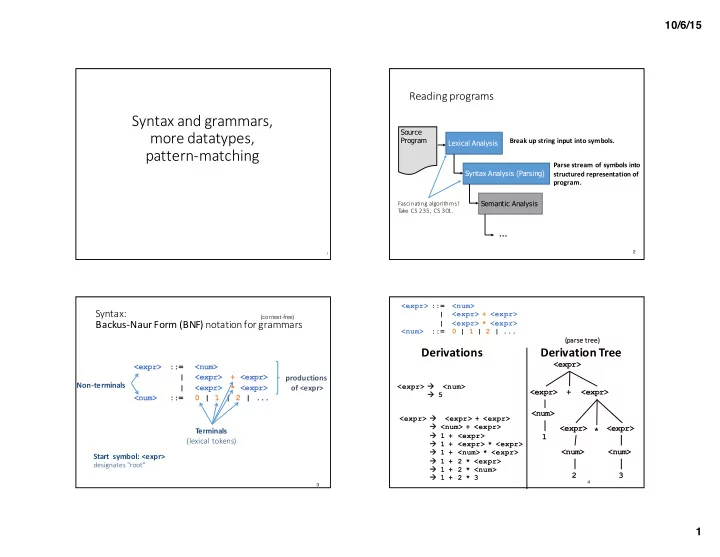
Syntax: Backus-­‑Naur ¡Form ¡(BNF) notation ¡for ¡grammars

3

<expr> ::= <num> | <expr> + <expr> | <expr> * <expr> <num> ::= 0 | 1 | 2 | ... productions

  • f ¡<expr>

Non-­‑terminals T erminals (lexical ¡tokens) Start ¡ symbol: ¡<expr>

designates ¡"root"

(context-­‑free)

4

<expr> à à <num> à à 5 <expr> à à <expr> + <expr> à à <num> + <expr> à à 1 + <expr> à à 1 + <expr> * <expr> à à 1 + <num> * <expr> à à 1 + 2 * <expr> à à 1 + 2 * <num> à à 1 + 2 * 3

<expr> <expr> <expr> + <num> 1 <expr> <expr> * <num> 2 <num> 3

<expr> ::= <num> | <expr> + <expr> | <expr> * <expr> <num> ::= 0 | 1 | 2 | ...

Derivation ¡Tree Derivations

(p (parse ¡ ¡tree)

slide-2
SLIDE 2

10/6/15 2

5

<expr> <expr> <expr> + <num> 1 <expr> <expr> * <num> 2 <num> 3 <expr> <expr> <expr> * <num> 3 <expr> <expr> + <num> 2 <num> 1

<expr> à <expr> * <expr> à <expr> * <num> à <expr> * 3 à <expr> + <expr> * 3 à <num> + <expr> * 3 à 1 + <expr> * 3 à 1 + <num> * 3 à 1 + 2 * 3

<expr> ::= <num> | <expr> + <expr> | <expr> * <expr> <num> ::= 0 | 1 | 2 | ...

Ambiguity:

>1 >1 ¡ ¡derivation ¡ ¡of ¡ ¡expressi ssion

Dealing ¡with ¡Ambiguity

Prohibit ¡it.

Force ¡parenthesization or ¡equivalent. Racket, ¡S-­‑expressions:

(there is (always an unambiguous) parse tree)

Allow ¡it ¡with:

Precedence by ¡kind ¡of ¡expression ¡(think ¡order ¡of ¡operations)

1 + 2 * 3 means ¡1 + (2 * 3)

Directional ¡associativity (left, ¡right)

left-­‑associative ¡ function ¡ application: ¡f 2 3 means ¡((f 2) 3)

Abstract ¡Syntax ¡Trees ¡(ASTs) ¡in ¡ML

(or ¡expression ¡ trees)

A ¡tiny ¡calculator ¡language: An ¡expression ¡in ¡ML ¡of ¡type ¡exp: ¡ How ¡to ¡picture ¡the ¡resulting ¡value: ¡

7

datatype exp = Constant of int | Negate of exp | Add of exp * exp | Multiply of exp * exp Add (Constant (10+9), Negate (Constant 4)) Add Constant 19 Negate Constant 4

Derived ¡from ¡ slides ¡due ¡to ¡Dan ¡Grossman

Recursive ¡functions ¡for ¡recursive ¡datatypes

Find ¡maximum ¡ constant ¡appearing ¡in ¡an ¡expression. (Program ¡analysis ¡for ¡our ¡tiny ¡language!)

8

fun max_constant (e : exp) =

slide-3
SLIDE 3

10/6/15 3

Evaluating ¡expressions ¡in ¡the ¡language

We ¡have ¡defined ¡a ¡tiny ¡calculator ¡programming ¡language. Let's ¡write ¡an ¡interpreter ¡for ¡it!

9

fun eval (e : exp) =

Datatypebindings, ¡so ¡far

Syntax: ¡ Type-­‑checking: Adds ¡type ¡t and ¡constructors ¡Ci of ¡type ¡ti->t to ¡static ¡ environment

  • Ci v is ¡a ¡value, ¡i.e., ¡the ¡result ¡“includes ¡the ¡tag”

Evaluation: ¡nothing! Omit ¡“of t” ¡for ¡constructors ¡that ¡are ¡just ¡tags, ¡no ¡underlying ¡data

  • Such ¡a ¡Ci is ¡a ¡value ¡of ¡type ¡t

10

datatype t = C1 of t1 | C2 of t2 | … | Cn of tn

Case ¡expressions, ¡so ¡far

Syntax: Type-­‑checking:

  • Type-­‑check ¡ e. ¡ ¡Must ¡have ¡same ¡type ¡as ¡all ¡of ¡p1 ... pn.
  • Pattern ¡C(x1,…,xn)has ¡type ¡tif ¡datatype t includes ¡a ¡

constructor: ¡C of t1 * ... * tn

  • Type-­‑check ¡ each ¡ei in ¡current ¡static ¡environment ¡

extended ¡ with ¡types ¡for ¡any ¡variables ¡ bound ¡by ¡pi.

  • Pattern ¡C(x1,…,xn)gives ¡variables ¡x1, ¡..., ¡xn types ¡t1,...,tn if ¡

datatype t includes ¡a ¡constructor: ¡C

  • f

t1 * ... * tn

  • All ¡ei must ¡have ¡the ¡same ¡type ¡u, ¡which ¡is ¡the ¡type ¡of ¡the ¡

entire ¡ case ¡expression.

11

case e of p1 => e1 | p2 => e2 | … | pn => en

Case ¡expressions, ¡so ¡far

Syntax: Evaluation:

  • Evaluate ¡ e to ¡a ¡value ¡v
  • If ¡pi is ¡first ¡pattern to ¡match v, ¡then ¡result ¡is ¡evaluation ¡
  • f ¡ei in ¡dynamic ¡environment ¡ “extended ¡by ¡the ¡match.”
  • Pattern ¡Ci(x1,…,xn) matches ¡value ¡

Ci(v1,…,vn) and ¡extends ¡the ¡environment ¡ by ¡ binding ¡x1 to ¡v1 … ¡xn to vn

  • For ¡“no ¡data” ¡constructors, ¡pattern ¡Ci matches ¡value ¡Ci
  • Pattern ¡x matches ¡and ¡binds ¡to ¡any ¡value ¡ of ¡any ¡type.
  • Exception ¡if ¡no ¡pattern ¡matches.

12

case e of p1 => e1 | p2 => e2 | … | pn => en

slide-4
SLIDE 4

10/6/15 4

Hold ¡on ¡to ¡your ¡hats!

Deep ¡truths ¡about ¡ML ¡and ¡patterns.

  • Every ¡val-­‑binding ¡and ¡function-­‑binding ¡uses ¡

pattern-­‑matching.

  • Every ¡function ¡in ¡ML ¡takes ¡exactly ¡one ¡argument

First: ¡extend ¡our ¡definition ¡of ¡pattern-­‑matching…

13

Pattern-­‑match ¡any ¡compound ¡type

Pattern ¡matching ¡also ¡works ¡for ¡records ¡and ¡tuples:

  • Pattern ¡(x1,…,xn)

matches ¡any ¡tuple ¡value ¡(v1,…,vn)

  • Pattern ¡{f1=x1,

…, fn=xn} matches ¡any ¡record ¡value ¡{f1=v1, …, fn=vn} (and ¡fields ¡can ¡be ¡reordered)

14

Hold ¡on ¡to ¡your ¡hats! ¡ ¡Deep ¡truths ¡about ¡patterns ¡ahead...

val-­‑binding ¡patterns

  • Remember ¡ tuple ¡bindings?
  • A ¡val-­‑binding ¡can ¡use ¡a ¡pattern, ¡not ¡just ¡a ¡variable
  • Variables ¡are ¡just ¡one ¡kind ¡of ¡pattern.
  • Style:
  • Get ¡all/some ¡pieces ¡out ¡of ¡a ¡product/each-­‑of ¡type
  • Usually ¡poor ¡style ¡to ¡put ¡constructor ¡pattern ¡in ¡val binding
  • Raises ¡ exception ¡if ¡different ¡variant ¡is ¡there.

15

val p = e

Function-­‑argument ¡patterns

A ¡function ¡argument ¡is ¡a ¡pattern

  • Match ¡against ¡the ¡argument ¡in ¡a ¡function ¡call

Examples ¡(fantastic ¡style!):

18

fun f p = e fun sum_triple (x, y, z) = x + y + z fun full_name {first=x, middle=y, last=z} = x ^ " " ^ y ^ " " ^ z

slide-5
SLIDE 5

10/6/15 5

Convergence!

T akes ¡ one ¡int*int*int triple, returns ¡int that ¡is ¡their ¡sum:

19

T akes ¡ three ¡int values, ¡returns ¡int that ¡is ¡their ¡sum:

fun sum_triple (x, y, z) = x + y + z fun sum_triple (x, y, z) = x + y + z

Every ¡ML ¡function ¡takes ¡exactly ¡one ¡argument

  • "Multi-­‑argument" ¡ functions:
  • match ¡a ¡tuple ¡pattern ¡against ¡their ¡single ¡argument
  • Elegant, ¡flexible ¡language ¡design
  • Cute ¡and ¡useful ¡things
  • “Zero ¡arguments” ¡is ¡the ¡unit ¡pattern ¡()

matching ¡the ¡unit ¡value ¡ ()

20

fun rotate_left (x, y, z) = (y, z, x) fun rotate_right t = rotate_left(rotate_left t)

Even ¡more ¡pattern-­‑matching

  • Patterns ¡are ¡so ¡much ¡fun!
  • Note ¡added ¡parens around ¡each ¡pattern, ¡replaced ¡=> ¡with ¡=.
  • If ¡you ¡mix ¡them ¡up, ¡you'll ¡get ¡some ¡weird ¡error ¡messages...

21

fun eval e = case e of Constant i => i | Negate e2 => ~ (eval e2) | Add (e1,e2) => (eval e1) + (eval e2) | Multiply (e1,e2) => (eval e1) * (eval e2) fun eval (Constant i) = i | eval (Negate e2) = ~ (eval e2) | eval (Add (e1,e2)) = (eval e1) + (eval e2) | eval (Multiply (e1,e2)) = (eval e1) * (eval e2)

Patterns ¡are ¡deep!

  • Patterns ¡are ¡recursively ¡ structured
  • Just ¡like ¡expressions
  • Nest ¡as ¡deeply ¡as ¡desired
  • Avoid ¡hard-­‑to-­‑read, ¡wordy, ¡nested ¡case ¡expressions
  • Full ¡meaning ¡ of ¡pattern-­‑matching:
  • compare ¡pattern ¡against ¡value ¡for ¡“same ¡shape”
  • bind ¡variables ¡to ¡the ¡“right ¡parts”
  • More ¡precise ¡recursive ¡definition ¡after ¡examples

22

slide-6
SLIDE 6

10/6/15 6

Examples

  • Pattern ¡a::b::c::d matches ¡all ¡lists ¡with ¡________ ¡elements
  • Pattern ¡a::b::c::[]

matches ¡all ¡lists ¡with ¡________ ¡elements

  • Pattern ¡[a,b,c]

matches ¡all ¡lists ¡with ¡________ ¡elements

  • Pattern ¡((a,b),(c,d))::e

matches ¡all ¡________

23

List ¡checkers

24

fun nondec (x::xs) = case xs of (y::_) => x <= y andalso nondec xs | [] => true | nondec [] = true fun nondec [] = true | nondec [x] = true | nondec (x::xs) = let val (y::_) = xs in x <= y andalso nondec xs end

List ¡checkers: ¡even ¡better!

25

fun nondec (x::y::zs) = x <= y andalso nondec (y::zs) | nondec _ = true fun allsq (x::y::zs) = x*x = y andalso allsq (y::zs) | allsq _ = true fun checkl (f, x::y::zs) = f (x,y) andalso checkl (f, y::zs) | checkl _ = true More ¡examples ¡to ¡come ¡(see ¡code ¡files)

Style

  • Nested ¡patterns: ¡elegant, ¡ concise ¡code
  • Avoid ¡nested ¡case ¡expressions ¡if ¡nested ¡patterns ¡are ¡simpler
  • Example: ¡checkl and friends
  • Common ¡idiom: ¡match ¡against ¡a ¡tuple ¡of ¡datatypes to ¡compare ¡all
  • Examples: ¡zip3 and ¡multsign
  • Wildcards ¡are ¡good ¡style: ¡use ¡instead ¡of ¡variables ¡ when ¡you ¡

do ¡not ¡need ¡the ¡data ¡

  • Examples: ¡len and ¡multsign

26

slide-7
SLIDE 7

10/6/15 7

(Most ¡of) ¡the ¡definition ¡of ¡pattern-­‑matching

The ¡semantics for ¡pattern-­‑matching ¡takes ¡a ¡pattern ¡p and ¡a ¡value ¡v and ¡decides ¡(1) ¡does ¡it ¡match ¡and ¡(2) ¡if ¡so, ¡what ¡variable ¡bindings ¡are ¡ introduced. Definition ¡is ¡elegantly ¡recursive, ¡with ¡a ¡separate ¡rule ¡for ¡each ¡kind ¡of ¡

  • pattern. ¡ ¡Some ¡of ¡the ¡rules:
  • If ¡p is ¡a ¡variable ¡x, ¡the ¡match ¡succeeds ¡and ¡x is ¡bound ¡to ¡v
  • If ¡p is ¡_, ¡the ¡match ¡succeeds ¡and ¡no ¡bindings ¡are ¡introduced
  • If ¡p is ¡(p1,…,pn) and ¡vis ¡(v1,…,vn), ¡the ¡match ¡succeeds ¡if ¡and ¡only ¡if ¡p1

matches ¡v1, ¡…, ¡pn matches ¡vn. ¡ ¡The ¡bindings ¡are ¡the ¡union ¡of ¡all ¡bindings ¡ from ¡the ¡submatches

  • If ¡p is ¡C ¡p1, ¡the ¡match ¡succeeds ¡if ¡vis ¡C ¡v1 (i.e., ¡the ¡same ¡constructor) ¡and ¡

p1 matches ¡v1. ¡ ¡The ¡bindings ¡are ¡the ¡bindings ¡from ¡the ¡submatch.

  • … ¡(there ¡ are ¡several ¡ other ¡similar ¡forms ¡of ¡patterns)

27

Got ¡a ¡match?

Semantically ¡equivalent:

28

fun fib n = if n = 0 then 1 else if n = 1 then 1 else (fib (n - 2)) + (fib (n - 1)) fun fib 0 = 1 | fib 1 = 1 | fib n = (fib (n - 2)) + (fib (n - 1)) fun fib n = case n of 0 => 1 | 1 => 1 | x => (fib (x - 2)) + (fib (x - 1))

intuition...

Do ¡you ¡suppose...? (Efficiency ¡ reasons ¡to ¡implement int specially, ¡but ¡could ¡be ¡a ¡datatype.) No ¡reason ¡we ¡couldn't...

29

datatype int = ... | 0 | 1 | 2 | ... datatype nat = Zero | Succ nat val one = Succ Zero fun add (Zero,x) = x | add (x,Zero) = x | add (Succ x,y) = Succ (add (x, y))

The ¡truth ¡about ¡true ¡(and ¡false)

30

datatype bool = true | false case e1 of true => e2 | false => e3 if e1 then e2 else e3

just ¡sugar

Are ¡you ¡noticing ¡a ¡pattern ¡here?