What do we mean by partnership ? Creating Take a taxi - - PowerPoint PPT Presentation

what do we mean by partnership creating
SMART_READER_LITE
LIVE PREVIEW

What do we mean by partnership ? Creating Take a taxi - - PowerPoint PPT Presentation

What do we mean by partnership ? Creating Take a taxi Human-Computer Partnerships Driver in control Wendy E. Mackay Inria, Universit Paris-Saclay 21 September 2018 What do we mean by partnership ? What do we mean by


slide-1
SLIDE 1

Creating 
 Human-Computer Partnerships Wendy E. Mackay

Inria, Université Paris-Saclay

  • 21 September 2018

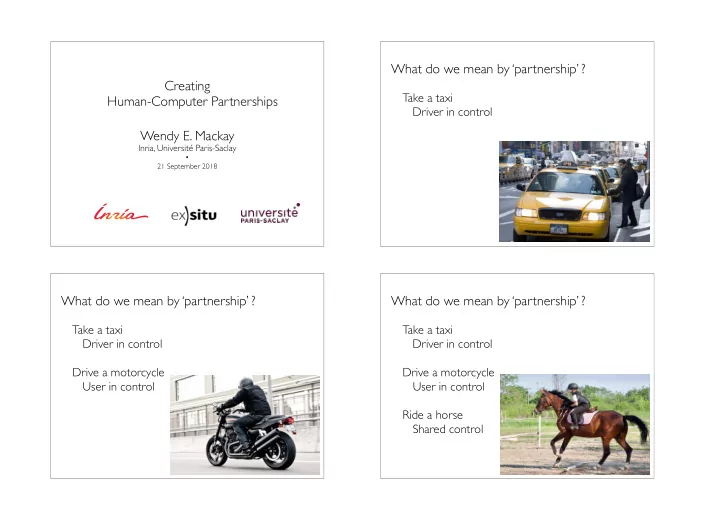
What do we mean by ‘partnership’ ?

Take a taxi Driver in control

What do we mean by ‘partnership’ ?

Take a taxi Driver in control

  • Drive a motorcycle

User in control

What do we mean by ‘partnership’ ?

Take a taxi Driver in control

  • Drive a motorcycle

User in control

  • Ride a horse

Shared control

slide-2
SLIDE 2

Human- Computer Interaction Artificial Intelligence Mediated Communication

How do we interact with computers ?

Computer as tool Empower users

  • Computer as servant


Delegate tasks

  • Computer as medium

Communicate Human-Computer Partnerships Human-in-the-loop A ‘simple’ human-computer partnership User types – Google suggests – User chooses

Wait what about this 
 ‘human-in-the-loop’ ?

slide-3
SLIDE 3

Human-Computer Partnerships Human-in-the-loop

Machine learning perspective: Human helps improve the algorithm

Human-Computer Partnerships Human-in-the-loop

Machine learning perspective: Human helps improve the algorithm

  • Computer-in-the-loop

How can we empower people ?

Human-Computer Partnerships Human-in-the-loop

Human helps improve the algorithm

  • Computer-in-the-loop

Human-computer interaction perspective:

Computers empower the human user

slide-4
SLIDE 4

We face a major design trade-off

power simplicity How to balance: power of expression simplicity of execution

Solution: Shift the curve

power simplicity Simple things should be simple, complex things 
 should be possible

Unified principles of interaction

Two complementary perspectives: System: How to build it ? Instrumental Interaction and Substrates

with Michel Beaudouin-Lafon

Unified principles of interaction

Two complementary perspectives: System: How to build it ? Instrumental Interaction and Substrates Human: How to interact with it ? Co-adaptive Systems Human-computer partnerships

slide-5
SLIDE 5

Human-computer partnerships People can adapt to technology they learn it adapt the technology they appropriate it

Discoverability Appropriability Expressivity

What can we learn from physical tools ?

We can use physical tools as designed…


What can we learn from physical tools ?

But we can also improvise


We can appropriate physical tools

20

slide-6
SLIDE 6

We can appropriate physical tools

21

We can appropriate physical tools … why not software ?

22

Musical instruments become part of 
 the body

Why can’t we learn to ‘play’ software tools ?
 without relearning the interface 
 with every software upgrade ?

slide-7
SLIDE 7

Human- Computer Interaction Artificial Intelligence Mediated Communication

Ways of interacting with computers

Computer as tool Empower users

  • Computer as servant


Delegate tasks

  • Computer as medium

Communicate Human-computer partnerships People can adapt to technology they learn it adapt the technology they appropriate it

  • Computers can

adapt to people they learn (AI) adapt people’s behavior they teach

Human-Computer Partnerships


People want: Discoverability Appropriability Expressivity

Smartphone interfaces are simple

slide-8
SLIDE 8

How to make them powerful, expressive and simple ?

Smartphone interfaces are simple

Discoverability

How can I learn 
 new gestures 
 and commands ? Octopocus

Learn gestures that issue commands Progressive feedforward
 What gestures are available ? Progressive feedback
 What did the system recognize ?

Olivier Bau UIST ‘09

Dynamic partnership

Experts just perform the gesture Novices pause ... the guide appears

slide-9
SLIDE 9

Octopocus video Appropriability

How can I define
 my own gestures ? Fieldward

Create personal gesture commands Choose easy-to-remember gestures Progressive feedforward reveals whether

  • command exists
  • it is recognizable

Joe Malloch, Carla Griggio & Joanna McGrenere CHI ‘17

Fieldward: create personal gesture commands

slide-10
SLIDE 10

Expressivity

How can I 
 express myself ?

Redefining gesture-typing keyboards to support user expression

Four ways to type the word “great” all produce the same result

Expressive Keyboard 


Jessalyn Alvina, Joe Malloch CHI‘16

Expressive Keyboard

Machine learning guesses the correct word
 Gesture variations creates expressive text

  • Users control 


text color font style and emojis

Expressive Keyboard

slide-11
SLIDE 11

Expressive typography Human-Computer Partnerships

Discoverability Appropriability Expressivity

Interactive paper for musicians

Discoverability

How can I learn 
 musical relationships ?

Paper Tonnetz

Musical relationships create a ‘paper substrate’ Draw music with gestures Jérémie Garcia, Fanis Tsandilas SMC‘12

slide-12
SLIDE 12

Paper Tonnetz

Appropriability

How can I define
 my own commands ?

Knotty Gestures: Draw a knot to define a command Interact now or later


Fanis Tsandilas AVI‘10

Knots can define mathematical or

  • ther relationships
slide-13
SLIDE 13

Knotty Gestures

Draw a line with a knot Choose “recording” to define the type of line

rec

Knotty Gestures

Add another knot to define the start of the recording

rec start

Knotty Gestures

Add a third knot to define the end of the recording

rec start end

Knotty Gestures

Slide the pen back and forth to play the recording

rec start end

slide-14
SLIDE 14

Knotty Gestures

Expressivity

How can I 
 express myself ?


Quid Sit Musicus


13th century musical scores Each note indicates expression

Philippe Leroux, Jérémie Garcia World Premier 2014

Paper Composer

Associate gesture characteristics with sounds and features

  • compose

& perform

IHM‘14 Jérémie Garcia

slide-15
SLIDE 15

Quid Sit Musicus?

Goal:
 true human-computer
 partnerships
 
 that empower
 rather than frustrate 
 (or replace) people