What Do Daycare & Soul Food What Do Daycare & Soul Food Have - - PowerPoint PPT Presentation
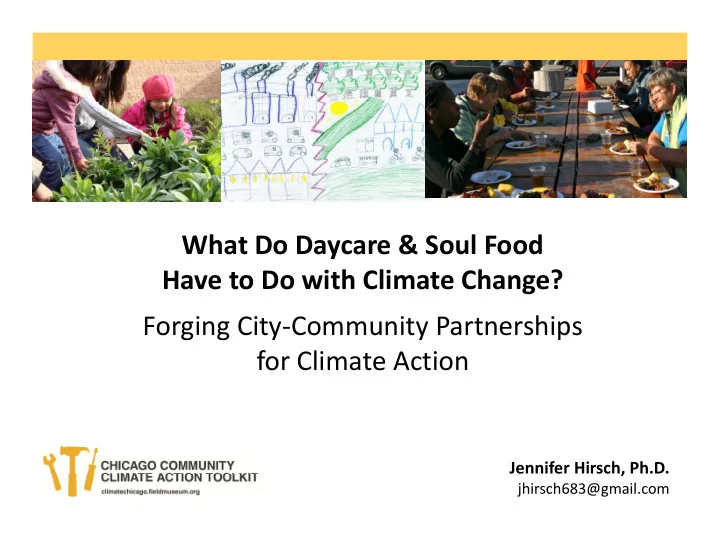
What Do Daycare & Soul Food What Do Daycare & Soul Food Have to Do with Climate Change? Forging City Community Partnerships for Climate Action Jennifer Hirsch, Ph.D. jhirsch683@gmail.com Introduction The Beginning: Rapid Participatory
Introduction The Beginning: Rapid Participatory Action Studies
2
Introduction
Place‐Based Approach
Introduction
Image‐Changing: Climate Action is US
Introduction
Big Plans, Community Action
5
Introduction
Community Assets Approach
Local INSTITUTIONS Citi ’
Schools Business Churches/ Houses
- f Worship
Citizens’ Associations f f
Block Clubs p
Gifts of INDIVIDUALS
Artists Libraries Income Parks Youth Labeled People Older Adults Cultural Groups Community Colleges Hospitals
6
Asset-Based Community Development (presentation), Kretzmann, John P. and McKnight, John L.
Introduction
Chicago Results
Collaborative Programs
- Energy Action Network
- South Chicago Retrofit Project
Recognition
- Showcased by U.S. Dep’t of Energy as
best practice in community engagement
- South Chicago Retrofit Project
- Chicago Community Climate
Action Toolkit E I Illi i (U S DOE
p y g g
- Promoted by Resource Media as a “best
example” of visual climate communication
- Energy Impact Illinois (U.S. DOE
Better Buildings Program)
- Steering Committee for Garrison
Institute, NY Climate, Cities, & Behavior Conference, 2013
7
Process
Creative Engagement Methods
8
Process
Big Plans: Community Strategies
9
T ibl A t Concerns
Process
Climate‐related Community Assets & Concerns
Tangible Assets
- Active libraries/art centers
- Nature preserves
- Entrepreneurs invested in the community
Cit id t hi Concerns
- Access to healthy food
- Youth opportunities
- Air quality
- Beautification
- City‐wide partnerships
- Construction/gardening skills
- High percentage of home ownership
I t ibl A t
- Beautification
- Economic development
- Revitalizing cultural traditions
Barriers Intangible Assets
- Home country‐town/family traditions: re‐use,
gardening, water conservation
- Awareness of climate change through Hurricane
K t i l l th t Barriers
- Green as gentrification
- Community image
- Suspicion of outside institutions (city,
universities) Katrina, local weather events
- History of collaboration to address big challenges
universities)
10
Process
Pilsen Project Approach
11
Project Community Climate Results
Climate=Co‐Benefit
African‐American Culture Local Green Economy Health Art Youth Tourism Stewardship Climate Change Education Green Economy Tour: Transportation, Energy Efficiency, Renewable Energy
Bronzeville
Tourism Youth Art Housing Energy Conservation Adaptation: Engage the Public
South Chicago
Mexican Culture Environmental Justice I i i Climate‐Friendly Gardens Climate Change Education W C i
Pilsen
Immigration Youth Water Conservation Stewardship Youth Local Economy Community Image Climate‐Friendly Gardens Climate Change Education Water Conservation Stewardship
Forest Glen Forest Glen
12
Results
Maintenance & Scale‐Up
Media Outreach
Strategies
Key Role for Local Government Empower trusted community organizations to take LEADERSHIP and OWNERSHIP
- f climate action
14
Strategies
Top 10 Strategies – Countdown!
- 10. Work through trusted &
- 5. Incorporate climate action
For Facilitating Leadership and Ownership
g umbrella organizations
- 9. Establish a Climate
p into existing programs
- 4. Link climate metrics to
q alit of life indicators Action Leaders Network 8. Focus on collective solutions quality of life indicators
- 3. Create neighborhood
demonstration hubs solutions 7. Build on assets 6. Identify & publicly
- 2. Make it (hyper‐) local,
cultural, & personal 1 Create & use place based
- 6. Identify & publicly
recognize local champions and i ti
- 1. Create & use place‐based,
visual, & participatory tools
15
innovations
Strategies
- 10. Work through Trusted & Umbrella Organizations
10 T t d i ti
North Kenwood‐Oakland/Bronzeville
- 10. Trusted organizations
These organizations “perform a critical role in spreading change through society”
16
p g g g y
(Corner and Randall 2011)
Strategies
- 9. Establish a Climate Action Leaders Network
10 Trusted organizations
- 10. Trusted organizations
- 9. Leaders network
17
Strategies
- 8. Focus on Collective Solutions
10 Trusted organizations
- 10. Trusted organizations
- 9. Leaders network
- 8. Collective solutions
18
Strategies
- 7. Build on Assets
10 T t d i ti
- 10. Trusted organizations
- 9. Leaders network
- 8. Collective solutions
- 7. Assets
19
Strategies
- 6. Identify & Publicly Recognize Local Champions & Innovations
10 T t d i ti
- 10. Trusted organizations
- 9. Leaders network
- 8. Collective solutions
- 7. Assets
- 6. Local champions
20
Strategies
- 5. Incorporate Climate Action into Existing Programs
10 T t d i ti
- 10. Trusted organizations
- 9. Leaders network
- 8. Collective solutions
- 7. Assets
- 6. Local champions
- 5. Existing programs
21
Strategies
- 4. Link Climate Metrics to Quality of Life Indicators
10 T t d i ti
- 10. Trusted organizations
- 9. Leaders network
- 8. Collective solutions
- 7. Assets
- 6. Local champions
- 5. Existing programs
- 4. Quality of life indicators
22
Strategies 3. Create Neighborhood Demonstration Hubs 10 T t d i ti
- 10. Trusted organizations
- 9. Leaders network
- 8. Collective solutions
- 7. Assets
- 6. Local champions
- 5. Existing programs
- 4. Quality of life indicators
3 Neighborhood hubs
- 3. Neighborhood hubs
23
Strategies
- 2. Make it (Hyper‐) Local, Cultural, & Personal
10 T t d i ti
- 10. Trusted organizations
- 9. Leaders network
- 8. Collective solutions
- 7. Assets
- 6. Local champions
- 5. Existing programs
- 4. Quality of life indicators
3 Neighborhood hubs
- 3. Neighborhood hubs
- 2. Local, cultural, personal
“I think storytelling is important because it helps us to remember. I think that stories are like a bridge, like a glue, like a foundation and that they are critical to allowing a people, a f f ”
24
community, a culture to reinvent itself without forgetting its past.”
‐ Emily Hooper Lansana, Storyteller, In The Spirit
Strategies
- 1. Create & Use Place‐based, Visual, Participatory Tools
10 T d i i
- 10. Trusted organizations
- 9. Leaders network
- 8. Collective solutions
- 7. Assets
- 6. Local champions
- 5. Existing programs
- 4. Quality of life indicators
3 Neighborhood hubs
- 3. Neighborhood hubs
- 2. Local, cultural, personal
- 1. Place‐based tools
25
Tools
Chicago Community Climate Action Toolkit
Tools
Education, Asset Mapping, & Action
Tools
Climate Change in the Windy City & the World
Global warming=snow? Regional impacts Local indicator species Basic climate science data visualization Activity Local Action: Green Ramadan
Tools
Visual Collages
Tools
Develop Your Own Project Idea
Conclusion
“Make no little plans. They have no magic to stir men's blood ” men s blood…
‐Attributed (perhaps falsely) to Daniel Burnham
“The world seems to be looking for the big solution which is itself part of the problem solution, which is itself part of the problem, since the most effective solutions are both local and systemic.” y
‐ Paul Hawken, Blessed Unrest
31
Conclusion
Learn More…
LIKE the Toolkit on Facebook
http://www.facebook.com/climatechicago
Sustainability – What’s Culture Got to Do with It? What s Culture Got to Do with It?
jlhirsch.blogspot.com
32