SLIDE 4 Selected References
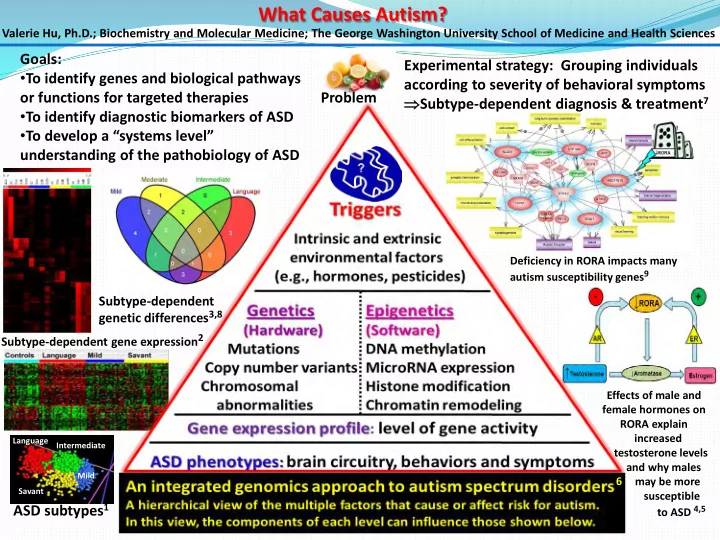
1) Hu, V.W. and Steinberg, M.E. (2009) Novel clustering of items from the Autism Diagnostic Interview- Revised to define phenotypes within autism spectrum disorders. Autism Research 2:67-77. 2) Hu, V.W., Sarachana, T., Kim, K.S., Nguyen, A., Kulkarni, S., Steinberg, M.E., Luu, T., Lai, Y., and Lee, N.H. (2009) Gene expression profiling differentiates autism case-controls and phenotypic variants of autism spectrum disorders: Evidence for circadian rhythm dysfunction in severe autism. Autism Research 2:78-97. 3) Hu, V.W., Addington, A., and Hyman, A. (2011) Novel Autism Subtype-dependent Genetic Variants are Revealed by Quantitative Trait and Subphenotype Association Analyses of Published GWAS Data. PLoS ONE 6(4):e19067. 4) Nguyen, A., Rauch, T.A., Pfeifer, G.P., and Hu, V.W. (2010) Global methylation profiling of lymphoblastoid cell lines reveals epigenetic contributions to autism spectrum disorders and a novel autism candidate gene, RORA, whose protein product is reduced in autistic brain. FASEB J., 24(8):3036-51. 5) Sarachana, T., Xu, M., Wu, R.-C., and Hu, V.W. (2011) Sex hormones in autism: Androgens and estrogens differentially and reciprocally regulate RORA, a novel candidate gene for autism. PLoS ONE, 6(2): e17116. 6) Hu, V.W. (2012) From Genes to Environment: Using integrative genomics to build a “systems level” understanding of autism. Invited review, Child Development, 84(1):89-103. 7) Hu, V.W. (2012) Subphenotype-dependent disease markers for diagnosis and personalized treatment
- f autism spectrum disorders. Invited review, Disease Markers, 33(5):277-88.
8) Talebizadeh, Z., Arking, D.E., and Hu, V.W. (2013) A novel stratification method in linkage studies to address inter and intra family heterogeneity in autism. PLoS ONE, 8(6):e67569. 9) Sarachana, T. and Hu, V.W. (2013) Genome-wide identification of transcriptional targets of RORA reveals direct regulation of multiple genes associated with autism spectrum disorder. Molecular Autism, 4:14.
More at:
http://www.gwumc.edu/smhs/facultydirectory/profile.cfm?empName=Valerie%20Hu&FacID=2046028605