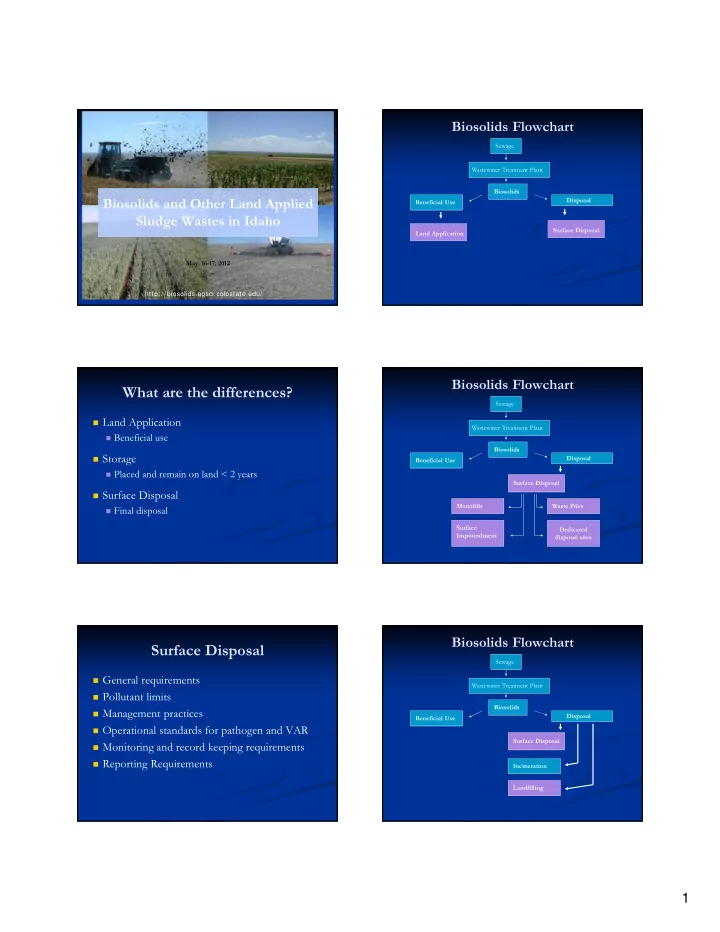
What are the differences? Sewage Land Application Wastewater - - PDF document

what are the differences
SMART_READER_LITE
LIVE PREVIEW

What are the differences? Sewage Land Application Wastewater - - PDF document

Biosolids Flowchart Sewage Wastewater Treatment Plant Biosolids Biosolids and Other Land Applied Disposal Beneficial Use Sludge Wastes in Idaho Surface Disposal Land Application May 16-17, 2012 http: / / biosolids.agsci.colostate.edu/


slide-1
SLIDE 1

1 Biosolids and Other Land Applied Sludge Wastes in Idaho

http: / / biosolids.agsci.colostate.edu/ May 16-17, 2012 Wastewater Treatment Plant Sewage

Biosolids Flowchart

Biosolids Beneficial Use Disposal Surface Disposal Land Application

What are the differences?

 Land Application

 Beneficial use

 Storage

 Placed and remain on land < 2 years

 Surface Disposal

 Final disposal

Wastewater Treatment Plant Sewage

Biosolids Flowchart

Biosolids Beneficial Use Disposal Surface Disposal Waste Piles Monofills Surface Impoundment Dedicated disposal sites

Surface Disposal

 General requirements  Pollutant limits  Management practices  Operational standards for pathogen and VAR  Monitoring and record keeping requirements  Reporting Requirements

Wastewater Treatment Plant Sewage

Biosolids Flowchart

Biosolids Beneficial Use Disposal Surface Disposal Incineration Landfilling

slide-2
SLIDE 2

2

Landfilling

 Regulated by Part 258 of Landfill Rule

 Pass the paint-filter liquids test

 (dewatering biosolids to about 20 percent solids or more

will generally meet this goal)

 Cannot contain > 50 ppb of polychlorinated

biphenyls (PCBs) (40 CFR Part 761)

 Must not meet the definition of hazardous wastes

Landfill Operators

 Ask for documentation for

 Hazardous waste characterization  Paint filter test results

 Procedures in operation plan for how they will

manage biosolids

 Waste Acceptance Criteria

Wastewater Treatment Plant Sewage

Biosolids Flowchart

Biosolids Beneficial Use Disposal Surface Disposal Incineration Land filling

Biosolids Incineration

 Involves the high temperature burning of

biosolids in an enclosed devise

 Uses an auxiliary fuel supply

 Gas, oil, wood chips, coal

 The resultant ash is significantly lower in volume

than the feedstock (biosolids)

Biosolids Incineration

 Concentrates the trace metals  Ash

 Non hazardous ash is not covered by Part 503 rule

when it is used or disposed

 Ash is disposed according to solids waste disposal

regulations in 40 CFR Part 258

 If ash is land applied then 40 CFR Part 257 applies

Biosolids Incineration

 Part 503 Incineration Requirements include:

 Pollutant limits  Limits for total hydrocarbons  General requirements and management practices  Monitoring, record keeping and reporting

requirements

slide-3
SLIDE 3

3 Other Sludge Wastes

 Biosolids  Domestic Septage  Industrial and Commercial Pumpable Wastes  Domestic Septage Mixed with Industrial or

Commercial Pumpable Wastes

The Septic Tank connection… Septage and Pumpable wastes

 Septage is classified according to the

environment in which it is generated.

 Domestic septage  Industrial or commercial pumpable wastes

 This is non-domestic waste

 Domestic septage mixed with non-domestic

pumpable wastes

Domestic septage

 Domestic septage is the liquid or solid removed

from a septic tank, cesspool, portable toilet, type lll marine sanitation device, or a similar system that receives only domestic septage

 Household  Non-commercial  Non-industrial

Domestic Septage Septic Tank Residence Wastewater Treatment Plant Sewage

Biosolids Flowchart

Effluent Biosolids Beneficial Use Disposal Sludge Domestic Septage Septic Tank Residence

 Domestic septage mixed with any sewage sludge

is considered sewage sludge.

Domestic Septage

Domestic Septage Septic Tank Home Wastewater Treatment Plant

 Regulated by 40 CFR 503  IDAPA 58.01.16 “Wastewater

Rules” apply

Sewage Sludge

 Regulated by IDAPA 58.01.15

“Rules Governing Cleaning of Septic Tanks”

 Domestic septage land applied

Domestic Septage Land Applied

Domestic Septage Septic Tank Home

 Regulated by 40 CFR 503  IDAPA 58.01.16 “Wastewater

Rules” apply

 Needs a DEQ approved Plan Land Application

slide-4
SLIDE 4

4 Industrial (or Commercial) Pumpable Wastes

 Material pumped from septic tanks or other

devices used in the collection, pretreatment, or treatment of any water-carried waste from any process of industry, manufacturing, trade, or business

 Examples:

 Grease Traps  Car Wash Sumps  Industrial by products

http://www.boynewaste.ie/sludge.htm

Non-Domestic Pumpable Wastes Land Applied

Industrial Pumpable Waste

  • r (non-domestic

septage) Septic Tank

 Not regulated by 40 CFR 503  Regulated by IDAPA 58.01.16

“Wastewater Rules”

 Needs a DEQ approved Plan Land Application Industry or Commercial Business Waste

Mixed Domestic and Non-Domestic Pumpable Wastes Land Applied

Industrial Pumpable Waste

  • r (non-domestic

septage)

 Not regulated by 40 CFR 503  Regulated by IDAPA 58.01.16

“Wastewater Rules”

 Needs a DEQ approved Plan Land Application Residence

Land Applied Sludge Wastes need an approved Plan

 Biosolids

 40 CFR 503  IDAPA 58.01.16 “Wastewater Rules”

 Domestic Septage

 40 CFR 503  IDAPA 58.01.16 “Wastewater Rules” apply  IDAPA 58.01.15 “Rules Governing Cleaning of Septic Tanks”

 Industrial and Commercial Pumpable Wastes

 No requirements under 40 CFR 503  IDAPA 58.01.16 “Wastewater Rules”  IDAPA 58.01.15 “Rules Governing Cleaning of Septic Tanks”

 Domestic Septage Mixed with Pumpable Wastes

 No requirements under 40 CFR 503  IDAPA 58.01.16 “Wastewater Rules” apply

DEQ’s Website:

Sludge & Biosolids

http://www.deq.idaho.gov/water-quality/wastewater/sludge-biosolids.aspx

 Reviews the Regulation of Biosolids in Idaho  Has links to many sites including

 More links to EPA’s Documents

 Biosolids Management Plan  Guidance for Land Application of Municipal

Biosolids

 Development of a Biosolids Management Plan  Checklist

DEQ Wastewater Program Staff

 Chas Ariss, P.E.

 Engineering Manager – Program Lead

 Tressa Nicholas, MSCE

 Wastewater Analyst, Biosolids, Training & Conference

Coordinator

 A.J. Maupin, P.E.

 Program Lead Engineer

 Olga Cuzmanov

 Permits, Compliance & Enforcement Analyst

 Lindsey Stanton

 Administrative Assistant

slide-5
SLIDE 5

5

http://www.kingcounty.gov/environment/wastewater/Biosolids/DocumentsLinks.aspx

Thank you!

 Workshop Webpage will have post workshop

material

 Make sure you have signed in for CEU’s  Thank you again, to Bob Brobst and Jim

Ippolito!!!

Resources

 Northwest Biosolids Management Association  Emerging Technologies for Biosolids Management EPA 832-R-

06-005 September 2006 http://www.epa.gov/owm/mtb/epa- biosolids.pdf

 A Plain English Guide to the EPA Part 503 Biosolids

http://water.epa.gov/scitech/wastetech/biosolids/503pe_index. cfm